Still not firing on all cylinders and equipped with a very unflattering over the ear and round the head mike, I deliver my keynote presentation about the story of Isabella Fry. It is the tale of an unfortunate woman, chocolate and a very bad man, which appears to go down well. Afterwards, we choose to stay in the main hall to listen to our friends talk about DNA. Firstly Michelle Patient and then our housemate for the duration, Maurice Gleeson. After lunch, Maurice is up again, this time talking about using DNA to identify unknown world war 1 casualties. By co-incidence, he was focussing on the Battle of Fromelles, which is featured in Barefoot on the Cobbles, although I don’t name it. Maurice used the session to launch the ‘Commemorating the Missing’ project. This encourages people to look at the list of the world war one soldiers whose bodies have never been recovered and ‘plant’ a virtual family tree on their behalf. Thus, if bodies are recovered in a location that links to those personnel, it might be possible to contact relatives so DNA can be obtained. I have already committed to ‘planting’ trees for the six Braunds on the list and we do already have relatives who have taken DNA tests, although obviously, it would be their decision whether or not their results should be used in this way.
There is a session on New Zealand School records and then I have to summon the adrenaline to talk about One-Place Studies at the end of the day. People are taking pity on my lurgy ridden state and keep pressing medication into my hands!
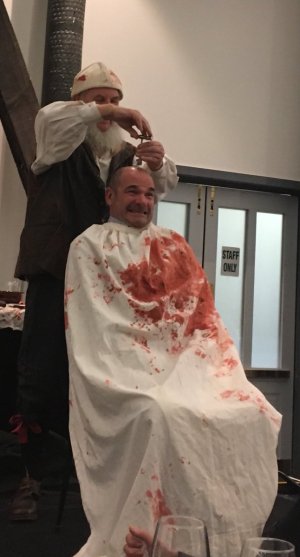 We are taken to the Chateau on the Park for the conference dinner where we have an unusual but very tasty, hot/cold buffet mixture and delectable but clearly not very good for us desserts. Chris ‘entertains’ all-comers with the delights of seventeenth century barber surgery. We do present to adults on a regular basis but the addition of alcohol has an effect on the levels of audience participation! At the request of the maitre d’, one of Chris’ patients is a young waiter, who enters into the spirit of the thing. Fiona, our self- appointed chauffeur and also the overworked conference convenor, explains about the psychological impact of the earthquake on Christchurch residents.
The Sunday begins with our seventeenth century presentation. Yesterday’s sessions were very well received but now I am feeling as if I am giving of my best. There is an overwhelmingly positive response afterwards, which gives us a warm fuzzy feeling. I listen to a double-handed talk on ‘Research Tips and Tricks’, which includes a very effective use of Power Point as a way of recording family history from the ’other Fiona’. I then listen to a story-telling session from Margaret Copeland, an historical interpreter who represents the wife of the goaler of nineteenth century Lyttelton Goal. I have to leave before the end to prepare for my own Facebook Generation talk. It was very well attended (there are three streams of lectures) and there was a real buzz afterwards, with plenty of questions and comments.
In the evening, we have invited a few fellow members of The Guild of One-Name Studies round to our adopted home. We are feeling more and more like riotous students by the minute. We have an hilarious evening, with the humour partly fuelled by the fact that the local pizza house names its offerings after the seven deadly sins. One of our party ordered a ‘Twelve inch lust’, no comment! There was also this hysterical attempt to take a picture with all of us in, using the time on someone’s precariously balanced phone. We had a lovely time but we are obviously showing our age, as our guests had left by 9.15pm and we managed to keep the house in very good order. Our hostess has been incredibly generous with her home and my early blog comment about Hokey-Pokey ice cream led to the freezer being stocked with the same – yum.
The final day already. I can’t believe it has gone so fast. I listen to Fiona talking about The Time Travelling Genealogist, encouraging us to record our own lives as part of our family history. Her ‘Memories in Time’ business has some great products and it is a very good presentation. Next, I learn about the ‘Decimation by the Invisible Enemy’, which is about the appalling effect of the Spanish flu on those on board the ship the Tahiti. I finish the conference with my ‘Remember Then’ session. I wondered how it would adapt to an international audience but judging by the reaction, nothing was lost in translation. It is sad to say goodbye to people who have become friends. We have had a wonderful time and have been looked after exceptionally well by all concerned.
Four of us take a trip to the Antarctic Centre in the afternoon. Included is a ‘Hagglund’ ride, deemed to be unsuitable for those with heart conditions, of a nervous disposition or who are pregnant. I briefly debate the wisdom of this and decide I should enter into the spirit of the thing. The Hagglund are the all terrain vehicles that are used on Antarctic expeditions and we career across a track hanging on tightly. It was a bit on the bumpy side but pales into insignificance in comparison to sand-dune buggy riding, so I survived unscathed. We pat some huskies and watch the blue penguins being fed. These are all rescue penguins, who would not survive in the wild. Then a chance to sit and relax whilst watching a 4D film. We don the approved glasses. It turns out that this is not as relaxing as all that, as the seats tilt alarmingly, to simulated power boating across a lake and at intervals, water is hurled in our faces.
We are then collected for a meal with some of the conference organisers. This is followed by Te Reo Maori lessons, which are being put on, free of charge, by the owner of the Fush restaurant. He is concentrating on teaching us ‘pidgen’ Maori, where we substitute English words for those we don’t know (which is most of them). We had already picked up that Maori is not actually pronounce Mawree but more like Mardi. Te Reo Maori was not originally a written language and there is no equivalent of the letter s for plurals. Instead, what comes before the noun indicates several, rather than one. So ‘the‘, followed by something singular is ‘Te’ but if it is plural, ‘the’ would be ‘nga’ (pronounced nar). This is great fun but my inability with languages has not undergone a great transformation and the fact that it is in the evening after a very hectic five days does nothing for my concentration. Somehow, this ends up with us appearing on Maori TV news, fortunately not at the point when it all caught up with me and my eyes closed momentarily.
Then, after reluctantly bringing our last evening chat to an end, comes the applied mathematics that is our packing. We have a baggage allowance of 30kg each; easy, 60kg you’d think. But we only have three bags, one small one having gone to meet its maker on the outward journey. We cannot be deemed to have one and a half bags each, so two of these bags cannot contain a total of more than 30kg. In addition, no one bag must weigh more than 23kg. Effectively, this reduces our total allowance to 53kg between us providing we can, without the aid of scales, distribute our belongings appropriately between the bags. If you think 53kg is a ridiculous amount of luggage for two people, you’d be right but remember that we have three sets of seventeenth century clothes, including hefty shoes and numerous heavy surgical instruments. I also have the clothes that I abandoned in Peru that have been, very kindly, brought to me from Australia. In addition, we have also picked up a few things from the conference and our preceding trip, which have to be accommodated.
 We safely negotiate our way out of Invercargill, where the street names bear testament to the Scottish/Victorian heritage. Keeping a sharp eye out for the maroon triangles that denote the South Scenic Route, we head eastwards. Today there are spells of sunshine amidst the showers, creating impressive rainbows at Fortrose. Many of the cattle are Belted Galloways and I wonder at the logistics of bringing mammals out to New Zealand from Europe by boat. How much food would be required? What would one do with the results of cows/sheep/deer consuming said food?
 Our geography field trip continues. We sail up Crooked Arm, which on its own is a similar size to Milford Sound. Today we can enjoy a sound that we can actually see, as the rain stops and there is even occasional sunshine. There are also rainbows, which, inevitably, are not done justice by the photography. The majority of our fellow travellers are American university students. Some are wearing more make-up than I have possessed in a life-time. Others are clad in tee-shirts and thin cardigans – it is three degrees, still others sleep the cruise away. At one point the captain cuts the engine and generator ‘so we can listen to nature’s silence’ for about ten minutes. This was never going to go well, especially as the rain begins again during the process.
 We make it back through the tunnel in time, just as snow is beginning to fall. There are a few stops on our way back to Te Anau, including a fruitless Kea hunting stop, a chance to photograph the Mirror Lakes and also to view Lake Te Anau from Te Anau Downs. By this point, the rain has almost stopped and we can actually see not just our hands in front of our faces but the lake as well.
 We head south down the 8, passing through a more barren landscape. We drive through Twizel, a town that grew up round the Hydro-electric industry and along the twists and turns of the Lindis Valley to Cromwell. This town, on the shores of the man-made Lake Dunstan, is in what used to be a gold mining area but is now better known as a wine-growing region. We take a walk round the town, most of which is housing estate and eventually reach the deserted historic quarter, which we remember from our previous visit. I was expecting to need multiple coats, gloves and hats but it is beautifully warm and despite road signs warning us that it is winter, our camper van tells us that the outdoor temperature is 21 degrees, allegedly warmer that it is at home! This is as far south as we reached on our previous visit, so from here onwards we are in uncharted territory.
 The History Interpreter - Janet Few