We made a return visit to Stott Park Bobbin Mill, a fascinating insight into the industrial heritage of the area. The factory was built in 1835 to provide bobbins for the Lancashire cotton industry and was ideally situated for water power and the necessary supply of birch, sycamore and ash. We arrived just in time for a guided tour by Ann. The mill produced bobbins in 260 different styles. Many of the workforce were young boys for the Ulverston workhouse. There was little regard for health and safety. Apart from the dust from the sawdust and shavings, the unguarded machinery would have been a hazard for any workers whose concentration lapsed; circular saws were driven at 3000 rpm. The workshops were well ventilated to reduce fire risks but this made them very cold. Shavings might be waist high to help keep the workers warm but this was of course a fire hazard. Nineteenth century workers were on piecework and were paid by the gross. The tally man would mark their sticks when each gross was completed.
Many workers were laid off when the supply of cotton was disrupted during the American Civil War in the 1860s and the ensuing ‘Lancashire Cotton Famine’ led to a drop in the demand for bobbins. About 1870, W A Fell introduced a semi-automatic boring machine, which simplified the task of boring holes in the bobbins, reducing it to loading new blocks and removing bored bobbins. In 1880, a steam engine replaced the water mill as a source of power. Once plastic began to replace wood the mill went into decline and it finally closed in 1971.
Rain stopped play as regards walking but we did stop off at the Esthwaite Water Café for some very acceptable cake and decent sized mugs of tea and coffee, which we consumed overlooking the lake.
We came home to the news of the Queen’s death.
The weather forecast was uncertain, so we decided on an early walk, whilst it was dry and headed anti-clockwise around the lake for a mile or so and then returned in order to head off to Acorn Bank, an interesting National Trust property. Acorn Bank is situated at Temple Sowerby, which takes its name from its association with the Knights Templar, who were gifted the manor by Henry II in 1185. The next owners, in the mid-fourteenth century, were the Knights of the Hospital of St. John. After the dissolution of the monasteries, Acorn Bank was in the hands Thomas Dalston and his descendants for almost four hundred years. The writer Dorothy Una Ratcliffe purchased Acorn Bank in 1934 and was it given to the National Trust in 1950. The house was tenanted until the 1990s and spent time as a nursing home.
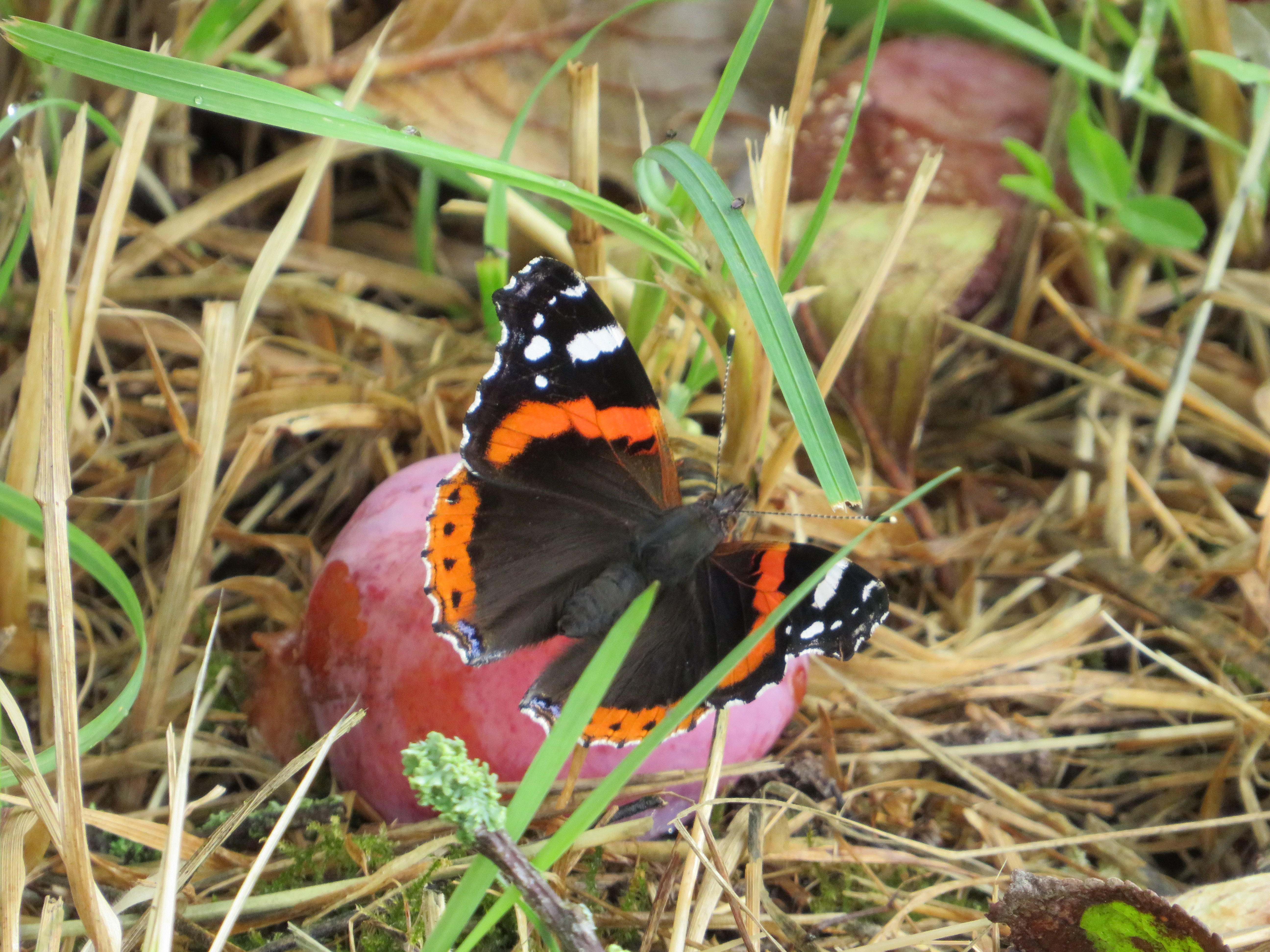
Parts of the current house are sixteenth century but there were later alterations and the façade is eighteenth century. It is the gardens and orchards that are notable at Acorn Bank. The orchards are home to over a hundred varieties of apple, some of which were grown in cordons, in other words, trained diagonally to save space. This year’s crop looked to be prolific. Here also is the largest herb garden in National Trust ownership. There were bee hives to aid pollination and we spotted a large number of red admiral butterflies feasting on fallen plums. Although the surrounding woodland, with its streams and ponds, are a haven for wildlife, the fauna was, as so often on our holidays, conspicuous by its absence. Within the woods are the remains of gypsum mines. This was produced on the estate from 1880-1938 and sold as fertiliser or for plaster. We also walked down to the watermill.
To make up for the lack of wildlife at Acorn Bank, the red squirrels came out to play once back on the site but hasty scampering made them difficult to photograph. They seem to make a habit of opening the top of one of the bird boxes to investigate the contents. The late afternoon was spent watching the accession speech of Charles III.
We set off early to go to Hill Top, a seventeenth century cottage owned by Beatrix Potter from 1905 but used as a writing retreat, rather than her home. She was responsible for extending the property but no mains water or sanitation system was installed until 1928, when her nephew came to live at Hill Top. It was fascinating to see some of Beatrix Potter’s books lying open to show illustrations that mirrored the part of the house or garden that we were in. A bed was covered by a reproduction of the wedding quilt made for her parents in 1863; the original quilt is in the V & A. The main living room had a rather strange wallpapered ceiling . Some knowledgeable guides told us the story of the house and Beatrix’s life. She was constrained by the mores of her time and regretted being known for ‘bunny books’ rather than her other accomplishments, such as botanical drawings. The first book she wrote after her marriage is now seen as a treatise in support of women’s suffrage and was turned down by Warne’s, her publishers. Her published works after this date tended to be re-presentations of earlier works. The cottage garden was beautiful and you expected to spot Peter Rabbit and friends hiding in the foliage.
On the way home, we stopped off to view the standing stones at Castlerigg, visited by William and Dorothy Wordsworth in 1799. We also called in at Keswick for some food. Finally, a short walk to the lake in the afternoon.
We drove out to St. Bees, which was an opportunity to see the sea but on the whole not very inspiring. We climbed the cliffs and rewarded ourselves with an ice cream. We returned via Threlkeld Mining Museum. The quarry opened in the 1870s to provide ballast for the newly opened Penrith-Keswick line and closed in 1982. There were plenty of construction vehicles in varying states of decay, some of which are being restored. We had mistimed our arrival to miss the 1pm train ride, so waited for the 3pm trip before heading home as the rain began. This is an interesting museum, which is clearly a hobby for construction vehicle enthusiasts. Don’t expect professional presentation of exhibits but worth a visit.
It was rainy on our last day in the Lakes, so we went for a drive towards Bassenthwaite. We had planned to go to the post office in Keswick but missed the turning and couldn’t find the free parking. When we finally found it there was no space, so we returned to the van and tried again later with more success. It finally stopped raining in the late afternoon so we could walk by the lake without getting soaked.
Amidst all this touristy activity working/volunteering life went on. Conducting a Zoom meeting was not without difficulty. Great signal in the hotspot but I couldn’t face standing up and waving my arms about for two hours to keep the light on in the hut. Plan B was driving the car to beside the hut and sitting in the car. Thankfully it was a new laptop so had plenty of battery. Of course nights are drawing in so by the middle of the meeting, not wanting to drain the car battery by using the courtesy light, I was in the dark in any case!





 The History Interpreter - Janet Few