 I was finally enticed by FamilyTreeDNA’s seasonal sale and purchased myself a family finder DNA kit. I am still not quite sure why I have done this but I never can resist a bargain. This morning, I was up early to provide my sample. The company advises doing this before you put in your dentures. That’s no problem, hopefully it will be a number of years before I will be inserting any dentures. It is also though supposed to be before breakfast. I am not much use before breakfast but I am very law abiding so taking the test has to be done very early, so I can eat. It is the first duty of the day, well after checking social media that is. I enlist assistance as I am notorious for not reading instructions. My assistant does not have his reading glasses with him – this is going well. I begin scraping away at my cheek with vigour whilst my assistant times the required 30-60 seconds. My jaw is unnaturally locked in an open position and it is really difficult to do this without dribbling. No one tells you that, or is it just me? About twenty seconds in I realise that I am using the flat side of the implement instead of the scrapy side. I fail to communicate this to my assistant by means of strange gurgling sounds (I am still scrapping and he is wondering why I haven’t stopped when the suggested number of seconds is up.) Sample safely ejected into phial provided, I start again with the other cheek.
 The waste bits of the scraper look like they have potential for turning in to instruments of witchcraft torture – excellent just what we need. No, seriously, this is not a joke. Deed done. Dilemma. How should I fill out the customs declaration? I am dubious about the etiquette associated with sending bodily fluids through the post. Can I legitimately classify it as a ‘gift’?
I have thought long and hard about who this ’family finder’ might find; the possibilities are limited. It is really designed to link you with 3rd-4th cousins, or closer relatives. Ok, who is that likely to be? I have no siblings, no first cousins and only six second cousins (those with whom I share great-grandparents). These are all on the same side of the family and two of them are adopted, so from a genetic point of view that leave me with four people, whom I already know, to match with. I must not neglect the ‘removeds’. These four second cousins have between them six children (my second cousins once removed), all of whom I know of. I believe one or two of them have produced children (my second cousins twice removed) but these are babies and unlikely to be looking for DNA matches.
I track back to my third cousins (shared great great grandparents). There are eight possible couples who have produced remarkably few descendants who are my third cousins. We are now in the realms of cousins who I have only discovered through family history. Over the 39 years that I have been seriously tracing my family (yes I was an infant when I started) I have looked for, contacted, or become aware of, third cousins on all of these eight branches; watch this space to see if DNA can turn up any more. While I am waiting for the test results, I will try to go back over these eight sets of great great grandparents and their descendants, to see if there are any I have missed. For now I can tell you that Philip and Mary Woolgar née Cardell had four children and I believe I have brought all their descendants’ lines down to my own generation or beyond. This is the line where I have second cousins but we are the only ones in our generation, so there are no third cousins on this line at all.
 I am hoping to open a history themed book on my ‘advent calendar’ (aka blog) for each day of advent. Some of them will be written by people I know so, to make it fair to my author friends, the order is being decided by drawing the names out of a hat. Today’s offering is The Cruel Mother by the late Sian Busby, which was recommended to me by our of the participants on my ‘Telling your Family’s Story’ course. Don’t be put off by the book’s title, which is taken from a folk song. It is a true story of the author’s great-grandmother, who drowned her infant twins during a bout of puerperal insanity. This may not sound like a laugh a minute and it isn’t meant to be. It is however a brilliant insight into early twentieth century attitudes to mental illness and the repercussions that this incident had down the generations. It also tells the story of Sian’s attempt to sift fact from rumour as she sought to understand more about her family’s secret past. If you are interested in human behaviour, social history, psychology or family history you will enjoy this book.
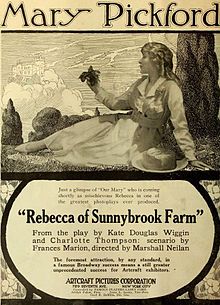 Mary Pickford finds her way on to the pages of chapter ten of Barefoot on the Cobbles, when Daisy visits the cinema, or picture palace. I needed a suitable film for Daisy and her friend Winnie to be watching in 1918. I was excited to realise that the first Tarzan film had recently been released and I was all set to send them off to watch that. Just in time, I discovered that this took eighteen months to reach the UK. I quickly substituted Rebecca of Sunnybrook Farm, which starred Canadian actress Mary Pickford. Like Daisy, I watched the film, although I had to rely on YouTube, so was deprived of the atmosphere of Torquay’s Pavilion cinema.
 Ok, so I am going to cheat a little here. Give me a break it is hard working keeping this up on a daily basis in the season of
  Today I should be making a guest appearance on
 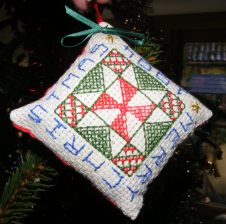 A shorter post today, trees to decorate, cards to write, as the time of year catches up with me. We have just been to get the Christmas Tree. This is a hugely important activity. It has to be the right tree; I have been known to take one back! Based on my guiding principle that if it fits in the room it is too small, this one is probably too small but it makes up for the fact that there is at least six inches between the top of the tree and the ceiling by its bushiness. The tree came from a nearby farm where you can stomp your way through mud and fallen apples to select your own, which is then cut to order. Now Christmas begins. My Christmas decorating policy would have interiors experts cringing as colour co-ordinated it is not but each decoration has its own significance. I
 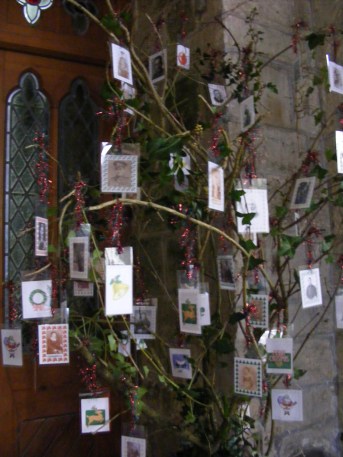 This month, our village is staging a Christmas Tree exhibition. Local groups and associations were challenged to decorate a tree that reflected their activities. Never one to resist a challenge, the history group set out to create something that would be representative of what we do. We debated using vintage tree decorations, which I have but they are too precious to leave unattended and anyway they would be inhabiting my own tree. In the end, our tree became a real joint effort as two members were charged with sourcing a natural ‘tree’ aka suitably shaped branches and greenery. Another member was to provide sand to secure the ‘tree’ in its pot. We did have difficulties with this as an unseasonable three day freeze meant that the sand pile was impenetrably solid. A gravel substitute was found. My contribution was the decorations. For these, we printed out small portraits of former residents, taken from our photograph collection, within seasonal frames. We abandoned the initial idea of putting the names on the reverse side as we feared that the stability of the tree would not withstand viewers trying to access the names. Instead, we provided a key to the identities of those on our ‘decorations’ to put beside the tree and instead put seasonal images on the reverse of the laminated ‘ornaments’. Glittery ties and ivy in lieu of tinsel finished off our entry. It has already attracted favourable comments and now we await the result of the vote for the ‘best tree’ in the New Year.
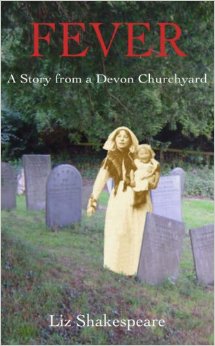 The historical novels out of my advent box today are the books of my friend, local author
  The History Interpreter - Janet Few