#100daysofbfotc Day 97: Frank Badcock

Frank Badcock on the left

Frank Badcock on the left

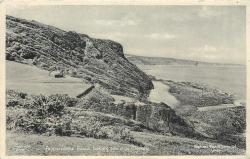
Frank Badcock’s story is told in the penultimate chapter of Barefoot on the Cobbles. This tragic episode serves to underline the influence of the sea on coastal communities and on the lives of the characters in the novel. The events of New Year’s Day 1919 are still retold in Clovelly.

Frank was born into a Clovelly fishing family in 1884. His parents were Robert and Annie Salome Badcock née Jewell and Frank grew up in a cottage on the quay. Like his father, Frank spent his working life on the sea. In 1905, he married local girl Merelda Dunn and they brought up three sons in their North Hill cottage. When the First World War broke out, Frank served on HMS Albion and was involved in the disastrous Dardanelles campaign in 1915. As the war drew to a close, Frank was in the Royal Naval Reserve, as a gunner on a merchantman.

‘  ‘Oh, God,’ he groaned, the rare blasphemy a sign of his anguish. ‘’Tis the Annie Salome, right proud of that boat Frank be. Named for his mother it were. Why the hell baint they back. They will never get into harbour now.’ ’

Barefoot on the Cobbles will be published on 17 November 2018. More information about the novel can be found here. Copies will be available at various events in the weeks following the launch or can be pre-ordered from Blue Poppy Publishing or the author. Kindle editions can be pre-ordered for the UK and also on Amazon.com.

#100daysofbfotc Day 96: Portledge

Portledge_House_Alwington_Devon

Image from Wikimedia

Portledge is the ‘big house’ in Alwington parish. At the time of Barefoot on the Cobbles and for centuries before, it was the seat of the Coffin, later Pine-Coffin, family. The estate included Peppercombe and the eastern side of the village of Bucks Mills, so for some of the novel’s characters, the Pine-Coffins were the Lords of the Manor. In the novel, both Polly and her mother, work for the Pine-Coffins. It would be highly likely that local young girls would begin their life in service here; there were few other opportunities in the area. When additional servants were required for special occasions, former servants and older women would be drafted in to assist the regular staff.

Although the history of the manor of Portledge is thought to go back to the eleventh century, most of the current house, the house that Polly would have known, is about 350 years old. A few thirteenth century elements of the building survive. After the Pine-Coffins left, the manor house became a hotel. It is now a private residence.

‘On the piano in the corner was a large bowl of roses and a photograph of a young girl, in a heavy silver frame. Mrs Pine-Coffin would be horrified, thought Polly, one of her earliest lessons at Portledge had been that, on no account, should anything be set upon the piano.’

Barefoot on the Cobbles will be published on 17 November 2018. More information about the novel can be found here. Copies will be available at various events in the weeks following the launch or can be pre-ordered from Blue Poppy Publishing or the author. Kindle editions can be pre-ordered for the UK and also on Amazon.com.

#100daysofbfotc Day 95: Abraham Tuke

PoppiesOn the centenary of the armistice it is fitting that today’s post should belong to one of the fallen. Chapter 8 of Barefoot on the Cobbles is set on the western front. In order to reflect the early years of the twentieth century, the novel needed to include an episode that was devoted to the experiences of a combatant. The choice of Abraham, from amongst the men that Clovelly lost, was largely a random one and his life story was not typical. Incidentally, Abraham was not his first given name but in common with several other characters, his name needed to be changed to avoid confusion.

I anticipated that this would be the most difficult chapter for me to write, as I am not a young male, nor have I ever been in a combat zone. The western front was the only location in the novel that I was not able to explore in person. I immersed myself in the war diaries of Abraham’s battalion and read personal memoirs and dairies about the little-known battle in which he lost his life. I discovered that, although the Battle of Fromelles is not a household name in the UK, it is in Australia; the ANZAC troops experiences appalling losses in this campaign. I was also helped by the archivist at Abraham’s school, who responded swiftly and in detail to my enquiries, allowing me to build up a much fuller impression of Abraham’s character.

Although the chapter would not stand up to scrutiny by a military historian, I reasoned that one soldier would not have an impression of the overall tactics, so, if the account seems a little confused, that is probably an accurate reflection of a single soldier’s experiences. In the end, this is the chapter that pleases me the most.
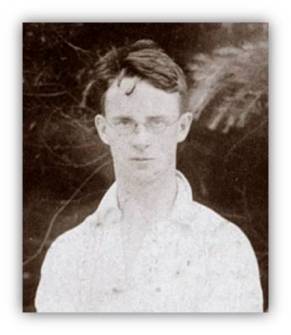
W A B Tuke

From the Archive of King’s College, Taunton

Abraham Tuke was born in Clovelly in 1894 and was baptised in the church that stood adjacent to his home. His father, Harry, was the Court’s head gardener and the family lived at Gardener’s Cottage, on the edge of the walled garden. Abraham was an only child and his childhood was very different to that of most of his peers. Although he attended Clovelly School as a young boy, he won a scholarship to the prestigious King’s College in Taunton. It must have been difficult to cope with this dislocation and I suspect that Abraham may not have fitted well into either of his worlds. Whilst at King’s, Abraham became Senior Prefect and a Corporal in the Officers’ Training Corps. He was in the debating society and appeared in school productions. He did well academically, winning prizes for History, Religious Instruction and Latin. His ambition was to become a teacher and he qualified at St. Luke’s College, where he played rugby and became editor of the college magazine. The latter made me think that he would have written poetry, so I read volumes of World War 1 poetry, including the efforts of less-known and probably less accomplished poets. In this way, Abraham was able to write a poem, which appears in the book. I consoled myself, as I write it on his behalf, with the fact that he didn’t have to be a very good poet!

Following a role in the Territorials, Abraham joined the 2nd/4th (City of Bristol) Battalion of the Gloucestershire Regiment rising to the rank of Sergeant. He perished on 19 July 1916.

‘Barbed wire coiled across the long grass, self-seeded crops from happier years dared to grow and poppies painted the fields. Abandoned and broken, ploughs rusted where they lay. Then there were the agonising reminders of war. The wooden crosses, roughly hewn, inscribed only with a date; the names of the soldiers who fell on that spot forever forgotten.’

Barefoot on the Cobbles will be published on 17 November 2018. More information about the novel can be found here. Copies will be available at various events in the weeks following the launch or can be pre-ordered from Blue Poppy Publishing or the author. Kindle editions can be pre-ordered for the UK and also on Amazon.com.


#100daysofbfotc Day 94: Hon. Arthur Asquith

Arthur-Melland-Asquith

Image by Walter Stoneman © National Portrait Gallery, London used under Creative Commons

The Asquith family were frequent visitors to Clovelly Court in the early years of the twentieth century and we meet them in chapter 5 of Barefoot on the Cobbles in this context. When Daisy moved to Torquay, I felt that, along with the majority of the population at this time, she needed to visit the cinema. Apart from the main feature and the ‘short’, there would have been a Pathe newsreel. I turned YouTube to see what would have been screened during the week of Daisy’s visit. In one of those amazing twists of fate, it turned out that Arthur Asquith’s marriage to the Honourable Betty Manners, heir to Clovelly Court, was being featured. It was one of those incidents that might read as a contrivance but like most of the other minor details in the novel, this really was true.

The Honourable Arthur Melland Asquith, son of the Prime Minister, was born in 1883. He went to Oxford University and then worked overseas. He had a distinguished career in the First World War, receiving the DSO on three occasions. Arthur Asquith had four daughters and died in 1939.

‘ ‘I know her,’ Daisy squeaked, elbowing Winnie violently, ‘That’s the Honourable Betty Manners. I knew she was going to marry Mr Asquith’s son but I never thought to see her on the screen down here in Torquay.’

The short film showed crowds lining the street, as the Prime Minister’s son, resplendent in his army uniform, accompanied his bride. Daisy’s two worlds collided, leaving her drained and a little homesick.’

Barefoot on the Cobbles will be published on 17 November 2018. More information about the novel can be found here. Copies will be available at various events in the weeks following the launch or can be pre-ordered from Blue Poppy Publishing or the author. Kindle editions can be pre-ordered for the UK and also on Amazon.com.

#100daysofbfotc Day 93: Mr Warlow

Scales_Of_Justice.svgCourt scenes require solicitors and Mr Warlow is the another of these. He appears at the trial on behalf of the Director of Public Prosecutions. In common with other professionals in Barefoot on the Cobbles, he represents authority and underlines the impotence of the villagers in the face of officialdom.

William Henry Warlow was born in 1854, in Birmingham, the son of William and Lucy Betsy Warlow née Watson. He grew up in Handsworth and by 1881 was working as a solicitor in Newcastle. He then moved to a seaside property in Alnmouth, Northumberland. After this, his career took him to London, first to Bloomsbury and then to Regent’s Street. He never married and died in 1928.

‘Sitting in judgement were the magistrates, with their intimidating air of officialdom; Mr Duncan in the chair with Mr Cock and Mr Fulford flanking him. Mr Warlow was there to speak for the Director of Public Prosecutions. Polly supposed that she should fear him, regard him as her enemy perhaps but she was numbed beyond feeling.’

Barefoot on the Cobbles will be published on 17 November 2018. More information about the novel can be found here. Copies will be available at various events in the weeks following the launch or can be pre-ordered from Blue Poppy Publishing or the author. Kindle editions can be pre-ordered for the UK and also on Amazon.com.

#100daysofbfotc Day 92: Eliza Wakely

PeppercombeAlthough we encounter Eliza Wakely through the conversations of others, rather than meeting her in person, she is another mother and provides a contrast to Polly’s brand of parenting. Eliza was born into the Found family of Peppercombe in 1831. She married Mr Wakely in 1860 and had six daughters and one son. In fact, the 1911 census suggests that there was another child, who presumably died young but there is no birth or death registration, either before or after the marriage, to confirm this.
The references to Eliza’s family being gypsies, which appear more than once in Barefoot on the Cobbles, are based on fact and also survive in the oral tradition of the family. In 1719, Eliza’s great grandfather was found (hence the surname) in a shippen on the farm of Robert Brookes at Wolley near Morwenstow. It is not clear why he was thought to have been left there by gypsies but the rumour persisted. Eliza died in 1917.

As soon as Polly’s first pains started, Eliza Wakely would put aside her reluctance to leave Peppercombe and come to oversee the birth of her first grandchild.’

Barefoot on the Cobbles will be published on 17 November 2018. More information about the novel can be found here. Copies will be available at various events in the weeks following the launch or can be pre-ordered from Blue Poppy Publishing or the author. Kindle editions can be pre-ordered for the UK and also on Amazon.com.

#100daysofbfotc Day 91: Florence Powell

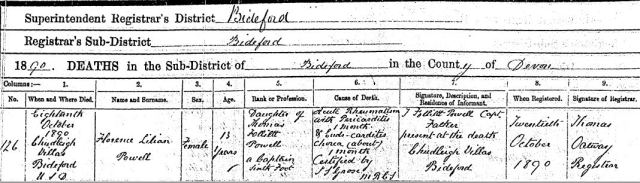
FlorenceWe never actually meet Florence Powell in Barefoot on the Cobbles, yet her short life, or more precisely her death, has ramifications that echo throughout the novel. Florence Lilian Powell was the second daughter of Thomas Folliott Powell and his wife Mary. She was born in Saltash, Cornwall in 1877 but shortly after her birth, the family relocated to Tavistock. By the time Florence was about eleven, the family had moved again, this time to Chudleigh Villas, East-the-Water, Bideford. On the 18 October 1890, Florence died at home from rheumatic fever. Receiving the copy of her death certificate was very exciting for me as there was already another character in the novel who died from the same cause. This gave me scope for drawing a number of parallels. Florence was the first person to be buried in the new East-the-Water cemetery. I searched through the undergrowth for a gravestone in vain. Perhaps there never was one; the family had financial worries. I hope that her place in the novel can be a memorial.
Her mother placed a bunch of rusty chrysanthemums on the long, wet grass in front of a forlorn gravestone. The name, Florence Louisa Powell, was deeply incised in the slate; a short life marked by the stark dates 1877-1890. The family was paying homage at this tangible reminder of a daughter, of a sister, who was forever frozen in time.’

Barefoot on the Cobbles will be published on 17 November 2018. More information about the novel can be found here. Copies will be available at various events in the weeks following the launch or can be pre-ordered from Blue Poppy Publishing or the author. Kindle editions can be pre-ordered for the UK and also on Amazon.com.

#100daysofbfotc Day 90: Athaliah Prance

CaptureAthaliah Prance appears in the Bideford chapters of Barefoot on the Cobbles. She, like her cousin Polly, is one of several sisters but unlike Polly, she struggles to be heard amongst her more boisterous sisters. It is with Athaliah that Polly is given the opportunity to explore the town.
Athaliah Prance was born in Bideford on 14 April 1872, just two weeks after Polly. She was the daughter of Joseph and Susan Prance née Found; her father was a shopkeeper in Mill Street. As is recounted in the novel, she married Frank Holwill, the ironmonger’s assistant, in 1893. They lived in Lime Grove, Bideford and had five children. As an adult, Athalia called herself Hetty but unfortunately, I did not find this out in time to give her that name in the novel. Later the Holwills moved to Northam. Athaliah died in 1955.

“The young women had gazed in the shop windows, admiring hats and haberdashery and strolled along the quay, watching the ships unloading. Athaliah insisted that their walks took them past Hopson’s ironmongery. She even took Polly inside, pretending to take an interest in the array of brooms and brushes on display. In truth it was Mr Hopson’s young assistant who had caught Athaliah’s eye.”

Barefoot on the Cobbles will be published on 17 November 2018. More information about the novel can be found here. Copies will be available at various events in the weeks following the launch or can be pre-ordered from Blue Poppy Publishing or the author. Kindle editions can be pre-ordered for the UK and also on Amazon.com.

#100daysofbfotc Day 89: Richard Ottley

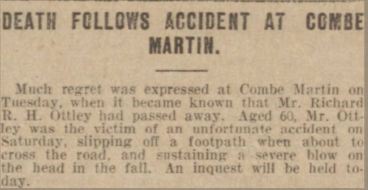
ottleyRichard Ottley appears in the court scenes. The detailed accounts of the trial in the press must have been written by someone.  There were no by-lines in the newspapers but I chose Richard to be my journalist. His purpose in Barefoot on the Cobbles is to suggest to the reader that the characters before them are multi-faceted and that incidents in their pasts have brought about the appalling situation in which they find themselves.

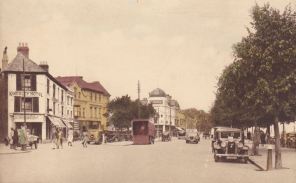
Needless to say, Richard Reginald Henry Ottley really existed. He was born in Buckingham in 1864 and he lived at Gorwell House Combe Martin. He died in Combe Martin in 1925, following injuries sustained when he fell off the pavement, whilst trying to cross the road. He left nearly £4000.

‘The prosecution had just called their key witness. Ottley was intrigued. What had motivated such a man, one who was clearly of the professional classes, to become embroiled in the goings on of an insignificant fisherman’s family? Ah but perhaps that was the point, Ottley began to mentally debate with himself, maybe the defendants were not so insignificant after all.’

Barefoot on the Cobbles will be published on 17 November 2018. More information about the novel can be found here. Copies will be available at various events in the weeks following the launch or can be pre-ordered from Blue Poppy Publishing or the author. Kindle editions can be pre-ordered for the UK and also on Amazon.com.

#100daysofbfotc Day 88: Winnie Hamm

Torquay Town Hall Hospital

Torquay Town Hospital

Winnie is a character where a little more imagination came into play. Barefoot on the Cobbles needed a VAD nurse, so I searched the Red Cross database to find someone of a suitable age who actually worked at Torquay Hospital. I also needed to include someone who was a little more street-wise, to introduce Daisy to life in the town and Winnie fulfilled that role. Although there is no evidence that Winnie and Daisy met in real life, they may have and Daisy would have needed a friend in her new home.

Winnie’s employment at Aylwood is another invention. On the other hand, Winnie’s description of her time at the hospital, far-fetched though it may sound, is taken from genuine memories of a VAD who worked at the Town Hospital at the time. In reality, Winnie Hamm worked in the pantry at the hospital from 3 November 1917, earning 9d a day.

Although I have implied, in the novel, that Winnie grew up in Torquay, the real Winifred Muriel Hamm was born on 24 Feb 1899 in Tooting, London to Sydney and Alice Hamm. When she was working at Torquay Town Hospital, Winnie’s address was Ruthven, Meadowfoot Lane, Torquay. At some point after the war, Winnie moved to Bathavon and in 1930, she was fined at Corsham Petty Sessions Court for failing to display a motor registration license. In 1939, Winnie was living with the mother at Laurel Cottages, High Street, Bathavon. Winnie was obviously keen on public service. She was a manager of Bathford Primary School and stood for the Parish Council in Bathavon in 1949. She died at the age of 96, on 20 June 1995 and is buried at St Swithun’s Bathford.

‘Daisy judged that Winnie was the younger by several years, probably not much older than Violet. Although not a hair was out of place, there was a light dusting of freckles across Winnie’s pert nose, which somehow made her seem more approachable.’

Barefoot on the Cobbles will be published on 17 November 2018. More information about the novel can be found here. Copies will be available at various events in the weeks following the launch or can be pre-ordered from Blue Poppy Publishing or the author.