Local and Family History Feel-good Factors

There are some moments in the daily round of historical research that make you feel warm and fuzzy and help to make it all worth while. There have been several of these lately. Yesterday I went to our local school to present prizes to pupils who had entered a competition run by Devon Family History Society’s Acorn Club. This was one of the outcomes of Buckland Brewer History Group’s involvement with the school, helping them to investigate the role of local men in World War 1. I had forgotten to factor in Children in Need day. I was one of the only people in the room not dressed as a super hero. I am not sure that my explanation – ‘I am me on a posh day’ – sufficed.

This week I was able to provide a young person, who is not in contact with half of their family, with details of their ancestors. The reaction ‘This is the best thing that happened to me in a long time. I feel a little bit more placed in this world now I know more of my family. I haven’t stopped smiling.’ reminded me why I do this.

I have enjoyed presenting to appreciative audiences, sharing three very different strands of history. Mistress Agnes aided by Master Christopher, instructed the Bridport Group of Somerset and Dorset Family History Society in the ways of the seventeenth century. This was followed by an online one place study session and a talk about emigration from North Devon to a local U3A. Next, I shall be discussing witchcraft in Bude and then more one place studies at the Society of Genealogists.

It has been ‘Explore Archives’ week in the UK and I visited my local record office. We are now so used to records being available online that we forget the plethora of documents that are only available in repositories; repositories that are increasingly under threat. So the good news that many more Devon records have been uploaded by FindmyPast, is tempered by the realisation that this will decrease the footfall in the record office and help to provide ammunition for those seeking to close the archives. The fact that without archives and archivists documents could not be preserved, catalogued, digitised and made available online, escapes many people. More on this here.

But back to the happy stuff. The wonderful world of genealogical and local historical collaboration came to the surface recently. I have exchanged information with the one-place researcher for the Buckinghamshire village where my grandmother was born. I have been sent a newspaper report, telling me that my great grandmother won prizes at the village show in 1872. In another newspaper report, I learned of the exploits of young people in my home village. All this information was thanks to the generosity of other researchers.
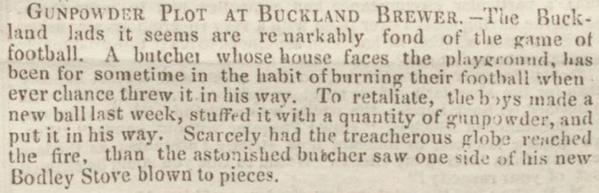
Exeter Gazette 30 September 1830 Guy Fawkes football

Exeter Gazette 1830

In an effort to spread the goodwill, I have enrolled on a (thankfully very short) ‘fun’ run. Can ‘fun’ and ‘run’ be used in the same sentence? So, in aid of Children’s Hospice South West, on November 30th, I shall be dressed as Santa (yes really) ‘running’ along Bideford Quay. I am touched by those who have sponsored me so far; additional sponsors are welcome.
 

T is for Teachers – can they inspire the next generation of historians?

What do you remember about the history of your schooldays? History didn’t make much of an impression on me in primary school, where we started at the stone age when we were seven and worked our way through to the Victorians by the time we left – after all the twentieth century was hardly history was it? This did at least give us the sense of chronology that is now sadly missing from school history teaching. For me the history bug began to bite in the early years of secondary school where an inspirational teacher, Mrs Goodridge, allowed us to do things. Amongst other things, we made a model Viking Village and drew huge plans of the interior of a Tudor ship. Doing things works, it is memorable and it engages the audience. My own former pupils built historically and mathematically correct replicas of the Globe Theatre and made miniature cob cottages (well, minus the cow dung – health and safety rules). The young people I work with rarely forget having their constipation cured by the barber surgeon.

I will say more about young people and history when we get to ‘Y’ because it is not just the young we need to inspire. Television programmes – from costume dramas to Who Do You Think You Are? – help to give people a sense of the past, albeit not always a very accurate one. Series such as Victorian/Edwardian/Tudor Monastery Farm go one better and are rooted in quality historical research. The interest that these programmes inspire should be cultivated. Adults and children alike need to be encouraged to engage with their heritage and what better way to do this than by making history relevant and personal. People are far more likely respond positively to the history of their own town or family than they are to the politics or economics of a far flung country in years gone by.

History is being squeezed from the school curriculum in favour of ‘more relevant’ subjects. History makes us who we are, it makes our nations what they are too, for better or worse. What could be more relevant than that? Historians of all persuasions need to take up the cudgels for their subject and see that it does not itself become history. Those of us who attempt to impart our love of the subject, must be innovative in order to capture our audience, in a market that is becoming increasingly competitive. We need to meet our learners where they are, be that in a classroom, through the pages of a book or using social media. It is a challenge but needs to be done, history is too precious not to share and too much fun to ignore.

N is for National and Local Customs and Traditions

Whether you are interested in Local or Family History it is interesting to find out about the customs and celebrations of the past. Some of these, such as Maypole Dancing on 1st May are countrywide, others are much more localised.

I have described some of my favourite celebrations here but there are many more. For its name alone Whuppity Scoorie, which takes place on 1st March in Lanarkshire, Scotland, has to be included. It involves children running three times round the church, wielding balls of paper on the end of a string. The origins are unknown but it probably relates to the coming of spring.

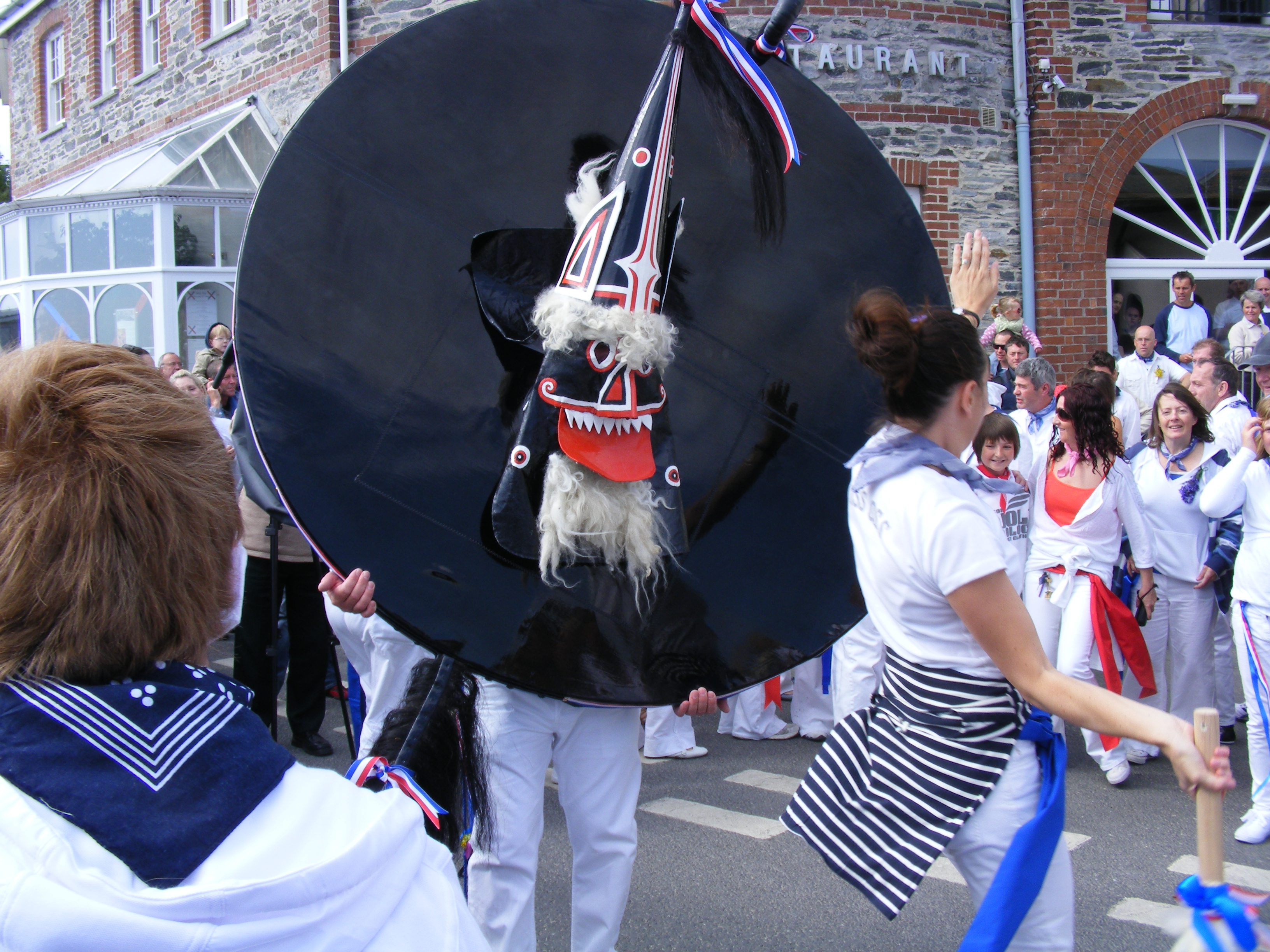
2 May 2011 Obb Oss Day teaser and blue oss 3

Padstow ‘Obby ‘Oss Day 1st May

Then there is Beltane. This is a pagan fire/fertility festival is celebrated on 20th April. Two Cornish celebrations next. Padstow ‘Obby ‘Oss Day on 1st May, when the blue and the red horses parade round the town, followed by their supporters. Followed by Helston Furry Dance or Hal an Tow, popularised by Terry Wogan as Floral Dance. Both are fertility festivals.


At Coopers Hill, Brockworth, Gloucestershire cheeses are rolled down the hill. This is another long standing tradition that has alternative suggested origins. This also take place in May. On 25th July, in Ebernoe, Sussex, the Horn Fair is celebrated. Currently rams horns are awarded to the highest scoring batsman following a cricket match. Nottingham’s October Goose Fair has a history that goes back 700 years. The November Lewes Bonfires, another Sussex celebration, commemorating not just the gunpowder plot but seventeen Protestant martyrs of the sixteenth century. Christmas Eve in Dewsbury, involves Tolling the Devil’s Knell. It was critical to appease the devil at the darkest time of the year.

For more customs see here, or read Ronald Hutton’s Stations of the Sun: A History of The Ritual Year in Britain. Think about the celebrations or customs that might have been part of your ancestors’ lives, or may have been traditional in the place where you now live. Try to attend some of these festival, the atmosphere is usually something special. For an interesting discussion on this subject watch this video.