#100daysofbfotc Day 43: Clovelly, Rat’s Castle

DSCF0708Rat’s Castle, a tiny two-roomed property near Clovelly Quay, makes a brief appearance in Barefoot on the Cobbles as it was Albert and Polly’s first marital home. This cottage was frequently allocated to Clovelly newly-weds, two rooms being all that they required. Tenancies were often short; as soon as the family began to arrive they would be moved on to a larger home. The origins of its name are unknown but presumably the cellars attracted rodents.

‘They had been granted the opportunity of renting the two-roomed cottage known as Rat’s Castle. This tiny dwelling near the quay was reserved for newly-weds and it had suited them well for the past year.’

Barefoot on the Cobbles will be published on 17 November 2018. More information about the novel can be found here. Copies will be available at various events in the weeks following the launch or can be pre-ordered from Blue Poppy Publishing or the author.


#100daysofbfotc Day 42: Mr Ellis

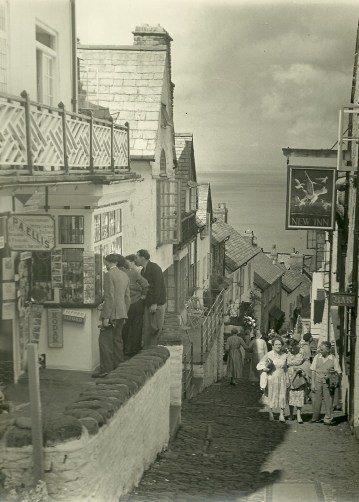
scan0002Mr Ellis does not appear in Barefoot on the Cobbles in person but his shop is part of the Clovelly village streetscape. John Ellis was born in Peterborough in 1854 and began his working life as an apprentice to a printer and stationer. In his twenties he described himself as an artist but it seems that he could not make a living from this and later, he worked for a woollen drapery in the town. It is not known how he met his wife, Alice Jewell from Clovelly. It is likely that John joined other visiting artists who were attracted by Clovelly’s picturesque street. He and Alice settled in Clovelly after their marriage in 1900 and they had one son, Paul. Although he preferred to be out in the street painting, John Ellis ran a High Street shop, selling artists’ materials and photography equipment, amongst more general items. His son later took over the shop and became a well-known photographer, being responsible for many of the scenes depicted in north Devon postcards.

‘ ‘Ellis’ shop is just down there on the left,’ Daisy said, more confident now. No one could be angry at her politely giving directions to trippers. ‘Mr Ellis is a bit of an artist himself, I am sure he would have what you need.’ ’

Barefoot on the Cobbles will be published on 17 November 2018. More information about the novel can be found here. Copies will be available at various events in the weeks following the launch or can be pre-ordered from Blue Poppy Publishing or the author.

#100daysofbfotc Day 41: Mrs Hamlyn

Christine Hamlyn

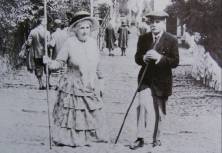
Mrs Hamlyn is the owner of Clovelly at the time in which Barefoot on the Cobbles is set. She is there in the background, impacting upon the lives of those who live on the cobbles. She is both a generous benefactoress and an intimidating member of the upper class, with family connections amongst the social elite of the day.

Christine Louisa Hamlyn Fane was born in 1855, the daughter of Lt. Col. Henry Hamlyn Fane and his wife Susan. She inherited the Clovelly estate in 1884 and married Frederick Gosling five years later; they both took the surname Hamlyn. She was an iconic Lady of the Manor and was responsible for major renovations of the Clovelly cottages. Her annual Christmas gifts to her tenants are mentioned in the local press; haunches of venison were frequently given. It is said that, if she found rubbish on the cobbled street, she would push the offending item with her cane until it reached the nearest door. She would then open the door and tap the litter inside. When she died in 1936, the villagers mourned her passing. As she was childless, the estate passed to her niece Betty.

‘The diminutive figure of Mrs Hamlyn appeared, her ebony cane scratching on the gravel path as she led her guests towards the ivy-clad church.’

Barefoot on the Cobbles will be published on 17 November 2018. More information about the novel can be found here. Copies will be available at various events in the weeks following the launch or can be pre-ordered from Blue Poppy Publishing or the author.

#100daysofbfotc Day 40: Bertie

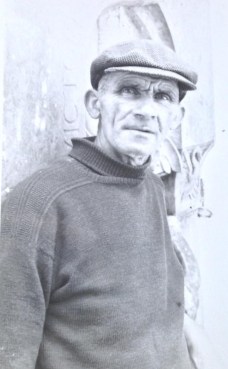
Bert Braund taken by Jim Willis

Taken by Jim Willis

Bertie’s presence in Barefoot in the Cobbles provides an opportunity to examine yet more facets of Albert and Polly’s brand of parenthood. Their second son, Bertie was born in 1900 and he spent much of his life in Clovelly, working on his father’s fishing boat. In today’s world, Bertie might have been labelled as having mild learning difficulties. A family story tells of how, as a schoolboy, he used to hold the donkeys and walk the unladen beasts up and down the street, when the visitors had finished their rides. Any silver coins he received as tips had to be handed to  his parents but bronze and copper were his to keep. After the deaths of his parents, Bertie went to live with his sister Violet in Bideford. He died in 1969.

‘The doctor looked at Bertie appraisingly.

‘Hello young man,’ he said. ‘You look just the age for my Scout Patrol. Have you heard of the Boy Scouts? I am sure you would enjoy the jolly times we have. We are off to camp in a week or two. What do you think of that?’

Bertie looked desperately at his mother for guidance. How on earth should he respond to this gentleman? He might have been speaking a foreign language for all Bertie understood of the words.

‘Oh no, sir,’ exclaimed Polly in horror. ‘Not Bertie sir, he’s well…. He’s not the sort for being away from home, camps and the like, no, no, no it would never do for Bertie.’ ’

Barefoot on the Cobbles will be published on 17 November 2018. More information about the novel can be found here. Copies will be available at various events in the weeks following the launch or can be pre-ordered from Blue Poppy Publishing or the author.

#100daysofbfotc Day 38: Oscar Abbott

DSCF0706

Oscar and his sister Emily

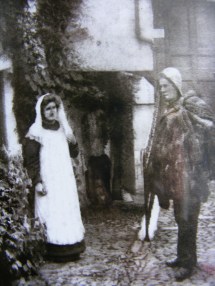
Oscar Abbott appears only fleetingly in Barefoot on the Cobbles yet he was a well known person in the Clovelly fishing community. Born in the village in 1887, son of Sydney and Mary Elizabeth Abbott nee Burnard Oscar grew up in Chapel Street. He married Mary Moss in 1917 and they had seven children, six of them within the first seven years of marriage. As a fisherman, Oscar had a reserved occupation during the First World War, as he was providing essential food. The Abbotts later moved to 12 High Street, Clovelly and Oscar served as a special constable in World War 2. He died in 1976.

‘With the keen sight and instinct of a fisherman, Oscar was the first to spot the speck on the lurching waves.

‘Oh, God,’ he groaned, the rare blasphemy a sign of his anguish. ‘’Tis the Annie Salome.’ ’

Barefoot on the Cobbles will be published on 17 November 2018. More information about the novel can be found here. Copies will be available at various events in the weeks following the launch or can be pre-ordered from Blue Poppy Publishing or the author.


#100daysofbfotc Day 36: Independent Street, Clovelly

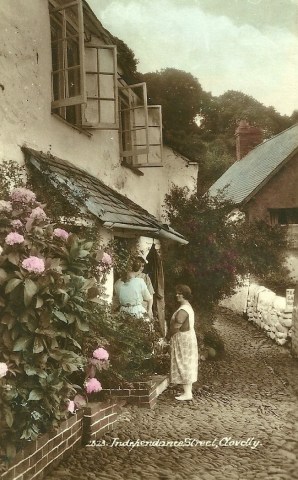
Independent Street Flossie Harris on rightIndependent Street, one of Clovelly’s few side streets, first appears in the pages of Barefoot on the Cobbles when Mrs and Mrs Collins arrive as paying guests in the home of Mrs Stanbury.

There isnt much to be said about a single street, an ordinary street, yet the incidents that took place there are the inspiration for the novel. Those houses, those inhabitants and a particular set of circumstances, all contributed to an appalling tragedy.

‘The path divided; Jack and his sledge swung to the right. Amelia was roused from her musings as they drew up at the far end of a row of cottages. Bright hollyhocks framed the newly painted door and the brass knocker shone.

 ‘You there Mrs Stanbury?’ bellowed Jack, rapping vigorously with the knocker. ‘Your guests be ’ere.’ ’

Barefoot on the Cobbles will be published on 17 November 2018. More information about the novel can be found here. Copies will be available at various events in the weeks following the launch or can be pre-ordered from Blue Poppy Publishing or the author.

#100daysofbfotc Day 30: Mr Tuke

Picture1At the time of Barefoot on the Cobbles, Harry Tuke was the head gardener at Clovelly Court. We meet him in the summer of 1909, when Daisy has just come to work for him as a live-out servant. I wanted to explain Daisy’s move to Torquay and her rather unusual role there as a gardener. To place her as the Tuke’s employee not only help to do this but also gave me the opportunity of making the Tuke’s son a love interest for Daisy.

A Yorkshireman by birth, Harry was in Clovelly in 1893, when he married Eliza Brenchley from Kent in Clovelly church. By this time, Harry was in his thirties and it seems likely that he had just taken up his post at the Court. The Tukes had just one son. As head gardener, Harry’s home was Gardener’s Cottage, close to the church, the Court and the gardens that he tended. He worked for the estate for over forty years, retired to rooms over the stables and died there in 1936. He was involved in the life of All Saints Church, being both a sidesman and a member of the Parochial Church Council.

Harry Tuke’s role as a senior servant to Mrs Hamlyn and his home, which was away from the cobbled street, set him apart from Clovelly’s fishermen. His family were consigned to an ambivalent social milieu, not quite a villager, yet lacking the status of the respectable middle-class.

‘Mr Tuke had noticed the allure that the garden held for Daisy and the thoughtful gentleman had begun to tell her more about the plants and how to tend them.’

Barefoot on the Cobbles will be published on 17 November 2018. More information about the novel can be found here. Copies will be available at various events in the weeks following the launch or can be pre-ordered from Blue Poppy Publishing or the author.

#100daysofbfotc Day 27: Holidaymakers

Capture 3Holidaymakers who ventured to North Devon’s coast were welcomed and dreaded in equal measure. By the time in which Barefoot on the Cobbles is set, the income from tourists was an increasingly important part of the local economy. For those who lived in Clovelly in particular, money gained from providing for visitors enhanced the precarious living scraped by the fishermen. Some visitors took up residence in the local guest houses, many others were interlopers for a fleeting day. They came by sea from further up the Bristol Channel and were ferried ashore by the fisherman. Others arrived by charabanc from the station at Bideford. Still others were transported by horse-drawn vehicles, to be disgorged at the top the cobbles, so they could descend into a different world, stumbling in their unsuitable shoes.

Through the pages of the novel, we arrive in Clovelly when everything is changing. Soon, it will no longer be a fishing village, with holidaymakers providing a secondary revenue stream; before long tourist vessels will eclipse the fishing boats in the harbour. Folk from ‘up-country’ may pass through, leaving little of themselves behind, or they may dislocate the lives of the inhabitants forever. Welcomed or despised, holidaymakers were needed and they could not be ignored.

‘In half-forgotten pre-war holiday seasons P & A Campbell’s steamers had brought hundreds of day-trippers from Ilfracombe, or even South Wales. Tourists were tolerated. They spoiled the solitude, the silence and the regular rhythm of the fishing year. Yet with them came colour, diversion, bustle, excitement.’

Barefoot on the Cobbles will be published on 17 November 2018. More information about the novel can be found here. Copies will be available at various events in the weeks following the launch or can be pre-ordered from Blue Poppy Publishing or the author.

#100daysofbfotc Day 26: Edward Collins

Without Edward Collins’ actions Barefoot on the Cobbles would not have been written. He embodies human frailty, as do we all. His complexities are hinted at in the very brief glimpses of him that have been found in the records. He was key to my story, yet, of the main characters, he was the one about whom I could find least. As I sought to uncover a sympathetic, yet believable, motivation for his somewhat strange behaviour, a three-dimensional individual began to emerge; one who had experienced his own trauma and tragedy. Mainly due to his common surname, I was unable to contact any family members. Should they read the novel, I do hope that they feel the conclusions I have drawn from the meagre facts are not illogical. Despite the appalling, albeit largely unintentional, ramifications of his actions, I wanted the reader to be able to empathise with Edward Collins, who was, in his own way, a victim. I hope I have succeeded.

We meet Edward Collins in Clovelly, where he is staying for the benefit of his health. From the outset he is an enigma. He and his wife can clearly afford expensive hotels, what then are they doing in a small guest house on the North Devon coast? He is comfortably off, a professional, a university man. How will he interact with Clovelly’s down-to-earth fishermen?
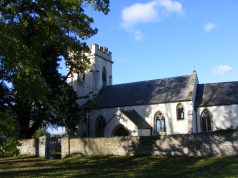
Thornfalcon Church burial place of Edward Collins

Thornfalcon Church

Edward Laurence Collins was born on 1 May 1880 in Liverpool. He gained an MA from Cambridge University and became a consulting engineer. Although I have been unable to positively identify a role for him during the First World War, I think that it is likely that he saw action in some capacity. He married Amelia Martha Hutson in 1915. It seems unlikely that the couple had any children. It also appears that his two sisters died unmarried, hence the lack of living relatives. The Collins remained in Clovelly for some time after the events described in the novel. Edward then travelled widely, probably in the course of his work, going to Gibraltar in 1926 and Chile in 1936. He had plans to live in the Channel Islands but I have no firm evidence that he did so. Edward Collins died on 17 January 1953 in Somerset and is buried in Thornfalcon Church.

‘Clovelly slept. There were no sounds from the cobbled street but the night and its attendant horrors, closed in on Edward Collins. Even eighteen months spent embraced in the village’s serenity had not banished the terrors that darkness could bring. He awoke from the recurring nightmare, shaking and sweating. Curled in a foetal position, clasping his knees, he silently sobbed.’

Barefoot on the Cobbles will be published on 17 November 2018. More information about the novel can be found here. Copies will be available at various events in the weeks following the launch or can be pre-ordered from Blue Poppy Publishing or the author.
#100daysofbfotc Day 20: Eli

Stan Flo and Stella, children of Eli and Maggie

Elis children

Eli has a role in Barefoot on the Cobbles as Clovelly’s carrier, primarily taking goods and passengers from Clovelly to the main town of Bideford. He is still using his horse and cart, in the face of competition from motorised alternatives. Born in 1871, Eli grew up in a Bucks Mills’ fishing family but moved to Upper Clovelly in his teens, to become a carpenter. In 1899, he married the daughter of the family with whom he lodged. They moved to Independent Street, in the village of Clovelly and later to The Bow. Eli’s father became a fish merchant in his later years, taking fish from Bucks Mills to market and perhaps this motivated Eli to become a carrier. As the twentieth century progressed, Eli moved with the times and worked as an attendant at the visitors’ car park in Clovelly. He died In 1955.

‘It was New Year’s Eve when Captain Jenn sent word for Eli to bring out his cart and collect the Clovelly crew members from the train.’

Barefoot on the Cobbles will be published on 17 November 2018. More information about the novel can be found here. Copies will be available at various events in the weeks following the launch or can be pre-ordered from Blue Poppy Publishing or the author.