#100daysofbfotc Day 77: Clovelly Lifeboat

HA_TC_A3P3-003 (2)The lifeboat that features in the penultimate chapter of Barefoot on the Cobbles is the Elinor Roget, or ‘Elinor Rocket’, as she was affectionately known. The Elinor Roget II replaced the first lifeboat of that name in 1907. She was a rowing lifeboat and the crew’s only protection were their cork lifejackets. In the novel, it is Albert who forms part of the crew but depending which account you read, it may have been his brother Alfred instead. Having tried to untangle the conflicting lists of the men who manned the lifeboat on New Year’s Day in 1919, it seems the crew is likely to have been: Tom Pengilly (coxswain), William Prince (Bowman), Oscar Abbott, Herbert, Albert (or Alfred), Charlie Headon, Philip Dunn, Richard Headon, R Hortop William Hamlyn, Fred Headon, Tom Jenn, Captain James Jenn, James Jenn junior and Arthur Shaxon. We do know that some of the crew stood down to be replaced by fresher men, when the lifeboat put to sea a second time. The new men were probably Richard (Dick) Cruse, Sidney Abbot, Richard Foley and Steve Headon. Despite there being a policy of not taking more than one man from each family, the Headon and Jenn families made a significant contribution to the crew. In fact, in a community such as Clovelly, where the families intermarried over successive generations, most of the crew were related in some way.

‘Albert was amongst the fourteen men with oars at the ready, cork lifejackets tightened. The watching crowd, apprehensive and fearful, strained to see the struggling fishing boat dipping and tossing in the distance. The lifeboat listed alarmingly as the oarsmen fought to maintain a steady path through the waves.’

Barefoot on the Cobbles will be published on 17 November 2018. More information about the novel can be found here. Copies will be available at various events in the weeks following the launch or can be pre-ordered from Blue Poppy Publishing or the author.

#100daysofbfotc Day 73: Clovelly Methodist Chapel

DSCF0844Religious observance was commonplace in Clovelly at the time of Barefoot on the Cobbles and the church-chapel divide was alive and well. Even though there are two descriptions of services in the parish church in the novel, many of the characters were Methodists rather than Anglicans. With no Methodist burial ground in Clovelly, Anglicans and Methodists alike were buried in the parish church. We do visit the chapel in chapter seven, just after Leonard has first encountered Annie.

Charles Haimes is credited with bringing Methodism to Clovelly in the very early years of the nineteenth century. His first convert was allegedly Mrs Whitefield. In common with other local landowners, there was initial resistance from the incumbent of Clovelly Court; with tenants being threatened with eviction if they attended Methodist services. This attitude softened Clovelly Methodist Chapel, which nestles behind the New Inn, is owned by Clovelly Estate.* In 1893 the north wall of the chapel collapsed, possibly due to the ingress of water. In the early twentieth century the chapel would be full each Sunday and the post-service gossip would have formed an important part of the weekly routine.

* The History of Methodism in North Devon by John Hayman Gould.

Barefot on the Cobbles will be published on 17 November 2018. More information about the novel can be found here. Copies will be available at various events in the weeks following the launch or can be pre-ordered from Blue Poppy Publishing or the author.

‘It was Sunday before Leonard saw the girl again. Leonard’s attendance at chapel was borne out of habit rather than conviction. His parents went, many of his neighbours went, except, of course, the Anglicans who plodded up the hill to All Saints or crammed into the tiny, village chapelry that was St Peter’s. It was what you did.’

#100daysofbfotc Day 70: Clovelly New Inn

New InnThe New Inn, one of two in Clovelly at the time of Barefoot on the Cobbles, is situated in the middle of the main street. Former mariner, James Berriman, had taken over as the publican of the New Inn by 1861 and was its landlord for more than four decades. James died in 1903 and his wife continued as proprietress of the inn until her death in 1912, at the age of 87. She did employ a manager; in 1911 this was Sarah Harvey. Albert Edward Bushell had taken over the New Inn by 1919 and may well have been the immediate successor to the Berrimans. It is likely therefore that he was the landlord at the time of the 1919 Club Service described in chapter 14.

In 1914, Christine Hamlyn’s programme of renovations reached the New Inn and pictures of the time show the inn sign, depicting a gannet, moving from one side of the road to another. At times, the Inn let rooms on both sides of the street. The First World War delayed the improvements and former cottages, including Polly and Albert’s, were incorporated into the refurbished inn.

The inn provided a venue for various meetings and seems to have been the meeting place for the Rechabites’ friendly society. Although, in the novel, I have set the inquest in the Red Lion, inquests were also held in the New Inn.

 ‘The Rechabites, mostly Methodists and non-drinkers, bundled into the New Inn, who were as happy to serve teetotallers as drinkers.’

Barefoot on the Cobbles will be published on 17 November 2018. More information about the novel can be found here. Copies will be available at various events in the weeks following the launch or can be pre-ordered from Blue Poppy Publishing or the author.

#100daysofbfotc Day 69: Granny Smale

Pengilly's Tea Rooms

We encounter Granny Smale, who ran one of Clovelly’s tea rooms, in chapter seven of Barefoot on the Cobbles. Stories of Granny Smale, or Granny Pengilly as she was also known, have come down to the present day. The incident with the cream, that is recounted in the novel, is just one of them.

Mary Ann Pickard was born in 1848, the daughter of William and Susan Pickard née Heard. Both the Pickards and the Heards were well known Clovelly families. In 1871, Mary Ann married mariner, William Pengilly, in Clovelly and they set up home in North Hill. In the 1891 census, Mary Ann can be found living in a three roomed cottage in the High Street, with six of their eight children. Just a week after the census was taken, her husband met with an untimely death. In order to support her family, Mary Ann ran Pengilly’s Tea Rooms in the High Street. She remarried, to Harry Smale, in the Zion Chapel in Silver Street, Bideford in 1897. Harry died in 1915 and Granny Smale’s granddaughter, Annie, came to help her run the tea shop. Mary Ann Smale died in 1920.

Leonard lingered outside Granny Smale’s, inhaling deeply as the aroma of baking brought a halt to his purposeful gait. Short, sturdy and energetic but elderly now, Granny Smale hadn’t been Granny Pengilly for twenty years or more but the sign outside the shop, that swayed and creaked in the salt-laden gusts, still read “Pengilly’s Tea-Rooms”. Harry Smale had succumbed to a sudden attack of influenza just last week and there had been speculation as to how Granny Smale would manage the business alone.’

Barefoot on the Cobbles will be published on 17 November 2018. More information about the novel can be found here. Copies will be available at various events in the weeks following the launch or can be pre-ordered from Blue Poppy Publishing or the author.

#100daysofbfotc Day 67: Rosie

scan0006

Rosie (left) and her sister Lily

Rosie was born in the last year of the peace and shared her birthday, 3 February, with her sister Lily. She was the youngest child in Polly and Albert’s family. The incident, in chapter 9 of Barefoot on the Cobbles, when Rosie fails to come home from school, is based on a real family story.

She married in 1936 and had one daughter but her husband died shortly afterwards, so Rosie returned to Clovelly to live with her parents. She spent the rest of her life in the village.

 Rosie ran indoors, oblivious of the commotion that she had caused. The good news rushed down the street faster than a flood tide. Villagers came to express their relief, or to check if the rumours of Rosie’s safe return were true.’

 Barefoot on the Cobbles will be published on 17 November 2018. More information about the novel can be found here. Copies will be available at various events in the weeks following the launch or can be pre-ordered from Blue Poppy Publishing or the author.

#100daysofbfotc Day 63: Mrs Harris

Mrs Margaret Harris is one of many Clovelly villagers whose lives are a backdrop to those of the main characters. Margaret’s neighbourliness leads her to become directly involved in the penultimate act of the Devon tragedy that is retold Barefoot on the Cobbles.

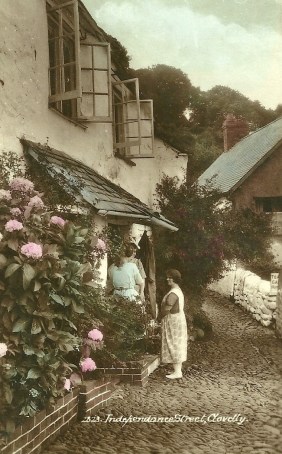
Independent Street Flossie Harris on rightMrs Harris was born Margaret Headon in Clovelly about 1853. Like many from Clovelly, she crossed the Bristol Channel and there she married James Harris, whose family also lived in Clovelly. With her husband away at sea, Margaret lived with her widowered father back in Clovelly. She became Polly’s neighbour in Independent Street, where Margaret ran a lodging house. Margaret and James had five children before James died in the 1890s. The Samuel Harris, who also appears in the novel, was the son of James Harris’ sister, Elizabeth. Margaret died in 1928.

Briskly, Emma Stanbury took charge. Later, when the children clattered back from school, she shooed them off to be minded by Mrs Harris.’

Barefoot on the Cobbles will be published on 17 November 2018. More information about the novel can be found here. Copies will be available at various events in the weeks following the launch or can be pre-ordered from Blue Poppy Publishing or the author.

#100daysofbfotc Day 55: Clovelly Church

1 April 2012 Clovelly ChurchyardDespite many of the main characters being Methodists, Clovelly Church appears in several key scenes in Barefoot on the Cobbles. It is here that the incident involving the suffragettes begins and here that we witness two funerals. On New Year’s Day, All Saints was also the venue of the annual ‘Club Service’, attended by members of the Friendly Societies.

This twelfth century church is at the top of the hill, away from the cobbles and close to Clovelly Court. There had been a timber-built place of worship on this site before the current church was built. The impressive roof is part of the renovations that took place in the fourteenth century. Further additions took place in later centuries.

‘Leonard shifted his body to gain himself a few extra inches of space and clutched the slightly damp, well-worn hymn book. The distinctive smell of steaming wet worsted pervaded the air. Reverend Simkin sonorously announced the first hymn. Tom Finch, during the week the rector’s gardener but proud organist on a Sunday, began to play, with more regard to volume than melody. Oh God our Help in Ages Past, comfortably recognisable to Methodists and Anglicans alike.’

Barefoot on the Cobbles will be published on 17 November 2018. More information about the novel can be found here. Copies will be available at various events in the weeks following the launch or can be pre-ordered from Blue Poppy Publishing or the author.

#100daysofbfotc Day 50: Mr Moss

Clovelly Harbour 1912John Thomas Moss appears only obliquely in Barefoot on the Cobbles, as the proprietor of the Red Lion Hotel on Clovelly’s quayside. He was born in Clovelly on 22 October 1868, the son of John and Mary Moss née Foley and spent his childhood living at North Hill. Initially, he followed his father’s trade and went to sea. John married Lizzie Arthur Slocombe, in 1893, in Ilfracombe and the eldest of their two daughters was born there. They set up home back in Clovelly, at 15 High Street and when he came ashore, John managed the Red Lion. He died 1951.

‘The members of the Mariners’ Union repaired to The Red Lion for their repast, which would be accompanied by beer, or even whisky. The Club Room had been suitably decorated with garlands of greenery and candles for the occasion. Mr Moss’ staff were on hand to serve a roast dinner, befitting of the status of those on the top table.’

Barefoot on the Cobbles will be published on 17 November 2018. More information about the novel can be found here. Copies will be available at various events in the weeks following the launch or can be pre-ordered from Blue Poppy Publishing or the author.

#100daysofbfotc Day 49: Will Harding

William HardingAs we meet Will Harding, in the penultimate chapter of Barefoot on the Cobbles, he is on his way home from a tour of duty on a merchant ship, just after the end of the First World War. Harding is the forgotten victim in a Clovelly tragedy whose tale is oft told. Whereas the event, which is included in the novel, acknowledges his companion, Harding’s name is not usually mentioned. It was only when researching for the book, I realised that two men were involved. I will hold my hand up to Will’s age being wrong in the novel. I could pretend that there was some valid literary reason for this but then you might ask me what that was. In my defence, Will is very vague about his age on official documents but I can’t justify why I chose to use the incorrect one.

William Robert Harding was actually born in Clovelly in 1882, son of Richard and Mary Ann Harding née Whitefield. Both families had a long seafaring tradition and Will joined the merchant service. He married Rosa Evelyn Jenn in 1903 in Cardiff and they had a son and three daughters. He served on a number of ships together with other Clovelly men.

‘Weary and apprehensive, Leonard hauled his kit bag on to the cart and hunched down next to Will Harding, an experienced sailor who looked older than his thirty four years, with weather-hewn face and prematurely balding pate hidden under a cap. Will was a family man, eager to get back to his pretty wife, his near-grown son Billy and three little girls.’

Barefoot on the Cobbles will be published on 17 November 2018. More information about the novel can be found here. Copies will be available at various events in the weeks following the launch or can be pre-ordered from Blue Poppy Publishing or the author.

#100daysofbfotc Day 47: Jack Foley


Donkeys going down

Donkey apparently going down the street

We meet Jack Foley in wartime Clovelly, when he is responsible for supervising the donkeys that transported goods up the cobbled street. As I was writing Barefoot on the Cobbles, Jack’s role in the novel resulted in a lengthy debate. I had composed a passage during which Jack led a laden donkey down the street. It was then pointed out me that donkeys only carried luggage up the street and the downward journey would be undertaken using a sledge. Regretfully, I re-wrote the passage. Then a photograph was found where a laden donkey appeared to be heading down. I regretted my re-write but it seems it was necessary after all, as I later learned that this was a posed photograph and not a reflection of real life in Clovelly.

The John, or Jack, Foley who appears in the novel was born in 1880 into a seagoing Clovelly family. John however remained ashore and became a carriage driver, almost certainly working for Mrs Hamlyn. In later life, perhaps due to the advent of motor transport, he worked as a general labourer. In 1903, he married Dorothy Wonnacott and spent most of his life living at 85 High Street, Clovelly. He died in 1962.

‘The Collins trailed a few paces behind their luggage as the lurching sledge negotiated the cobbles under the adept guidance of Jack Foley.’

Barefoot on the Cobbles will be published on 17 November 2018. More information about the novel can be found here. Copies will be available at various events in the weeks following the launch or can be pre-ordered from Blue Poppy Publishing or the author.