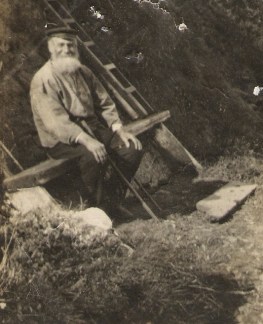
#100daysofbfotc Day 76: Captain James

Captain James with telescopeCaptain James appears in the first chapter of Barefoot on the Cobbles when he is visited by his grandchildren Albert and Eadie. Born in 1809, James spent his whole life living in Bucks Mills. He went to sea at the age of eleven and was a fisherman and pilot. He was credited with saving the lives of several local fishermen who had got into difficulties in Bideford Bay.

In 1836 he married his first cousin Mary and they had eleven children. He probably began his married life in a property known as The Bluff, before building King’s Cottage, next to his father’s home in 1845.  He died in 1898.

The grandfather, Captain James, was held in high regard by the villagers, most of whom were relatives of one kind or another. He could no longer row out to pilot boats in over the bar, or rescue ships in distress, these glories were now merely memories to be shared with the next generation. The old man might still potter in the bay, handline for fish from the shore or sit in the porch and ponder on the past. He would raise his telescope to scan the sea that had been his love and his master for more than eighty years.

Barefoot on the Cobbles will be published on 17 November 2018. More information about the novel can be found here. Copies will be available at various events in the weeks following the launch or can be pre-ordered from Blue Poppy Publishing or the author.

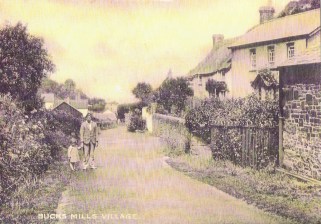
 

#100daysofbfotc Day 68: Bucks Mills Methodist Chapel

Malcolm Langford cards (9)

Former Methodist Chapel on the left

In a tract written in the 1850s, the irreligious nature of the inhabitants of Bucks Mills was lamented. The evangelising efforts of the Wesleyan Methodists and the Bible Christians bore fruit and the characters in Barefoot on the Cobbles attend the Wesleyan Methodist Chapel in the first chapter. The original, tin roofed, chapel was probably constructed in the 1860s. It was Captain Joe, Albert’s uncle, who is said to have donated the land on which the chapel was built. He also promised that his subscription to the chapel would increase by £2 each year. He lived to be 87, so this may have been rash. In 1907, the chapel was closed and a new chapel was built on the opposite side of the road. Leet Cottage now stands on the site of the old chapel.

‘Kneeling on a coarse hassock between Mary and Albert, Eadie’s mind wandered as the words of the prayers washed over her. The walls of the chapel echoed back the phrases with an eerie resonance. For Eadie, the sermon was the hardest part. The dust motes swam in the sinking sunlight and she struggled to stay awake as the preacher spoke of sin and salvation.’

Barefoot on the Cobbles will be published on 17 November 2018. More information about the novel can be found here. Copies will be available at various events in the weeks following the launch or can be pre-ordered from Blue Poppy Publishing or the author.
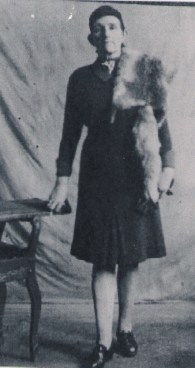
#100daysofbfotc Day 62: Aunt Ellen

Aunt Ellen was another minor character, in Barefoot on the Cobbles, who was fascinating to research. Like her sister, she spent time in the asylum at Exminster, contributing to her sister-in-law Polly’s dread of the institution. Although Eadie was a year old when Ellen was admitted, she was probably suffering from post-natal depression.

Mark's & Emily's

Mark’s Cottage in the foreground on the right

Ellen was the ninth child in a family of eleven and grew up in a fishing family at King’s Cottage, Bucks Mills. She was born on 11 June 1848 and married her first cousin, Thomas, ‘Crumplefoot Tommy’, in 1873. It appears that the first year of their married life was spent in the cottage now known as Mark’s, before they moved to Ivy Cottage. In the 1911 census, Ellen states that she had ten children but only nine have been identified; three of these died young. Her mental ill-health was probably a contributing factor to her willingness to hand her daughter, Eadie, to her brother to be brought up. Ellen died on 22 January 1919.

 Polly felt frozen fingers grip her heart. She was well aware that Matilda’s sister, Albert’s Aunt Ellen, had spent nigh on a year in the asylum, when Eadie had been a year old. They’d blamed that on child bearing. Polly glanced involuntarily at Nelson in his cradle. Was she immune to this affliction that struck at mothers unawares?’

 Barefoot on the Cobbles will be published on 17 November 2018. More information about the novel can be found here. Copies will be available at various events in the weeks following the launch or can be pre-ordered from Blue Poppy Publishing or the author.


#100daysofbfotc Day 51: Eadie

EadieEadie is another character who had to undergo a name change to avoid confusion. She appears in only three chapters, near the beginning of Barefoot on the Cobbles, yet her role is an important one. It is through Eadie that we first glimpse how Albert might react to parenthood. Her story has been handed down through the family and is told in the novel with little elaboration.

Eadie was born on 14 May 1884 into a large family, who lived in what was then called Ivy Cottage, Bucks Mills; the history of the cottage will be posted in a couple of days’ time. Her father was a fisherman, known as ‘Crumplefoot Tommy’. Her mother, Ellen, struggled to cope and when Eadie was about six, she was informally adopted by Ellen’s brother, William and his wife Mary. From that point onwards, Eadie spent her whole life living in Rose Cottage in Bucks Mills. She married her first cousin, Walter in 1908, amidst a certain amount of disapproval because of their close kinship; they were in fact cousins several times over as Eadie’s parents were also first cousins. Eadie cared for William and Mary in their old age but somehow found room for eleven children in the tiny four-roomed cottage. Walter died in 1938, when the youngest child was only eleven and Eadie died in 1955.

‘On the step of Captain Joe’s substantial house sat a weeping child, dishevelled and dirty, her tears tracked by the grubby smears on her sun-stained cheeks. A young fisherman was walking towards her, on his way up from the shore. As Albert approached, the girl’s hand scrubbed across the bottom of her nose and she sniffed heartily. The other hand failed to push her dark hair from her eyes. Her faded ribbon had long since ceased to perform its duty.’

Barefoot on the Cobbles will be published on 17 November 2018. More information about the novel can be found here. Copies will be available at various events in the weeks following the launch or can be pre-ordered from Blue Poppy Publishing or the author.

More information about Bucks Mills can be found here.

#100daysofbfotc Day 46: Mary – ‘Mrs William’

Mary, a fisherman’s wife, appears in the first chapter of Barefoot on the Cobbles. She is the first mother that we get to know in the novel and through Mary, we can experience a manifestation of motherhood that is rather different from those that are revealed in later chapters. Unlike most Victorian families, Mary has only two children, Albert and Fred. There is no evidence for any other live births but she may have suffered miscarriages. Of course, there could have been another reason for her untypical lack of fecundity. The story of how she opens her heart and home to young Eadie is a true one. Like a number of Bucks Mills’ wives, Mary was often known by the forename of her husband, to avoid confusion with others of the same surname, hence ‘Mrs William’.

St. Anne's Church (old postcard)

St. Anne’s, Bucks Mills

Mary’s post should really have been yesterday. She was born as Mary Jane on 22 September 1842 at Horn’s Cross, Alwington, Devon to Richard and Hannah Hamlyn née Lewis and she was the only child of their marriage. They were a farming family and Mary worked as a launderess; nonetheless, in 1862, Mary met and married William, a fisherman from the neighbouring parish. Theirs was the first marriage in the newly opened Anglican church at Bucks Mills. Their son, Albert arrived nine months later and his brother followed two years after that.

Mary lived at Rose Cottage in Bucks Mills for the last forty years of her life. She died in 1928.

More information about Bucks Mills can be found here.

Albert was explaining to his mother how he had rescued a distressed Eadie from the square.

‘Mebbe you stay here for a day or two maid, ’til your da calms down,’ said Mary.

There was reassurance in the words but who was the more comforted, Mary or this dark-visaged child with sadness in her soul? Mary turned to her son, who had unwittingly presented her with a few days of companionship.’

Barefoot on the Cobbles will be published on 17 November 2018. More information about the novel can be found here. Copies will be available at various events in the weeks following the launch or can be pre-ordered from Blue Poppy Publishing or the author.

#100daysofbfotc Day 39: King’s Cottage, Bucks Mills

King's Cottage coloured postcard

King’s Cottage, Bucks Mills is the home of Albert and Eadie’s grandparents. We get a glimpse inside in the first chapter of Barefoot on the Cobbles.

On 27 January 1845, Reverend John Thomas Pine Coffin, the landowner, had entered into an agreement with Albert’s grandfather, James, giving him permission to build ‘a house over the watercourse at the machine platform at Buckish, Parkham’. This land was adjacent to James’ father’s home. The new house was to become King’s Cottage and the rent was one shilling a year. By the time we open the front door of King’s Cottage in the novel, the family have lived there for forty five years. They were to remain there for a further twenty years. It was a substantial cottage, with a view over the bay and unique plumbing arrangements, which are mentioned in the book. Kings Cottage was described in the North Devon Journal in 1855, the house ‘at the lower extremity of Bucks, on a towering height above the beach, is a real curiosity. The rivulet that comes down between the hills, by and under part of his eagle’s nest premises, discharges itself in a cataract on the beach where it flows into the Atlantic.’

After the family left, it was tenanted by a relative of Clementine Churchill.

‘Even the gate was exciting, having, as it did, a ship’s wheel at the centre. Eadie’s small fingers would proudly trace the name that was engraved in the wooden frame: King’s Cottage. She smiled; her granfer was a king.’

More information about Bucks Mills can be found here.

Barefoot on the Cobbles will be published on 17 November 2018. More information about the novel can be found here. Copies will be available at various events in the weeks following the launch or can be pre-ordered from Blue Poppy Publishing or the author.

#100daysofbfotc Day 34: Uncle John

John (Kivell) BraundThere is a passing reference to Uncle John in chapter 4 of Barefoot on the Cobbles, when he assumes the responsibility for his sister, Matilda. Born on 6 October in Bucks Mills, John was the eldest of Albert’s surviving uncles. Like his father, grandfather and brothers, John was a fisherman. In order to distinguish him from the other Johns in the same family, who also lived in the village, he was known as ‘Johnny Kivell’. He took his wife’s maiden surname as a nickname, as opposed to her christian name, which was the method adopted by the other Johns. He was also called ‘Big Johnny Kivell’ and he was renowned for his strength. He allegedly carried a hundredweight of limestone up the street. This is undoubtably an exaggeration but nonetheless, a lifetime of hauling lobster pots obviously required plenty of muscle.

Johnny Kivell and his wife Susan had eight children and they also brought up a granddaughter. He lived all his life in Bucks Mills. After he married, John made his home at number 9, now known as ‘George’s’. In the 1890s he and his growing family moved next door, to number 10, which has now been amalgamated with the adjacent cottages. The family were devout Methodists and John was instrumental in the building of the new Methodist Chapel in the village in 1907. John died on his 91st birthday, in 1930.

 ‘Uncle John says her [Matilda’s] language is something shocking. Her excuse is the devil’s got her tongue. Sounds like she’s gone proper mazed. She used to go to chapel regular, now she’s saying she’s going to hell. Uncle John’s been having a right time of it.’

 Barefoot on the Cobbles will be published on 17 November 2018. More information about the novel can be found here. Copies will be available at various events in the weeks following the launch or can be pre-ordered from Blue Poppy Publishing or the author.

#100daysofbfotc Day 32 Ada Wakely


Ada

Ada Wakely grew up in the fishing hamlet of Peppercombe, the fourth of five sisters. She appears in Barefoot on the Cobbles as an acolyte to her elder sister, Polly. It is Ada who travels to Bideford to attend Polly’s wedding and Ada who is in Clovelly to assist when her sister gives birth to her firstborn.

One of Ada’s personal tragedies is alluded to chapter 4 of the novel. After marrying a cousin of Polly’s husband Albert, Ada settled in Bucks Mills as a fisherman’s wife. Her son was born after seven years of marriage. Sadly, he was severely disabled and died at the age of twelve. This was not to be the only misfortune in Ada’s life but you will have to wait for the post about her husband, George, to learn more. Ada herself lived to the age of 105, dying in 1981.

‘Ada arrived from Peppercombe on the Friday bringing family news.

‘Ma sends her love,’ she said. ‘She wishes you well, ’tis in part the journey, you know she’s never liked the town. ’Tisn’t that ma hasn’t taken to Albert so much but he is from Bucks and that’s hard for her to swallow. She wants us all to settle down in Peppercombe and not go no further.’

‘And shall you?’ asked Polly.

Ada reddened.

‘Well,’ she said hesitantly, ‘who knows? Maybe I’ll be wed to a man from Bucks too one day.’ ’

 Barefoot on the Cobbles will be published on 17 November 2018. More information about the novel can be found here. Copies will be available at various events in the weeks following the launch or can be pre-ordered from Blue Poppy Publishing or the author.

#100daysofbfotc Day 25: ‘Johnnie Adelaide’

Malcolm Langford cards (8)

The home of ‘Johnnie Adelaide’ (right hand cottage)

‘Johnnie Adelaide’ is so called to distinguish him from another John, who lived at the other end of Bucks Mills village. Both men had their wife’s christian name appended to their own, becoming ‘Johnnie Adelaide’ and ‘Johnnie Lydia’. ‘Johnnie Adelaide’ is mentioned just once, in the first chapter of Barefoot on the Cobbles, along with two of his daughters Norah and Gertie. As inhabitants of 4 Forest Gardens, ‘Johnnie Adelaide’ and his family were Mary and William’s neighbours. John’s wife, Adelaide, had lived in the cottage with her widowed mother, Mrs Dunn and continued to bring up her family there. 4 Forest Gardens eventually passed to ‘Johnnie Adelaide’’s daughter, Louisa.

Like most of the men in Bucks Mills, ‘Johnnie Adelaide’ spent his working life at sea, combining fishing with engagement in the merchant service. He had been born in the village in 1847. At the age of thirty three he married Adelaide Dunn and they had four daughters and a son.

‘Firmly and before she could be gainsaid, Mary answered, ‘She be staying put. There’s too many of them down at Ivy. I could do with some help in the house now me arthritics be so bad and she will walk up to school with Johnny Adelaide’s girls. Norah’s about her age and Gertie can keep an eye on them both on the way. She won’t be no trouble.’ ’

#100daysofbfotc Day 24: Bucks Mills, The Coffin Arms

Coffin Arms 1928By the time that it is mentioned, in the first chapter of Barefoot on the Cobbles, it has been twenty years since the Coffin Arms closed its doors. Its unusual name comes from the local landowners, the Pine-Coffin family. The Coffin Arms served the fishing village of Bucks Mills as an ale house for fifty years before the licence was transferred to the Coach and Horses at Horns Cross. Bucks Mills has been a dry village since that time. It is likely that it provided off sales rather than being an inn.

The cottage formed part of the Pine-Coffin estate and was almost certainly built, along with most of the other dwellings on that side of the Bucks Mills road, in the 1810s. The earliest known tenants were the Bale family. During the 1840s the Coffin Arms was taken over by Samuel Harris, who combined beer selling with lime burning. Thomas and Thirza Webb were in residence in the 1860s, until Thomas transferred the licence to his brother-in-law, Joseph Dark.

Once the Coffin Arms became a private residence, it was the home of the Steer family for fifty years. Jane Steer took four orphaned nieces and nephews into her home. This brought the total number of inhabitants in 1871 to fourteen.

In the 1920s, with new owners, the name was changed to Woodlands. The house has lain semi-derelict for decades. More information about Bucks Mills can be found here.

‘He had signed the pledge at a young age of course but did not find abstinence irksome. Since the Coffin Arms closed to customers decades ago, there was no ale-house in Bucks Mills, so alcohol was not a temptation.’

Barefoot on the Cobbles will be published on 17 November 2018. More information about the novel can be found here. Copies will be available at various events in the weeks following the launch or can be pre-ordered from Blue Poppy Publishing or the author.