Making Christmas Cake and more Cs from the history interpreter’s historical advent calendar

Christmas Cake making time, a little later than usual this year. They seemed to turn out well. Then off to source a Christmas tree. The year I don’t have a tree I will have turned up my toes. Not for me the colour coordinated decor though. I have to have the largest tree my cottage will accommodate. Well actually, to be honest, I often opt for one that doesn’t fit in my cottage. Then I have to persuade someone of my acquaintance to wield a saw. I have to say that I am perfectly capable of wielding my own saw but not in zero temperatures. One year I famously took a tree back because it was too small, then there was the year that I took a seven foot tree on a bus crowded with Christmas shoppers – and that was in the days before trees got squished into handy nets. Anyway back to the reason for the large as possible tree. I have a large collection of tree decorations and they all have to be displayed. A large number of these are older than I am (that’s seriously ancient – what it is to be vintage!) and all have family significance; the collection having been added to each year. Some were made by my mother and daughters and all are precious. Last year, as I removed them from the tree, I made a note of any of particular interest so my descendants will know what they are disposing of! I even took the precaution of putting all the really special ones in one box. I haven’t worked out how these will be identified if I drop dead whilst they are on a tree!

Today then, the annual ‘spring’ clean of the living room that occurs pre decorations. This means all the historic brasses have been cleaned. In the days when I was a Tawny Owl, this task was delegated to the hapless Brownies – I am sure it was good for some badge or other. Now I am lacking slave labour I have to do my own. Tomorrow the tree comes in and the pudding gets made (yes late again).

Carols

Carol is a word of Anglo-Norman origin and actually means a circle dance, not necessarily accompanied by singing. Music was viewed as pagan and carols were banned from church services. Traditionally St Francis of Assisi is thought to have added singing to a Christmas service in a cave in Greccio, Umbria in 1223. In Medieval Times, carols or curls, were Christmas songs that were often regional in nature, sung by local groups of waits, sometimes as part of a mystery play. Most of the well known carols date from the C16th. Carols fell out of use in the C17th to be revived in the C19th.

Christmas Carol

The well known story by Charles Dickens was first published in 1843, making Ebenezer Scrooge, Bob Cratchit and the three ghosts famous.

Christingles

Christingle means ‘Christ Light’ and they were originally part of the traditions of the Moravian Church. Each part of the Christingle was given a religious significance and Bishop Johannes de Watteville first used it as a way of explaining the meaning of Christmas in 1747. In 1968, the Christingle Service in the UK became a way of raising money for the Children’s Society

Crackers

Crackers were invented by confectioner Tom Smith in 1847 as a way of marketing his bonbons.
C is for Candy Canes, Cake and a very cold Clovelly – the history intepreter’s historical advent calendar and other things

Yesterday it seemed like a good idea to join the community of Clovelly in their switching on of the Christmas lights celebration. That would be seemed. A lovely occasion but for some reason best known to myself, I failed to don my normal winter wear of a million thermal layers. We also arrived ridiculously early. Surely even I should have worked out that turning on lights and fireworks would require something resembling darkness? Unfortunately not. So I froze. Have already written note to self in next year’s diary along the lines of ‘on no account arrive before 4.30pm’ and ‘thermal socks required’. Clovelley’s cobbles may be iconic but the cold don’t half strike upwards from them! The Lapland holiday is looking increasingly like mid-life crisis madness.

The first half of the Cs for the advent calendar today and cake making for me, later than usual this year. For someone who can’t cook – and I do mean REALLY can’t cook – it is incongruous that I always make cakes and pudding.

Cake

Originally a ‘plum pottage’ was eaten at the end of a period of fasting on Christmas Eve. Spices, fruit and honey were added to make a celebratory dish and to represent the gifts of the wise men. Richer household, with ovens, converted this to a plum cake. Neither contained plums but they did include fruit such as raisins. This was traditionally eaten on Twelfth Night rather than Christmas Day. It didn’t become a Christmas Day cake until Twelfth Night celebrations were banned in 1870.

Candles

The use of candles at Christmas derives from the many light festivals that accompany the winter solstice in different traditions. In Victorian times, candles were placed, rather dangerously, on Christmas trees, before these gave way to electric fairy lights. Martin Luther is credited with being the first to add candles to an indoor tree in the C16th. He was trying to recreate the impression of the stars shining on the outdoor trees.

Candy Canes

It is thought that sweets in the shape of shepherds’ crooks were first made in 1670 at the request of Cologne Cathedral’s choirmaster in order to quieten children during services. Candy canes were white until the beginning of the C20th. According to the National Confectioner’s Association, in 1847, German immigrant August Imgard used the candy cane to decorate a Christmas tree in Wooster, Ohio. Religious symbolism has been attached to the candy cane. The white is said to represent Christ’s purity and red His shed blood. Traditionally, the three red stripes are for the Holy Trinity.

Cards

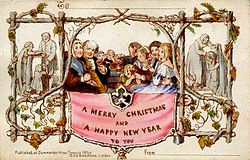
The First Christmas Card

The First Christmas Card

The earliest reference to a Christmas card is thought to be that of  1843 in the diary of Henry Cole, director of V & A Museum. The first commercial design, by John Horsley, was issued in 1846 when 1000 copies were printed.

B is for Bells, Boar’s Head and Boxing Day – the history interpreter’s historical advent calendar

Bells

The association between Christmas and bells, particularly church bells, is a longstanding one. Christian church tradition starts the new day at sunset on Christmas Eve. Services that began after that time would be regarded as the first Christmas Day service and bells would be rung. Some churches ring only the largest bell four times before midnight, followed by all the bells being rung in celebration at midnight.

Boar’s Head

This tradition probably dates from Anglo-Saxon times and is based on Norse sacrifices to the goddess to Freyr, to bless the new year. A boar’s head with an apple in its mouth is the heart of a traditional Medieval banquet. Queen’s College Oxford celebrate the Boar’s Head on the Saturday before Christmas. Apparently a former student escaped from a boar by thrusting a copy of Aristotle down its throat.

Boxing Day

The day to box up excess food to share with the poor. Church alms boxes were often distributed on this day. Modern Christmas ‘boxes’ take the form of money.

A is for Advent – the history interpreter’s historical advent calendar

The first in my alphabetical historical trivia advent calendar. Yes I know there are 24 days and 26 letters of the alphabet. Actually I am in trouble as I have several letters with no entries thus far.

Advent

The modern period of Advent was established by The Council of Tours in 567 as a period of fasting. They also declared the twelve days from Christmas to Epiphany to be a sacred, festive season. Previously there had been a 6 week fast from St. Martin’s day (11th November Martinmas).

Advent Calendar

A Lutheran idea originating in Germany in the early C19th to mark the count down to Christmas. Originally this might have been as simple as drawing a chalk line on the door each day from 1st December. Others hung religious pictures on the wall or lit candles each day, sometimes the 24 candles would be arranged in a frame known as an advent clock. This developed into the modern wreath. The first reference to a (handmade) calendar is in 1851 and printed calendars appeared in the first decade of the C20th.

Advent Wreath

In ancient Rome people used decorative wreaths as a sign of victory. Some believe that this is where the hanging of wreaths on doors came from. The roots of the Advent wreath go back to the pagan practices of the Germanic peoples who, in the dark days of winter, decorated their houses with evergreens and lit candles as symbols of hope of spring to come. These traditions were adopted by the Christian church and the symbolism was transferred to represent Christ the everlasting light. Traditionally, the wreath is made of four candles in a circle of evergreens with a fifth candle in the middle. Three candles are violet and the fourth is rose but four white candles or four violet candles can also be used. Each week in church, the candles are lit, one candle the first week and then another each succeeding week until the Sunday before Christmas. The last candle is the middle candle. The lighting of this candle takes place on Christmas Eve. It represents Jesus Christ being born. The first reference to a public hanging of an Advent wreath is in Hamburg in 1839.

S is for too many things!

Excited to learn that I am to speak on North Devon Emigrants at the Halstead Trust’s Exodus: Movement of the People conference in Leicestershire in September. Now to decide which example emigrants to choose. Cheered me up after a morning slogging through ‘S’ Enquire Within entries; unfortunately these include Scotland, Seamen and other lengthy topics. It is incredible how much has changed since the last, pre-internet, edition. Having become obsessed with the alphabetical motif I have decided to adopt it for an after dinner talk/Christmas entertainment that I appear to have been ‘volunteered’ for. A is for advent, Y is for Yule and all things in between. I may inflict this on my blog followers as a sort of advent calendar.

I am beginning to regret the decision to incorporate the burial registers from Buckland Brewer into our memorial inscriptions’ index. The registers have been transcribed but I felt I should check the transcription. Despite all my palaeographical practice with the High Admiralty documents, this is going to be tricky. The handwriting is not the problem, nor indeed is the Latin. The pages appear to have been chewed by rats, damaged by tempest or something similar. I may have to trust the transcription done in the 1930s, at least for the earliest entries.

B is for British History Online

Have now finished ‘B’ for my Family Historians’ Enquire Within edit. Just thought I would, for the uninitiated, share how good British History Online is. A treasury of national and local documents, many from the early modern period, that can be searched by surname or place name. So many sources, so little time.

I am also getting back to the Buckland Brewer Memorial Inscriptions indexing project. The full transcriptions are all done and we are indexing. Still haven’t braved storm and tempest to take the remaining photos but I will, I WILL. We also plan to incorporate the burial registers for a ‘buried in Buckland’ overview. Bit of an indexing fest all round really as I am about to start some Clovelly indexing and I am now whizzing my way through the C17th Court of High Admiralty documents – on a case relating to the misappropriation of a cargo of serges at the moment.

Also revisted my Dawson ancestors this week. Have finally confirmed that the ‘fact’ that  great great auntie Alice died in a fire in Whitstable is rubbish. I had several similar ‘facts’ on this branch, gleaned from years of discussions with my mother and great aunt, both of whom knew the individuals they were talking about. Apart from the mode of auntie Alice’s demise, other ‘facts’ that proved groundless include the name of her first husband (actually there was no first husband but the name I was given was also incorrect for the father of her illegitimate child). No, William Sadler’s, name was not William but Harold, Uncle William’s wife was Fannie, not Carrie and as for the surname for cousin May’s husband – no relation to the truth at all. All this depsite the labels in the family photo album that I had revelled in since early childhood. ‘Always label your family photographs’. Yes, but it would help if the labels were right!

Auntie Alice – who definitely didn’t burn to death – and Cousin May

Now for the Braund Society Christmas lunch today.

Christmas gift idea for historians

Well, I’ll get the advert over first. I am offering gift wrapped copies of my book Coffers, Clysters, Comfrey and Coifs (RRP £12.95), posted anywhere in the UK, for £13 – a great present idea for those history loving friends or family members. Overseas prices on request – contact me on historyinterpreter@hotmail.co.uk

My daytime sessions in the C17th are over for 2012. I now of course delude myself that I will get all those jobs done, that have remained undone since March. I have no basis on which to come to this conclusion but I guess I can hope. Yesterday, during a C17th session with thirteen year olds, I was asked, in all seriousness, if they had Facebook at the time of the Civil War. I explained the no electricity = no computers scenario but the enquirer clearly thought I was making this inconceivable idea up. Sad though that this young person had never spoken to his parents or grandparents about their childhoods.

After work I went off to vote, always an incongrous activity in C17th costume but important to exercise my democratic rights. People chained themselves to railings so I could be one of the 15% to turn out. Wonder what would happen if we adopted the Australian system of making voting compulsory?

Been adding a few more historical quotes to pages of my website, gleaned from yesterday’s school visit. Can you spot them?

As anticipated, my own contribution to Instruments of Death ended up on the cutting room floor but my three colleagues feature – an interesting series.

Now which of the 18 things on my ‘to do’ list to tackle first?

Enquiring Within, Military Records, Newspapers and Reindeer

A real variety this time. Excited to announce that I am being given the opportunity to contribute to the editing of a long awaited new edition of that family history classic Enquire Within. This was first produced by Fred Markwell and Pauline Saul and always featured highly on my family history students’ list of ‘musts haves’. At the moment I am fixated on the ‘G’ entries – from gavelkind and Genuki to gypsies. I am not working alphabetically and no, I couldn’t resist the temptation to start with X Y and Z – three letters of the alphabet done already you see!

Bit of a diversion when the British Newspapers came online via Find My Past. Am now working my way through 38163 Braund entries. We are obviously a very newsworthy family. Also distracted by Ancestry releasing World War One records free for Remembrance Day. Downloaded 59 pages worth for my grandfather, Frederick Herbert Smith. Nothing very exciting, in one respect. His Bii health rating means he was trained as a gunner but seems to have spent his time pen pushing in England. It did solve the mystery of the address of one of his former homes though. From the address on the records I was able to go to Google Street View and find that the current house was recognisable from a photo that I have, taken in about 1900. Also surprised to find that he gave the address of his future wife as his own, some four years before they married. Now I don’t know if the lodger became the boyfriend or vice versa.

Frederick Herbert Smith

Really getting into the Marine Lives transcribing now. Currently, I am embroiled in the adventures of the Endeavour in 1655, when the barbarous French made off with 113 pipes of Canary Wine that they had on board.

This week I had been booked to give a talk at a local history society. As the evening approached, I became less and less confident that the topic they had chosen was suitable for that particular audience. I therefore risked giving them the premiere of my talk on C17th witchcraft instead. It seemed to go well and I look forward to repeating it next week.

Excited to learn that Gregg Wallace is to be of the celebrities at this year’s Who Do You Think You Are? Live a little less excited to discover that my application to be a speaker again this year got lost in the ether, so I wasn’t considered. I just hope that my service provider (who swear this losing of e.mails is not possible – depite it happening with unfailing regularity) know that I have access to swords and muskets. Talking of swords and muskets – looking forward to the episode of Instruments of Death, to which I contributed, being screened on Yesterday Channel tonight.

To cheer myself up after the Who Do You Think You Are? disappointment, I decided to spend the earnings from the job I mustn’t mention on a trip to Lapland – as you do. Now off to discover exactly where Lapland is.

Swords, ships, stories and polo shirts

An enjoyable day last week at the annual conference of Cornwall Family History Society. Then back to croak my way through a ‘between courses’ dinner talk. Fortunately  this was in short segments and I was ably assisted by Master Christopher (barber surgeon to the desperate) so my voice just about held out, if it did sound a little painful. Anyway, being told about gory medical procedures didn’t seem to put people off their meal.

The voice gradually improved throughout a week in the C17th, although the outdoor session struggling with a large group of French teenagers and a howling gale required Master Christopher to come to my rescue.

We’ve now heard that Instruments of Death will be screened on the Yesterday Channel on 12th November and then repeated twelve times in the few days afterwards. I would say this was overkill but it might be taken as a pun. The episode that I was involved in was centered around the English Civil War, its weapons and the medical techniques available for the treatment of any resulting wounds. I probably won’t appear myself (even if I’m being generous mine was a cameo appearance) but my colleagues will. This is episode one of what should be an interesting series.

More transcriptions of High Admiralty documents for the Marine Lives Project this week. I am getting into the swing of these now and it is an exciting project. If you are interested in C17th maritime history take a look.

Yesterday was the second of my one day Writing up your Family History courses. I was very pleased with how it went and was amazed that students came from Cornwall, Somerset, Berkshire and Hampshire! What a great bunch, all hopefully now motivated to put their family story into some kind of permanent form. Been a good week for sales Coffers, Clysters, Comfrey and Coifs – am planning to market it as a Christmas present suggestion – oh dear, Christmas catalogues come out in June, maybe I’ve missed the boat.

Very excited to learn that my new status as leader of the North Devon Group of Devon Family History Society entitles me to wear an official polo shirt – shame it won’t be available in time for today’s meeting in Exeter, which is to be followed by a meeting of Devon members of The Guild of One Name Studies.

Mistress Agnes turns Witchfinder

Well it is official, I have the plague – or more strictly a throat infection. Whilst some of my acquaintance are enjoying the peace and quiet it has made working impossible, so I am off sick for the first time in thirty years. I am very annoyed to be missing the fun but I have to admit that miming what not to wear in the C17th isn’t awfully effective. I know I should be able to solve this, probably with lemon balm and echinacea but at present I am on proprietary medicines; can one overdose on Strepsils?

I have been putting the finishing touches to my C17th witchcraft talk – due for its premiere next month at the North Devon branch of Devon Family History Society. I am fascinated by this topic. Partly because three of the last (or possibly the last depending on who you believe) witches to be hanged in England came from Bideford, my nearest town. Witch fever also has resonances with modern day bullying culture and mass hysteria. It was very interesting to watch Channel 4’s programme about an American town where a number of teenaged girls have developed Tourette’s like symptoms. Was I alone in screaming (silently due to the lack of voice) ‘erogtism’ at the screen?

As part of the talk I have been looking at Devon witches, not just those from Bideford. I normally begin my C17th talks by encouraging my audience to think of their own C17th ancestors, named or unnamed. Up on the screen go the three couples amongst my own C17th ancestors who I can name. These include Peter and Katherine Elford of Mary Tavy, Devon. When I get to the list of those indicted in Devon for witchcraft in the C17th who do I find but Johanna Elford. Is it, could it be? Peter had a sister called Johanna………..

Other news is that I am now leader of the North Devon Group of Devon Family History Society. This is a great honour and we are working on planning the Summer Conference for next year. Two excellent speakers booked already and a novel theme – under wraps at present. I croaked my way through a discussion on the form that Clovelly Archive Association‘s database might take. This promises to be innovative and exciting with applications for other One Place Studies and Local History Societies. Then it was back to the memorial inscriptions indexing for my own parish and investigating possible chancel liability for the PCC; a bit different this last. Today I work on regaining my voice, wait for a series of bastardy examinations to arrive in the post and some healing herbs work. Never let it be said that my life isn’t varied.