Banff National Park – Day 35 (8)

We have fresh air in this room but sadly a very noisy, full-sized fridge. I am looking forward to getting back to the silence of home, interrupted only by the occasional baaing of sheep. The combination of the aftermath of my chilly day in Québec, lack of breakfast and general exhaustion is making me feel quite dizzy but I am looking forward to a trip round Banff National Park and today we take a turn in the front seats of the coach. An acronym for Banff is ‘be aware, nothing for free’. We shan’t be going to the similarly entitled ‘just another small place to earn revenue’ – Jasper.

One of the reasons why the Canadian Pacific was routed through Banff was because of the presence of the hot water springs and a tourist industry grew up in the 1880s. This surrounded what is now the enormous, prestigious Banff Springs Hotel, that has been rebuilt and enlarged over the years. It now contains 750 rooms that cost from $600-$1600 a night. The hotel reputedly trades on its name and fame, rather than its standard of service, which is poor. Tour groups are not allowed to sightsee in the hotel but individual tourists are. It is suggested that we saunter in in ones and twos, feigning ignorance and pretending that we have never seen the rest of our party before – this works.

Banff National Park is the oldest in Canada and the third oldest in the world, being established in 1885. It is one of four adjacent parks in this area, which together make up the Mountains’ National Parks, only 5% of which are accessible from the road. Logging, mining, hunting and fishing are no longer allowed in areas under their jurisdiction.

294 Elk Banff National Park 19 October 2015Our driver and guide are up for breaking the rules so we go to places no tour bus has gone before and find ourselves being driven round the golf course in search of wildlife and we are lucky enough to see a whole herd of wild elk. We are fortunate that we chose today to be in the front seats. The First Nations word for elk is wapiti, or ‘white backside’. It was introduced to the area from the US by transporting a hundred or so by train and letting them loose in the Banff and Jasper National Parks. The antlers are shed each spring and new ones grow at a rate of 1½ inches a day. A rack of antlers (i.e. one side) can weigh up to 40lbs.

299 Hoo doos Banff National Park 19 October 2015We have a photo stop at Bow Falls. We learn that the stone cairns we have been seeing, that look like men, are Inuksuk, Inuit symbols that were originally intended as way marks. The next photo opportunity is at Surprise Corner. We are on Tunnel Mountain, or ‘the sleeping buffalo’. There is no tunnel through this mountain but one was planned. We see Hoodoos, sandstone stacks created by water and wind erosion, that were feared by the First Nations people as it was thought that they represented evil spirits. A final pause at Two Jacks Lake then back past Lake Minnewanka (lake of the water spirit), the largest in the park at 15 miles long. It is frozen for six months of the year. The lake was enlarged as a result of it being dammed for HEP and there are now submerged buildings in the lake that are a target for scuba divers.

Mike drops us off in the centre of Banff by which time I am feeling increasingly weird so we fall into the nearest café for an all day breakfast. Our choice wins no prizes for décor, with uncovered concrete floors and exposed wiring on the ceiling but the breakfast was remarkably good and cheap. We walk down to the Bow River to look round the Buffalo Nations’ Luxton Museum, dedicated to First Nations’ history. It was founded by journalist and eccentric Samuel Luxton. I am reminded of much from my ‘American West’ teaching, with travois, pemmican (dried meat), sweat lodges and sundances. Something that I was not aware of was the use of ‘sage sticks’ to ward off evil spirits. The museum contains some beautiful craftwork and enough stuffed animals to have kept a taxidermist busy for a lifetime. We even get a hot drink included in our entrance fee, although we do have to make this ourselves.

The river is a jewelled green colour and very beautiful but now I just want to lie down in a darkened room, well, lie down at least. So we walk back up to the hotel, collecting some provisions on the way – there has to be some benefit to the noisy fridge, so we ensure that we will make use of it. This hotel also has a guest laundry with very efficient free dryers, so we do some washing – would be rude not to.


Off to the Rockies – Day 34 (7)

Mike, our new driver, introduces us to the features of our bus; we have four seats each! We begin with a tour of a deserted Calgary. Few people live downtown, although attempts are being made to encourage people back to live in the centre. Although Calgary is larger than Edmonton, the latter is the provincial capital of Alberta. Calgary has made money from the oil and gas industry. Instead of an underground system it has above ground walkways, like covered bridges, connecting buildings. We are able to see the winter Olympics’ facilities from 1988. This was the year made famous by Eddie the Eagle and the Jamaican bob sleigh team. Although it took Montréal thirty five years to pay off the debt incurred by the staging of the 1976 summer Olympics, Calgary made a fortune from the winter Olympics of 1988. We see the ski jumps at Canmore. As competitors now jump 25-30 metres further, these runs are no longer suitable for international competition. We stop at the Olympic Park and watch some ice hockey in progress, although lacrosse, brought over from France, is the national sport.

The Blackfoot confederacy of five First Nations’ tribes were attracted to what is now Calgary, at the confluence of the Bow and Elbow rivers, close to the rivers themselves and the nearby cliffs, suitable for buffalo jumps, which made it ideal for winter settlement. In the 1860s, American whisky traders tried to exchange adulterated whisky and other goods with First Nations tribes. This unbalanced trade was to the detriment of the First Nations people. They were susceptible to alcohol and this led to drunkenness and inter-tribal conflict. Chief Crowfoot, early settler Sam Livingstone and missionary Rev George MacDougall expressed concerns but these were ignored until the 1873 massacre of Cypress Hill when 23 indigenous people were slaughtered. As a result, F division of the North West Mounted Police set up log-built Bow Fort in 1875 as a base for the small troop of men patrolling the area from Edmonton, 200 miles to the north, to Fort MacLeod, which is 100 miles further south. James MacLeod, the commissioner of the North West Mounted Police, gave the name of his birthplace, a bay on the Isle of Mull, to Calgary. Calgary earned the nickname ‘cow town’. Before exploitation by the Europeans, there were 200 million head of bison in North America but these were decimated within a decade in the 1870s. By 1884, the town of Calgary had grown up but this timber-built town was burnt down two years later; the town was then rebuilt from yellow sandstone. Between 1896 and 1914 free land grants were offered as inducements to settle in the west.

Next is a visit to Fort Calgary, a very interesting museum where we could have spent much longer. Amelia explains the history of the area and Chris finds himself dressed as a mountie. Recruits to the North West Mounted Police got a land grant of 160 acres after three years’ service. Their iconic red jackets, the king’s colours, distinguished them from those in the US who had blue jackets. Nowadays red jackets are only worn for ceremonial purposes.

We see the Calgary tower, which was built in 1967 to celebrate the centenary of confederation; initially it was called ‘husky tower’. It is 626 feet high and the Olympic flame was lit from the top during the Olympics. It has now been replaced as the tallest building in Calgary by The Bow. We then visit the grounds where the Calgary Stampede, ‘the biggest outdoor show on earth’, is held. The Stampede, a ten day event in July, attracts a million people. It was started by Guy Weadick in 1912 as a competition for ranch hands. It now begins with a free breakfast and parade. The Saddledome stadium is appropriately shaped.

Our journey takes us alongside the Bow River and the route of the Canadian Pacific Railway to Banff and the Rockies. We are on Highway 1, which traverses 4800 miles from St. John’s, Newfoundland to Victoria and is the world’s second longest highway. George Stevens, the first president of the Canadian Pacific Railway, came from Banff in Scotland and gave its name to the town. The Cascade Mountain looms over us and epitomises Banff. The aspen trees are skeleton-like as they have already lost their leaves and the landscape looks barren and dry with yellows and browns.

284 The Rockies 18 October 2015The Reservations set aside for the First Nations people are often on very poor soil. Traditionally, the First Nations burnt land to cause the bison to stampede over a cliff to escape the fire. The Blackfoot were so named because their feet were blackened from running over the cinders. Alternatively, bison were stalked and frightening into stampeding over ‘jumps’. The Spanish introduced horses to North America in the sixteenth century. This and the use of rifles changed the way in which bison were hunted. Here we are in the land of the Stoney, or ‘stone boilers’, First Nations tribe, so named because they cooked using the warmth from stones that had been heated in boiling water. The hoardings we have seen are only allowed on First Nations land and they get rent.

Banff is the highest town in Canada, at 4537 feet above sea level. Streets are named for Canadian animals and we spot some elk in the river. Banff has a very different character from other places we have visited and it displays its identity as a ski resort. A high proportion of the businesses here are owned by Japanese. We stop for a meal and Chris once again goes for something local, with elk and bison meatloaf; I stick to half a chicken, of proportions that would make an emu look small.

We take an eight minute gondola ride to a height of 7500 feet up Sulphur Mountain. Did I mention that I don’t like heights? This activity was scheduled for Tuesday but the gondola is closed for building work then. The views are spectacular and although the timing means we do not get very long at the top, it was well worth it. As we descend to the lower terminal, the cars inexplicably stop for five minutes to everyone’s consternation. We were only about 30 feet from the ground and would have been the next car to land but some of our fellow travellers who were left suspended, swaying in the wind higher up were beginning to panic.

It’s Saturday it must be Calgary – Day 33 (6)

We wake up in Montréal to snow, so we forego the chance to walk round the old town before our organised city tour begins. Again we have a Québecois guide and we learn that Jacques Cartier was the first known European on the island of Montréal. ‘Ville Marie’ was settled in the seventeenth century by missionaries. Until a hundred years ago Montréal was a walled city and all the buildings within the walls had to be stone. Half the population of Québec, about four million people, live in greater Montréal.

The city is the venue for many conventions and an annual jazz festival. When the 1967 World Fair was held here one island was enlarged and another created for this purpose. For this, they used earth that was excavated in order to create the underground city, which, at 40km, is even more extensive than that in Toronto. We get to drive round the Formula 1 Grand Prix track. Ok, so our maximum speed was 30kph but we got the idea. We also saw the Olympic rowing basin.

Today there are a mere 828 roadworks in the city and we have to make a few detours. 1% of the budget of all construction projects has to be spent on public works of art. The flowers are all being taken in for winter and street furniture has to be removed to allow for snow clearance. We see the first lock of the St Lawrence seaway. Until the locks were built ships had to stop at Montréal. Despite its distance from the ocean, it is the busiest container port of the Atlantic coast of North America. We also pass Mc Gill university, Canada’s oldest.

242 Olympic Park Montreal 17 October 2015A quick stop at Olympic Park sets the autumn colours against a light dusting of snow. Finally, we visit the impressive Notre-Dame Basilica. There has been a stone church on this site since the 1670s but the current building was begun in the 1820s. The architect was Irishman James O’Donnell. The stone structure is lined in wood. The interior decoration is spectacular, in an over-the-top sort of way, rivalling some of the Baltic churches. The stained glass windows, made in Limoges, depict the history of this part of Canada. Pavarotti sang here, Céline Dion married here and it was also the venue for the funeral of Pierre Trudeau.

Then it is farewell to eastern Canada. We had to jettison some of our food in order to prepare for our internal flight. We also said goodbye to our ball of string, which has smelt very odd since getting wet in Darlington. We have somehow managed to cram our belongings into an acceptable amount of bags and head for Montréal airport for our flight to Calgary, nearly 2000 miles further west. This takes us into our fifth province, Alberta. As we have different surnames the system does not realise that we want to sit together, so we are allocated seats in different rows. In fact, I have to eject an interloper from my seat. I am now next to a silent lady and in front of someone who is clearly germ ridden. I am already wondering if my cold day in Québec has given me a sore throat so this is the last thing I need. I doze and read my way through the four hour flight. I am once more impressed by the grid like patterns of the settlements as we come into land. Our bus has broken down so Mark arrives with a rescue bus and the sunset over the Rockies as we arrive is beautiful.

This is probably the most comfortable hotel room so far, with the most enormous bed and a firmer mattress than many. We are very happy to trade the noise of air conditioning for an open window and the hum of traffic – fresh air – hurrah!

A Chilly Québec – Day 32 (5)

We meet outside the hotel at 7.15am to be picked up for our day trip to Québec. By the time we are shuttled to the coach depot, have paid our fare and are shoe-horned on to a full coach, an hour has gone by and we are still in Montréal, waiting to leave. Irritating, flashing and headache inducing TV screens on the coach are conveying no information beyond saying ‘Bonjour’ and that is the English language version.

We cross the St. Lawrence on the Montréal Bridge. Many of the nineteenth century emigrants I am researching would have travelled down the river as far as Montréal. The driver attempts a commentary in French and English. The English version, at least, can only be described as wooden in its delivery. The TV begins to show us a series of photographs, accompanied by what purports to be ‘soothing’ music and patronising commentary (what is it with Canadian voice-overs?).

We stop at the services where the toilets appear to still be under construction. The doors of the ladies have interesting gaps round them and there is a clear view of the ‘business’ end of the gents as we pass by. Now the onboard TVs are showing an episode of Mr Bean. Which bizarre sociological survey suggested that this might go down well with tourists to Canada? Maybe the lack of dialogue is meant to be suitable for a multi-lingual audience. Never a fan of slapstick, I am wondering if I can get away with subtly vandalising the screen above my head. Some of my fellow passengers are rolling in the aisles, those that are awake that is. Others are devouring large Tim Horton’s (a bit like Macdonald’s). I opt for admiring the scenery. Momentary relief as Mr Bean comes to and end but it transpires that this video contains several episodes – deep joy. No, I am wrong, it is the same episode on a loop. Even the people who thought it was funny the first time have stopped laughing. I estimate we have time for three more showings before we reach Québec and I lose the will to live.

A local regulation means that Anne-Marie is not allowed to guide in Québec so we have a Québecois guide whose ability to switch from French to English has to be heard to be appreciated – very impressive. The temperature is now what I expected of Canada and it is raining. This is the day when my fleecy gloves would have been useful. It is also a day when my fleecy gloves are reposing safely in my hotel room. We admire Québec through the mist, beginning with a short walk through the old part of the city. We see the iconic Hotel Chateau Frontenac, patronised by royalty and celebrities and allegedly the most photographed hotel in the world. Roosevelt and Churchill planned D-day here. We are directed to the Funicular railway and are advised that this is a better route to the upper town than ‘break-neck’ staircase.

212 Montmorency Falls 16 October 2015Back on the coach, we are taken to Montmorency Falls, which are 100 feet higher than Niagara but less impressive. I am glad to see them though as I had originally planned that we should detour via here at the beginning of our trip but woosed out when I saw how busy the road was and we went for the shortest possible route instead. It is just a shame that the visibility is less than brilliant. In winter, the sides of the falls freeze but not the centre. The Duke of Kent, father of Queen Victoria, had a holiday home by the falls.

Québec means the place where the river narrows and it is the largest Canadian province. The city itself is unique and beautiful, what a pity we didn’t have better weather. Québec is the only walled city in North America and deservedly, an urban World Heritage site. 96% of the city’s population are French speaking. Québec was founded in 1608 by French explorer Samuel Champlain and fortifications were established. It was strategically important as it controlled the entrance to the Great Lakes. Louis XIV sent out 770 women to redress the gender imbalance in the city. The Notre Dame des Victories was built in 1688 and is the oldest stone church in North America. We are taken past the citadel to the Plains of Abraham where a twenty minute battle in September 1759 replaced the French administration with British. This is the battle in which General James Wolfe perished. His body was shipped back to England for burial in a barrel of rum. The citadel is grassed over as camouflage.

214 Hotel Frontenac 16 October 2015The St Lawrence is so named because explorer Jacques Cartier discovered it on 10 August, which is St. Lawrence’s day. They used to float timber down the river but it is now taken by truck for ‘environmental’ reasons. It is the second longest river in Canada at 3200km. It has the highest unsalted tides in the world; as much as seven metres in the spring. This, together with the currents, ice and wind, makes it very difficult to navigate. Qualified pilots are obligatory for river traffic now. Most of the harbour is on reclaimed land. The huge silos can hold 225,000 tonnes of grain, on its way from the prairies.

Québec is a beautifully clean, tree lined city; apparently the streets are washed every morning. There are street musicians playing a variety of instruments including a harp. 17% of the world’s fresh water is found in this province. Water, with its potential for HEP is a valuable resource and cables carry 735,000 volts to provide much of the electricity for New England and New York. Wood, copper and petroleum are also important. The temperature ranges from -40 degrees C in winter to 34 degrees C in summer and there is an annual snowfall of 540cm. As Québec is built on the Canadian Shield it is not possible to create underground city like Montréal or Toronto. This makes it less popular than the cities further west and therefore it is cheaper to live here, with apartments being available for $500-$700 a month and two bedroom condos selling for as little as $150,000.

At one time Kingston and Québec took it in turns to be the capital on a sixteen year rotation but this led to arguments between British and French administrations so Queen Victoria nominated what is now Ottawa as the new capital because it was the mid-point between the two. Québec is still a centre of provincial government so the main employers are the civil service and tourism. It is now the number one destination for cruise ships, with more than a hundred a year calling in.

Our guide leaves us to our own devices and we reject the sensible idea of using the funicular railway and climb ‘break neck’ stairs instead. We want to explore the Plains of Abraham and the presidential building for ourselves. We also see the Joan of Arc gardens. There are some seriously over the top Halloween decorations at city hall. We visit the Quartier Petit Champlain, which is the craft quarter and is now run as a co-operative. We eat here and begin to thaw out. Chris has opted for bison burger. This street was voted the best street in Canada last year.

It has been a very long day but we are glad we made the trip. Yet more episodes of Mr Bean enliven our return trip and accompany the snoring of the person in the seat behind us.

En route to Montréal – Day 31 (4)

Today we are provided with breakfast so we stock up on food. Chris has been trying waffles, which you cook yourself when required. This is clearly a bit of an art – perhaps one he hasn’t quite yet mastered. There is joy in the Canadian camp as the Blue Jays won last night, against the odds we gather. We go to check out only to be told that we have already checked out – how peculiar. We can’t even thank anyone for paying our room bill as there wasn’t one.

We are back on the eastern bound 401 through GTA (Greater Toronto Area) on our way to Montréal. There are 16 lanes of traffic all together but we make relatively swift progress. We can use the HOL (high occupancy lane) which helps. Today is a ‘getting from here to there’ day but it gives Anne-Marie a chance to tell us plenty of general information about life in Canada. Any mistakes in what follows are probably mine. The Great Lakes are tidal and currents can be strong, leading to shipwrecks. This makes us appreciate the role of members of the Braund family who were pilots (that is not an auto-correct for pirates) on the lakes in the nineteenth century. Ice-breakers keep the St. Lawrence open as far as Montréal all year round; beyond Montréal it is closed from December to April. There are seven locks to negotiate, five maintained by Canada and two by the USA. ‘Salties’ bring cargoes to Montréal when the ‘Lakers’ take over for the journey further west. Lake Ontario, the smallest lake, is 182 x 56 miles. Trains can be 2-3 miles long so the ones we’ve seen (and thought were huge) were mere babies at not even a mile long. 90% of Canadian air traffic goes through Toronto’s Pearson airport.

There are approximately 1 million First Nations people in Canada. Those with at least one First Nations great grandparent can register as First Nations and receive tax concessions and additional hunting and fishing rights. The eastern tribes of North America such as the Iroquois and Mississagua, known as the woodland tribes, were semi-nomadic. The prairie tribes were nomadic, following the bison. This brings back memories of teaching ‘the uses of the buffalo’ to my year 9s – complete with actions – probably best not to envisage this. The west coast tribes lived in permanent villages, with forty to sixty people in a single cedar long-house. This lifestyle allowed more opportunity for crafts so there is more native art and craft from the west. Inuit means ‘first person’ and they are found primarily in Nunavet. The advent of the Europeans threatened the culture and health of all these peoples.

The earliest Europeans were fur traders from two rival companies. The British Hudson’s Bay Company, founded in 1670, established a fort on the shores of the inhospitable Lake Hudson. This was bound up with the search for the northwest passage, with the aim of discovering an easier route to Asia. From 1779, the North West fur trading company, run by French, was established; they were more proactive in opening up western Canada.

After confederation of the eastern provinces in 1867, John A MacDonald promised the western areas a railway if they joined the dominion. He planned to link the original five confederated states with British Columbia. Problems with engineering and manpower hindered the building of the railway. A political decision was taken to build the Canadian Pacific Railway closer to the US border than advised by the engineers. This was because, in 1867, the US purchased Alaska and the Canadians were worried that they would encroach down west coast. This was especially significant as gold had been found there. British Columbia, who had joined the eastern provinces on the strength of the promised railway, got fed up with waiting and threatened to annex to the US, so railway was hurried up. We go through Kingston, the home of Sir John A MacDonald and former capital of Upper Canada.

Post-school education is expensive, leaving a skills shortage. The immigration of those who can fill vacancies are welcome. Unemployment is about 7% but there are wide regional variations. The average wage is $36000 but many people have more than one job.

We learn about traditional Canadian food. There are 70 species of maple but only the sugar maple produces the sap for maple syrup. The temperature needs to be -7 degrees C for sap production. Forty litres of sap tapped from the bark of tree will be reduced to one litre of syrup. This is put on waffles but also on ice cream and bacon. Clearer syrup is better quality. In Québec poutine chips with gravy and cheese curds are frequently served. ‘Beaver tails’ are an appropriately shaped pizza base/pancake cross and are served with topping. In Montréal smoked beef sandwiches are eaten with sauerkraut. Salmon is also very popular.

We take a detour down 1000 Island Parkway, which is much more attractive than the 401. Despite the name, there are actually 1864 islands. To be classified as an island the land has to be above water all year round and have at least one tree on it.

We have three comfort stops, during which I am frantically logging on to try and prepare a Swords and Spindles pitch that will give us a whole weeks’ work. In the middle of Tim Horton’s, up pop both Lucy and Edward on Skype, so I can have a quick chat in muted tones – lovely. We have worked out that we can save on tips by eating in fast food joints, although this does mean that our diet is rather heavily weighted in favour of French Fries (these are so not chips!). Inevitably, as we are in Canada, our meal is served with bread. We purloin this for Chris’ breakfast. Owing to a serious miscalculation on the marmalade front we have nearly a whole jar of very tasty three fruits marmalade to consume before our internal flight on Saturday. This also necessitates liberating a plastic knife and some butter. We have purchased some special offer 7up and I inadvertently drop the top of the bottle in an inaccessible place on the coach. After a certain amount of scrabbling about it is retrieved.

We arrive in Montréal, Canada’s second largest city, which is built on an archipelago. No building is allowed to be built higher than the ‘mountain’ for which Montréal (Royal Mountain) is named, so there are fewer skyscrapers than Toronto. Here we say goodbye to our first driver, Marian. We are staying in the Holiday Inn on the edge of Chinatown. It has a weird pagoda on the roof and all rooms adhere to the principles of Feng Shui. This appears to involve hiding the coffee percolator in the bathroom. Canadian hotel rooms don’t run to kettles. This is awkward as in order to get boiling water it has to be done through a coffee percolator and the instructions on the workings of these are not always clear. It also means that the tea drinker amongst us always gets tea that tastes of coffee, as the boiling water has ‘percolated’. This would be just about ok if he weren’t allergic to coffee. We obviously don’t quite get this one right and there is an interesting flood in the bathroom. What many of our rooms do have are cool table lamps that incorporate plug sockets. Here we have a lovely view of the Notre Dame Basilica but are too tired to appreciate it.

Niagara Falls – Day 30 (3)

Anne-Marie, our guide, arranges alarm calls for us each day. These are based on the, mistaken, principle that it takes us ninety minutes to get ready. If pushed we could accomplish this in less than a third of the time. We drive out of Toronto. Like many large cities it has its share of beggars and rough sleepers, here though the latter might choose positions in the middle of sidewalks. Today is cooler – just as well as I am now down to my super hot clothes. To begin with our coach is super hot too but this is adjusted just in time to prevent the entire party from expiring from heat exhaustion. Anne-Marie keeps us informed with plenty of information about what we are passing and Canada in general. We learn that the difference between a condominium and an apartment is that the former is owned and the latter rented. We pass by Fort York again and are reminded that this used to be the shoreline of Lake Ontario and that all the harbour south of here is on reclaimed land. The grounds of the 1928 Canadian Exhibition are also on our route and we see a three story ‘GO train’ (GO stands for Government of Ontario); these and GO buses are designed for commuters. Today’s addition to our First Nations’ vocabulary:- Canada or Kanata, which means village or community – ironic for the name of the second largest nation in the world. That is second largest (to Russia) by area, the population is only 34 million. That is 48 times the area of the UK but about half the population. 90% of these live in the south, within 100km of the US border; the climate and lack of arable land further north discouraging settlement. Some more useful information from today: All cars have daytime running lights. $1 coins are called ‘loonies’ because they depict the loon (a water bird). $2 coins have thus become ‘Twonies’.

We head out on Queen Elizabeth Way (QEW) through the heavily industrialised areas around Hamilton, which produces 60% of Canada‘s steel. We see the Welland Canal, whose eight locks take shipping from Lake Erie to Lake Ontario, which is 325 feet below. Then we are in the wine and fruit growing areas of the Golden Horseshoe. The vines and soft fruit grow well in the micro-climate between Lake Ontario and the Niagara Escarpment. The vines are grafted on to root stocks that are more resistant to the cold and bugs. Roses are often planted near the vineyards as they are more susceptible to pests than vines and are therefore a good pest indicator. Our first stop is Konzelmann Winery for some wine tasting. This is not exactly our idea of fun but it is very informative and our guide Ben is entertaining. ‘Non-wine’ is found for the half of our party (including us) who don’t want wine at this time of day. We learn how to sniff (twice), swill and taste in the appropriate manner. We are encouraged to breath in through our mouths with wine in our mouths. This is actually very difficult to do without dribbling it all down your front. Cheese and crackers are provided so we take the opportunity to acquire free food. We are also told we should have wine and food in our mouths simultaneously, another difficult feat but no one chokes.

Our next stop is at the very pretty town of Niagara on the Lake. The first capital of Canada was here and there are beautiful flowers and horse-drawn carriages. George Bernard Shaw is very popular in the town and a festival is held in his honour. There were some truly spectacular colours at Fort George where we park. The highlight of Chris’ visit was discussing malfunctioning fan belts with the driver of a broken down school bus.

191 American Falls and Hornblower 14 October 2015Then it is on to the iconic falls. Niagara means thundering water but now much of the force of the water has been diverted to two power stations for HEP, thereby slowing the rate of erosion to just over an inch a year. The falls are 12,500 years old and in that time they have carved out a seven mile long gorge. There are now three falls that make up Niagara Falls: American Falls, which are 1000 feet wide and 135 feet high; neighbouring Bridal Veil or Little Luna falls and the largest, predominantly Canadian, Horseshoe Falls, which are 2700 feet wide and 140 feet high. We have time to wander round and take photographs of this awesome sight before our trip on the Hornblower (formerly the Maid of the Mist), for a close up and distinctly soggy view of the falls. We are led away to our fate. This is Canada, life jackets are for wimps. Contrast that with our local theme park where life jackets are essential before you can take a pedalo across a totally calm boating lake. Here we are standing on an open, slippery deck in turbulent water but are clearly not expected to fall in. We are issued with fetching red ponchos, which aren’t terribly effective once you get in the wind. I prove once again that my waterproof coat is not waterproof. Had I thought this through I would be wearing my contact lenses as, once in the spray, I can no longer see. An added complication was the failure of my camera batteries just as I embarked. Juggling a camera and two sets of batteries whilst unable to reach my pockets and trying to prevent my poncho taking off was a challenge and my partner in crime was conspicuous by his absence at this point. This is expedition was not to be missed and proved a real bonding exercise for our group.

We are staying at the Radisson Falls Hotel. Some of our party have paid extra for a falls view room. We were not aware of this option and therefore have a car park view room instead. The hotel boasts a ‘swimming pool’ that would make a self-respecting paddling pool look large. The falls are to be illuminated from 8.30pm. We eat in the hotel and manage to stay awake until the appropriate time. We go to a viewing area but are not very impressed and photography is impossible at this distance. By this time, it is very cold and we can’t face the walk back down the hill for a closer look. Will we regret this? We are glad however that our planned evening trip on the boat was cancelled in favour of a daylight voyage, when we could take successful photographs.

Toronto – Days 28 & 29 (1 & 2)

We say goodbye to all the Braunds who are heading homeward as we have to get to the Chelsea Hotel to meet up with our package tour co-travellers. From now on, the days have two numbers to help me keep organised; one is the day of our holiday the other is the day of our tour – hope you can keep up. We investigate various ways of getting ourselves and our possessions to the new hotel. As we don’t want to walk for twenty five minutes with six weeks’ worth of luggage or change several times on public transport, it seems a taxi is our logical option. This will, we are told, cost us a serious amount of money (they are not wrong) but we bite the bullet. It seems all taxi drivers in Canada drive without any hands on the wheel – we manage to survive. We had the option to meet the rest of the tourists at the airport, to which we could have had free travel but we clearly didn’t think this through and when asked to state where we would join the others we stupidly opted for the hotel.

Once at the hotel, I am relieved to find, after some confusion during which I am mistaken for the tour guide (do I look like a tour guide?), that our names are recognised, so we must be in the right place. This is Canada’s largest hotel with 1590 rooms. To save time, certain lifts stop at particular floors only, we need blue lifts and can resume the ‘guess which lift will arrive first’ game that we played on the cruise. In fact the hotel is about the same size as the Celebrity Eclipse and the corridors are as confusing. We are on the eighteenth floor, with an accessible balcony from which to view the town. Did I mention that I like heights about as much as I like the 401? I am excited to realise that this might be the Chelsea Hotel – as in Leonard Cohen – although Google suggests that that was one in New York instead – oh well. We haven’t been through central Toronto before and I am in awe of all the sky scrapers. We venture out for a quick walk round the block and then meet up with the tour guide and eleven other people with whom we are to spend the next fortnight.

I will have some issues if I want to leave things in the safe. The code is made up of the first four letters of my surname – good luck with that one. The hotel has the ultimate in low maintenance fish tanks, a large screen showing a film of an aquarium. We manage to acquire a good value ‘build your own’ salad for our meal. You pay per plate so it is a challenge to see just how much you can pile on.

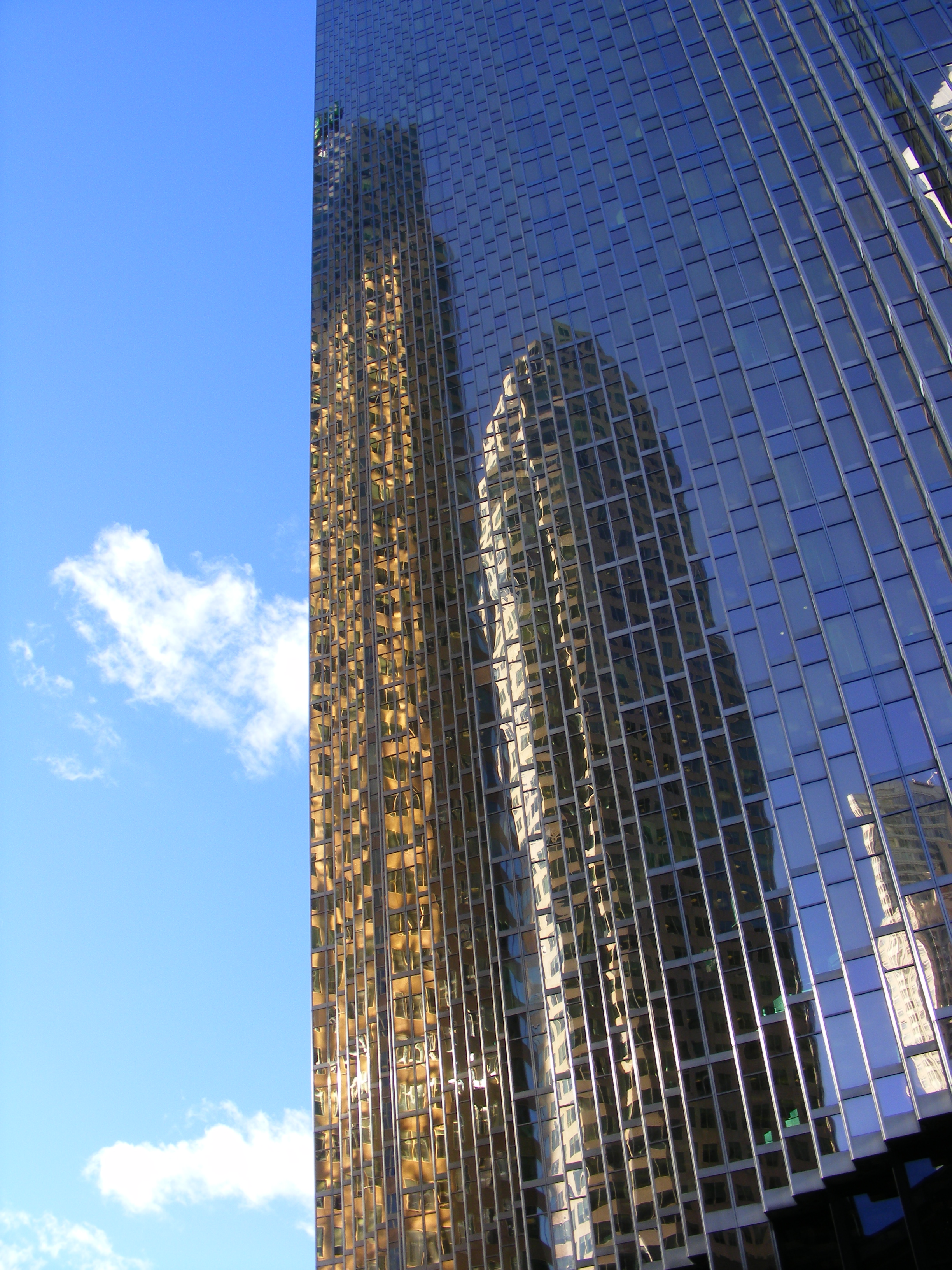
166 Royal Bank of Canada golden towers 13 October 2015The next day and we go down for our breakfast. Our friends from Buckland Brewer are also holidaying somewhere in Canada. That somewhere would be right here, in this hotel, on this day – what a coincidence. This morning we have a coach tour of the sights of Toronto. We set out on Yonge Street, which was entered into the Guinness Book of Records as being the longest street in the world at 1178 miles; it is however only 56km long but was mistakenly measured along with another street. We are taken through Brookfield Place, where an old office façade hides a modern covered shopping centre. This method of combining old and new is not uncommon in Toronto. Toronto has 11 miles of underground shops and restaurants, ideal for winter weather, which isn’t yet here. We look at the shiny golden towers of the Royal Bank of Canada towers, whose windows were impregnated with gold dust.

165 CN Tower 13 October 2015Toronto has a ‘tossed salad’ population; with 120 nations represented, yet retaining their own cultures. Apart from those of British, French and First Nation (the current politically correct term for native Americans) backgrounds, the Italians are the most numerous community. There is also a significant Chinese presence, due mainly to nineteenth century railway workers and those who came during the gold rush. We drive through the vibrant Chinatown.

Toronto itself is 222 years old so pre-dates confederation in 1867. There were about 200 First Nation villages along the northern shores of Lake Ontario and in 1615, Frenchman Etienne Brulé, a fur trader came to the area. In 1760 the British ousted the French in this region. In 1793, when American invasion was feared, Fort York was built to protect the harbour entrance and initially the new settlement was called York. Colonel Simcoe’s Queen’s Rangers manned the garrison here. Simcoe also relocated the capital of what was then Upper Canada, to York from the more vulnerable Niagara. The name became Toronto in 1834, which is a First Nation (Algonquin) word meaning ‘gathering place’; ‘Ontario’ translates as ‘shimmering waters’.

We spend some time in St Lawrence Market, with its glorious smells and many meat, cheese and other food stalls. Then it is off to the CN tower so some of us can climb up and stand on the glass ceiling, like I’m going to do that. Even the fact that said floor can support forty hippos (must have been tricky getting them in the elevator) won’t persuade me. We admire the 1800 foot tall tower with feet firmly on the ground. It was built as a telecommunications tower in 1976 at a cost of $65 million and was the tallest building in the world for many years. Next door is the Bluejays’ Skydome stadium. There are some needle games going on at the moment apparently. The pitch is large enough to land seven jumbo jets on – rather like the hippos thing – would you want to try? The playing surface is seven stories down.

We have decided to try to find Fort York. Not realising that we would have the chance to be dropped off at the CN tower, which is much nearer to the fort than the hotel, we are not wearing the best shoes for walking but it seems daft to go back to the hotel (nearly three miles away), change our shoes and walk all the way back again, so we head off in the vague direction of the fort. After a slight detour, we have to go under a fairly dodgy looking underpass and arrive at the fort. They are probably not best pleased that construction is playing havoc with the approach to the museum/historic site. We decided to come here as we’d heard that they were currently displaying one of the copies of the Magna Carta, dating from 1300, that is normally in Durham Cathedral. It does seem a bit incongruous to come across the Atlantic to view a British treasure but it is an interesting display and also on view is the lesser known ‘Forest Charter’.

Then on to the fort itself and an opportunity to get more good value artefacts that we can use in the world of Swords and Spindles, as long as we can fit them in our baggage. Although, after the fort’s initial establishment in 1793, fortifications were then concentrated on Kingston, further tensions led to the strengthening of Fort York in 1811. The fort played a significant part in the war of 1812, when, in 1813, the American troops tried to move into what is now Canada, greatly outnumbering those defending the fort. In an attempt to distract the Americans, the British, together with a few Canadian and First Nation soldiers, ignited the ammunition store, which also prevented the Americans getting their hands on the ammunition – some parallels here with the Battle of Torrington. In fact, one of Simcoe’s weapons was an outdated Cromwellian culverin There was a moving list of those who perished in the battle of Fort York in 1813, including a William Toogood, a drummer with the American troops, who must surely have Isle of Wight connections. The Americans were victorious and occupied the fort for six days, later burning it down. The fortifications were rebuilt by the British in 1814.

A long, uphill walk north and east back to the hotel, by which time we were really regretting not having more suitable footwear but still glad we chose to visit the fort. Food in the hotel again and Chris has elevated the ‘how much salad can you fit on a plate?’ game to the level of an Olympic sport and is probably heading for a world record.

Braunds United – Days 25-27

Heavy rain and high winds during the night did nothing to lessen my impending sense of doom as I anticipate our rush hour journey back to Toronto. Luckily the worst of the weather has abated by the time we leave the site but the trip along the 401 is not one I shall be aiming to repeat. Our van is returned on time and found to be satisfactory. There have been times when I seriously doubted that we would get thus far unscathed. We have travelled 6663km, across four provinces in 22 days and stayed on 14 different sites (returning to two sites twice), it would have been 15 if one of those on the itinerary hadn‘t been closed. We used approximately 1600 litres of fuel, which cost us around $1600 or £800 – eat your heart out UK drivers!

Then began the wait for our courtesy bus to the hotel. Our chauffeur is a lovely chap from Jamaica but I do rather wish he a) wouldn’t turn round when he talks to us and b) that he wouldn’t gesticulate frequently, with both hands off the wheel. Then over 300 emails of the past few days to deal with as we unpack at Best Western, our home for the next three days; three days in one place will seem like luxury.

By lunch time enthusiastic Braund reunion attendees are foregathering in the foyer of the Best Western, many of these are people that we have not met before but it is, as usual, like a gathering of old friends. Braund matters are discussed until we have little voice left and the evening is spent in Mickele’s Restaurant, which is next to the hotel. The staff are not a bit bothered by catering for 32 people, who all want different dishes and who want to pay in twos and threes.

156 Braund Reunion 10 October 2015The next day is spent in a very pleasant church room in Toronto, with 55 Braund family members exchanging news and views, finding themselves on family trees and discovering connections. There were mini reunions within the reunion, with cousins meeting up for the first time in many years. Everyone was full of excitement and enthusiasm, listening to presentations and learning more about our shared history. Then off to a local restaurant to do what Braunds do best – eat.

160 Black Creek Village 11 October 2015A chance to catch our breath the following morning and then a coach ride for our party to go to Black Creek Village. This is another pioneer village, the former land of the Stong family who had Germanic roots and settled here in 1816, having come, along with many others, from Pennsylvania. Those of German origin were, in general, more welcome than the English, as they had the farming skills that were required. Keeping a party of Braunds together is a little like juggling jelly and Black Creek Village, whilst very interesting, does not win an award for super organisation. After some free time wandering, we somehow get our unruly crew into two groups for a tour of the village. We see several historical interpretations including the weaver who is using large balls made up of thin strips of material as her weft. The 36 inch wide, linen warp threads have taken two days to string up and a seven metre length of cloth would take several days to produce. Ladies would bring in their balls of material for weaving. The weaver would keep a quarter to make things to sell on as payment and the remainder would be woven up and returned to the owner. We learn that the weather was much harsher in the early nineteenth century; so warm clothing was essential. Climate change, urban smog and the felling of trees have all made a difference.

Volunteers for dressing up are called for – how could the Mistress Agnes in me refuse? Next we visit the printer’s workshop and then the doctor’s residence. Another party have been celebrating a wedding. Here’s is a tip: if you are going to have your wedding at a pioneer village take some alternative footwear as stilettos are not a total success. When we planned this weekend it was scheduled for the date we happened to be in Toronto; we had no idea it was Canadian Thanksgiving. Our scheduling meant that twenty five Braunds, from three continents, had a traditional Thanksgiving dinner at Black Creek Village. The staff did seem to have been to some bizarre alternative school of waitressing, whose technique involves a lot of pointing at the customers and asking the same question several times but otherwise all was fine. Just because we hadn’t eaten enough, in the evening we went up the road from the hotel for yet more food. A wonderful weekend with lovely people and I think the North Americans will certainly be getting together again.

Port Hope and Cobourg – Day 24

We set off, heading east on the 401, to take a look at Port Hope, where Braund and other emigrants settled. The Archives is open from 1-5pm and we plan to look for that rare species a Canadian car park, so we can walk round the town first. As we drive past the Archives at 10am a sign reads ‘open’ so we take it at its word and enter. They seem surprised that we are surprised they are open and there is even room to park alongside. Maybe Port Hope Archives have their own time zone. Few records pre-confederation in 1867 but we do find some documents worth photocopying. Extracting ourselves from the parking space does involve some nifty reversing back on to the road but we manage. There is even a place to park by the harbour so we can view the town. We see some Canada geese and a large orange butterfly, which I later learn was a Monarch, that won’t stay still long enough to be photographed. The harbour-side is industrialised and dominated by a large Cameco plant, which is guarded by conspicuous security personnel. I am carrying a camera in preparation for photographing the site of William Braund’s house, which is nearby, so I am keen to keep a low profile and not be accused of spying. Chris decides to ask the security guard what goes on here – now they will think he is the distraction technique for my illicit photography. To make matters worse, it turns out that they produce uranium for a nuclear plant; my chances of arrest for industrial espionage soar.

152 Canada Geese 8 October 2015We walk up the hill through the ‘heritage town’ and find the Episcopalian Methodist Church, which was built in 1875. We also learn that the Prince of Wales, later Edward VII, visited in 1860, so some of my emigrants may have been part of the celebration. Returning to the harbour we see numerous dead salmon in the creek, presumably failing in their attempt to return upstream after spawning.

Next stop is Cobourg and another fail on the car park front. We eventually find a residential street where it seems possible to park without risking collision, parking infringement or the wrath of residents. We eat our final meal in the van and then head off for the library for me to talk about emigrants to the Lakeshore Genealogical Society. The organisers have been a little concerned by my unavoidable web silence over the last few days; they did not have a plan B. This is another very friendly group and in keeping with the other societies I’ve visited, they provide elaborate refreshments: soft drinks, fruit, cheese and crackers. Puts the UK’s cup of tea and a biscuit to shame. There is even a descendant of one of my case study families in the audience. As a prequal to this weekend’s Braund reunion, two of our members have come along to listen to tonight’s talk. Heavy rain begins as we head back to Darlington, on the last of our three journeys in the dark. It is a bit of a shame that we decided to take the final opportunity of washing clothes. It has been a glorious, hot sunny day until just before we reach the site in order to rescue our by then dampened clothes.

Parry Sound and Back to Darlington – Days 22 & 23

We have one of our longest days driving today to re-trace our route south on the 17 and 69. We have managed not to duplicate our journey very much so far but there really was no sensible option for this bit. In any case the road looks very different in this direction and it is noticeable that the trees have reddened since we came the other way on Saturday and Sunday. Pulling off for petrol resulted in a very pretty detour round a back street. I finally managed to locate a post office so I could pay a small fortune to send back the corrected proofs of ‘Remember Then’ – this had better be worth it and mean we get a pre-Christmas publication date. Today’s best town by-line was ‘Echo Falls – worth repeating’ – who thinks these up?

In theory the sat-nav knew exactly where this site was. Theories are all very well and the last couple of miles were undertaken without her aid. Just as we began to look for a place to make a U-turn, the site appeared. This is one of several Ontario Provincial Parks sites that we have used and is better patronised than some. The receptionists always ask if they can reveal our pitch number to guests enquiring about us – sadly I don’t think we are likely to have any visitors! Today I was also asked, not just for the license plate number of the van but where it was registered. How on earth do I know? She writes down Toronto, later we discover that it tells you on the plate and I should have said Alberta, oh well, can’t be far apart!

We have a lakeside pitch again and just to make us feel at home the train line is nearby, so we have the joys of hooting trains once more. Next to us is another Canadream van – we have not encountered many – driven by a couple from the Isle of Wight. We make the obligatory tour of the site to view Oastler Lake, which is very attractive. Today marks the half-way point of our trip.

144 Oastler Lake 6 October 2015While we have our breakfast we watch a red squirrel unearth nuts in our pitch’s fire pit and retreat to eat them. Good job we hadn’t lit a fire. We did wonder if this squirrel likes his nuts roasted! With the view of the lake in the background, the only thing that mars this site are the ever present trains, which hoot long, loud and repeatedly all through the night.

A little more step retracing as we head back to Darlington Provincial Park for our last two nights. Some rain for the early part of the journey does not detract from the trees that are now truly beautiful. We are going through Kawartha Lakes, allegedly because it will be a new road for us and also because the Jewell and Prouse families emigrated there from Buckland Brewer and Clovelly. Actually this route is primarily in order to avoid the centre of Toronto. Today’s is a comparatively short drive. Not as short as it should have been owning to a road closure. A sign helpfully said ‘Detour’ but there was no clue as to where the alternative route might be. Some deviations, hesitations and a U-turn later and we are back on track. We end up with nice views of Lake Simcoe that we might otherwise not have had.

We have another lovely lakeside pitch at Darlington Provincial Park. Inevitably there are still trains but not quite so close as they were last night at Parry Sound. On this stop at this site we have time for a walk through the park to McLaughlin Bay; here the squirrels we spot are black. The first European setters arrived in Darlington Township, via Port Darlington near Bowmanville, in 1794. Roger Conant, John Burk and John W Trull had answered the appeal for United Empire Loyalists to settle in the area that is now the park.

Chris has a bit of an incident with the shower curtain rail – there now isn’t one. I hasten to add that this was inadequate construction techniques and not his aggressive shower curtain pulling. Tomorrow is likely to be a busy day so we start to see how much we can cram back in to our suitcases. This seems to go worryingly well – what cupboards have we forgotten to empty?