Of Poetry, Pustules and Publicity

Well, now I have been reminded what going out to full-time work feels like. Phew – no housework has been done for a week and I was in a state of collapse most evenings (the ones when I wasn’t working that is). To be fair, that was partly due to the after effects of the accident. I am clearly not as recovered as I thought I was. It helped that we were working in a really lovely school with a staff who got involved to the extent of painting plague pustules on themselves, which got worse as the day wore on. Who else in their working day hears surreal comments such as, ‘how do my pustules look?’?

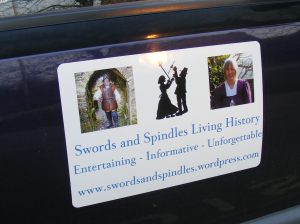
Car magnetA curious incident on our way to the school: we have to pick up a colleague in the van. Said colleague lives in a road where parking is at a premium so Chris parks the van a hundred yards up the road, where he is blocking someone’s drive and walks back to collect our colleague. I am skulking in the van, trying to keep a low profile but am being eyed very suspiciously by a couple who have just emerged from a house over the road. I am wondering if I can reach for a sword before they remonstrate with me for illegal parking and obstructing their neighbours’ drive. Chris returns and they are still staring. I had forgotten that we have our super advertising magnets affixed to the vehicle. It turns out that the people viewing our car with suspicion are Medieval re-enactors. We have a nice chat and exchange contact details before running the gauntlet of rush hour traffic.

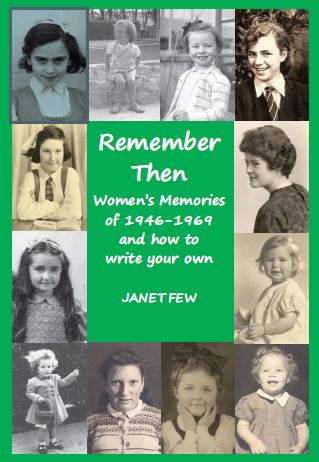
Reviews for Remember Then are starting  to appear and we were featured in The National Archives’ newsletter, raising us in the Amazon cultural books list to number 187 at one point. I am stupidly excited by this. Sales this week have necessitated my going to the town Post Office in seventeenth century clothing after our time in school. This is always fun, as reactions vary from politely ignoring the fact that I am strangely attired, to curiosity, to barely disguised mirth.

A very interesting members’ evening at Buckland Brewer History Group as usual with several members contributing short items of an historical nature. Local author Liz Shakespeare outlined some of the research she has been doing for her forthcoming book about the postman poet Edward Capern. He was known to compose poetry in a Buckland Brewer cottage whilst waiting to continue his round. Liz has done some painstaking research to try to identify this cottage, using clues from the poetry and it turns out that it was mine!


More about Books

Well, Happy New Year to the three people who are reading this. Actually, there may be a few more than three as I have just had two of my busiest days on this site, with over 500 visitors. This is probably because my lovely volunteers who helped me to compile my latest book of memories of the 1950s and 1960s  Remember Then have been busy advertising it. Sales are going very well and I have sustained a book related injury as a result so my back is now suffering. The good news is that those who have received their copies have said some lovely things about it. There are still quite a number of books in the spare bedroom – I have visitors in March. There is no room for them and the books! For this reason, I have been encouraging people to buy directly from me rather than via Amazon or the publisher. Despite this I did, one morning, rank in the top 300 on the cultural history books sales list on Amazon. If you have Christmas money to spend …….. Another book buying opportunity – if you have been saving up for Unlock the Past publications (including mine) My History are offering a 25% discount until 15 January.

This year’s list of lectures has already begun, with Mistress Agnes making a visit to a local WI to instruct the ladies on how a seventeenth century housewife should behave. I have a frantically busy week coming up with all five days in schools (I think it is 35 years since I did a full working week outside the home) AND four evening functions the same week – if there are more blogs after 22nd January – I survived. Several new eBay purchases have been made ready for the school visits, as we have three slightly different presentations to give, as well as our regular repertoire. Watch the Swords and Spindles site for details. Talking of eBay, don’t you just love it when eBay makes suggestions ‘especially for you’. What on earth in my buying or watching history might suggest that I would be interested in a Batman DVD or a Happy Santa toilet seat?

Also coming soon is my webinar for Ontario Genealogical Society – kindly advertised for me by John Reid of Anglo Celtic Connections. I am busy working with Pharos Tutors on two online courses for later in the year so stand by for more news on those. Mistress Agnes is appearing in an official capacity at Who Do You Think You Are? Live this year and I shall also be involved in a seminar and conference for the Guild of One-Name Studies, so no signs of a quiet life on the horizon.

Thank you to everyone who enquired about my recovery from the car accident. I am currently car-less and it still hurts to laugh, cough, sneeze or exert myself (good excuse to postpone the New Year exercise regime) but I’m getting there thank you. Ridiculous conversations with the insurance company abound.
An excerpt regarding my injury:
Insurance clerk with no medical training to me: ‘You have refused physiotherapy. You would have recovered more quickly if you had had physiotherapy.’
Me: ‘My doctor has not suggested physiotherapy. I do not yet have a replacement car. I am a 32 mile round trip from the nearest hospital, there are two buses a week. How do you suggest I get there?’

Books, Books and More Books

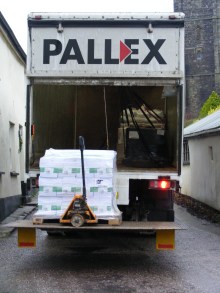
DSCF2455B-day arrives. The day that 1000 copies of Remember Then are supposed to descend on my doorstep. Well not actually on my doorstep but on a driveway near me. I am not supposed to lift much following the car accident so I have enlisted help. Unfortunately the help I have enlisted isn’t supposed to lift either! Ten out of ten to the delivery driver who finds my house without being misled by his sat-nav/enquiring at the local shop/phoning me in desperation/giving up and going home all of which have been resorted to in the past. I have been asked in advance if there are any narrow lanes to negotiate. I live in the middle of nowhere, of course there are narrow lanes.

DSCF2457The delivery lorry is quite large, it is rush hour, traffic is at a standstill ok, for traffic read one car and a tractor but at a standstill nonetheless. My pallet of books is duly deposited. Said pallet is the focus of attention for my assistant – it will be firewood by tomorrow. The books are shrink wrapped in packets of 16. That means an awful lot of packets, more indeed than we anticipated as it turns out that my 1000 copies is actually 1146. Weird number I know but that is how many there are. Living as I do in a very small cottage this poses somewhat of a problem. I have persuaded my trusty assistant that he must have a bed at home that needs supporting with several hundred books underneath. That still leaves a ridiculous amount for me. Far more than my already overflowing loft can cope with. I stow a few packets in the cupboard under the stairs. A few more (far too few) fit under the spare bed. The only option is to leave a not insignificant pile in the tiny spare bedroom. By my reckoning it will be two years before I get said spare bedroom back, to say nothing of the rest of my house and as for my assistant’s ……..

DSCF2460Fortunately my lovely ladies who contributed to the book and others have been ordering copies so some are already winging their way to new homes. One lady collects eight copies, now all I need is 100 more like her ……. In order for this winging to commence, books have to be wrapped and posted. A quirk of the Post Office’s pricing structure means that, although some people have ordered several copies, it is cheaper to post these singly. So my initial tranch of orders from twenty-five people needs to be fifty parcels. An industrial scale production line is set up on the kitchen table. I have been hording bubble wrap for this for ages. Resisting the temptation to spend the morning popping bubble wrap instead, we begin signing, wrapping and addressing books. Two rolls of brown paper and one roll of brown sticky tape later we have a pile of not very elegantly wrapped books. Brown sticky tape is second only to cling-film in the non-user friendly all-time list. Now to post. The mobile post van is outside my house. There is already a queue of eight people waiting in the rain. Anyone who ends up behind me in the queue will not be thrilled that I have fifty parcels, all of which need proof of posting. Aside from which the van only has another half-hour before it departs for its next stop, so it is off to the Post Office six miles away. Two circuits of the block are required before a parking place appears. Then half an hour to get the pile of books on their way. The poor assistant had to renew his printer roll to produce all the proof of posting slips. Good job we didn’t try the post van option.

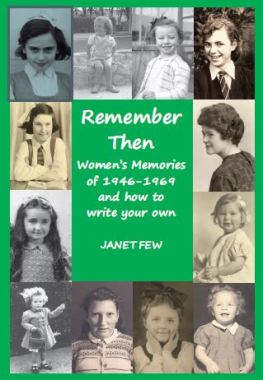
CoverSo in the interests of returning my home to some sort of normality/retaining my sanity orders are very welcome. If you remember the 1950s and 1960s you should enjoy reading it. I can say that as it isn’t really my work, although my name is on the cover, it is the work of my wonderful volunteers. Even if this period is distant history it is a fascinating insight into the recent past. If you have thoughts about writing your own memories, the book gives you guidance. Further details can be found here.

Christmas preparations, missing decorations, typos and a little about research

It was the end of November. I had been away for seven weeks but I had cleaned my many inherited brass ornaments, made my Christmas cake and pudding, written my Christmas cards and made chutney. How can this be? Do I never sleep? The truth is that I was without a functioning laptop for a week; hence the paucity of blog posts lately. The old one died of overheating, Basically, if it was turned on for more than ten minutes it turned itself off in order to cool down. I became adept at judging the crucial ‘save’ point before it died but any attempt at proper work was thwarted. I have been provided with an early Christmas present in the form of a new ‘industrial strength’ laptop. I did ask if I was required to save it for 25th. Strangely, the generous donor did not relish another month of associating with me whilst I was computerless.

Either I am turning into a grumpy old woman (I can hear my descendants muttering ‘turning?’) or I have been surrounded by an unusual level of incompetence lately. Firstly I was totally confused for a day and a half (easily done) by the fact that the new computer’s date was set for 24 hours ahead of real time. I couldn’t understand how I was receiving emails marked Yesterday that had clearly been sent today. Next I attended a local planning meeting where two architects, who looked about twelve, were defending the indefensible. They lost all credibility when I discovered three errors on their presentation boards within five seconds. I know it isn’t necessarily a word in everyday use but surely an architect, or at least their spell checker, should be able to spell vernacular? Then FindmyPast announce their latest indexes and appear to think that the 1600s are the fifteenth century. Not sure that inspires faith in the accuracy of their transcriptions.

Whilst on the subject of FindmyPast, I returned to the 1939 Register to try again to find my grandparents’ home at 159 Davidson Road. This time, I ploughed through all 600 properties in Davidson Road, arranged in random chunks of odds and evens but about 30 numbers were missing and somebody-or-other’s law dictated that this included number 159. After some very imaginative searching I discover that these properties had been listed with the address  ‘Davidson’ instead of ‘Davidson Road’. Why had I not been able to find my grandparents by name you ask? Well I had identified a possibility for granny – the middle initial had been wrongly transcribed, either by the enumerator or by FindmyPast (I still haven’t succumbed and parted with money) but I had dismissed this entry as she was not accompanied by Grandpa. Mystery solved – Grandpa’s birth year was incorrect by twenty years – sigh.

There have been various social events in the locality in the run up to the festive season, including a village quiz. I was enlisted on to a team who were, we later found out, identified as the pre-quiz favourites – we did in fact win but mainly due to a very lucky choice of round on which to play our joker. The trouble with being recruited on the history platform is that one is expected to know everything about the history of the whole world from yesterday back to the dawn of time – no chance. I failed spectacularly on UK Prime Ministers and the Wall Street Crash but my moment of glory came when required to name the Teenage Ninja Mutant Turtles!

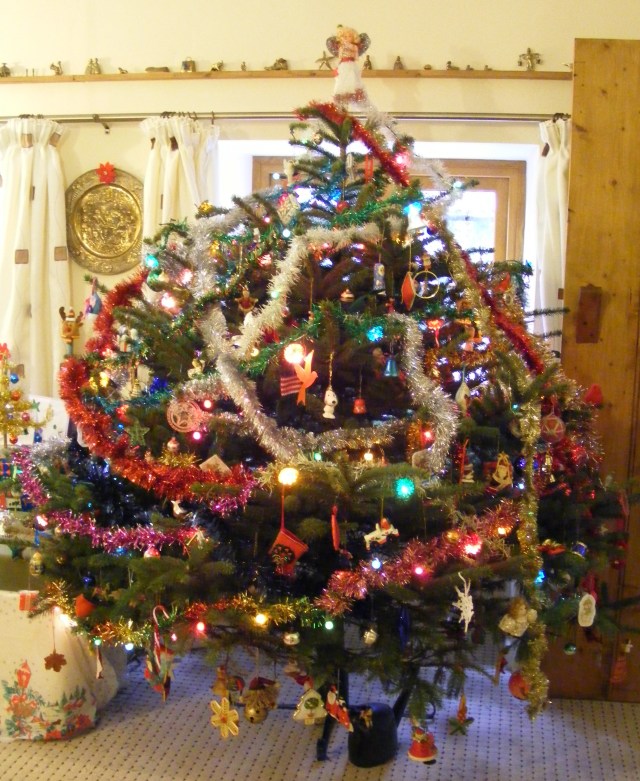
DSCF2453Then there was the saga of the decorations. Two years ago I blogged about my treasured historic Christmas decorations. Suitably large tree purchased I ventured up in the loft and brought down the decorations. Lights affixed I went to hang the most precious decorations first. Exasperated, I realised that I hadn‘t got that box, so I waited for assistance and returned to the loft again. They weren’t there! They had to be there. I knew exactly where they should be and in what box – a red and white box that had contained a turkey in the 1960s. With a sense of rising panic I ransacked all the boxes in loft. This is harder than it sounds as the height in my loft means you can’t stand upright and I am still recovering from the car accident so heaving a very large number of heavy boxes in a manner that would alarm ‘lifting and handling’ trainers was not desirable. Boxes heaved not once but twice and I am in despair/in tears/beginning to think I am losing the plot. Martha contemplates a 600 mile journey to help me look. I was disproportionately upset about what are after all just ‘things’ but I haven’t ever spent a Christmas without these decorations on my tree and they bring back many memories. I cannot understand where they can be. After all, half of my loft had been emptied and sorted this year and they should be in the other half – notwithstanding I check the other half as well. Surely they can’t possibly have been given to a charity shop during the clearing of the other half of the loft? Irrationally I search every cupboard in my house, places in which I know they cannot be. Equally, I know they are in the loft. Do I have Borrowers? Have I had burglars? I know, what self-respecting burglar is going to leave no trace and only steal a box of Christmas decorations?! I spend a sleepless night. Next morning, loft search take three. Eureka! There they are, ok the turkey box is in another box but this is a box I swear I have looked in three times already. In the same box was the stocking my mum made for me for my first Christmas and its twin that I made when I had a second child – I hadn’t realised these were also missing, so that was a trauma avoided!

If I don’t get a chance to blog again before the big day – have a lovely Christmas and I hope that 2016 will be a year of peace, tolerance and joy.

Remember Then: memories of 1946-1969 – a book for Christmas or shortly afterwards?

TCoverhis post was going to be the sad tale of the missing Christmas decorations and other stories but you will have to wait for that. I can finally announce that we might (and I stress might) have my new book available for Santa to bring to a home near yours – if you are in the UK at least.  Remember Then: women’s memories of 1946-1969 and how to write your own is almost ready but although I am hopeful, I am not in a position to 100% guarantee that it will be with you for Christmas. I have been told that it will be with me by 21st December at the latest (but publishers have known to be wrong!). This is the last date for posting before Christmas but means I will have to send first class if copies are to stand any chance of reaching you in time. The book is a collection of reminiscences that 80 lovely ladies helped me to compile and should bring back memories for anyone who grew up in post-war Britain. You can find more details of the publication by following the link above. Please email me on historyinterpreter@hotmail.co.uk for details of how to obtain copies.

Home to Historical Happenings, the 1939 Register and Other Matters

It has been a sobering and thought-provoking week both internationally and personally. Not only have world events put matters into perspective but on the way home from delivering a talk to Somerset and Dorset Family History Society (always amongst my favourite audiences) we were involved in a minor car crash. It was a total accident. Chris was driving my car round a bend at about 25mph on a quiet road between Crewkerne and Taunton. A very slippery surface meant that there we were, on the wrong side of the road with an oncoming car. Result: one very squashed car, five hours in A & E, some bruising for Chris and severe seat belt related bruising for me. Ironically, I spent most of the Canadian trip being convinced that we would have a car accident. We come home to a familiar type of road, slow speeds and not a manic driver in sight and that is where it all goes wrong. The ‘what ifs’ go through your mind. ‘What if we had decided to go home via Exeter instead of Taunton?’ – we debated this and I chose Taunton. ‘What if the other car had been going faster?’ etc. etc..

Now I am supposed to rest. Although many of my days are fairly sedentary (too sedentary) I really don’t do resting, whatever that is. I joke that it was not the ideal way for Chris to get out of listening to my Leonard Cohen CD on the way home and bemoan the fact that that my favourite CD and of course my car, are now in a car graveyard somewhere near Yeovil but of course these are insignificant material possessions and the important thing, for which I am very thankful, is that we and those in the other car, are unlikely to have any lasting ill effects. As I can’t travel very far in a car until I am less bruised, or stand up much, I have had to rearrange my diary for the next week or two. This means failing to go to work due to illness for only the second time in over 30 years. Chris is currently impersonating Mistress Agnes for one of several school bookings that have come in in the last few weeks. He is not, I should make clear, wearing Mistress Agnes’ clothing, merely fulfilling her role. Seventeenth century bookings have come in thick and fast in the last few weeks and we have been in some lovely schools.

Back to my ‘normal’ life. I have spent a few mad weeks catching up since our Canadian adventure, including of course visiting the small members of the family to find that they are now less small. I have several new research clients, which is always exciting, especially as one case fits the bill as a North Devon Bible Christian emigrant to add to my collection. In my absence, my article ‘The Impact of the Bible Christians in Rural North-West Devon: a force for unity or division?’ for The Devon Historian Volume 84 (2015) has appeared in print. Shauna Hicks has also blogged her recollections of the Baltic Cruise, with some lovely comment about our presentations. These have been added to my testimonials page and that of Swords and Spindles. What an honour to have impressed one of Australia’s leading family and local historians. Thank you Shauna, we enjoyed your presentations too and are so sorry that your cruise was marred by injury.

 I can’t ignore the recent release of the 1939 Register by FindmyPast, on behalf of The National Archives. So far, I am still waiting to be impressed, although, to be fair, I haven’t ventured to the part where you actually part with money. On the subject of money, I do understand that they need to recoup their costs but I feel that subscribers could have been given a better deal. We are, they claim, paying for, amongst other things, a multitude of contextual information that is being provided. Am I alone in feeling that this expensive hand-holding is unnecessary? Those who want context (and I hope most do) are surely capable of finding it for themselves and sadly many are merely name gatherers who won’t even bother to look at this.

With one place studies in mind, I am very disappointed in the place search. As yet I have totally failed to bring up a rural area. It may well be possible but it certainly isn’t intuitive. I did find my grandparents’ road as part of an attempt to work out what they had been mis-transcribed as (surely you can’t do much wrong with Smith?). Unfortunately the road, which I did find, had over 600 houses and they were not in full numerical order. Odds and evens I could cope with but these were in chunks of random odds and evens and I lost the will to look through 25 pages to find number 159.

As for the 98.5% transcription accuracy claim, I think my family must all be in the other 1.5%. Out of ten searches only two were apparently problem free. Three were not found at all, despite imaginative searching, one of these was probably due to a recent death. One forename was mis-transcribed and the birth year was incorrect (although that may not be transcriber error), two had no middle initial but may not have provided one, one of these also had an incorrect birth year. Two are almost certainly redacted entries but both have very unusual names and died in the district in which they were born before the key year of 1991. In any case, one was born before 1915 as well. None of those who I located could be found by searching under their date of birth – I have the birth certificates – they can’t all be wrong. So, so far then, ‘could do better’. Now thoughts are turning to the Christmas, season. Do check out my friend’s wonderful cards. Some people are so creative and talented.

Bears in the Mist Days 42-44 (15-17)

391 Capilano Suspension Bridge 26 October 2015We are recovering from watching Dancing with the Stars last night. This is a more raucous version of Strictly Come Dancing with less obvious dancing and way more advertisements. Today we are off on a tour of the North Shore of Vancouver with minibus driver/guide Rob, another driver who displays some signs of the ‘no hands on the wheel’ Canadian driving style. This is a personalised tour for just six of us. We drive through Vancouver’s North Shore Rainforest to Capilano Fish Hatchery, to take a stroll through the forest and watch the salmon. The hatchery was created following the building of the Cleveland Dam, which interfered with salmon returning to their spawning grounds. The hatchery now releases 1 million salmon, of various types, a year. It was fascinating to see large saplings that had rooted in the decaying stumps of other trees. Next it was off to the suspension bridge, which was built so someone could access their house but is now a tourist attraction. This activity is described as ‘adrenaline pumping’ and involves walking across a 450 foot wobbly bridge 230 foot off the ground. I hate heights – did I say that before? Why am I doing this? In the end I accomplish the challenge by dint of walking very fast and looking straight ahead. Fortunately, as Canada is already virtually closed for the winter, there aren’t too many people about, thus reducing the wobble factor. Then as if this isn’t enough I traverse twenty mini suspension bridges in the tree top walk. This was actually more difficult. There is a quiz available for children, Never one to refuse a challenge, I am able to persuade the person dishing these out that our party can participate. I thought it was a bit mean that we only rated one reward badge between us on completion. I did draw the line and pass on the cliff walk. This walkway can allegedly take the weight of 35 killer whales. I remain to be convinced that someone has actually tried this. We see a Douglas Fir that is 1300 years old, 20 feet in circumference and 205 feet high.

DSCF2414Then a gondola ride up a very misty grouse mountain. The ‘panoramic’ views of Vancouver were somewhat compromised by the weather but at the top were at last bears. Ok, so they were captive bears but their enclosure covers five acres so we still might have missed them but they were both visible through the drizzle. Grinder and Coola, the grizzly bears were orphans who were rescued about fourteen years ago. Having seen them from behind the safety of a wire fence maybe I am glad we didn’t encounter any whilst out for a stroll.

Our guide takes as back Downtown (all the city centres are referred to as ‘Downtown wherever’) via the expensive British Properties. Many Canadians like to surround their homes by trees. These are often so close to the building that they must block out almost all the sunlight.

Back at the hotel, I attempt to avoid the not sitting together issue of our internal flight by cunningly checking on online. This sort of works except that I press the button for a web based boarding pass instead of having it emailed to me. I have no way of printing this. Front desk are very helpful but unable/unwilling to link my lap top to their printer. I can’t email this to them for them to print as it is not an email. I try turning it in to a pdf but the vital part comes out blank. I try retrieving the web page on the guest computer – fail. I therefore have to keep the web page open and lap top charged until I arrive at the airport. Then there are issues with the room’s fridge. Most of our rooms have had full sized fridges. This one turns out to be more of a freezer. Don’t freeze bananas – ever – just don’t.

We check out in the morning. I carefully put my room ‘key’ (card) down while I check the bathroom. I return to find it missing. Despite turning the room upside down – still missing. We brave this out by handing just one key card in and seem to get away with this. Then luggage stowed on our coach we are on a walking ‘foodie’ tour of the food carts of downtown Van. Roughly translated as a tour of the street vendors of central Vancouver, of which there are over 200. Fortunately for our legs and stomachs we only visit four. To get a coveted license you need to show that you can offer something different, so there are some weird and wonderful concoctions on offer. When carts were first allowed for the Olympics, seventeen licenses were on offer and 800 applications were received. Most carts are not allowed to open near to a restaurant selling similar food and only a few are open in the evening.

This is not something we would choose to do if it weren’t part of the package but we jump at the chance of free food and are game for pretty much anything, unlike several of our fellow travellers. Our guide keeps shouting ‘come on foodies’, which most of us clearly are not. Our first stop is ‘Japadog’, who offer us hotdogs with seaweed. This tastes pretty much like you’d imagine and the seaweed looked (and tasted) more like fish skin. The flavour has an unwelcome persistence. The high refusal rate benefited the nearby rough sleepers, who were given the portions that our party rejected. Next was a green onion pancake, followed by an exotic naan bread something or other. Finally a chocolate chilli cookie.

Then to the airport to leave our driver Mike and guide Anne-Marie. I attempt to wave my lap top at check-in but they are uninterested and our passes are printed. Chris has problems at security with a flat, credit card sized spanner in his wallet, that has escaped the scanners of all the other security desks we have passed. We then have a four hour wait. Vancouver is a very pleasant, uncrowned airport and we chat to those who have been on the tour with us. I decide to use up our small change and have a coffee. All I wanted was an ordinary black coffee but I lacked the sophistication to know which of the many options on offer would result in my ending up with what I desired. Inevitably I choose wrong and end up with an egg cup full if something totally undrinkable. I am persuaded, with the support of one of my new friends, to take this back and ask for it in a larger cup topped up with boiling water, which is a slight improvement.

The flight is quite empty so we have plenty of space. Despite our bodies thinking it is night time, I do not manage to sleep, as usual. We land at mid-day UK time, or 4.00am to us. We rush though corridors, lifts and travelators and manage to arrive at Heathrow coach station with ten minutes to spare in order to catch the earlier coach to the one we have booked. The downside to this is that we have to pay £40 to change our booking, The thought of being in Devon four hours earlier is too much for us and we succumb. There is no time to get food or drink or use the facilities. Well, actually there was, as the earlier coach was late but we didn’t know this at the time. Never mind we think, we can get food when we stop. Unfortunately, as the coach is running late we are not allowed to alight at any stop, except our final destination. In the event this was still a good decision as the coach we were actually booked on ended up being an hour and a half late, so it would have been gone midnight before I got home. We go back to Chris’ to get the car and find that our friends have cooked a meal we can share – hurrah. Then it is home at last ZZZZZzzzzz

Normal service will resume shortly.

Parks and Gardens – Days 40 & 41 (13 & 14)

342 Butchart Gardens, Victoria 24 October 2015The sun has deserted us today but we are off to visit the truly beautiful Butchart Gardens, which were constructed in a former limestone quarry over 100 years ago. The colours are just unreal. Today we do see some wildlife, in the form of black-tailed deer and later seals. After the visit to the gardens, we walk round the harbour seeing the ‘Fisherman’s Wharves’, where there are houseboats and food stalls as well as commercial fishing boats. Some of our fellow travellers are whale watching but we have passed on this activity. Given our lack of success with wildlife, they are probably glad that we have decided not to jinx this tour for them. We later learn that a party of British whale watchers lost their lives on this coast the following day.

Then we take the coastal route to the ferry and even in a land full of trees, we are amazed at the amount of unclaimed driftwood. Chris is working out how he can get it home for the wood-burner. There are some very prestigious homes on this part of Vancouver Island. We eat on the ferry again and are impressed with the efficient way that they cope with all the food orders. Compared to Victoria, which is sheltered by the mountains, Vancouver’s climate is very wet but we have a fine day for our visit. Vancouver is Canada’s third largest city after Toronto and Montreal, with 2.3 million people living in Greater Vancouver, the majority of whom are of oriental descent. There are a large number of rough sleepers in the city because of the warmer climate.

The first European who is known to have set foot in Western Canada is Francis Drake, who landed on the west coast of Vancouver Island in the sixteenth century. Two hundred years later he was followed by Captain Cook who was accompanied by George Vancouver, a man of Dutch descent who was appointed to survey the coast of what became Vancouver Island. The city of Vancouver is surrounded on three sides by water. We visit the vibrant Granville Island Market on the waterfront, with its many bright, evocative-smelling food stalls. We see the Winter Olympic Village and the Stadium as well as yet another Chinatown. An area of the city is called Gastown after ‘Gassy’ Jack Deighton who opened a bar in the area and was famed for chatting or ‘gassing’. We are just in time to see the ‘steam clock’ letting off steam for the quarter hour and we pass the convention centres to reach Stanley Park. Stanley Park is 1½ times the size of New York’s Central Park and is beautiful. There are some impressive First Nations’ Totem Poles, which are basically family trees that you read from the bottom upwards, as the most significant symbol is at the bottom. They are traditionally carved from Western Red Cedar, known as ‘the tree of life’ because of its many uses. We also see raccoons (briefly) and plenty of Canada geese. The raccoons have become a problem as some are carrying rabies. Finally a photo stop at Lion Gate Bridge, which we shall be crossing tomorrow and then it is off to our final hotel of the trip.

In Search of Ogopogo – Days 38 & 39 (11 & 12)

We get a lie-in today so it is a bit of a shame that I wake up at 4am and can’t get back to sleep again. I make use of the hotel swimming pool, which bizarrely necessitates walking through the breakfasting guests in order to gain access. We are driven down to Kelowna waterfront, on the shores of Lake Okanagan, which is beautiful. Kelowna, meaning grizzly bear, is the largest town in the Okanagan region and has the drawback of having a very high fire risk, with frequent evacuations being needed. We view the town and lake from the vantage point of Knox Mountain. Once again our coach boldly goes forth in uncharted areas. We are informed that we are safe to drive up a narrowing roadway as school buses have been observed taking this path up the mountain. No one has reported any coming back down again, which is more worrying. Signs say that active bears have been sighted in this area. At this point I would settle for inactive bears. We see no bears.

Lake Okanagan is reputedly home to the Ogopogo, or as the First Nations call it Nhaatik. This is similar to the Loch Ness monster and some believe that channels link the two lakes. We see no Ogopogo, so are unable to claim the $2 million reward for its discovery. It is another beautiful day and the thermometer on a waterfront building is reading 24 degrees. That may be an exaggeration but it is certainly warm and the TV news later tells us that it was the warmest Canadian September for over a century. It is a beautiful area and timber is being soaked in the harbour to stop it splitting, We also see seaplanes. A wit on a bike thinks Chris is Santa Claus and assures him that he has been good this year. I suppose this might have been vaguely amusing if the bike rider had been five rather than fifty.

335 Lake Okanagan 22 October 2015We visit Summerhill Pyramid winery for a tour. The vineyard is totally organic; corks barrels and cleaning methods all have to be chemical free, so all cleaning is by steam only. The non-wine this time is a rather sweet, cloying grape juice. All wine spends at least a month being stored in the pyramid. This is a one eighth replica of the pyramid at Giza and allegedly has beneficial effects on the wine because it is a sacred geometrical chamber and harnesses special energy. Chris agreed that it felt cold and I was finding it hard to breathe inside but I think the spiritual energy largely passed us by. Nonetheless the setting of the vineyard is spectacular. We eat in the pub attached to the hotel. Like other similar venues, this involves watching sport, or indeed a choice of various sports, on the numerous large screens in the bar.

The following day, we cross the Okanagan Bridge, which was formerly a floating bridge. Today the temperature is 5 degrees, so a bit of a change from yesterday but it is still sunny. We see evidence of previous forest fires and here evacuation is mandatory in times of danger. As we travel west across a mountain highway there are warnings about the necessity for snow chains and winter tyres as we pass ‘chain up’ areas.

In these logging regions two trees have to be planted for every one that is harvested. An experienced planter can plant 2000 trees a day, for which they earn 50 cents per tree. There are problems with the mountain pine beetle damaging trees. The warmer climate means that the beetle is no longer being killed off during winter. The trees that are attacked have a bluish tinge to their wood. This is still being harvested as ‘denim pine’ and its popularity makes it expensive. There are also a quarter of a million head of cattle in this area. We do see cattle. Most round-ups are now done by helicopter rather than cowboys.

Our first stop is in Merritt, in Nicola Valley. This is famous for its saw mills, rodeo and country and western ‘walk of stars’. Today’s ailment is an infected eye, product no doubt of air-conditioning overkill but drops are available at a local shop. From here it is on to Hope, where several roads are named for Shakespearean characters. Hope is the chain-saw capital of the world. An annual chain-saw carving competition is held and there are many carvings in the streets. The town was also the setting for a Rambo film, which was on TV last night. We follow Highway 1 from Hope, alongside the Fraser River, named for fur trader Simon Fraser. This is salmon fishing territory. Salmon lay 4000 eggs at a time, of which only two are likely to make it back to the spawning site.

Only 4% of British Columbia is suitable for agriculture and most of the land is in the Fraser Valley. Nonetheless BC can feed 65% of its population. We see the enormous Thornton Railyard, the third largest in North America, which handles 4000 items of freight per day. We take the ferry across the Straits of Georgia to Vancouver Island, consuming burgers and very nice real chips (none of this French fries rubbish) on board. Strangely these ferries open their doors before docking – scary. Vancouver Island is the size of England, much of it is inaccessible by road and the population is only 750,000, half of whom live in the city of Victoria, the capital of BC and our destination. We are on the Saanich Peninsula, where Fort Victoria was built in 1843. The Hudson Bay Company erected this fort to stop incursions from US traders. Early settlers were the English middle classes, who brought English customs, such as gardens and tea drinking. There is gig-racing taking place on the Elk and Beaver Lakes, reminding us of home.

Mining, logging, shipbuilding, whaling were the original industries but the area was disadvantaged because the Canadian Pacific Railway stopped short of Vancouver Island, now most employment is in the administration and tourism sectors. The climate makes it popular place to live and Victoria is home to many rich retirees, with consequent impact on property prices. Going northwards on Vancouver Island is referred to as going ‘up island’ but we are staying in the south. Victoria’s Chinatown was the first in Canada. We see many totem poles in Thunderbird Park. Here we are in the ‘Pacific Rim of Fire’ earthquake zone and we are urged not to exceed the maximum numbers in the lifts. It is unclear how this might cause an earthquake.

In Search of Bears – Days 36 & 37 (9 &10)

It is glorious autumn weather with clear blue skies as we set off for Lake Louise, keeping a sharp eye out for the bears that we hope to see. This morning, Canadians have woken up to a landslide victory by new prime minister liberal Justin Trudeau, son of Pierre. Our first wildlife spot is a deer trotting across Safeways’ car park. We drive along the scenic Bow Valley Parkway. The Vermilion Lakes are a valuable wetland habitat for migratory birds. Moose also like wetlands and can dive up to five metres in search of their preferred food, aquatic plants. We see no moose. Most of the trees are lodge pole pines, which will only regenerate at temperatures of 45 degrees C, hence the need for controlled burning. We see elk damage to the aspen trees, whose bark has been stripped. We see no elk.

The road we are travelling on was built by Ukranian internees after the First World War. The grain trains often have spills that attract animals. These are meant to be cleared to stop wildlife getting killed but bears are still often spotted by the railway tracks. We see no bears. We pass the Valley of the 10 Peaks and Morant’s Curve on our way to the village of Lake Louise, the highest permanent settlement in Canada and location for Doctor Zhivago. Lake Louise was named for Queen Victoria’s daughter who was married to the then Governor General of Canada, the Marquis of Lorne. The Lake itself is glacier fed and is frozen for eight months of the year as the surrounding mountains block out the sun. We walk round the lake and notice a significant drop in temperature as we move beyond the sun’s reach. I am still feeling a bit wobbly so it is a very gentle stroll. We see squirrels and birds (unidentified). We see no bears. Another coach party are all sporting natty orange scarves. We enquire why our group have not been similarly garbed.

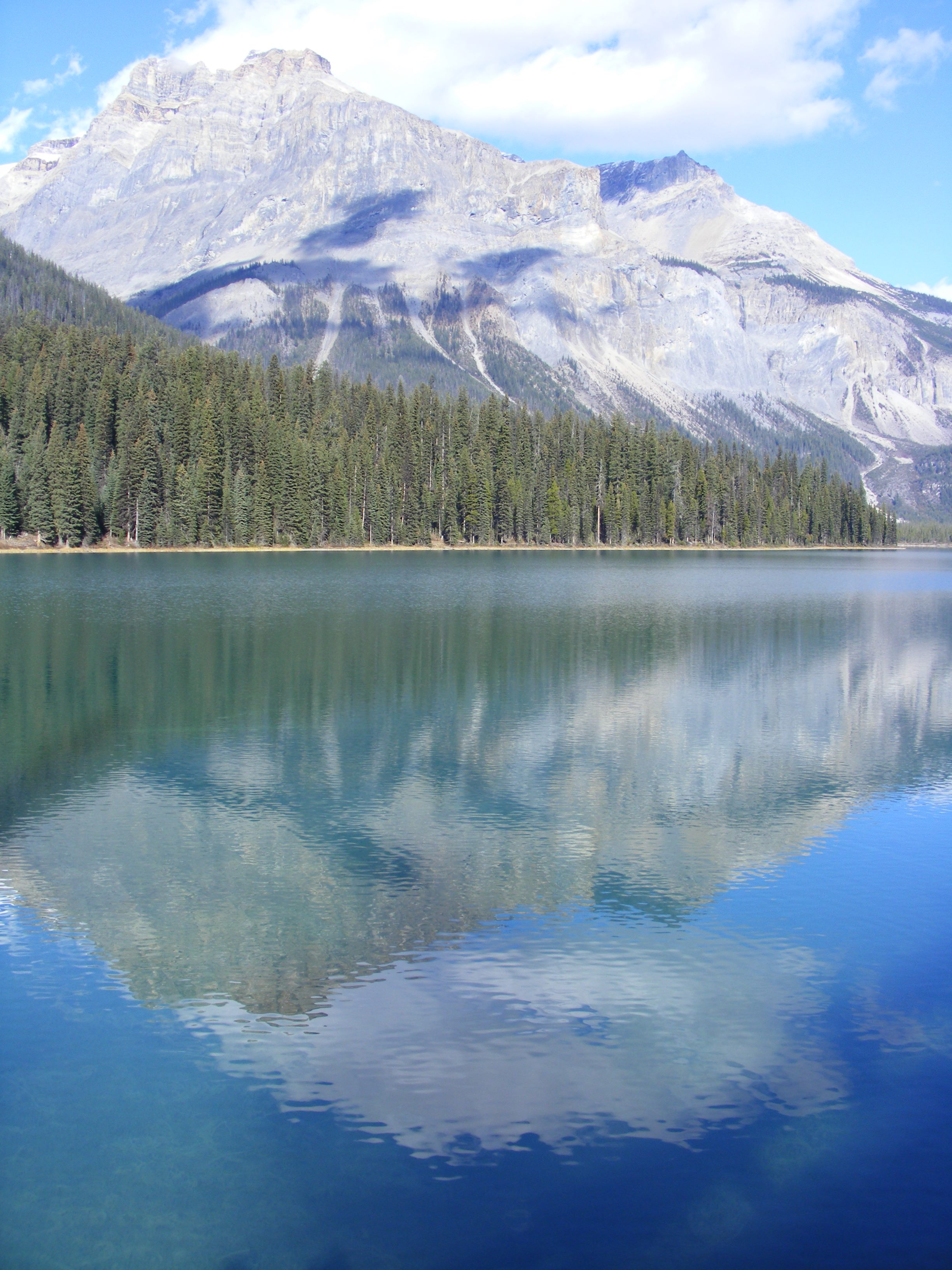
316 Emerald Lake 20 October 2015At some point in our day we photograph Emerald Lake, with its wonderful reflections. The Bow River flows west to east, as do all rivers east of the continental divide. We cross the divide into British Columbia; on this side the rivers flow into the Pacific instead. We see Mount Hector, nicknamed Mount Snoopy because of its appearance. Other points of interest are the spiral tunnels, which enable the Canadian Pacific Railway to cope with a 106 foot level change without exceeding an acceptable gradient. Completed in 1907, the tunnels took 1000 men 75 car loads of dynamite and twenty months to build. That sounds like the basis for a maths problem. We also see the overpasses and tunnels that have been created along migratory paths; these have reduced animal fatalities by 99%. Our final stop of the day was at Natural Bridge, a bridge-like rock formation over Kicking Horse River. I am more than ready to lie down and hope I feel better for what is to be a long day tomorrow. We see no bears.

The next day my ailments have ‘resolved’ themselves into an excruciating backache, which I do my best to ignore. We are leaving the Rockies now and retrace some of our steps from yesterday, through the Yoho National Park (yoho means awesome, we have learnt and it is well named). The Bow River has been abandoned in favour of Kicking Horse River. Between 1857 and 1860 the Palliser Expedition, surveying modern day Western Canada and the US, included Dr James Hector. He was kicked by horse at what is now Kicking Horse Pass and it was only discovered that he was still alive when he was being lowered into his grave. This route was adopted by the Canadian Pacific Railway and we see the spiral tunnels again but as yesterday, they are devoid of trains. More wildlife fails as we see no big horned sheep, which normally frequent this area and we still see no bears.

We pick up the course of the Columbia River, which is 1200 miles long. There is low lying cloud as we pass through the Rocky Mountain Trench that separates the Rockies from the Columbia mountains. The trench is one of the earth’s features that is visible from outer space. There were plans to flood a vast area here in order to supply water to the western US but project ‘big bath tub’ was abandoned because of fears that the ecology and weather would be irretrievably altered.

Wolves were hunted to extinction in the 1940s but were reintroduced into this area; we see no wolves. Beaver are also found here. At up to a metre long, including their tails, they are North America’s largest rodent. A beaver will use two hundred deciduous trees a year. We see no beaver. Next we are in the Glacier National Park, which contains about 400 glaciers and we are crossing the Rogers’ Pass, discovered by Albert Bowman ‘Hells Bells’ Rogers in 1882. Rogers was given a $5000 reward by Canadian Pacific for discovering the route but he framed the cheque instead of cashing it. The road is protected from avalanches by tunnel-like ‘snow sheds’, as the area gets 50-60 foot of snow each year. The army used to use howitzers to shoot down imminent avalanches but now explosives are dropped by helicopters.

We stop for lunch in Mount Revelstoke National Park. We are consuming sandwiches purchased at our previous stop. We are told that grizzly and black bears are found here. Grizzly bears have more of a hump and different shaped faces but black bears aren’t exclusively black. We see no bears of either variety. Next stop is the point at which the final spike of the Canadian Pacific Railway, joining the east and west coasts, was driven in. Most of the line was built from east to west but the westernmost section was sub-contracted so the final joining spike was here at Craigellachie in 1885. The railway runs for nearly 3000 miles, with bridges over more than 1000 streams. We hear the story of Lady Agnes, wife of Sir John A MacDonald, who strapped herself to a seat attached to the cowcatcher for some of the journey when travelling on the newly opened Canadian Pacific coast to coast railroad. The Trans Canadian Highway was completed in 1962.

328 Ice creams at Swan Lake 21 October 2015At Grindrod we see a house decorated all over with hub-caps – each to their own. The first Europeans in the area we are now entering, like many others, were fur traders, followed by gold seekers. The favourable agricultural conditions encouraged permanent settlement. The 100 mile long Okanagan Valley is another fruit and vine growing region. There are random large piles of sawdust everywhere. We stop at Swan Lake for refreshments and plan to have ice-creams. Fortunately we were not first in the queue. Our fellow travellers have opted for double cones; they really should not have done that. It is going to take us a considerable while to get outside our ‘single’ scoop cones, which each have five scoops of ice cream piled precariously upon them. The final photo stop is at Kalamalka Lake – the lake of many colours. We see no bears.

We have carelessly lost another hour on our journey and I am trying to catch up with what has been happening at home. I am excited to find the corrected proofs and cover of Remember Then in my inbox as well as yet more Swords and Spindles booking enquiries. For the first time, we have a ‘reception’ at our hotel and cookies and drinks are awaiting our arrival. Not wanting to pass up the chance of free refreshment we partake – having first sniffed the fruit juice suspiciously. It looked like tomato juice, which is not a favourite but was actually mango.