Harnessing the Facebook Generation: ideas for involving young people in family history and heritage and other news

Busy, busy, busy. What with the job I must not mention, now almost completed and Swording and Spindling like mad it has all been very hectic. It is especially satisfying to have spent five days in schools in the last fortnight and to have been so well received by staff and students (they all asked us back next year – what more could we ask for?). In the same fortnight, two talks for adults as well, so much for ‘retirement’.

TDSCF3191hings have taken a bit of an Australian turn lately. I spoke to the Society of Australian Genealogists about causes of death. Sadly this was not an all expenses paid trip; my presence was merely virtual. In addition, the Australian company Unlock the Past have published another of my booklets Harnessing the Facebook Generation: ideas for involving young people in family history and heritage, something I feel very strongly about. It can be purchased from the publishers.  It is also available as an ebook and it should soon be on sale in print form from UK and Canadian outlets. It is always exciting to hold the actual copies in your hand, even though you know what is inside! Australia are going to have their own Family History Expo in October; the down under equivalent of RootsTech or Who Do You Think You Are? Live. Unfortunately I won’t be going but if you are in the right hemisphere, do give it some thought.

I have also been ‘Racing’ for Life in aid of Cancer Research. Despite the temperature suddenly soaring to 10 degrees above anything I had encountered so far in what has laughingly passed for our summer, I survived. I was under strict instructions not to ‘race’; really difficult when you are as competitive as I am. So no trying to come in under 40 minutes as I usually do. Still I did get round the 5km in under three-quarters of an hour, so I guess I just have to grow old gracefully and be content with that. There is still time to sponsor me.

#EUref A Historian’s Perspective

I am making a once in a lifetime exception to my self-imposed embargo on blogging about politics or religion, on a day that I feel may be marked by the historians of the future as a memorable day. Undoubtedly today is a watershed, perhaps a watershed on the scale of the Norman Conquest, Henry VIII’s capricious decision to divorce Anne Boleyn, or the loss of America as a colony. You are probably aware that these were not events that resulted in peace, prosperity and religious freedom for all. Whether today will be memorable for good or ill remains to be seen. In a recent Facebook post, I referred to one of the historical quotations that adorn the headers and footers of my website. Now I would like to draw your attention to the one at the top of the home page, George Santayana’s ‘Those who cannot remember the past are condemned to fulfil it’. Time will tell quite what we have condemned ourselves to fulfil in the wake of the whole referendum debacle. I am not writing this as a passionate advocate or adherent of either ‘Remain’ or ‘Leave’. To be so would be to ignore the all too apparent flaws in one scenario or the advantages of the other. As the campaigns lurched uncertainly into action I sat firmly on the fence. I tried, I really tried, to balance emotional gut reaction with economic reality. Both sides bombarded us with rhetoric, invective and contradictory information. As a historian, I am all too aware of propaganda and spin and we had both in good measure. My working life requires seeking evidence, verifying sources but it seemed that, for much of the information, there was none. It all boiled down to a frying pan – fire decision. The EU is clearly restrictive and broken but the isolationist alternative was fraught with uncertainty and bigotry.

I am actually not so concerned about the outcome of the vote, hardly the overwhelming endorsement some would have us believe. In the end, after much thought, the ‘winner’ wasn’t actually the outcome that attracted my X in the box but that is largely immaterial; I could see pros and cons to both options. My fear, concern and profound sadness today is because the campaign has been accompanied by so much intolerance, bigotry and downright hatred. No one, on either side of this deeply divisive debate, can feel that the run up to what some are terming ‘Independence Day’ has been anything but dirty. The prejudice and fanaticism has been fueled and proliferated by that double-edged sword, social media. Even people I believed to be perceptive have seemed to accept what was clearly errant nonsense as the inveterate truth.

I can respect anyone who cast their vote, in either direction, following thought and deliberation. Sadly many have voted on the basis of scaremongering, or have made their choice because of the alleged charisma of the leading advocates of one cause or the dislike of those fronting the other. Unsupported statements have been hurled by both sides, things got personal, childish, ridiculous. Where was the evidence? The convincing data? Twentieth century political history has never been my favourite period but it doesn’t take an historian to draw the parallels that have already been drawn with the blinkered adulation of Herr Hitler, who was hailed as the saviour of post world war I Germany. He was going to make Germany great. It seemed such a good idea at the time. Now are we heading for our own hate-fuelled Kristallnacht or have the ultra right-wing, who tarnished others who believed ‘Leave’ was the right option, been placated by today’s result? If so, for how long?

I can’t help feeling that those claim that Brexit is the solution to all our problems are being blinded by euphoria. Leave or Remain – either route would have been beset with uncertainty, faction and the need for hard work and compromise. The divisions in our country have become a chasm and it is far from being over yet. There is a mutual back-patting amongst those in the Leave camp and talk of ‘getting our country back’. Beware of what you wish for. We have not ‘got back’ the country of the halcyon pre EU days. Days which lie largely in the imagination. The country we have ‘got back’ is a shadow of its former self; diminished by what will inevitably and understandably be the defection of Scotland. A country fractured by the attitude that those of different opinions, cultures and faiths are somehow of less value. A country where distorted stereotypes are applied to those of a particular ethnicity, belief or sexuality. A country where political hatred sees the murder of a woman who was working for what she believed to be the greater good. A country that seems to have forgotten the concepts of compassion, of compromise, of caring. As for one gloating Leave activist who commented that we had won the country back without a shot being fired, insensitively ignoring Jo Cox’s murder, in one respect he is right, a war has been created. War is never pretty, there are no winners and we can only speculate on who will be the casualties that Brexit and the aftermath will leave in its wake.

If the new Britain, for it will be many decades before it can become Great, is to work it will need every iota of forgiveness and fortitude that we can muster. We will have to learn to accept others who are outside our comfy ‘exactly like us’ sphere and learn to work in harmony. We need to stop moaning about what is wrong and strive to put it right. America is no longer the land of the free, Britannia has long since ceased to rule the waves. World events of the past weeks are destroying people’s faith in humanity. However much you wanted to leave the EU, this is not a time for unadulterated elation. When cloud nine bursts it will become clear that we are embarking on a hazardous journey without sat-nav, survival kit and for some, without a moral compass. We may have done the right thing, this may be an unremitting disaster, while it all unravels and it become clear which of those alternatives is the actuality, the UK needs the healing balm of kindness, understanding and forbearance.

Rant over. If anything is ever normal again normal service will resume shortly.

The Land of the Hoggs, more Ornithological Ramblings and Sunshine!

We have chosen today to drive through the striking Northumbrian countryside to one of my favourite places on earth. The visibility isn’t bad and it isn’t raining, this must count as summer. We drive along the back roads with the Cheviots as a backdrop but the Otterburn Ranges are being just that, shooting ranges, so, not wanting to be shot, we skirt the Northumberland National Park. A note for my Australian readers, unlike Australia, who seem to call any public open space a National Park, in the UK it has to be something seriously special to be awarded that status. This area is spectacular and Northumberland has to be one of the most beautiful counties if you like wide open expanses and a raw kind of beauty and I do. You will not find comfy chocolate-box scenery here but skies stretch forever and the sheep on the rocky outcrops are looking decidedly dishevelled in the period between lambing and shearing. I sometimes wonder if there is some weird genetic memory at work that attracts me to certain places. My great grandfather, John Hogg and his ancestors came from these wild outlying hillsides between Hadrian’s Wall and the Scottish border, before moving in to Morpeth.

443 Thockrington 2 June 2016We are heading for Thockrington where the Hogg family lived in the eighteenth century. I am 99% certain that my great great grandfather was baptised here. The grain of doubt comes from the fact that gg grandfather changed his age and birth place at every conceivable opportunity and even swaps John for George on one occasion. Despite having two ‘wives’ one of whom he acquired during the period of civil registration (whoopee, a marriage certificate with a father’s name you’d think) no marriage records have been found. Anyway back to Thockrington. This is an amazing place with views that are virtually unchanged since the Hoggs were here (as long as you stand with your back to the wind turbines). Here you are on top of the world, absolutely the right place to build a church and a truly spiritual place, whatever higher being you might subscribe to. I maintain that everyone should visit here but not all at once, obviously and not when I am here. If you take my advice be prepared for driving a fair way along single track road, possibly across cattle grids, depending on your direction of approach, driving through a farmyard and finding a church, a farm and absolutely nothing but awe inspiring scenery as far as you can see in all directions. Do it, it is worth it. Just to add to the glory the sun comes out.

We drive back through the ruggedly picturesque Great Bavington, which is probably where the Hoggs lived, whilst being baptised and buried in Thockrington; Bavington is a hamlet and not a parish in its own right. Bavington boasts the oldest Presbyterian Chapel in Northumberland. It now functions as a United Reformed Church. Outside is a plastic box full of water and snacks and walkers are invited to help themselves to sustenance in return for a donation. What a wonderful idea, I do hope it is not abused. Swooping swallows dart across the fields, these have been my favourite bird since I won a badly written book about swallows as an infants’ school prize. Lapwing and swifts are also in evidence. The hedgerows abound with a blue and purple comfrey, a variety that is new to me.

We are only a couple of miles from Wallington House and as I neglected to get my National Trust passport stamped yesterday, we decide to call in again for this purpose and also to use the facilities that are distinctly lacking in Thockrington and Bavington. As the weather is now almost seasonable, we take the riverside walk round the estate. This is great for flowers and birds and today’s tally includes a baby moorhen, Canada goslings, a goldcrest and even a glimpse of a retreating kingfisher. I have only seen a kingfisher a handful of times, the only disappointment was that this and the gold crest were not photographable.

There is an antiques ‘emporium’ near the campsite. There should be a government health warning about such things. Do we buy beautiful china, furniture or jewellery? No. Our idea of holiday souvenirs include a helmet, two small horn beakers and a substantial pewter mug to add to the stuffed rat that we purchased in Eyemouth, well they are tax deductible.

Well, dear readers this concludes the holiday, thanks for travelling along. Ramblings about my weird historical life will resume shortly, although I am about to enter that black hole that is the job I must not mention. Said job, family visits and other work will keep me from ‘normal’ life for a while. What exactly is ‘normal life’?

Dodging the Weather Again

Here, I am stepping in the footsteps of my ancestors, the Hogg family. We start by revisiting St Mary’s, Morpeth, which was closed on my last visit and proved to be so again this time. Given the size of the graveyard, there is no hope of locating the three family graves that I know are here, especially as they probably don’t have marker. There is an address for a ‘parish office’ about a mile away that is theoretically open. We drive off there but only have a road name and not a number. None of the houses or bungalows in the road look remotely like a parish office and no one available to ask seems to have heard of a church, let alone a parish office. We give up and have a quick walk round Morpeth. I am fascinated by the courts that hide behind the main streets and which were once the homes of my ancestors.

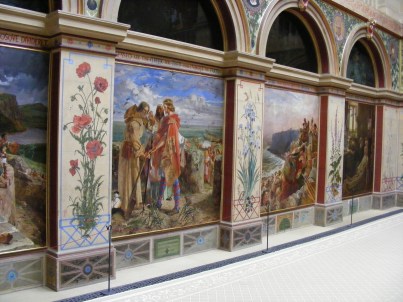
440 Wallington House Central Hall 1 June 2016Scotland is apparently bathed in sunshine. Typical, here we have drizzle and falling temperatures. Time for another National Trust property near you visit, this time to Wallington House near the weirdly named Cambo. The house was built for William Blackett in 1688 and then passed into the Trevelyan family, who, as the name suggests, originated in Cornwall. The most notable feature of this house is a central courtyard, which was covered over in the 1850s and decorated with murals depicting the history of Northumberland, for which the artist, William Bell, was paid £100 a panel. We are supposed to spot stuffed squirrels in the various rooms. I clearly need a two year old with me for this. Mind you I was not helped by the sample squirrels being three times the size of the hidden ones. There is a group called Robson’s Choice playing the Northumbrian pipes in the hall. These are very different from Scottish bagpipes and are much more suited to an indoor performance. They are not blown but the air is injected by squeezing bellows strapped to the elbow. My favourite features are once again the kitchen and also a series of photographs of former servants that are on display as part of a ‘Silent Voices’ project.

As we leave, the custodian asks if we are going to look round the gardens. Has she stepped outside lately? We have brought clothes suitable for northern summers but they are seriously inadequate for what the weather has thrown at us on this trip.

Across the Border Again and a Lesson in Hydraulics

So yet again we cross the border and are on the doorstep of Eyemouth World of Boats as it opens. A lovely lady directs us on a short drive to the storage sheds. She makes no mention of ostriches, perhaps I misunderstood. She had said that she was unable to locate the boat we were interested in but when we provide a few more details (like giving her the correct name) we are in luck. I can see why this is a health and safety nightmare. Someone has removed the steps up to a three foot high platform on which most of the boats are stored. Undaunted, we scramble up on the platform and are able to see the Flying Foam. Ironically she was on display at World of Boats until last year when she was moved to make room for the whaler.

We manage to get back in order to move the van at the approved time and head for a site near Alnwick, which we are learning to call ‘Annick’, so that we sound like locals. We have been to this site before (see archive posts for October 2012 for that visit) and we are on the adjacent pitch to the one that we occupied on that occasion. Unusually, I have planned no itinerary for this part of the holiday. The weather is still demanding an inside venue so it is a case of looking for a National Trust property near us. This turns out to be Cragside, near Rothbury. We encounter a first at a National Trust property, we have to queue to get in. The house has been subject to several extensions and is a distinctly strange shape. The imposing Victorian house was the home of the Armstrong (later Watson-Armstrong) family. William George Armstrong, was an engineer who specialised in hydraulics, meaning that there are various gadgets in the house. Cragside was the first house in world to be lit by electricity that had been generated by water power. He also installed a hydraulic lift in the 1870s.

Unusually, there are decorative tiles on the walls, up to dado rail height, on all floors. There is a very interesting kitchen, with high ceilings and a mechanical jack to turn the joints of meat. There is an over-the-top chimney breast in the drawing room, probably installed to impress the future Edward VII, who visited with his wife and children in 1884. There is also an exhibition about the local businessman, David Dippie Dixon, who, amongst other things, was in charge of the Northern Picture Puzzle Exchange. These were not the lobed jigsaw pieces that we are used to but interlocking, push-fit puzzles.

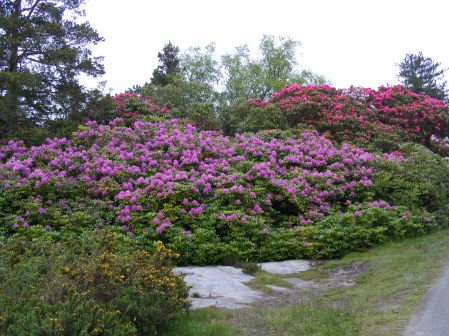
438 Cragside Rhododendrons 31 May 2016Cragside has plenty of opportunities for outside exploration, with gardens and extensive grounds. Given the temperature, we opt for driving along the six mile estate drive, which commences by driving under an arch through the house. This is obviously the right time for a visit as the rhododendron lined woodland paths are spectacular. It is a shame that we have neither the time, energy, or the warmth, to explore on foot. Home then via a quick shopping stop at Rothbury.

Across the Border

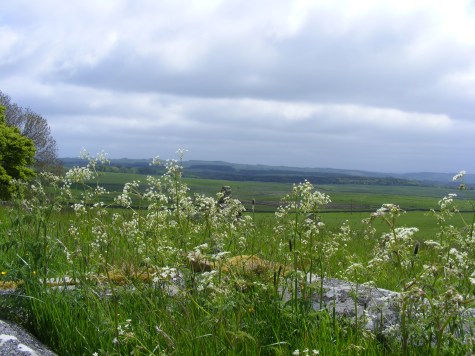
It is ten degrees as we leave Scotland. Arriving in England, it might be a little warmer but there is a thick mist. Too late we realise that the earliest entry on the site at Berwick on Tweed is not midday but 1.00pm. We arrive at 12.10pm and are third in the queue. There is not much room for queuing so our arrival effectively blocks the exit, meaning that no one can get a vehicle, much less a caravan, in or out. The harassed warden arrives, pointing out that we are all early. She has no option but to let at least one of us through the barrier. In the end she kindly allows us all on site. Having set up we return to Scotland. The sole reason for us stopping here is to see a Bucks ledge boat that is currently owned by World of Boats in Eyemouth. This small west country fishing boat is carvel constructed in a style that is unique to Bucks Mills and it belonged to a member of the Braund family. We arrive in a very chilly Eyemouth and locate World of Boats. We pay our modest entrance fee and converse with the very chatty custodian who explains all about their new acquired whaler. World of Boats own over 400 boats from across the globe. Unfortunately, 395 of them are not on display, including, inevitably, the Bucks ledge boat. On enquiring we learn that they are off site in the ostrich sheds. The ostrich sheds? These are not open to the public on the grounds of health and safety as the boats are stored on racks. Illogically, we can however view these if accompanied by a custodian. I assume that said custodian is briefed to catch any boat that looks likely to land on our heads. There will be someone who can take us tomorrow. In theory we are not available tomorrow as we have to be off site and heading south in the morning. We decide however that, by dint of arriving as the museum opens, we can just fit in a quick trip to the ostrich sheds before we leave.

Our boatless excursion leaves us with an afternoon free, so we cast about for something to do in Eyemouth, ideally something indoors, so not the thrilling trip in a speed boat that is on offer. There is a large yellow flag saying ‘house open’ and signs to Gunsgreen House, so we give that a try. Although this is not a venue that we can enter free of charge on the strength of our memberships, it has the advantage of being only hundreds of yards from World of Boats. The name Gunsgreen probably dates from the time when soldiers from nearby forts practiced in this area. The house, designed by John Adam, was built for John Nisbet in 1753. Nisbet was a local merchant who was also involved in organised smuggling on a very large scale. This was not usual on the east coast, especially after the Union of the Crowns, in 1707, imposed the crippling English taxes on Scotland. The nearest customs house was a three hour ride away at Dunbar, so Eyemouth was an ideal spot. An interesting aside: Dunbar Kirk Sessions reveal that, in the 1730s, Nisbet had been in trouble for an association with servant girls.

429 View from Berwick site 30 May 2016The main product that was smuggled was tea, which in Nisbet’s time attracted 119% tax. The house includes a hidden chute where large quantities of tea could be stored, a hidey hole under the floorboards, capable of concealing three men and warren like cellars, where our tour began. The top floors were not finished for twenty years, by which time a tenant, John Stewart, was in residence. The house was sold to rival merchant and smuggler, Alexander Robertson, to pay debts and then passed to the Home family. From 1906-1965 the house was run as a guest house by the Dougals. It then did time as a clubhouse for golfers and was finally acquired for restoration by the trust in 1998. In fact very little had been altered by the succession of owners. Pleased with our choice of ‘bonus’ visit, we return to Berwick Seaview site, which is by then living up to its name.

Edinburgh and an Encounter with the Earl of Moray

Despite not being the greatest fans of cities, we feel we do have to spend time in Edinburgh and today’s the day. Unfortunately, as we discovered yesterday, it is also the day of the Edinburgh Marathon but we hope that this won’t cause too many problems. We feel that we are unlikely to be mistaken for competitors. There is a half-hourly minibus service from the site into the city. You appear to just queue up for this. I am not daft, I can work out that if all of the 400 or so people on the site want to get on a 16 seater minibus at  the same time, we may be unlucky. Obviously we need to be at the front of the queue. We plan to catch the first bus at 9.30am. Left to me I’d have been there at 8.00am but I am restrained until 9.10am. We are the only people waiting. By the time it gets to 9.25am I am feeling that I would be comforted if there were some other people in the queue, as reassurance that a) we are waiting in the right place and b) we weren’t supposed to ring up and request the minibus. 9.30am and we (and no-one else) board the vehicle for the city centre.

We walk along Prince’s Street and through the beautiful Prince’s Gardens, making our way up and it certainly is up, to Edinburgh Castle. Yet again our English Heritage membership comes in handy, gaining us free entry. We join a guided tour in a group which includes Americans, Australians, Germans and Japanese. Our leader is Laura, whose delivery is very amusing and we learn of the castle’s history. This site has been occupied for 3000 years but the earliest remains are 900 years old. It has been used continuously, at times as a royal residence, a seat of Parliament and it is still a working garrison. At 400 feet above sea level the castle dominates the city and it is in an ideal defensive position. Laura comments on the historical inaccuracies of Braveheart – Wallace was a rich lowlander and not a kilt-wearing peasant a la Mel Gibson.

416 Edinburgh Castle 29 May 2016The weather is much better today. Not as much better as some of the locals, with their bare chests and shorts, are implying; I still have my coat and jumper on. We can at least see the view over the Firth of Forth as the mist has lifted. The castle fire a cannon at 1pm daily, except Sundays, so we shall miss that. St Margaret’s Chapel is the oldest part of the castle. It was built in memory of Margaret, the mother of David I. It is very tiny and although it is still used for weddings, you are limited to 25 guests. After our tour we wait for an excellent presentation by an historical interpreter, representing Sir Thomas Randolph, Earl of Moray who, in 1314, was charged with recapturing the castle from English occupation. It was one of three castles in English hands at the time. Roxborough was re-taken by men disguised as cows. Randolph, whose half uncle was Robert the Bruce, climbed the rock using a secret path revealed to him by the son of a former castle governor and got inside the castle with thirty men, whilst others created a diversion at the gates, so the castle was recaptured from inside. It is great to chat to the interpreter and try his weaponry. The chain mail is seriously heavy and the full face helmet certainly restricts the field of vision. He has a fiendish looking mace, which was designed for use by churchmen who were not allowed to let blood, although bashing people over the head was fine!

We queue for a considerable time to see the Scottish crown jewels. The sceptre, sword and crown were first used together for the coronation of the infant Mary Queen of Scots in 1543. These had to be hidden from Cromwell’s troops and somehow went missing from 1707-1818. We also see the Stone of Destiny, also known as the Stone of Scone, which has been used in coronation ceremonies for centuries. It was ‘acquired’ from the Scots by Edward I and taken to England. In 1950, four students stole it and broke it in the process, after four months they abandoned it at Abroath as a political protest. It was returned to England until 1996 when it was finally given back to the Scots on the proviso that it can be borrowed for future coronations. A quick look through the royal apartments and then off to view the Great Hall, with its impressive hammer beam roof and vast collection of armour and armaments. We also tour the Scottish war memorial that commemorates nearly 150,000 Scottish war dead.

By this time we have been on our feet for 2½ hours so decide to invest in the hop on hop off open-top city tour bus. We don’t actually do any hopping but make nearly two complete circuits, once listening to the standard commentary and once to a Horrible Histories version. The latter makes much of the connection with Burke and Hare.  We are warned to beware of the tram lines. We must not stand on the seats or take ‘anything lengthy’ on the top deck. The examples given are fishing  rods and helium balloons. We have neither so we are fine. Edinburgh’s contribution to medicine is mentioned. It is home to the oldest College of Surgeons, founded in 1505. We stop at the grass market, where sales of grass for animal feed, as well as other produce, have been held since 1477; it was also the site of the gallows. Now it is a trendy area with cafés and outside eating spaces. Being Scotland, these are full because the sun is out, despite the piercing wind. We see the back of the Greyfriars Bobby statute, commemorating the dog who held a vigil on his dead master’s grave for fourteen years. The Royal Mile (actually a Scottish mile so longer than ours) links the castle to Holyrood House, which comes next along with Holyrood Park, the latter is the largest royal park in Britain. Arthur’s Seat towers 800 feet above us. Several Edinburgh streets are actually bridges, not over rivers but linking areas of higher ground. Most of the streets in the new, planned, city have Hanoverian inspired names. The city is the largest urban world heritage site in the world. We see our first pipers of this Scottish trip.

The only evidence of the marathon was some rubbish and a few abandoned traffic cones. We are only half an hour early for the first return minibus trip of the day and we are the only passengers. This is our final full day in Scotland but the holiday is not quite over.

Rubbing Shoulders with the Knights Templar

The journey this time is a very short one in to Edinburgh. We approach what we believe is the Forth Road Bridge. It seems to have some rather disconcerting gaps in it. Ah! Fortunately this is not the Forth Road Bridge, or at least not yet; it is still under construction. I am disappointed that no one is actually in the process of painting the real Forth Road Bridge. There are warnings of a running event in the city but we are aiming for the north of Edinburgh so hope to avoid this. We later discover that this event is not until tomorrow and that it is the Edinburgh marathon. I am quite excited to be directed down Quality Street; this does actually appear to be the Quality Street. It might have been better if we had not been directed down Quality Street as we are in the midst of another sat-nav fail. This time it knows where site is (unlike the last two destinations) but seems to think that our caravan will fit down a road blocked by bollards with the gap between them barely wide enough for a car, sigh.

Today is the first time since we reached Scotland that we have been able to go out in tee-shirts, well Chris is in a tee-shirt; I still have a jumper on. We are trying to find the Chapel of Rosslyn, which has associations with the Knights Templar, always a fascination for me. Wouldn’t you think it would be in a place called Rosslyn? Nope. It is in Roslin, which is not what I was putting in the sat-nav! When we find it, along with four coach loads of other tourists, there are guide leaflets in every language but English. The rationale behind this is that the interpretation boards are in English, so we won’t need a leaflet. I would like to take one home so I opt for French on the grounds that I may understand one word in three. First comes the Old Rosslyn Inn, which was opened from 1660-1866 but is now a private house. It was patronised by ‘celebrities’ such as the future Edward VII, Walter Scott, William and Dorothy Wordsworth and Robert Burns.

The Chapel was begun in 1446 by Sir William St Clair, Prince of Orkney, who owned nearby Rosslyn Castle. What was known as the Collegiate Chapel of St Matthew, was intended as a private chapel so masses could be said for the souls of the St Clair family. The chapel was built in an over the top gothic style using local stone and probably employing French masons. It took forty years to ‘complete’ but was half the size of that which was originally planned, perhaps because the impetus was lost with the death of St. Clair.

One advantage of all the tour buses is that we can eavesdrop on a group’s commentary. A French guide explains, in very good English, some of the symbolism behind the many carvings. She is aided by a green laser pointer. Our attention is drawn to over 100 green man carvings. This pagan symbol is not unknown in chapels but so many of them is very unusual. There are, understandably, carvings that are full of religious symbolism as well as animals and plants. The plants include maize, which is strange as it was carved fifty years before Columbus discovered America. There are angels playing instruments, including bagpipes, a dance of death and depictions of the seven deadly sins. There is a legend attached to two of the carved pillars. One was supposed to be executed by the master mason and a more elaborate one by the apprentice, who was inspired by a dream. The incensed mason then killed the apprentice in a fit of jealous rage. Two of the gargoyles are supposed to depict the mason and his apprentice, complete with head wound. Ironically, the mason is sited so that he stares at the apprentice’s column.

The chapel is associated with the Knights Templar, early twelfth century warrior monks whose role was to protect pilgrims on crusade and to find and guard treasures from the Temple of Solomon in Jerusalem. The chapel came to prominence because it features in Dan Brown’s Da Vinci Code and the visitor footfall increased five fold as a result. After the Reformation, prayers for the dead were no longer customary but the chapel is still in use for regular services. Monck stabled the horses of the Parliamentarian forces in the chapel in 1650. By the eighteenth century it had fallen into disrepair and as a ‘ruin’, become a focus for Romantic poets and artists including Turner. Its initial restoration was inspired by Queen Victoria and now there are 175,000 visitors a year, many of whom seemed to be there on the same day as us. I was a bit disappointed that there was not more information on the Knights Templar but it was fascinating nonetheless.

412 Currie Kirk 28 May 2016On the way back to the van we call in at Currie, where my granddaughter’s ancestors came from but no luck with the graveyard here. There are some very unusual stones there though.

Puffins and other Birds

It is twenty degrees and sunny in the Highlands today. Sadly we are no longer in the Highlands and we have mist, drizzle, ten degrees and a very cold wind. We set off for the twenty mile trip to Anstruther, still unsure if our boat to the Isle of May will sail today. We arrive early, that would be early even by our standards. The boat, The May Princess, which takes 100 passengers, is full. It is mostly full of a party of fourteen year olds whose degree of preparedness for today’s activity varies. One girl is wearing a thin jumper that stops a few inches above her waist and has slashed sleeves. The lady next to us works on an Antarctic survey project. She at least is appropriately dressed. She claims that the Isle of May is one of her favourite places on earth. There are some very serious cameras on board. One man has a four foot long lens; I dread to think what it weighs or how it will fare in this drizzle. We have secured what appear to be the best seats on the boat, outside yet under an overhang to protect us from the rain.

Another toilet related comment alert. The comfort system that increases the availability of toilets, which we used in Aberdeenshire, has been disbanded in Fife. Chris therefore used the time whilst we were waiting for the boat to walk through the rain quite a long way and then was indignant at being charged thirty pence for the privilege. I have elected to wait until we board. This means that I have to wait until the boat is at sea before using the facilities. These are typical boat ‘heads’, with another puzzle as to how the flush works. Too late I spot the instruction to put toilet paper in the bin rather than down the pan. Without going into too many gory details, I will report that it did end up in the correct receptacle. Then comes the challenge of trying to keep on my feet whilst returning to my seat.  The boat is lurching in a spectacular manner, with waves crashing on deck to the accompaniment of many girly screams from the school party and that was just the boys. This is the roughest sea I have experienced since whale watching. I am the proud possessor of seasickness tablets. They are at home. I remember the whale watching instructions to put pressure on the pulse points, this seems to work.

We see gannets and learn that they are part of the 150,000 strong colony on Bass Rock, the largest colony in the Northern Hemisphere. There are ¼ million sea birds on the Isle of May, including 92,000 puffins, surely I will at last see one. Puffins return to the same burrows each year and once they leave the island, the chicks do not come back to land until they are mature enough to mate three years later.

386a Puffins Isle of May 27 May 2016We start to see more and more seabirds through the mist and drizzle, including my first ever puffin! As we near the island the water is thick with guillimots, razorbills and more puffins. We have three hours to spend on the island and we walk most of the pathways. Departing from the marked routes is strictly forbidden in case puffin burrows are damaged. Even with my very basic £100 camera I manage half decent, recognisable shots of the islands birds. Apart from the puffins, razorbills and guillimots there are, oystercatchers, shags, fulmars, black-backed gulls (lesser and greater), fulmars and kittiwakes. There is also an active tern colony and the terns dive bomb the visitors making their strange ticking cries (that would be the terns’ cries, not the visitors). Eider duck nest right by the pathways; I had forgotten that the females were a drab brown, in contrast to their gaudy husbands. A tremendous plus for having had to do this part of the trip two years later than originally planned is that, had we made it here as intended in August 2014, there would have been far less to see. Despite the chilling wind I am having a great time, though I agree that slightly warmer weather would have been the icing on this particular cake.

394 Shag Isle of May 27 May 2016A great deal of what is known about sea birds and migrations patterns is thanks to data collected on May. Only the researchers live on the island as the lighthouse is now automated. It is 200 years old and was built to replace the oldest lighthouse in Britain, which was a coal fired beacon tower dating from 1636. This took between one and three tons of coal a night to maintain, all of which was brought from the mainland and hauled to the top of the tower. The island used to be a monastic foundation, with St Ethernan’s shrine attracting pilgrims since the seventh century. The island was home to St Adrian until he carelessly got murdered by the Vikings in 875. In 1500, James IV had a picnic on the island, because he could I guess. After the 1715 Jacobite rebellion, three hundred fleeing Jacobites somehow got stranded on May for eight days without food.

We return to the boat and choose to sit on the top deck, as the drizzle has stopped. I ask which is the appropriate side of the boat to sit for the best view of the cliffs on the return journey. The island is home to 100 or so grey seals and we see these as we travel along the coast. The tide is very low and the gangplank is at a ninety degree angle. The chap in front of me is on crutches, he manages better than I. Yet another day when a serious defrosting is required when we get home.

The Kingdom of Fife

It is back along the now familiar A96 to a grey Aberdeen, which our sat-nav insists on pronouncing Abradeen. There are glimpses of sun as we head south on the A90. At Dundee, we cross the Tay Bridge, which is celebrating its 50th birthday. Finally it is on to the A92 into Fife. Our sat-nav is especially designed for those with caravans and includes all our sites as points of interest, so we have put in our destination – Balbirnie Park in Markinch. Markinch is the home of the ancestors of my grandson but I have left the family history to his other grandma.

We begin to lose confidence in the sat-nav as we wind our way through the backstreets and end up down what appears to be a dead end. We are being directed to turn left in a few yard, the road appears to stop. I get out to investigate and discover that the ‘road’ is a metre wide earthen footpath. Chris does a several point turn with the van and I turn navigating using the postcode instead (there is no road as part of the site’s address). This sends us to a spot three miles away and still no site in sight (there’s a pun in there somewhere). Plan c is to put in ‘Markinch’ and use the written directions in the Caravan Club book. Success! This is a heavily wooded site, which looks pleasant but the trees make the van very dark. As someone who has only just acquired a car that can be opened remotely, I am excited by the barrier key, which allows me to zap the site barrier from a distance using a fob and watch the barrier rise. Ok, so I am easily amused.

373 Scottish Fisheries Museum 26 May 2016.JPGA nature reserve was on the itinerary for this afternoon but we are still in single digit temperatures, with biting winds and drizzle, so we think again. We decide to head for Anstruther to see where tomorrow’s boat trip starts. We drive along the Fife Coastal Tourist Route, through the East Neuk villages, past fields of potatoes and arrive at Anstruther. This areas was described as a fringe of gold by James II. ‘Neuk’ means corner and here we are on a small corner of the east coast. We spot some shell houses in Anstruther and then we find the harbour and enquire at the ferry office. Yesterday’s and today’s sailings have been cancelled due to bad weather, this does not bode well. It is definitely a day for an indoor activity so we look round the Scottish Fisheries Museum, which used to be home to some Braund family boats. We knew that these had moved to Eyemouth and we hope to see them in a few days’ time. The museum is very well done, part of it is housed in the former occasional lodgings of sixteenth century abbot of Balmerino. There is another strange toilet-related incident at the museum. These are very strange contraptions and I am initially at a loss as to how to effect a flush. There are tiny hand basins on top of the cisterns and turning on the tap also flushes the toilet.

On the way home, we drive back through Pittenweem, which is an historic fishing village that the guide book recommends. Maybe on a sunny day….. One of our party is hardy enough to wander round and inspect the fishing boats. Enough is enough and it is time to batten down the van’s hatches and thaw out yet again.