We have earmarked today for a trip to Mont Orgueil (pronounced ur goye) Castle, overlooking Gorey Harbour. We arrive as the castle opens, so are in time for a free conducted tour. Our guide, Daniel, takes us up twisting slippery stairways, down and round through a maze of rooms. We are very glad that we joined this tour as we learn much that we would never have found on our own. I strongly suspect that we would also have missed several of the rooms, as the periodic redevelopments of the castle have left it with a tangle of intertwined corridors, staircases and chambers. Here are some random things that we were told. I am taking no responsibility for the accuracy of the same!
There has been occupation on this site since Neolithic times but what remains dates from the thirteenth century or later. In 1204, King John lost control of Normandy to Philip II of France. The Channel Islands, which were part of the Dukedom of Normandy and thus joined to England since the Norman Conquest, opted to remain with England rather than Normandy. This made them the frontier during conflicts between France and England and thus fortifications were needed. We examine the murther (or murder) holes over the portcullis. Traditionally, these would be used to drop anything from boiling oil to dead animals onto the invading enemy. Mont Orgueil’s situation gave its occupants another option, boiling up shellfish to make quicklime, which would burn when it came into contact with the sweaty bodies of those attempting to enter the castle. The only antidote was urine. In order to provide a well within the middle ward in case of siege, they had to dig through nineteen metres of granite.
Mont Orgueil’s role as a frontier fortress was particularly important during the 100 years’ war, which bizarrely didn’t last for 100 years at all but from 1337-1453. In 1461, Margaret of Anjou, wife of Henry VI, intrigued to return Jersey to the French but the French failed to capitalise on this and they were chased out in 1467. Henry Tudor was exiled to Jersey and spent time at Mount Orgueil, before his victory at Bosworth.
At various times in history, the castle has been the seat of island administration. In 1549, John Thynne was Captain of the castle and he oversaw many of the Tudor improvements. Thynne was also responsible for building Longleat House. Modifications to the castle kept in line with developments in weaponry. Lead from roofs of dissolved English monasteries, such as Glastonbury, were used in the castle. Henry Cornish was another captain during the time of an absentee governor. He was responsible for installing three breech loading cannons. By the end of the reign of Elizabeth I, the castle was deemed to be obsolete, as it was not suitable for defence against attack by cannon from the sea. It was to be demolished but Walter Raleigh persuaded Elizabeth I to leave it intact, whilst building Elizabeth Castle as an effective replacement for defensive purposes.
 In 1634, the Puritan William Prynne had his ears cut off and was to be imprisoned for life for remarks that were deemed to be insulting to Queen Henrietta Maria. He was kept as a political prisoner at Mount Orgueil, where he was well treated by the governor Sir Philip Carteret. He was pardoned by Charles II. The castle was then used as a prison for three of those who had signed Charles I’s death warrant. Jersey was Royalist during the English Civil War and Jersey was the first place to proclaim Charles II as king in February 1648/9, just a month after his father was executed. Charles II rewarded leading family the Carterets, with land in the new world, now known as New Jersey. Three altar stones have been found at the castle. One is now in Trenton, New Jersey. Between 1562 and 1660 there were sixty six witchcraft trials on Jersey; half were put to death, mostly by hanging and strangling. I can’t quite work out how one can be both hanged and strangled but don’t shoot the messenger. During the Napoleonic era, Phillipe D’Auvergne used the castle as his headquarters for a spy network against France.
There are a number of fascinating art installations in the castle. One is a modern representation of the Medieval wounded man, which illustrated various possible battle wounds. In theory this was supposed to be encouraging, as the claim was that these wounds could be cured. I feel that this might be more off putting than encouraging but this was the era when John Bradmore successfully removed an arrow that had become embedded in the skull of the future Henry V. I guess they kept stressing the successes and conveniently ignored the failures. There is an unusual hologram of the queen, executed by artist Chris Levine in 2004 and an impressive sculpture showing the English and French Medieval Royal Families.
A very interesting historical interpreter is braving the rain and he tells us about Medieval weaponry, whilst undertaking his leather work. We are introduced to the Bec de Corbin (crow’s beak), a new one on us. This is a long metal pole with a spike and a multi-pronged hammer, designed for penetrating armour; you wouldn’t argue with someone wielding one of those. It was a shame about the drizzle, although my Niagara Falls poncho came into its own. The potential of a damp Mont Orgueil exhausted, we returned to the apartment to relax.
 Next stop is Corbiére Point, in the far south west of the island, overlooking the lighthouse. After a quick walk round, we drive on up the west coast and are very disappointed to find that the Wetlands Centre on the nature reserve closed for the winter last week and there is no opportunity for self-guided walks round the reserve. This is the second place we wanted to go to that had already finished its season, the other was the Living History Museum. We understand the need to have enough visitors to be profitable but this seems very short sighted as there are plenty of tourists about – us for example!
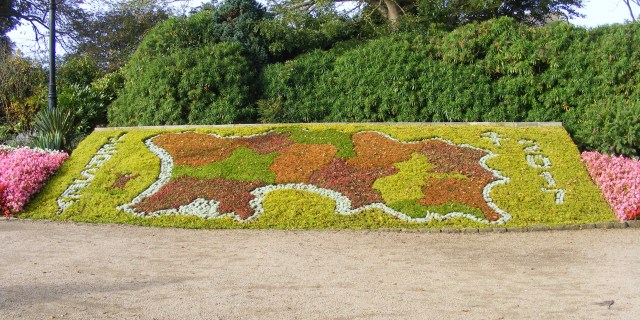 Another hike in to St Helier, this time to visit the Maritime Museum. Our now familiar route takes us through the attractive Howard Davis Park. This used to be a large residence and estate until it was purchased by Mr Davis. As a boy, he was caught scrumping and had been punished by the then owner. Young Davis had vowed that he would destroy the manor house and as an adult he was able to do just that once it came in to his possession.
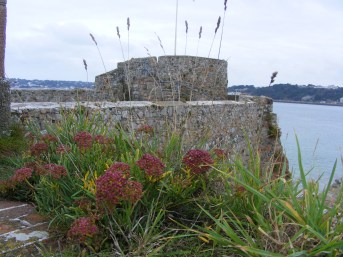 I am about to relate what we learned whilst on the Castle but we did spot a few historical inaccuracies, so, if this is total rubbish, don’t blame me! The rock on which Elizabeth Castle now stands was first built on in 1155, when an abbey was founded here and named after the hermit, Helier, who inhabited an outer rock in the middle of the sixth century. Helier was allegedly decapitated by a pirate and was able to pick up his own severed head, walking 200 yards with it. Helier was later sanctified and gave the principal town of Jersey its name. The Medieval abbey was later reduced to a priory for half a dozen monks and had been abandoned before threats from France and Spain made it advisable to fortify the island. Engineer Paul Ivy was responsible for these early fortifications in the time of Queen Elizabeth I. Labourers came from the parishes, who had to provide men to work twelve hour shifts for three days a week, thus allowing them to work on their own land the rest of the week. The project was funded by taxing island residents. The Governor of Jersey in 1600 was Sir Walter Raleigh and he named the Castle after Elizabeth I, calling it Isabella Bellissima (Beautiful Elizabeth).
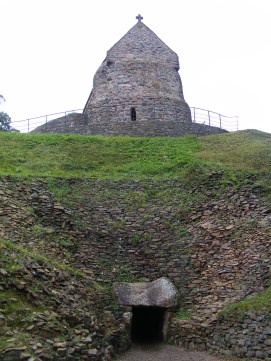 Next, to investigate the burial chamber itself. When it was constructed, the population of Jersey was likely to have been about 3000. The stone came from the eastern part of the island and some of the blocks weigh up to twenty tonnes. The chamber was covered by stones and then earth to form a cairn that is nine metres high and thirty six metres in diametre. The entrance to the burial chamber is a ten metre tunnel that is about three foot high. It is quite difficult to negotiate, especially as overnight rain has left puddles underfoot that need to be avoided but we accomplish this without injury. It was more than just a burial chamber and would have been used for various religious ceremonies. The entrance is aligned so that, on the equinox, the rising sun shines down the tunnel and illuminates the back wall of the chamber. The site was abandoned about 2500 BC and a belief grew up that it was home to a dragon. The legend goes that the Norman Seigneur of Hambye came to rid Jersey of the dragon but was himself slain by his own servant, who claimed the credit for killing the dragon and subsequently married the Seigneur’s widow. She discovered the truth, had the servant executed and a chapel erected in memory of her husband. An alternative story, told to us by the on site historical interpreter, is that it was a Viking pirate, rather than a dragon. Is this a case of make up any story for the tourists and they will believe it we wonder?
 The weather forecast suggests that the rain will hold off until mid-afternoon, so we decide that we can choose an outdoor activity for today and opt for an exploration of the north coast, including a walk along some of the coastal footpath. We start to work our way up the east coast stopping at a few bays on the way, making the most of the fact that parking is free on a Sunday. We stop at Verulet Point and take a quick look at a small craft market. Then it is on to Rozel and Boulay Bays in the north east. At this point the direction finding gremlins strike again. I am sure St John’s village is very pleasant and all that but driving through it from different directions no fewer than five times might have been overkill. Just as we locate the proposed start of our walk and four hours before schedule, it begins to rain. We decide to drive along the coast instead, not that we can see much through the mist. Still, I guess we have been very lucky with the weather so far. A couple more passes through St John’s for luck and we appear to be heading westward.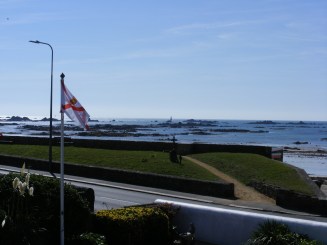
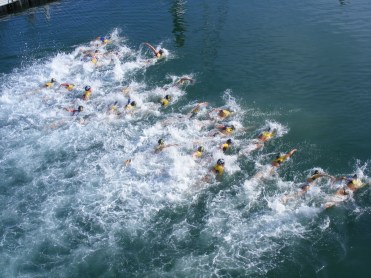 In England, an international event such as this would be advertised from several miles distant but the triathlon is a well kept secret until you reach the course itself. Nowhere is the route advertised, not even in the tourist information bureau. It is being staged in a move to increase interest in Triathlon, I think they may therefore have missed a bit of a trick here. We enquire of a policeman, who looks like an immature twelve year old and position ourselves for the start of the women’s elite race. This is not a traditional triathlon, all the stages are much shorter and are repeated three times with ten minute breaks between each round. It begins at 4.00pm, expect when it doesn’t. We are some twenty feet above a very murky looking marina where the swim is being held. During the twenty five minute wait for the start, I am feeling less and less comfortable gazing down from this dizzy height – I get uncomfortable standing on a chair. Finally, we see the women set off and then we are able to move round to get a clear view of the circuit where the cycling and running take place. I am a bit sorry that this isn’t the men’s race and that we are going to miss Johnny Brownlee but I am pleased to be part of the event.
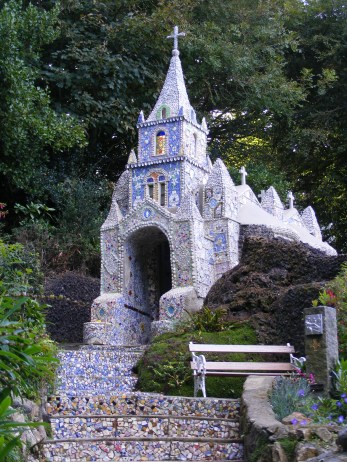 Today was our last day on Guernsey and we aimed for the south coast. On the way we called in at The Little Chapel. This is a fascinating grotto, decorated with millions of pieces of broken china. Low-key it’s not and probably not what you’d want in your back garden but well worth seeing. It was built in 1914 by Brother Deodat and was inspired by chapels at Lourdes.
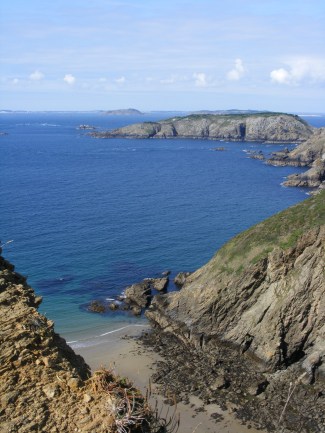 Our carriage ride leaves at 11.30am and we are with Winston aged seventeen (the horse) and Andrew aged sixty something (the guide). We spend a very pleasant two hours rambling round the island. Andrew, a native Sarkese, provides a commentary that needs, in places, to be taken with several large pinches of salt. He descends from one of the original forty 1565 settlers, although he keeps saying 1665. We stop at Banquette Landing in the north of the island to view an ‘Elizabethan’ gun. Said gun is inscribed GR but who’s to quibble; I am familiar with the concept of telling a good story to the tourists. Randomly, also at this location is a flock of emu; diversification rules I guess. There are two dairy herds on Sark and all have to be Guerseys. Sark dairy products resemble those from Guernsey but apparently the butter is different, I am not sure in what way. There are two levels of property prices on Sark and all property is leasehold. Those who have been resident for at least fifteen years pay about half the prices that incomers are charged. Planning permission is required for new builds and building is not allowed on the Cotil, or cliffs. Sark is independently governed and there is no income tax and only a small equivalent to council tax. This is offset by the need for hefty health insurance and private pensions as there is no state funded health or social service. Sark’s ambulance and fire engine are pulled by tractors and these are manned by volunteers. There is a private doctor and two nurses on the island.
 The History Interpreter - Janet Few