A some point in the middle of the night the heater we rented with the camper van whimpered and died. In other nocturnal news, having left Chris’ phone on in case of yet more re-arranging of our itinerary, we received a call at mid-night about PPI. It was a night of torrential rain, with thunder and lightening rolling and roaring round the lake. This was marginally quieter than the door of our neighbour’s camper van, which they felt obliged to open and shut approximately every thirty seconds between 11pm and 1am. This they recommenced at 6am.
We were ready in good time for our 7.45am pick up to (hopefully) go to Milford Sound. We can actually see the road from the camper van. Given the pouring rain, one of us wanted to wait until we saw a vehicle draw up and then make a run for it. The other one would have been out there getting soaked from at least 7.30am. No prizes for guessing which was which. In the end, the mini-bus was early so it was a case of head out when we spotted it, which was at 7.40am. One of us had only asked, ‘Can we go outside and wait now?’ about eleventy billion times by this point. We were the first on board, which meant that we could sit at the front but this position came with the responsibility of being umbrella monitor. Our super ace guide for the day on our Fiordland Tours/Mitre Peak Cruise was Jonathan. He began by asking us if we would rather go tomorrow instead, as the weather was forecast to be better. None of the fourteen on board were able/keen to do this so we headed intrepidly on.
Jonathan gave us some information about what we couldn’t actually see due to the poor visibility. He did try to make a positive out of the heavy rain: the waterfalls will be more impressive. Between the years 1000 and 1800 half of New Zealand’s rainforest was burnt in order to aid the hunting of the now extinct flightless bird, the moa. Farmers moved in and free ranging deer were introduced. These soon became a pest and wild deer were killed or corralled into venison farms. This apparently involved leaping out of helicopters and winching up deer in order to transport them. We do indeed see some impressive waterfalls through the murk and also some cabbage trees, the southernmost growing palm tree. There is beginning to be a problem with non-native pine trees. These have been planted as a carbon-emissions pay back but they are encroaching on the National Parks and altering the habitat. Fiordland covers 5% of New Zealand and at 1.25 million hectares, it is the country’s largest National Park. It is also one of the world’s wettest places. They are not wrong there. The ten metres annual rainfall here is twenty times the annual rainfall of Christchurch. Just a bit of a shame that all ten metres have decided to fall today.
We stop for morning tea and very acceptable scones at Gunn’s Camp. Then comes the news that the Milford Road is closed due to a ‘wet slide’ avalanche. The heavy rain has put weight on the snow and the road is blocked. It may, or may not, be passable later. We walk the Marian Lake trail while we wait to see what transpires. I was lured on this short walk by the possibility of seeing blue ducks or Pukeko. The rain is still torrential and we are wielding complementary umbrellas. I have my camera in my other hand. Then comes the unbelievably wobbly suspension bridge over the rushing torrent. I am never a fan of anything high up or wobbly and the feeble looking safety wires on either side were only about 2 foot six high. Given the umbrella and camera, I was left with no spare hand with which to cling to the side wires for grim death. I lurch from side to side alarmingly but somehow make it across and indeed back. There was not a Pukeko in sight.
We return to the road junction to find the road still closed so we resign ourselves to having to miss Milford Sound. As compensation, Jonathan drives us up back past Gunn’s Camp to the Humboldt Falls. Then comes the news that the road is open after all. We are too late for our scheduled cruise but Jonathan thinks they will hold a boat for us. We are now very short of time as we have to be back on the Te Anau side of the tunnel before 4.00pm when the road will be closed due to forecast snow and we may be marooned in Milford, perhaps for days. Either that or the mini-bus will turn into a pumpkin, probably the former. We decide to give it a go.
Our own boat is not sailing but we can hitch a ride on a Juicy cruise instead. Their booked party has given up and not risked coming through the tunnel. Better still there is a selection of curries on board that they have ordered and which we can consume. This is our second free meal of the day as we still have the bonus packed lunch awarded to us in return for not being able to go to Milford Sound yesterday. We set off on Juicy’s Gem of the Sound. We learn that the rainwater forms a layer on top of the salt water in the sound. This is a rare phenomenon that only occurs in a handful of places in the world. We stop at McKenzie falls and venture out to view the Tasman Sea, ‘the Roaring Forties’, with its four metre swell. Our voyage is slightly shortened to ensure that we get back through the tunnel before the witching hour. We do get up close an personal with Stirling Falls. Some of those on board accept the invitation to stand on deck. Any parts that were not already drenched by the rain are now soaked in spray. Judiciously, we remain indoors at this point.
 We make it back through the tunnel in time, just as snow is beginning to fall. There are a few stops on our way back to Te Anau, including a fruitless Kea hunting stop, a chance to photograph the Mirror Lakes and also to view Lake Te Anau from Te Anau Downs. By this point, the rain has almost stopped and we can actually see not just our hands in front of our faces but the lake as well.
Back on site, I become very grateful for the charm offensive that Chris has been launching on the ladies at reception since we arrived. He has managed to blag us the loan of a heater.
 We head south down the 8, passing through a more barren landscape. We drive through Twizel, a town that grew up round the Hydro-electric industry and along the twists and turns of the Lindis Valley to Cromwell. This town, on the shores of the man-made Lake Dunstan, is in what used to be a gold mining area but is now better known as a wine-growing region. We take a walk round the town, most of which is housing estate and eventually reach the deserted historic quarter, which we remember from our previous visit. I was expecting to need multiple coats, gloves and hats but it is beautifully warm and despite road signs warning us that it is winter, our camper van tells us that the outdoor temperature is 21 degrees, allegedly warmer that it is at home! This is as far south as we reached on our previous visit, so from here onwards we are in uncharted territory.
 We stop for refreshment at the top where, allegedly, we encounter the highest postbox in the southern hemisphere. It is a little early to post things home so we don’t make use of it. In an effort to control the caffeine intake, I have a very pleasant ginger, honey and lemon hot drink. There is free water available and my travelling companion offers to get me some while I am waiting for my purchased drink to arrive. The container is empty and whilst attempting to take it to the staff for refilling, he drops it on the floor. Fortunately it bounces. Later a small child, away from watchful parental eyes, turns on the tap at the bottom of this now full water container, so the contents runs all over the carpet. This makes our offence seem trivial.
 We leave Methven at 10.25am and the dashboard tells us it is nine degrees outside (for the benefit of those who are more familiar with the other sort of temperature calibrations, about 50 degrees). With the beautiful Southern Alps on our right, we drive down the 77 and 72, crossing the Rangitata River and on to the 79 through Geraldine and Fairlie. Then it is ‘The Starlight Highway’ to Lake Tekapo. I hadn’t realised it when I planned the route but here we are in the Aoraki Mackenzie International Dark Sky Reserve. This is allegedly one of the best places in the world to view the night sky. It is pretty stunning by day too, with the autumn-tinted trees reflected in the clear lake. Apparently the glacial ‘rock flour’ gives the water its startling turquoise tinge. The people we speak to in shops, along with the site receptionist, all seem surprised that we are staying for two nights. Does no one normally stop for more than one night? We gather two nights may be a good thing as tomorrow is predicted to be particularly favourable for stargazing. The bad news is that snow is forecast. On this site, we have a premium lakeside pitch, only slightly marred by the boating clubhouse, if you look to the right.

![DSCF0219[1]](https://thehistoryinterpreter.com/wp-content/uploads/2018/04/dscf02191.jpg?w=312&h=234)
![DSCF0207[1]](https://thehistoryinterpreter.com/wp-content/uploads/2018/04/dscf02071.jpg?w=340&h=255) We encounter toll gates along the Pan-American highway. We are pulled over by the police and our driver has to rattle off the nationalities of all on board. That seems to satisfy the officer and we are waved on our way. There is definitely more vegetation now and even rice fields, irrigated by the Cotahuasi river.
We encounter toll gates along the Pan-American highway. We are pulled over by the police and our driver has to rattle off the nationalities of all on board. That seems to satisfy the officer and we are waved on our way. There is definitely more vegetation now and even rice fields, irrigated by the Cotahuasi river. Our tour has a special ‘beat the rush’ boat trip to the Ballestas Islands, hence the early start. The islands are known as the poor man’s Galapagos and we are hoping for wildlife. We set off in the Carol 1, which is a speed boat but the shelter of the Paracas peninsula makes for a smooth trip. We spot a colony of pelicans, followed by Turkey Vultures, the only birds on the islands that do not eat fish. There are also Chilean Grey Gulls and Elegant Terns from further north. We stop to photograph the 170 metre high Candelabra geoglyph, carved in the hillside. It may be attributable to the Nazca civilization but others believe the style suggests it is post-Hispanic i.e. after 1532. We see some of the 20,000 seals that inhabit the islands, their pups were born a couple of months ago. Humbolt Penguins waddle along the cliffs and there are Inca Terns, with their distinctive red legs and beaks. Ballestas means ‘arrow slit’ and there are many crevasses and arches in the rocks. We also see large colonies of Boobies. There were those amongst our parties who had different expectations when these were mentioned. A rare Red-footed Cormorant is also spotted.
 After a tasty ice cream our journey continues. We pass a cart loaded with seaweed. Three different types are used for fertilizer, food and cosmetics. The next stop is Huacachina, an oasis in the middle of the Ica district desert. We are here for an ‘optional/compulsory’ ride in a sand buggy. These take eight passengers and career hectically up and down the dunes in an alarming fashion. Nothing ventured, I rashly agree to try these. My judgement may have been clouded by the amount of pisco I had consumed. I wedge myself in the back row between Chris and another sturdy gentleman of our party. Maybe sitting in the back row was not so wise, as it seems that this is where you experience maximum bounce. I have my arms stretched out and am gripping the bar in front of me as if my life depends on it. Oh, hang on ……. My feet are braced. Occasionally I open my eyes and I am flung up and down in the air as we hurtle up and down the dunes at about 30mph. Believe me, it felt considerably faster. We make a few stops to photograph the view and the oasis below. Some of our party sand board down a couple of dunes, to be collected at the bottom. In places the gradient is 1:2. I wonder if this is a good point at which to mention my heart condition. Disconcertingly, the driver periodically gets out of the vehicle to fiddle with it and add more fuel. I don’t contemplate what happens if we break down out here. I mentally debate if this is more terrifying than being on the back of a Skidoo for 2½ hours at minus 23 degrees in Finland – it is a close run thing. At the end of the journey my fingers have to be prised off the bar. On balance, I am glad I went, although I am not likely to repeat the experience. I should point out that I have never been on a roller coaster, which provides a similar ‘experience’ and I have only been down a playground slide a handful of times, so this was definitely out of my comfort zone. We have a very pleasant lunch in the hotel and paddle in their pool. Ok, so I had chicken and chips but it was lovely. This was accompanied by a complimentary pisco sour. I have probably had more alcohol today than in the past year.
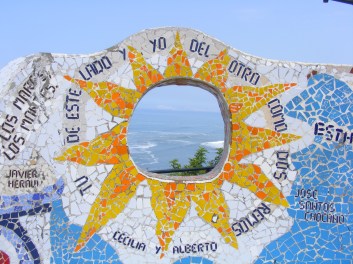 Our Australian friends, with whom we are sharing this adventure (we are blaming them for everything!), arrive. They have already spent two months in South America. We stroll back down to the park in the afternoon. There are street sellers trying to con gullible tourists; we do succumb to an official looking ice cream salesman, who is unperturbed by us paying with a 50Sol note. The lollies were unusual but refreshing and the ‘choc-ice’ was ice cream sandwiched between bourbon like biscuits. The extreme gymnasts and joggers have mostly given up due to the heat but there are tightrope walkers who have strung ropes between the trees. I have already developed some interesting blisters from my first walk in sandals for six months.
 The History Interpreter - Janet Few