#100daysofbfotc Day 78: Arthur Wakely

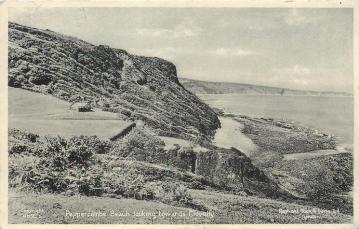
PeppercombeThere are only brief references to Arthur Wakely in Barefoot on the Cobbles. His escape from his Devonshire home, to become a coachman in Midlothian, Scotland, was an example to Albert that there was a world beyond the fishing villages on the north Devon coast.

Arthur William Wakely was the eldest of the Wakely family and the only surviving son in a family of girls. He was born on 21 April 1861 in Peppercombe Valley. Initially he moved to Bideford and worked as a painter but shortly afterwards changed his occupation. In 1882, he married a Scottish girl Mary Eliza MacAulay in London, where they had no doubt met whilst in service. They moved with the family to their Scottish home in Edinburgh, by which time Arthur is working as a coachman. Arthur and Mary had at least eight children. We lose track of Arthur and his family after 1901.

‘It was from Polly that he learned that there were two more sisters at home, Ada and Ethel and a brother, Arthur, who was making his own way in the world.’

Barefoot on the Cobbles will be published on 17 November 2018. More information about the novel can be found here. Copies will be available at various events in the weeks following the launch or can be pre-ordered from Blue Poppy Publishing or the author.

#100daysofbfotc Day 77: Clovelly Lifeboat

HA_TC_A3P3-003 (2)The lifeboat that features in the penultimate chapter of Barefoot on the Cobbles is the Elinor Roget, or ‘Elinor Rocket’, as she was affectionately known. The Elinor Roget II replaced the first lifeboat of that name in 1907. She was a rowing lifeboat and the crew’s only protection were their cork lifejackets. In the novel, it is Albert who forms part of the crew but depending which account you read, it may have been his brother Alfred instead. Having tried to untangle the conflicting lists of the men who manned the lifeboat on New Year’s Day in 1919, it seems the crew is likely to have been: Tom Pengilly (coxswain), William Prince (Bowman), Oscar Abbott, Herbert, Albert (or Alfred), Charlie Headon, Philip Dunn, Richard Headon, R Hortop William Hamlyn, Fred Headon, Tom Jenn, Captain James Jenn, James Jenn junior and Arthur Shaxon. We do know that some of the crew stood down to be replaced by fresher men, when the lifeboat put to sea a second time. The new men were probably Richard (Dick) Cruse, Sidney Abbot, Richard Foley and Steve Headon. Despite there being a policy of not taking more than one man from each family, the Headon and Jenn families made a significant contribution to the crew. In fact, in a community such as Clovelly, where the families intermarried over successive generations, most of the crew were related in some way.

‘Albert was amongst the fourteen men with oars at the ready, cork lifejackets tightened. The watching crowd, apprehensive and fearful, strained to see the struggling fishing boat dipping and tossing in the distance. The lifeboat listed alarmingly as the oarsmen fought to maintain a steady path through the waves.’

Barefoot on the Cobbles will be published on 17 November 2018. More information about the novel can be found here. Copies will be available at various events in the weeks following the launch or can be pre-ordered from Blue Poppy Publishing or the author.

#100daysofbfotc Day 76: Captain James

Captain James with telescopeCaptain James appears in the first chapter of Barefoot on the Cobbles when he is visited by his grandchildren Albert and Eadie. Born in 1809, James spent his whole life living in Bucks Mills. He went to sea at the age of eleven and was a fisherman and pilot. He was credited with saving the lives of several local fishermen who had got into difficulties in Bideford Bay.

In 1836 he married his first cousin Mary and they had eleven children. He probably began his married life in a property known as The Bluff, before building King’s Cottage, next to his father’s home in 1845.  He died in 1898.

The grandfather, Captain James, was held in high regard by the villagers, most of whom were relatives of one kind or another. He could no longer row out to pilot boats in over the bar, or rescue ships in distress, these glories were now merely memories to be shared with the next generation. The old man might still potter in the bay, handline for fish from the shore or sit in the porch and ponder on the past. He would raise his telescope to scan the sea that had been his love and his master for more than eighty years.

Barefoot on the Cobbles will be published on 17 November 2018. More information about the novel can be found here. Copies will be available at various events in the weeks following the launch or can be pre-ordered from Blue Poppy Publishing or the author.


#100daysofbfotc Day 75: Hon. Margot Asquith

We meet the Honourable Mrs Asquith, the wife of the Prime Minister Herbert Henry Asquith, in Clovelly Church on an early summer morning in 1909. The Asquiths were regular guests at Clovelly Court, where their hosts were great supporters of the Liberal political cause.

https://upload.wikimedia.org/wikipedia/commons/5/55/Margaret_Emma_Alice_%28%27Margot%27%29_Asquith_%28n%C3%A9e_Tennant%29%2C_Countess_of_Oxford_and_Asquith.jpg

Photographer Adolph de Meyer used under Creative Commons

The Mrs Asquith who appears in the novel was H H Asquith’s second wife. Alice Emma Margaret (known as Margot) Tennant was born on 2 February 1864 to Sir Charles and Emma Tennant née Winsloe. The family were from Glen House, Traquair in the Scottish Borders. Margot married Asquith on 10 May 1894 in St. George’s Hanover Square. She had a reputation as a wit and a socialite. She was also a writer, although her works were not greeted with universal acclaim. Margot bore Asquith five children but only two survived to adulthood. In the 1920s, Margot amassed significant debts and she tried various money making schemes, including advertising Wix cigarettes. She died on 28 July 1945 and is buried in Sutton Courtenay.

‘The service dragged on, the sermon began and Daisy struggled to focus on what Reverend Simkin was saying. She became aware of some scuffling in the Asquiths’ pew. Mrs Asquith was scrabbling in the beaded reticule that dangled from her wrist. She appeared to be writing something down. Perhaps she was making notes on Reverend Simkin’s rather turgid address, which advocated duty and forbearance.’

Barefoot on the Cobbles will be published on 17 November 2018. More information about the novel can be found here. Copies will be available at various events in the weeks following the launch or can be pre-ordered from Blue Poppy Publishing or the author.

#100daysofbfotc Day 73: Clovelly Methodist Chapel

DSCF0844Religious observance was commonplace in Clovelly at the time of Barefoot on the Cobbles and the church-chapel divide was alive and well. Even though there are two descriptions of services in the parish church in the novel, many of the characters were Methodists rather than Anglicans. With no Methodist burial ground in Clovelly, Anglicans and Methodists alike were buried in the parish church. We do visit the chapel in chapter seven, just after Leonard has first encountered Annie.

Charles Haimes is credited with bringing Methodism to Clovelly in the very early years of the nineteenth century. His first convert was allegedly Mrs Whitefield. In common with other local landowners, there was initial resistance from the incumbent of Clovelly Court; with tenants being threatened with eviction if they attended Methodist services. This attitude softened Clovelly Methodist Chapel, which nestles behind the New Inn, is owned by Clovelly Estate.* In 1893 the north wall of the chapel collapsed, possibly due to the ingress of water. In the early twentieth century the chapel would be full each Sunday and the post-service gossip would have formed an important part of the weekly routine.

* The History of Methodism in North Devon by John Hayman Gould.

Barefot on the Cobbles will be published on 17 November 2018. More information about the novel can be found here. Copies will be available at various events in the weeks following the launch or can be pre-ordered from Blue Poppy Publishing or the author.

‘It was Sunday before Leonard saw the girl again. Leonard’s attendance at chapel was borne out of habit rather than conviction. His parents went, many of his neighbours went, except, of course, the Anglicans who plodded up the hill to All Saints or crammed into the tiny, village chapelry that was St Peter’s. It was what you did.’

#100daysofbfotc Day 72: Philip Waters

Picture1A story about a fishing community needs to include a boat builder and in Barefoot on the Cobbles it is Philip Waters from Appledore. In the novel, Polly’s father works in the Waters’ family yard and it is to Philip that Albert turns when he wants a new boat. It is said that the Waters put double ribs in the bottom of their clinker boats for additional strength.

Philip Bale Waters was born in 1863 in Appledore, into the boat building family of Edwin Waters and his wife Mary Elizabeth née Bale. Edwin was a Clovelly man, which is why the Clovelly fishermen trusted his boats. When he was a child, Philip’s family lived with his maternal grandparents at 12 Alpha Place. He did his apprenticeship in Appledore and married Harriet Williams in 1884; they had 11 children. They spent most of their married life living at 123 Irsha Street in Appledore. Philip died in 1959 at the age of 95.

‘A few more catches like this and there would be enough coins in the pot on the mantleshelf for Alb to buy a better boat. He hankered for a ledge boat, such as they used at Bucks Mills, preferring it to the heavier picarooner favoured by the Clovelly men. Polly looked up at her husband.

‘There’s nigh on three pounds ten in the pot now,’ she said. ‘You could send word to Philip Waters, over to Appledore. By the time the boat’s ready, us’ll have enough.’ ’

Barefoot on the Cobbles will be published on 17 November 2018. More information about the novel can be found here. Copies will be available at various events in the weeks following the launch or can be pre-ordered from Blue Poppy Publishing or the author.

#100daysofbfotc Day 71: Robert Meyers

Upton Road

Upton Road, Torquay

We meet Robert Meyers towards the end of Barefoot on the Cobbles, when the action moves to Torquay and illness stalks his household. Robert is one of the characters whose speech hints at the Devonshire dialect. In truth, it would probably have been broader but that would have rendered it incomprehensible to non-Devonian readers. Robert John Meyers, or Mayers, is Kate Cornelius’ father. Despite his Germanic sounding name, he was born in Morchard Bishop, Devon in 1846. He was registered with the surname Mare and was the son of John and Charlotte Mare née Drew.

Robert married Caroline Foot in 1868 and settled in Torquay, where they had five children. Initially, Robert worked as a carman, later he became a packer on the railway and then a furniture packer. When his wife died, in 1912, he lived with his married daughter Kate in Upton Road until his own death in 1921.

‘‘Then Mr Meyers’ foot was on the stair. He only ever came to the upper floor to use the bathroom. This time though, he knocked on Daisy’s door but remained discreetly outside.

‘Them’s all falling sick now,’ he called, with a lapse of grammar that would have earned a reprimand from his daughter. ‘I hopes you can shift for yoursen a bit. Francis has just taken hisself off to bed and Mrs Meyers started with it this afternoon. There’s only me left standin’. What’s that they say about creaking gates eh?’ The old man chuckled to himself.’

Barefoot on the Cobbles will be published on 17 November 2018. More information about the novel can be found here. Copies will be available at various events in the weeks following the launch or can be pre-ordered from Blue Poppy Publishing or the author.

#100daysofbfotc Day 70: Clovelly New Inn

New InnThe New Inn, one of two in Clovelly at the time of Barefoot on the Cobbles, is situated in the middle of the main street. Former mariner, James Berriman, had taken over as the publican of the New Inn by 1861 and was its landlord for more than four decades. James died in 1903 and his wife continued as proprietress of the inn until her death in 1912, at the age of 87. She did employ a manager; in 1911 this was Sarah Harvey. Albert Edward Bushell had taken over the New Inn by 1919 and may well have been the immediate successor to the Berrimans. It is likely therefore that he was the landlord at the time of the 1919 Club Service described in chapter 14.

In 1914, Christine Hamlyn’s programme of renovations reached the New Inn and pictures of the time show the inn sign, depicting a gannet, moving from one side of the road to another. At times, the Inn let rooms on both sides of the street. The First World War delayed the improvements and former cottages, including Polly and Albert’s, were incorporated into the refurbished inn.

The inn provided a venue for various meetings and seems to have been the meeting place for the Rechabites’ friendly society. Although, in the novel, I have set the inquest in the Red Lion, inquests were also held in the New Inn.

 ‘The Rechabites, mostly Methodists and non-drinkers, bundled into the New Inn, who were as happy to serve teetotallers as drinkers.’

Barefoot on the Cobbles will be published on 17 November 2018. More information about the novel can be found here. Copies will be available at various events in the weeks following the launch or can be pre-ordered from Blue Poppy Publishing or the author.

#100daysofbfotc Day 69: Granny Smale

Pengilly's Tea Rooms

We encounter Granny Smale, who ran one of Clovelly’s tea rooms, in chapter seven of Barefoot on the Cobbles. Stories of Granny Smale, or Granny Pengilly as she was also known, have come down to the present day. The incident with the cream, that is recounted in the novel, is just one of them.

Mary Ann Pickard was born in 1848, the daughter of William and Susan Pickard née Heard. Both the Pickards and the Heards were well known Clovelly families. In 1871, Mary Ann married mariner, William Pengilly, in Clovelly and they set up home in North Hill. In the 1891 census, Mary Ann can be found living in a three roomed cottage in the High Street, with six of their eight children. Just a week after the census was taken, her husband met with an untimely death. In order to support her family, Mary Ann ran Pengilly’s Tea Rooms in the High Street. She remarried, to Harry Smale, in the Zion Chapel in Silver Street, Bideford in 1897. Harry died in 1915 and Granny Smale’s granddaughter, Annie, came to help her run the tea shop. Mary Ann Smale died in 1920.

Leonard lingered outside Granny Smale’s, inhaling deeply as the aroma of baking brought a halt to his purposeful gait. Short, sturdy and energetic but elderly now, Granny Smale hadn’t been Granny Pengilly for twenty years or more but the sign outside the shop, that swayed and creaked in the salt-laden gusts, still read “Pengilly’s Tea-Rooms”. Harry Smale had succumbed to a sudden attack of influenza just last week and there had been speculation as to how Granny Smale would manage the business alone.’

Barefoot on the Cobbles will be published on 17 November 2018. More information about the novel can be found here. Copies will be available at various events in the weeks following the launch or can be pre-ordered from Blue Poppy Publishing or the author.

#100daysofbfotc Day 68: Bucks Mills Methodist Chapel

Malcolm Langford cards (9)

Former Methodist Chapel on the left

In a tract written in the 1850s, the irreligious nature of the inhabitants of Bucks Mills was lamented. The evangelising efforts of the Wesleyan Methodists and the Bible Christians bore fruit and the characters in Barefoot on the Cobbles attend the Wesleyan Methodist Chapel in the first chapter. The original, tin roofed, chapel was probably constructed in the 1860s. It was Captain Joe, Albert’s uncle, who is said to have donated the land on which the chapel was built. He also promised that his subscription to the chapel would increase by £2 each year. He lived to be 87, so this may have been rash. In 1907, the chapel was closed and a new chapel was built on the opposite side of the road. Leet Cottage now stands on the site of the old chapel.

‘Kneeling on a coarse hassock between Mary and Albert, Eadie’s mind wandered as the words of the prayers washed over her. The walls of the chapel echoed back the phrases with an eerie resonance. For Eadie, the sermon was the hardest part. The dust motes swam in the sinking sunlight and she struggled to stay awake as the preacher spoke of sin and salvation.’

Barefoot on the Cobbles will be published on 17 November 2018. More information about the novel can be found here. Copies will be available at various events in the weeks following the launch or can be pre-ordered from Blue Poppy Publishing or the author.