Aunt Matilda, along with other characters, provided me with an opportunity to explore the issue of mental health. Matilda lived all her life in a cottage in Bucks Mills and assumed the traditional youngest daughter’s role of caring for her elderly parents. After her parents died, she lived quietly with her elder sister and they served refreshments to holidaymakers from their home. When that sister too died, matters began to unravel for Matilda. I was very excited to discover detailed case notes relating to Matilda’s time in Exminster asylum. As well as outlining her condition, these documents also included a physical description. So, although no photograph survives, I know that she was old, well nourished, with marked cavities, a slight beard and moustache, dark eyebrows, blue eyes, a pale complexion, flushed cheeks, a far-away, slightly worried, expression and that she weighed 7 ½ stone.

Exminster Asylum
On 28 January 1908, Matilda was admitted to Exminster Asylum, with what was described as a first attack of mania. She was found to be suicidal and frequently had to be restrained from injuring herself; she kept scratching her face. She admitted to having tried to get out of a window and claimed to have heard roaring noises in her head for years, which was worse if she had catarrh. In addition, she heard voices and believed she was going to be killed. She frequently gave way to swearing, saying that the devil had changed her tongue. Matilda was recorded as being a dissenter, at this date, almost certainly a Methodist and had been happy in her faith but now believed she was going to hell. She also said that she had lost the use of her legs and that she did not want to live. She was described as being dull and melancholic in manner, with a defective memory. Other comments on her condition reveal that she slept badly and was noisy at night. She suffered from constipation and said that she had only a little bit of a tongue and no stomach, so nothing could go through her.
As you can imagine, this was wonderful background information for a writer and a true incident from her time in the asylum is described in chapter 4 of Barefoot on the Cobbles. Some may wonder why she appears in the novel at all. Apart from wanting to tell her story for its own sake, it also helps to explain why the spectre of the asylum haunted the other characters.
‘King’s Cottage was also home to Aunt Matilda, their grandparents’ youngest daughter, who cared for her parents in their old age. She was a strange little woman, slight and swarthy, with rotten teeth and the faintest suggestion of a moustache. The poor woman was inoffensive enough but she dwelt in the corners of Eadie’s nightmares, chilling and dark.’
Barefoot on the Cobbles will be published on 17 November 2018. More information about the novel can be found here. Copies will be available at various events in the weeks following the launch or can be pre-ordered from Blue Poppy Publishing or the author.
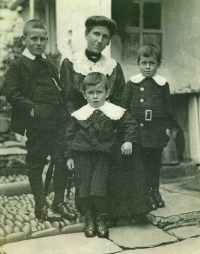 Merelda Badcock née Dunn is a mariner’s wife, whose life has been shaped by the rugged North Devon coast. She was born in Clovelly, into a seafaring family, on 3 March 1882 and married Frank Badcock in 1905. Over the years, she watched her menfolk risk their lives on the ocean. Her three sons were all born in a small Clovelly cottage. We meet her at the end of the book, when, desperate for food, her husband, having just returned from the war, puts out to sea on New Year’s Day. Merelda is left waiting anxiously on the shore, as her husband’s fishing boat, the Annie Salome, sets off into a storm.
 The military hospital that was set up in the Town Hall in Torquay at the beginning of the First World War was one of the largest in the country. The climate in Torquay was thought to be particularly suitable for convalescing soldiers and there were a number of other hospitals in the town. The hospital is mentioned in Chapter 10 of Barefoot on the Cobbles as Daisy’s friend Winnie has been working there as a VAD nurse. Unlikely though they may sound, Winnie’s experiences, that are described on pages 200-201, are based on the memoirs of a real volunteer at the hospital. Although family information suggests that Daisy nursed whilst she was in Torquay, there is no record of her having been attached to the Red Cross as a VAD, in the Town Hall Hospital or elsewhere. I have therefore given her a slightly different role.
 Daisy is arguably the heroine of


 In the novel, Rose Cottage is the home of William and Mary and their two adult sons. We encounter the Cottage and its inhabitants in the first chapter of
  Captain William Pengilly has long since met with an unfortunate end by the time he is mentioned in Chapter 7 of
  The Independent Order of Rechabites is a friendly society, founded in 1835. These societies provided a form of health insurance and death benefits to members in the era before the welfare state. The village inn was often the focus for friendly societies, who might have a dedicated Club Room in the local hostelry. By contrast, the Rechabites upheld the values of the Temperance Movement. It does seem however that the Clovelly branch did have an association with the New Inn.
 The History Interpreter - Janet Few