#100daysofbfotc Day 45: Richard Wakely

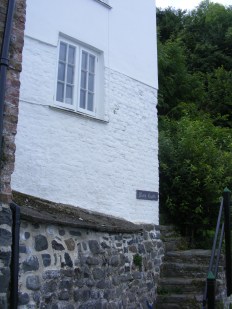
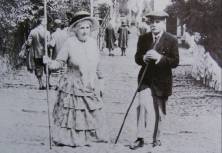
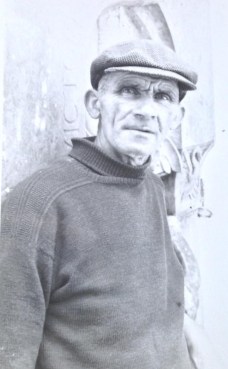
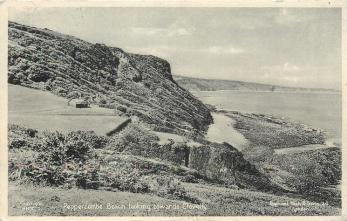
Peppercombe‘Richard’ Wakely is one of the characters in Barefoot on the Cobbles whose christian name had to be altered to avoid confusion. In real life, he was named William and he lived in the hamlet of Peppercombe. Born in 1835, he began his working life as an agricultural labourer and around the time of his marriage to Eliza Found in 1860, he trained as a ship’s carpenter. In order to ply his trade with Waters’ boatbuilders in Appledore, he walked in to town each week, returning to his family at weekends. William was still working in his late seventies even though he would have been eligible for an Old Age Pension.

The Wakelys had a son and five daughters who survived infancy, two others died as babies. William himself died at the age of 95, in 1931.

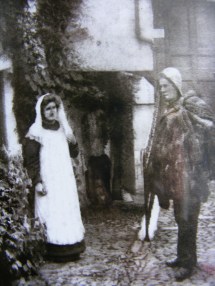
Her father’s tar-stained holdall was slung across his shoulder and thudded on his back with each successive step. It receded into the distance, as he gained more ground. Richard seemed unaware of his daughter’s presence, let alone her exertions. Lost in thought, he spat a plug of tobacco into the bank and kept his gaze firmly forward, glad that the heat of the day was abating for the journey. Richard contemplated the long walk ahead of him.’

Barefoot on the Cobbles will be published on 17 November 2018. More information about the novel can be found here. Copies will be available at various events in the weeks following the launch or can be pre-ordered from Blue Poppy Publishing or the author.

#100daysofbfotc Day 44: Captain Thomas Powell

Captain Thomas Folliott Powell was a gift to an author looking for interesting minor characters. He appears only briefly, in chapters 2 and 3 of Barefoot on the Cobbles, yet his behaviour has ramifications that echo through the remainder of the novel. When I first discovered that Polly had been a domestic servant at Chudleigh Villas and that the Powells had advertised for a servant in the local press at the appropriate time, I decided that they made a perfect match. On further investigation, the Powells’ story opened up several opportunities.

The position of troops during the mutiny – wikimedia

Thomas Folliott Powell was born on 3rd August 1834 in Newport Pagnell, Buckinghamshire, the son of William Powell, a solicitor and his wife, Eliza née Miller. The family descended from minor gentry. Thomas bought a commission in the army in 1853 and served in South Africa, the East Indies and India. As a Captain of the 6th regiment of foot, he was involved in the Indian Mutiny of 1857-9. Thomas retired from the army in 1865 and was able to sell his commission for £2500.

There is some confusion about the name of Thomas’ wife, who appears in the novel as Emily but who was in reality Mary Jane Winter (known as Amy), who had been born in the East Indies. They married in London in 1868. Four daughters and a son were born between 1876 and 1882. We can only speculate why there were no children during the first eight years of the marriage. EDIT I have now discovered that there were also two other sons who died in infancy; one was born in 1874 but that still leaves a long gap before the birth of the first child.

The family moved to Chudleigh Villas, Bideford in the late 1880s. Thomas seemed unable to match his lifestyle to his income and he was supported by his widowed mother, who provided the furnishings in their home and made them an allowance of £300 a year. Thomas had first been declared bankrupt in 1883, when he was living in the Plymouth area. He squandered the money he had made from his commission and it seems that a gambling addiction was a major contributor. His father had, perhaps wisely, left Thomas nothing in his will and when we meet him in the novel, Thomas is once again in financial difficulties. The family downsized to Ford Cottages, in New Road, Bideford. His second bankruptcy was annulled in 1898 and Thomas died in Portsea, Hampshire the following year.

‘ Mrs Powell regained her composure and resumed her tirade, ‘Why couldn’t you just have found enough to pay off Mr Tardrew? If you’d only done that, all this might have been avoided. Then there’s that money you owe to Tanton’s Hotel, how could you have run up such a bill? Your mother has been more than generous, we should be able to live comfortably on the three hundred pounds a year that she gives us. What on earth will she think? We cannot expect her to keep making us an allowance if you are such a spendthrift. It is no wonder that your brother has washed his hands of you.’

‘What’s done is done, eh Emily,’ Captain Powell replied. ‘Like as not I shall be declared bankrupt again.’ ’

Barefoot on the Cobbles will be published on 17 November 2018. More information about the novel can be found here. Copies will be available at various events in the weeks following the launch or can be pre-ordered from Blue Poppy Publishing or the author.
#100daysofbfotc Day 43: Clovelly, Rat’s Castle

DSCF0708Rat’s Castle, a tiny two-roomed property near Clovelly Quay, makes a brief appearance in Barefoot on the Cobbles as it was Albert and Polly’s first marital home. This cottage was frequently allocated to Clovelly newly-weds, two rooms being all that they required. Tenancies were often short; as soon as the family began to arrive they would be moved on to a larger home. The origins of its name are unknown but presumably the cellars attracted rodents.
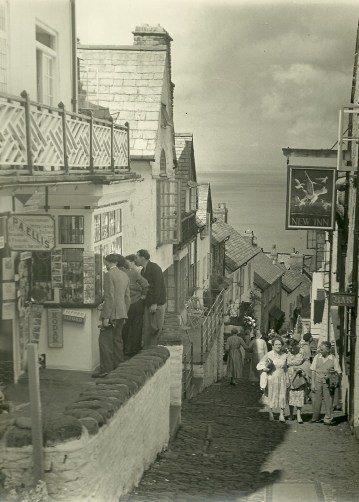
‘They had been granted the opportunity of renting the two-roomed cottage known as Rat’s Castle. This tiny dwelling near the quay was reserved for newly-weds and it had suited them well for the past year.’

Barefoot on the Cobbles will be published on 17 November 2018. More information about the novel can be found here. Copies will be available at various events in the weeks following the launch or can be pre-ordered from Blue Poppy Publishing or the author.


#100daysofbfotc Day 42: Mr Ellis

scan0002Mr Ellis does not appear in Barefoot on the Cobbles in person but his shop is part of the Clovelly village streetscape. John Ellis was born in Peterborough in 1854 and began his working life as an apprentice to a printer and stationer. In his twenties he described himself as an artist but it seems that he could not make a living from this and later, he worked for a woollen drapery in the town. It is not known how he met his wife, Alice Jewell from Clovelly. It is likely that John joined other visiting artists who were attracted by Clovelly’s picturesque street. He and Alice settled in Clovelly after their marriage in 1900 and they had one son, Paul. Although he preferred to be out in the street painting, John Ellis ran a High Street shop, selling artists’ materials and photography equipment, amongst more general items. His son later took over the shop and became a well-known photographer, being responsible for many of the scenes depicted in north Devon postcards.

‘ ‘Ellis’ shop is just down there on the left,’ Daisy said, more confident now. No one could be angry at her politely giving directions to trippers. ‘Mr Ellis is a bit of an artist himself, I am sure he would have what you need.’ ’

Barefoot on the Cobbles will be published on 17 November 2018. More information about the novel can be found here. Copies will be available at various events in the weeks following the launch or can be pre-ordered from Blue Poppy Publishing or the author.

#100daysofbfotc Day 41: Mrs Hamlyn

Christine Hamlyn

Mrs Hamlyn is the owner of Clovelly at the time in which Barefoot on the Cobbles is set. She is there in the background, impacting upon the lives of those who live on the cobbles. She is both a generous benefactoress and an intimidating member of the upper class, with family connections amongst the social elite of the day.

Christine Louisa Hamlyn Fane was born in 1855, the daughter of Lt. Col. Henry Hamlyn Fane and his wife Susan. She inherited the Clovelly estate in 1884 and married Frederick Gosling five years later; they both took the surname Hamlyn. She was an iconic Lady of the Manor and was responsible for major renovations of the Clovelly cottages. Her annual Christmas gifts to her tenants are mentioned in the local press; haunches of venison were frequently given. It is said that, if she found rubbish on the cobbled street, she would push the offending item with her cane until it reached the nearest door. She would then open the door and tap the litter inside. When she died in 1936, the villagers mourned her passing. As she was childless, the estate passed to her niece Betty.

‘The diminutive figure of Mrs Hamlyn appeared, her ebony cane scratching on the gravel path as she led her guests towards the ivy-clad church.’

Barefoot on the Cobbles will be published on 17 November 2018. More information about the novel can be found here. Copies will be available at various events in the weeks following the launch or can be pre-ordered from Blue Poppy Publishing or the author.

#100daysofbfotc Day 40: Bertie

Bert Braund taken by Jim Willis

Taken by Jim Willis

Bertie’s presence in Barefoot in the Cobbles provides an opportunity to examine yet more facets of Albert and Polly’s brand of parenthood. Their second son, Bertie was born in 1900 and he spent much of his life in Clovelly, working on his father’s fishing boat. In today’s world, Bertie might have been labelled as having mild learning difficulties. A family story tells of how, as a schoolboy, he used to hold the donkeys and walk the unladen beasts up and down the street, when the visitors had finished their rides. Any silver coins he received as tips had to be handed to  his parents but bronze and copper were his to keep. After the deaths of his parents, Bertie went to live with his sister Violet in Bideford. He died in 1969.

‘The doctor looked at Bertie appraisingly.

‘Hello young man,’ he said. ‘You look just the age for my Scout Patrol. Have you heard of the Boy Scouts? I am sure you would enjoy the jolly times we have. We are off to camp in a week or two. What do you think of that?’

Bertie looked desperately at his mother for guidance. How on earth should he respond to this gentleman? He might have been speaking a foreign language for all Bertie understood of the words.

‘Oh no, sir,’ exclaimed Polly in horror. ‘Not Bertie sir, he’s well…. He’s not the sort for being away from home, camps and the like, no, no, no it would never do for Bertie.’ ’

Barefoot on the Cobbles will be published on 17 November 2018. More information about the novel can be found here. Copies will be available at various events in the weeks following the launch or can be pre-ordered from Blue Poppy Publishing or the author.

#100daysofbfotc Day 39: King’s Cottage, Bucks Mills

King's Cottage coloured postcard

King’s Cottage, Bucks Mills is the home of Albert and Eadie’s grandparents. We get a glimpse inside in the first chapter of Barefoot on the Cobbles.

On 27 January 1845, Reverend John Thomas Pine Coffin, the landowner, had entered into an agreement with Albert’s grandfather, James, giving him permission to build ‘a house over the watercourse at the machine platform at Buckish, Parkham’. This land was adjacent to James’ father’s home. The new house was to become King’s Cottage and the rent was one shilling a year. By the time we open the front door of King’s Cottage in the novel, the family have lived there for forty five years. They were to remain there for a further twenty years. It was a substantial cottage, with a view over the bay and unique plumbing arrangements, which are mentioned in the book. Kings Cottage was described in the North Devon Journal in 1855, the house ‘at the lower extremity of Bucks, on a towering height above the beach, is a real curiosity. The rivulet that comes down between the hills, by and under part of his eagle’s nest premises, discharges itself in a cataract on the beach where it flows into the Atlantic.’

After the family left, it was tenanted by a relative of Clementine Churchill.

‘Even the gate was exciting, having, as it did, a ship’s wheel at the centre. Eadie’s small fingers would proudly trace the name that was engraved in the wooden frame: King’s Cottage. She smiled; her granfer was a king.’

More information about Bucks Mills can be found here.

Barefoot on the Cobbles will be published on 17 November 2018. More information about the novel can be found here. Copies will be available at various events in the weeks following the launch or can be pre-ordered from Blue Poppy Publishing or the author.

#100daysofbfotc Day 38: Oscar Abbott

DSCF0706

Oscar and his sister Emily

Oscar Abbott appears only fleetingly in Barefoot on the Cobbles yet he was a well known person in the Clovelly fishing community. Born in the village in 1887, son of Sydney and Mary Elizabeth Abbott nee Burnard Oscar grew up in Chapel Street. He married Mary Moss in 1917 and they had seven children, six of them within the first seven years of marriage. As a fisherman, Oscar had a reserved occupation during the First World War, as he was providing essential food. The Abbotts later moved to 12 High Street, Clovelly and Oscar served as a special constable in World War 2. He died in 1976.

‘With the keen sight and instinct of a fisherman, Oscar was the first to spot the speck on the lurching waves.

‘Oh, God,’ he groaned, the rare blasphemy a sign of his anguish. ‘’Tis the Annie Salome.’ ’

Barefoot on the Cobbles will be published on 17 November 2018. More information about the novel can be found here. Copies will be available at various events in the weeks following the launch or can be pre-ordered from Blue Poppy Publishing or the author.


#100daysofbfotc Day 37: Mark

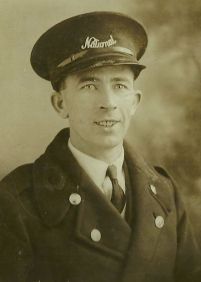
Mark Braund bus conductorGrowing up in Clovelly, Mark was the fifth child in a family of eight. With so many other characters to write about, I did consider leaving Mark out of Barefoot on the Cobbles, yet I found that he needed to be there. Not only would his absence have left an unexplained gap in a run of evenly spaced children but what happened to Mark provided yet another strand that explained the subsequent behaviour of his mother, Polly.
Born in 1906, Mark resisted the lure of the sea and worked for the National Bus Company as a conductor and then a driver. In 1931, he was the conductor on a bus travelling through Horns Cross, when one of the passengers, Joseph Daniels, was killed as he alighted from the bus. No blame was attached to the driver, who was a distant cousin of Mark’s.

In 1935, Mark married Dorothy Good but he fell ill shortly afterwards and died in 1941. The couple had no children. Dorothy outlived him by over sixty years.

 ‘Polly pushed open the door to the bedroom where the boys slept. It always smelled musty, as only a boys’ room can. The clothes Mark had discarded the previous night were pooled on the floor next to the bed that he shared with Nelson. Polly passed her hand across the lad’s forehead. It felt clammy to the touch.’

Barefoot on the Cobbles will be published on 17 November 2018. More information about the novel can be found here. Copies will be available at various events in the weeks following the launch or can be pre-ordered from Blue Poppy Publishing or the author.

#100daysofbfotc Day 36: Independent Street, Clovelly

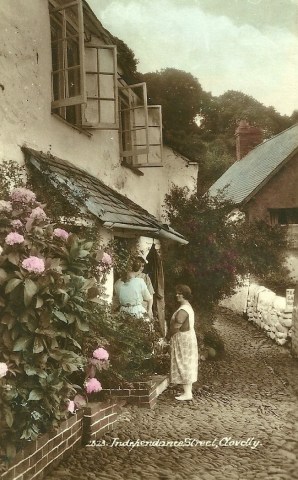
Independent Street Flossie Harris on rightIndependent Street, one of Clovelly’s few side streets, first appears in the pages of Barefoot on the Cobbles when Mrs and Mrs Collins arrive as paying guests in the home of Mrs Stanbury.

There isnt much to be said about a single street, an ordinary street, yet the incidents that took place there are the inspiration for the novel. Those houses, those inhabitants and a particular set of circumstances, all contributed to an appalling tragedy.

‘The path divided; Jack and his sledge swung to the right. Amelia was roused from her musings as they drew up at the far end of a row of cottages. Bright hollyhocks framed the newly painted door and the brass knocker shone.

 ‘You there Mrs Stanbury?’ bellowed Jack, rapping vigorously with the knocker. ‘Your guests be ’ere.’ ’

Barefoot on the Cobbles will be published on 17 November 2018. More information about the novel can be found here. Copies will be available at various events in the weeks following the launch or can be pre-ordered from Blue Poppy Publishing or the author.