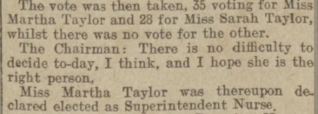
#100daysofbfotc Day 56: Louisa Taylor

Western Times 2 September 1915

Western Times 2 September 1915

Louisa Taylor was the superintendent nurse at the infirmary attached to Newton Abbot workhouse. It is her attitude that contributes to Albert’s sense that everything is slipping terrifyingly out of control. Although we know some of the actual words that she spoke during the trial, we know very little about her. So few clues and the surname Taylor make her very difficult to research. Although the newspaper reports of the incident that leads to her appearance in Barefoot on the Cobbles consistently refer to her as Louisa, she was probably Martha Louisa Taylor and was appointed in 1915, three years before her appearance in the book.

It is likely that she was born in Bitton, Gloucestershire on 1 January 1876 to George and Mary L Taylor; her father was a coal miner. In 1911, Martha Louisa was working as a charge nurse at the workhouse in Kenninghall, Wayland, Norfolk. She remained at Newton Abbot workhouse until at least 1929 but she later retired to Keynsham, Somerset, where she shared a home with two other retired nurses. She died in Somerset in 1958. She is just the sort of character who it is a privilege to have included, as she as no descendats to honour her memory.

‘Louisa Taylor, the superintendent nurse at the infirmary, took Albert into a cramped office. Black-covered ledgers lined the walls and untidy papers trickled over the desk. The nurse, in her sharply starched uniform, moved a pile of books from a chair and bade Albert sit down. She was a woman past middle age, with a plain but pleasing, lined face and iron grey hair. Her brisk efficiency was at odds with the state of her surroundings.’

Barefoot on the Cobbles will be published on 17 November 2018. More information about the novel can be found here. Copies will be available at various events in the weeks following the launch or can be pre-ordered from Blue Poppy Publishing or the author.

#100daysofbfotc Day 55: Clovelly Church

1 April 2012 Clovelly ChurchyardDespite many of the main characters being Methodists, Clovelly Church appears in several key scenes in Barefoot on the Cobbles. It is here that the incident involving the suffragettes begins and here that we witness two funerals. On New Year’s Day, All Saints was also the venue of the annual ‘Club Service’, attended by members of the Friendly Societies.

This twelfth century church is at the top of the hill, away from the cobbles and close to Clovelly Court. There had been a timber-built place of worship on this site before the current church was built. The impressive roof is part of the renovations that took place in the fourteenth century. Further additions took place in later centuries.

‘Leonard shifted his body to gain himself a few extra inches of space and clutched the slightly damp, well-worn hymn book. The distinctive smell of steaming wet worsted pervaded the air. Reverend Simkin sonorously announced the first hymn. Tom Finch, during the week the rector’s gardener but proud organist on a Sunday, began to play, with more regard to volume than melody. Oh God our Help in Ages Past, comfortably recognisable to Methodists and Anglicans alike.’

Barefoot on the Cobbles will be published on 17 November 2018. More information about the novel can be found here. Copies will be available at various events in the weeks following the launch or can be pre-ordered from Blue Poppy Publishing or the author.

#100daysofbfotc Day 54: Mr Lefroy

Scales_Of_Justice.svgGeorge Frederick Lefroy appears in the court scenes at the beginning and end of Barefoot in the Cobbles. He is the solicitor for the defence, so plays a significant role in determining the outcome of the trial.
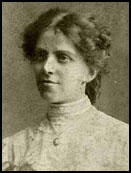
He was born in Bristol on 15 February 1882, the son of Reverend Frederick Anthony and Henrietta Lefroy née Gurney. By 1904, George was serving with the 1st Gloucesters, Royal Garrison Artillery Volunteers as a Second Lieutenant. George married Isobel Elaine May Beaman in Eastbourne, Sussex in 1908 and had one son. In the First World War he was a Lieutenant in the Royal Field Artillery. He was invalided out and was awarded the Silver War Badge. The Lefroys lived at Orchard House, Pilton in Barnstaple and he set up in partnership with Mr Seldon. He died in 1938.

‘Mr Lefroy rearranged his papers. He wanted this strange little lady to go free and not just because it would enhance his professional reputation. He prided himself on his ability to represent and take seriously, the cases of the downtrodden and Polly was certainly that.’

Barefoot on the Cobbles will be published on 17 November 2018. More information about the novel can be found here. Copies will be available at various events in the weeks following the launch or can be pre-ordered from Blue Poppy Publishing or the author.

#100daysofbfotc Day 52: Jessie Kenny

Jessie Kenney 2Jessie Kenny was one of three suffragettes who played a key role in an incident that is described in Chapter 5 of Barefoot on the Cobbles. Jessie was one of twelve children; she was born on 1st April 1887, in Springhead, near Oldham and she worked in the local cotton mills. Together with her elder sister, Annie, she was inspired to take up the cause of women’s suffrage after hearing Christabel Pankhurst speak in 1905. The sisters joined the Women’s Social and Political Union. At this time Jessie was still in her teens but having learned to type at evening classes, she was soon serving the cause as secretary to Emmeline Pethick-Lawrence. A month in prison in 1908 damaged Jessie’s health, yet she continued to be active within the movement, which is how she came to be in North Devon in 1909, haranguing the Prime Minister, not for the first time.
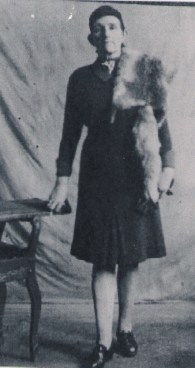
After re-couperating in Switzerland, she reputedly had a lung condition, Jessie spent time in Paris, living with Christabel Pankhurst. She also went to Russia to help Emmeline Pankhurst mobilise Russian women to contribute to the war effort. When the First World War was over, she worked for the American Red Cross in Paris. She went to North Wales Wireless College and qualified as a ship’s radio officer, the first woman to do so however women were not allowed to take up this role. Instead she worked as a steward on cruise liners. Later she took up a post in the office of a school in Battersea. She died in Essex at the age of 98.

‘Suddenly the sharp-eyed police constable noticed the three women. Blowing his whistle and calling to his colleague, he made his way towards the suffragettes at a trot. The young ladies leapt up. With hats falling and hair flying, they headed for the cliffs. As the constable set off in pursuit, the women wisely dispersed in different directions.’

Barefoot on the Cobbles will be published on 17 November 2018. More information about the novel can be found here. Copies will be available at various events in the weeks following the launch or can be pre-ordered from Blue Poppy Publishing or the author.

#100daysofbfotc Day 51: Eadie

EadieEadie is another character who had to undergo a name change to avoid confusion. She appears in only three chapters, near the beginning of Barefoot on the Cobbles, yet her role is an important one. It is through Eadie that we first glimpse how Albert might react to parenthood. Her story has been handed down through the family and is told in the novel with little elaboration.

Eadie was born on 14 May 1884 into a large family, who lived in what was then called Ivy Cottage, Bucks Mills; the history of the cottage will be posted in a couple of days’ time. Her father was a fisherman, known as ‘Crumplefoot Tommy’. Her mother, Ellen, struggled to cope and when Eadie was about six, she was informally adopted by Ellen’s brother, William and his wife Mary. From that point onwards, Eadie spent her whole life living in Rose Cottage in Bucks Mills. She married her first cousin, Walter in 1908, amidst a certain amount of disapproval because of their close kinship; they were in fact cousins several times over as Eadie’s parents were also first cousins. Eadie cared for William and Mary in their old age but somehow found room for eleven children in the tiny four-roomed cottage. Walter died in 1938, when the youngest child was only eleven and Eadie died in 1955.

‘On the step of Captain Joe’s substantial house sat a weeping child, dishevelled and dirty, her tears tracked by the grubby smears on her sun-stained cheeks. A young fisherman was walking towards her, on his way up from the shore. As Albert approached, the girl’s hand scrubbed across the bottom of her nose and she sniffed heartily. The other hand failed to push her dark hair from her eyes. Her faded ribbon had long since ceased to perform its duty.’

Barefoot on the Cobbles will be published on 17 November 2018. More information about the novel can be found here. Copies will be available at various events in the weeks following the launch or can be pre-ordered from Blue Poppy Publishing or the author.

More information about Bucks Mills can be found here.

#100daysofbfotc Day 50: Mr Moss

Clovelly Harbour 1912John Thomas Moss appears only obliquely in Barefoot on the Cobbles, as the proprietor of the Red Lion Hotel on Clovelly’s quayside. He was born in Clovelly on 22 October 1868, the son of John and Mary Moss née Foley and spent his childhood living at North Hill. Initially, he followed his father’s trade and went to sea. John married Lizzie Arthur Slocombe, in 1893, in Ilfracombe and the eldest of their two daughters was born there. They set up home back in Clovelly, at 15 High Street and when he came ashore, John managed the Red Lion. He died 1951.

‘The members of the Mariners’ Union repaired to The Red Lion for their repast, which would be accompanied by beer, or even whisky. The Club Room had been suitably decorated with garlands of greenery and candles for the occasion. Mr Moss’ staff were on hand to serve a roast dinner, befitting of the status of those on the top table.’

Barefoot on the Cobbles will be published on 17 November 2018. More information about the novel can be found here. Copies will be available at various events in the weeks following the launch or can be pre-ordered from Blue Poppy Publishing or the author.

#100daysofbfotc Day 49: Will Harding

William HardingAs we meet Will Harding, in the penultimate chapter of Barefoot on the Cobbles, he is on his way home from a tour of duty on a merchant ship, just after the end of the First World War. Harding is the forgotten victim in a Clovelly tragedy whose tale is oft told. Whereas the event, which is included in the novel, acknowledges his companion, Harding’s name is not usually mentioned. It was only when researching for the book, I realised that two men were involved. I will hold my hand up to Will’s age being wrong in the novel. I could pretend that there was some valid literary reason for this but then you might ask me what that was. In my defence, Will is very vague about his age on official documents but I can’t justify why I chose to use the incorrect one.
William Robert Harding was actually born in Clovelly in 1882, son of Richard and Mary Ann Harding née Whitefield. Both families had a long seafaring tradition and Will joined the merchant service. He married Rosa Evelyn Jenn in 1903 in Cardiff and they had a son and three daughters. He served on a number of ships together with other Clovelly men.

‘Weary and apprehensive, Leonard hauled his kit bag on to the cart and hunched down next to Will Harding, an experienced sailor who looked older than his thirty four years, with weather-hewn face and prematurely balding pate hidden under a cap. Will was a family man, eager to get back to his pretty wife, his near-grown son Billy and three little girls.’

Barefoot on the Cobbles will be published on 17 November 2018. More information about the novel can be found here. Copies will be available at various events in the weeks following the launch or can be pre-ordered from Blue Poppy Publishing or the author.

#100daysofbfotc Day 48: Mary Pickford

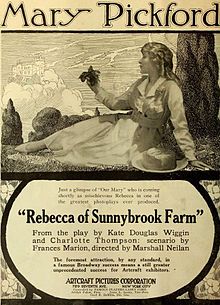
Rebecca_of_Sunnybrook_FarmMary Pickford finds her way on to the pages of chapter ten of Barefoot on the Cobbles, when Daisy visits the cinema, or picture palace. I needed a suitable film for Daisy and her friend Winnie to be watching in 1918. I was excited to realise that the first Tarzan film had recently been released and I was all set to send them off to watch that. Just in time, I discovered that this took eighteen months to reach the UK. I quickly substituted Rebecca of Sunnybrook Farm, which starred Canadian actress Mary Pickford. Like Daisy, I watched the film, although I had to rely on YouTube, so was deprived of the atmosphere of Torquay’s Pavilion cinema.

Mary’s real name was Gladys Louise Smith and she was born in 1892. She was one of the most famous leading ladies of the silent films of the 1910s and 1920s. Famous for her curly hair, she was known as ‘the girl with the curls’ but also as ‘America’s Sweetheart’ and ‘Queen of the Movies’. She grew up in Toronto, where her mother took in lodgers after being deserted by her alcoholic husband. One of the boarders was the stage manager at Toronto’s Princess Theatre and through him, Gladys was given small roles. In 1909 she was taken on by the Biograph Company and began churning out a film a week. By 1916 she had joined the company that was to become Paramount Pictures. Mary and her second husband, Douglas Fairbanks, were the celebrity couple of their day and when Daisy was watching her, Mary was at the height of her career. Her fame began to wane with the introduction of the ‘talkies’. Interestingly, Mary Pickford caught the Spanish flu in 1918 and as she leaves the cinema, Daisy begins to feel unwell…….

‘Winnie was impatient to see her idol, Eugene O’Brien, in Rebecca of Sunnybrook Farm. She hurried Daisy along, anxious that the crowds had made them late. Daisy was daydreaming of having wonderful curls, like the film’s heroine, Mary Pickford. She patted her own straight hair that was caught in a loose bun at the nape of her neck. She still hadn’t plucked up the courage to have it cut short.’

Barefoot on the Cobbles will be published on 17 November 2018. More information about the novel can be found here. Copies will be available at various events in the weeks following the launch or can be pre-ordered from Blue Poppy Publishing or the author.

#100daysofbfotc Day 47: Jack Foley


Donkeys going down

Donkey apparently going down the street

We meet Jack Foley in wartime Clovelly, when he is responsible for supervising the donkeys that transported goods up the cobbled street. As I was writing Barefoot on the Cobbles, Jack’s role in the novel resulted in a lengthy debate. I had composed a passage during which Jack led a laden donkey down the street. It was then pointed out me that donkeys only carried luggage up the street and the downward journey would be undertaken using a sledge. Regretfully, I re-wrote the passage. Then a photograph was found where a laden donkey appeared to be heading down. I regretted my re-write but it seems it was necessary after all, as I later learned that this was a posed photograph and not a reflection of real life in Clovelly.

The John, or Jack, Foley who appears in the novel was born in 1880 into a seagoing Clovelly family. John however remained ashore and became a carriage driver, almost certainly working for Mrs Hamlyn. In later life, perhaps due to the advent of motor transport, he worked as a general labourer. In 1903, he married Dorothy Wonnacott and spent most of his life living at 85 High Street, Clovelly. He died in 1962.

‘The Collins trailed a few paces behind their luggage as the lurching sledge negotiated the cobbles under the adept guidance of Jack Foley.’

Barefoot on the Cobbles will be published on 17 November 2018. More information about the novel can be found here. Copies will be available at various events in the weeks following the launch or can be pre-ordered from Blue Poppy Publishing or the author.


#100daysofbfotc Day 46: Mary – ‘Mrs William’

Mary, a fisherman’s wife, appears in the first chapter of Barefoot on the Cobbles. She is the first mother that we get to know in the novel and through Mary, we can experience a manifestation of motherhood that is rather different from those that are revealed in later chapters. Unlike most Victorian families, Mary has only two children, Albert and Fred. There is no evidence for any other live births but she may have suffered miscarriages. Of course, there could have been another reason for her untypical lack of fecundity. The story of how she opens her heart and home to young Eadie is a true one. Like a number of Bucks Mills’ wives, Mary was often known by the forename of her husband, to avoid confusion with others of the same surname, hence ‘Mrs William’.

St. Anne's Church (old postcard)

St. Anne’s, Bucks Mills

Mary’s post should really have been yesterday. She was born as Mary Jane on 22 September 1842 at Horn’s Cross, Alwington, Devon to Richard and Hannah Hamlyn née Lewis and she was the only child of their marriage. They were a farming family and Mary worked as a launderess; nonetheless, in 1862, Mary met and married William, a fisherman from the neighbouring parish. Theirs was the first marriage in the newly opened Anglican church at Bucks Mills. Their son, Albert arrived nine months later and his brother followed two years after that.

Mary lived at Rose Cottage in Bucks Mills for the last forty years of her life. She died in 1928.

More information about Bucks Mills can be found here.

Albert was explaining to his mother how he had rescued a distressed Eadie from the square.

‘Mebbe you stay here for a day or two maid, ’til your da calms down,’ said Mary.

There was reassurance in the words but who was the more comforted, Mary or this dark-visaged child with sadness in her soul? Mary turned to her son, who had unwittingly presented her with a few days of companionship.’

Barefoot on the Cobbles will be published on 17 November 2018. More information about the novel can be found here. Copies will be available at various events in the weeks following the launch or can be pre-ordered from Blue Poppy Publishing or the author.