#100daysofbfotc Day 67: Rosie

scan0006

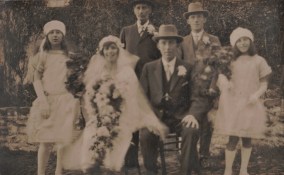
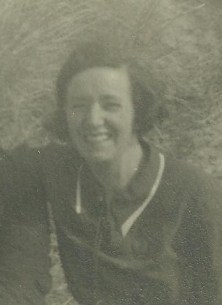
Rosie (left) and her sister Lily

Rosie was born in the last year of the peace and shared her birthday, 3 February, with her sister Lily. She was the youngest child in Polly and Albert’s family. The incident, in chapter 9 of Barefoot on the Cobbles, when Rosie fails to come home from school, is based on a real family story.

She married in 1936 and had one daughter but her husband died shortly afterwards, so Rosie returned to Clovelly to live with her parents. She spent the rest of her life in the village.

 Rosie ran indoors, oblivious of the commotion that she had caused. The good news rushed down the street faster than a flood tide. Villagers came to express their relief, or to check if the rumours of Rosie’s safe return were true.’

 Barefoot on the Cobbles will be published on 17 November 2018. More information about the novel can be found here. Copies will be available at various events in the weeks following the launch or can be pre-ordered from Blue Poppy Publishing or the author.

#100daysofbfotc Day 65: Bideford Pannier Market

Pannier MarketIn 1891, when Polly visits Bideford Pannier Market in the second chapter of Barefoot on the Cobbles, the new market building had only been open for seven years. It replaced an earlier market on the same spot and was designed, in particular for the butchers, in a designated Butchers’ Row and fishmongers. It was also the local corn exchange. The previous market had been owned by the Lords of the Manor but as they were disinclined to improve the building, the Corporation took responsibility. Market days were Tuesdays and Saturdays and attracted many traders and shoppers from the surrounding rural villages.

The building cost the ratepayers £4200 and it opened on 15 April 1884 amidst great celebrations. The area was bedecked with garlands and there was a peal of church bells, a gun salute and a mayoral procession. Other activities including a concert, a dinner for 200 town worthies, with food provided by the nearby (and now closed) New Inn. This must have been a protracted affairs there were many loyal toasts. The North Devon Gazette gives a detailed account of the proceeding and the attendees at the dinner. Later in the week there was a tea party for 2000 children.

Bideford’s market charter dates from 1272 and the Medieval market was in a different location, at the bottom of the High Street, near the river. The panniers, that give the market its name, are the woven baskets that would be slung either side of the backs of the donkeys and pack horses who brought the produce to market.

‘Tuesday brought market day, with its feverish hubbub and bustle. From early morning, eager sellers arrived with their produce, by rail, by cart, or with panniers slung across the back of a horse or a donkey. Farmers’ wives walked to the town from the surrounding villages to sell eggs, cheese or succulent pies. The smell of the butchers’ stalls with their carcasses of meat and hanging game, caught the throats of the more fastidious. Squawking chickens in stacked crates and the shouts of the stallholders, vied with the chatter of gossiping women and the squeals of children clamouring for sweetmeats.’

Barefoot on the Cobbles will be published on 17 November 2018. More information about the novel can be found here. Copies will be available at various events in the weeks following the launch or can be pre-ordered from Blue Poppy Publishing or the author.

#100daysofbfotc Day 64: Aunt Susan

Aunt Susan makes a brief appearance in Barefoot on the Cobbles. She was the first member of Polly’s family to move from rural North Devon to Bideford and was an inspiration to her nieces, making them aware that there was life beyond their birthplace. She was born about 1834, the daughter of Zechariah and Sally Found. Susan’s great grandfather was a foundling, hence the surname. He had been abandoned in the porch of Morwenstow Church more than a century before Susan’s birth. Time had done nothing to diminish the rumour that all the Founds were gypsies and the Found children were still snubbed in the neighbourhood. Susan spent her childhood in a cottage in the woods above Bucks Mills, which compounded the stories. Susan went into service in Parkham. Here she met Joseph Prance, a fisherman and they married in 1855. At first they lived with Joseph’s father in Peppercombe. In the 1870s, Joseph came ashore and together they ran a fishmonger’s shop in Mill Street, Bideford.

CaptureDespite having had eight children of her own, in 1890, Susan took in four grandchildren, following her eldest daughter’s death. Her, niece Lydia, was also living with the Prances. In later life, Susan lost her hearing. She went to live with her youngest daughter and her family in Bideford and died in 1924.
Aunt Susan greeted Polly warmly. ‘You’ll have to shout,’ she said, as Polly thanked her for letting her visit, ‘I’m a bit deaf now’.

Certainly her aunt had aged in the few years since Polly had last seen her. Apart from her own brood of girls, Aunt Susan was now custodian of two young grandchildren, following the recent death of Polly’s cousin.’

 Barefoot on the Cobbles will be published on 17 November 2018. More information about the novel can be found here. Copies will be available at various events in the weeks following the launch or can be pre-ordered from Blue Poppy Publishing or the author.

#100daysofbfotc Day 63: Mrs Harris

Mrs Margaret Harris is one of many Clovelly villagers whose lives are a backdrop to those of the main characters. Margaret’s neighbourliness leads her to become directly involved in the penultimate act of the Devon tragedy that is retold Barefoot on the Cobbles.

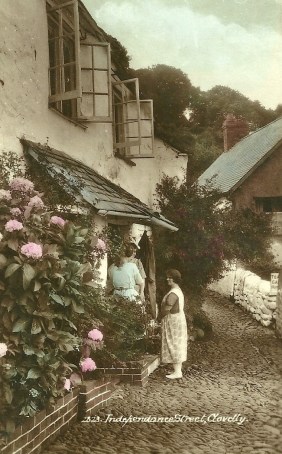
Independent Street Flossie Harris on rightMrs Harris was born Margaret Headon in Clovelly about 1853. Like many from Clovelly, she crossed the Bristol Channel and there she married James Harris, whose family also lived in Clovelly. With her husband away at sea, Margaret lived with her widowered father back in Clovelly. She became Polly’s neighbour in Independent Street, where Margaret ran a lodging house. Margaret and James had five children before James died in the 1890s. The Samuel Harris, who also appears in the novel, was the son of James Harris’ sister, Elizabeth. Margaret died in 1928.
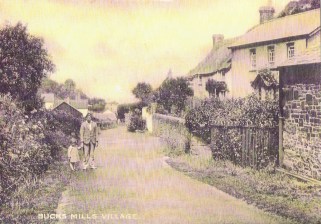
Briskly, Emma Stanbury took charge. Later, when the children clattered back from school, she shooed them off to be minded by Mrs Harris.’

Barefoot on the Cobbles will be published on 17 November 2018. More information about the novel can be found here. Copies will be available at various events in the weeks following the launch or can be pre-ordered from Blue Poppy Publishing or the author.

#100daysofbfotc Day 62: Aunt Ellen

Aunt Ellen was another minor character, in Barefoot on the Cobbles, who was fascinating to research. Like her sister, she spent time in the asylum at Exminster, contributing to her sister-in-law Polly’s dread of the institution. Although Eadie was a year old when Ellen was admitted, she was probably suffering from post-natal depression.

Mark's & Emily's

Mark’s Cottage in the foreground on the right

Ellen was the ninth child in a family of eleven and grew up in a fishing family at King’s Cottage, Bucks Mills. She was born on 11 June 1848 and married her first cousin, Thomas, ‘Crumplefoot Tommy’, in 1873. It appears that the first year of their married life was spent in the cottage now known as Mark’s, before they moved to Ivy Cottage. In the 1911 census, Ellen states that she had ten children but only nine have been identified; three of these died young. Her mental ill-health was probably a contributing factor to her willingness to hand her daughter, Eadie, to her brother to be brought up. Ellen died on 22 January 1919.

 Polly felt frozen fingers grip her heart. She was well aware that Matilda’s sister, Albert’s Aunt Ellen, had spent nigh on a year in the asylum, when Eadie had been a year old. They’d blamed that on child bearing. Polly glanced involuntarily at Nelson in his cradle. Was she immune to this affliction that struck at mothers unawares?’

 Barefoot on the Cobbles will be published on 17 November 2018. More information about the novel can be found here. Copies will be available at various events in the weeks following the launch or can be pre-ordered from Blue Poppy Publishing or the author.


#100daysofbfotc Day 61: Fred

Alfred Braund - Clovelly lifeboat coxwainFred, Albert’s younger brother, is referred to briefly in Barefoot on the Cobbles. In reality, he was Alfred, known as Alf but I felt that this was too similar to Albert, so I opted for the alternative abbreviation. Like Albert, Alfred moved from his Bucks Mills birthplace to Clovelly. He married there and had two children. He was an active lifeboatman and was coxswain for a number of years.

 Albert and Fred, uneasy in their Sunday clothes, would be fidgeting restlessly, aware that there were nets to mend or pots to make but knowing that these were not tasks for the Sabbath.’

Barefoot on the Cobbles will be published on 17 November 2018. More information about the novel can be found here. Copies will be available at various events in the weeks following the launch or can be pre-ordered from Blue Poppy Publishing or the author.

#100daysofbfotc Day 60: Lydia

Lydia, Polly’s overpowering elder sister, makes a brief appearance in Barefoot on the Cobbles and had a part to play in furthering the relationship between Albert and Polly. Her imperious nature highlights the attraction of Polly’s less assertive personality and it is Lydia who draws Polly to Bideford. This physical separation from Albert helps Polly to reassess her feelings.

Lydia Wakely was born in Peppercombe in 1868 and was the eldest of the five surviving daughters. She moved to Bideford to work as a dressmaker, the only one of the sisters who appears to have had a trade. In the novel, her employer was Mrs Newman, who was indeed a local dressmaker but there is no evidence for the identity of Lydia’s real life employer. I tried to give Lydia a personality that matched the facts. She saw two of her younger sisters marry before her, finally securing a husband at the age of thirty. Her spouse, William Jenkins, was a carpenter and they lived initially at Wood Cottage in Landcross. By 1911, however they were living in an 11 room home in Bay View Road, Northam and employing a live-in servant. This and her childlessness, was very different from Polly’s experiences. Lydia died in 1929.

Capture

‘ ‘I’m Miss Wakely, Lydia Wakely,’ she said, ‘and these are my younger sisters, Jane and Polly.’

The emphasis on the word younger did not escape Albert. Miss Wakely was clearly expecting that Albert would consider her sisters too childish to warrant notice.’

 Barefoot on the Cobbles will be published on 17 November 2018. More information about the novel can be found here. Copies will be available at various events in the weeks following the launch or can be pre-ordered from Blue Poppy Publishing or the author.

#100daysofbfotc Day 59: Violet

Walter Daniel and Violet Braund Wedding

Violet’s Wedding to Walter Daniel

It might be hard to believe that I tried to cull my cast of thousands in Barefoot on the Cobbles but I did and Violet was one of the candidates. She remained in the novel’s pages for two reasons, firstly because to expunge her would have left an unnaturally large gap in Albert and Polly’s family. More importantly, I needed to use the true story of her illness to explain Polly’s reaction to her other children’s ill-health. My interest in the history of medicine meant that I enjoyed researching symptoms and the likely treatments of the time.

Violet was born on the 12 June 1903 in Clovelly. She suffered from rheumatic fever as a child and was never very strong. She married Walter Daniel in 1925 and lived firstly in Upper Clovelly and later in Bideford; the couple had no children but her brother, Bertie, lived with the Daniels after the death of his parents. Violet died in 1977.


The next days were a frenzy of fear, as Violet lay, feverish and lethargic, in the bed that she shared with Daisy. Daisy squeezed in with the boys, so that Violet was undisturbed but still the little girl whimpered and moaned. Reluctantly, they sent for Dr Ackland, whose solemnity betrayed the seriousness of Violet’s condition. 

Barefoot on the Cobbles will be published on 17 November 2018. More information about the novel can be found here. Copies will be available at various events in the weeks following the launch or can be pre-ordered from Blue Poppy Publishing or the author.


#100daysofbfotc Day 58: Torre Station, Torquay

Torre StationIn Barefoot on the Cobbles Torre Station in Torquay is both a gateway and a meeting point. It is here that Daisy alights to begin her new life. It is here that the many wounded soldiers arrived for transfer to the hospitals and nursing homes of Torquay; in this way it is where Daisy’s world collides with the horrors of the Western Front. Torre Station is also where Polly passes through on her way to confront her feelings for her daughter.

I studied the early twentieth century railway network, to try to get details of Polly’s journey to Torquay correct. I even used genuine train times, although I suspect that these may have been disrupted by the needs of the war. I was writing about an era when the railway was the predominant means of transport. So it was important that there should be train journeys in the novel. The journeys I describe were taken in real life and would have been lifechanging for the characters that undertook them.

‘Torre Station was small, more like Barnstaple but it still pulsed with hectic life, hypnotising Polly into inaction. Reminders of the war were ever-present. Each person carried with them the scars of the past four years; the age had marked them all. Anonymous, khaki-clad Tommies, with their old men’s unfathomable eyes staring from the bodies of boys. Bold young women, their shorter hem-lines and bobbed hair, reflecting a new freedom.’  

Barefoot on the Cobbles will be published on 17 November 2018. More information about the novel can be found here. Copies will be available at various events in the weeks following the launch or can be pre-ordered from Blue Poppy Publishing or the author.

#100daysofbfotc Day 57: Annie

Barefoot on the Cobbles is emphatically not a romance, yet it is a novel about people and people have relationships. Annie appears as a love interest for Leonard. There is an argument for removing the whole story of their courtship from the novel but I feel that it needs to be there. Leonard is not a principal player in the main events and as such, can give a different perspective. Annie is the vehicle for exploring a relationship that contrasts with Daisy’s association with Abraham.

Mary Ann (Annie) Stoneman was just a Victorian, being born twenty days before the death of Queen Victoria. She was the fifth child in a family of ten and five of her siblings died as infants. Her father, Sidney, was a labourer and the family moved frequently. Annie was born at Bulland in Parkham and as a small child spent time living with her mother’s grandmother in Clovelly. She later went to school in Monkleigh. In 1909 the family spent a few months living at Rakeham Toll House, near Torrington and Annie transferred to Frithelstock School. A family story relates that a tramp was found on the doorstep of the Toll House with his throat cut. This may be why they only spent a few months there before before moving again to Bideford, where they lived at Brookfield Terrace, East the Water.

Image (3) - CopyWhen her step grandfather died, Annie was sent to Clovelly to help her maternal grandmother, Mary Ann Smale, in her Clovelly tea-rooms. It is here that we and Leonard, first meet her. I don’t want to give away too much of her story but she did marry and brought up her family in Bideford. She died there at the age of 97.

‘As Leonard drew level with the small panes of blemished glass his eye was drawn by a sudden movement within. Enveloped in a large, wrap-round apron, a slender girl was in the window, dusting the deep sill and readying it for the day’s display of cakes.’

Barefoot on the Cobbles will be published on 17 November 2018. More information about the novel can be found here. Copies will be available at various events in the weeks following the launch or can be pre-ordered from Blue Poppy Publishing or the author.