Rain

There has been torrential rain all night and today is no different. We learn later that a month’s worth of rain fell today, probably all where we were. I decide against doing our washing before we set off for the day. I could probably have just hung it up outside for a thorough rinsing. As we leave the site we spot a sign for the local pub. Apparently it serves real food, that’s a relief, if a somewhat strange concept – along the lines of real ale I suppose. We drive through the Grizedale Forest, deliberately taking the pretty route to our destination and ignore the somewhat interesting suggestions by the Sat Nav.

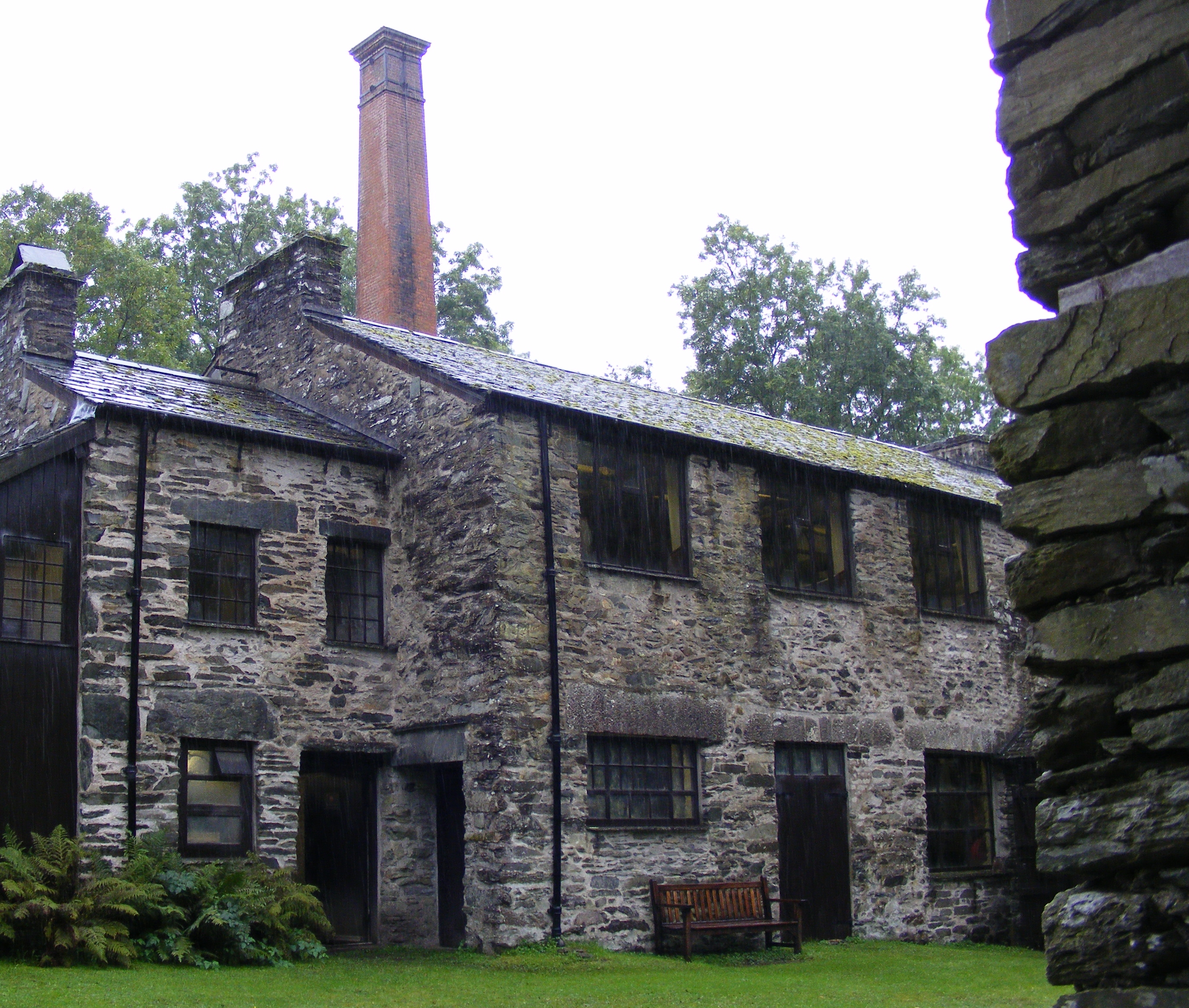
We arrive at Stott Park Bobbin Mill where we have a fascinating tour. Open from 1835-1971, it turned bobbins for the Lancashire cotton industry. It was one of hundreds of mills in the southern part of the Lake District where the running water to power the mills was sited near wood that could be coppiced to produce the bobbins. In the hey day of cotton production, in the early C20th, twenty Oldham cotton mills required a million bobbins each to operate and these were used once only. This constituted 20% of the spinning capacity of the UK and this equalled the production in the whole of the US at that time. More recently, they produced wooden cotton reels for such companies as Sylko and which, with the addition of rubber bands, we turned into tanks in my childhood.

Stott’s Park Bobbin Mill

Some of the bobbins were made from tops, poles of a similar diameter to the bobbins. Larger pieces of wood, or cakes had several bobbins punched out from each one, a little like cutting mince pie bottoms from pastry. The lathes and boring machinery, which had no safety guards, look lethal and were often worked by young boys from workhouses in places like Liverpool. As always at places like this, I think how important it is for those who have ancestors who worked here to fully understand the conditions. The deep sawdust had implications for the health of the workers so I am drawn back to my ‘How our Ancestors would have Died’ talk. The workers on the mechanised boring machine were paid a farthing a gross for their bobbins. One in every dozen bobbins was set on one side to help the worker keep his tally stick for payment. We also learnt the origin of the phrase ‘knocking off’ from work. An individual machine could be stopped without the main belts stopping, by knocking the smaller belt off to one side of the rotating spindle so that it was slack and no longer turned. We are very taken with the gunpowder barrel that is part of the display showing how coppiced wood can be used. We wonder if we can acquire one to take with us to the seventeenth century. It is unusual in that it is cylindrical in shape, rather than being wider in the middle, like most barrels.

We then stop off at Fell Foot Park, Newby Bridge, which, in theory, has spectacular views of Lake Windermere. It is still poring with rain so it is a good job we have umbrellas with us. Of course they would be more useful if we hadn’t left them in the caravan. In the driving rain, we do a quick dash round to see the Lake and look forward to hot drinks, hot water bottles and dry clothes. We arrive back at the van to discover that the electricity to this part of the site is down. This is starting to be a bit of a theme. We make do on our gas for a while, then decide to move to a different pitch. This is another individual, tree lined pitch and we even have our own sheep in the wood behind us.

Heading Northwards

We get away from Tewkesbury before 9.00am and the drive towards Coniston is largely uneventful. Only at the very end does our journey go a little awry and we don’t quite take the intended route. Good job we are used to narrow roads – surely this track down which the car and caravan barely fit is not an A road? It seems it is. On arrival at the site, there is a bit of an issue. I am sure we are to be here for seven nights but the site say we are booked in for eight. I check on the computer, yes we are here for eight nights – now we look like total numpties. We choose a secluded pitch at the far end of the caravan site. We are in a wooded location; already this is Blytonesque.

We drive a few miles through Coniston to walk round Tarn Hows, part of the Monk Coniston estate. This is held out by the AA Lake District guide as one of the unmissable sights – one down seven to go. The name Tarm Hows is a remnant of the C7th-C9th Norse habitation in this area. Tarn from tjorn, meaning tear drop and haugh or hill i.e the small lake within the hills. At the view point is a large empty picture frame that you are supposed to use to surround your photograph of the view. One lady is having difficultly getting herself, her baby and her dog all in the correct position whilst her hapless husband tries to get the perfect photo. There are some fluffy belted Galloway cattle guarding a bridge that we have to cross. Feeling like a scene from Billy Goats Gruff we placate the cattle and carry on our way over the rickety bridge. From a distance, a tree appears to be covered in some very regularly distributed fungus. On closer inspection, passers by have inserted coins into the fallen trunk – a money tree no less. The scenery is quite distinctive, plenty of hills, water, drystone walls and sheep.

The Money Tree

A Belted Galloway

The weather forecast is for torrential rain and gales with severe weather warnings – deep joy.

Mistress Agnes and the wrong sort of teasel

On a beautiful late summer morning we watch two balloons hover above the field behind the van. These are of the hot air, rather than the Happy Birthday, variety. A few minutes drive and we are The Strode Theatre in Street for Somerset and Dorset Family History Society’s Annual Conference. It is an impressive venue and the first time I have had an upper circle to address. Alas no one is actually going to be sitting up there today. I am wired for sound and run through the usual ‘one, two, three, testing’ routine. A lady approaches me with a gift, momentarily I wonder why she is giving me a hairbrush but no, she has read ‘Coffers, Clysters, Comfrey and Coifs’ and she knows teasels are used for carding wool. It appears that the illustration in my book is the wrong sort of teasel and the lovely lady has brought one of the correct sort along for me. I am irrationally excited by this. It is like no teasel I have seen before, darker, stiffer and more cylindrical than the common teasels and much more suitable for the job. Aren’t people wonderful.

My ‘How Your Ancestors Would Have Died’ presentation is well received and no one seems to have been put off the superior buffet lunch by the recurrent diarrhoea and vomiting theme in my talk. I get for enquiries for four future talks at various south west venues, including one in 2016. ‘Book early to avoid disappointment’, I say. Many positive comments about my Who Do You Think You Are? episode too. In the afternoon, an interesting talk by Roger Gutteridge on ‘My Ancestors and other Smugglers’, concentrating on the Rideout family. I had corresponded with him about this family when I was researching it for a friend many years ago. I sell some copies of ‘Coffers, Clysters, Comfrey and Coifs’, thus reducing the weight in the van a little.

We leave Street for Tewkesbury in order to make tomorrow’s journey north a little more manageable. After an uneventful journey we arrive at the caravan site, in the shadow of Tewkesbury Abbey, at 17.59. That’s fine, last time we were here we were in trouble for arriving at 19.59 when they closed at 20.00. Unfortunately closing time is now 18.00 so we have made the same mistake again. We site ourselves on one of the five empty pitches, wind down the van’s legs and set up the water. We then discover that some incompetent eight vans down has plugged their electric cable into the wrong socket, leading everyone else along the line to be connected to the wrong socket as well. Rather like the situation when one does ones buttons up incorrectly, this leaves us with no electricity. We debate the relative demerits of just using gas over night and the hassle of re-pitching the van and opt for the latter.

The History Interpreter is off on her adventures again

Somebody or other’s law states that the shorter one is of time, the longer even quite simple tasks will take. Already pressed for time following the ‘10 talks in 5 days’ scenario (actually it was 5 talks in 10 days but it just felt like the former) I am behind with my holiday preparations.

First job is to get the cats to their holiday home, which is far better equipped than their own. Normally I have assistance when inserting the cats into their cat boxes but today I have to manage alone. The task began last night with barring all escape routes as one cat knows when he is well off and has to be prevented from decamping next door in the early hours of the morning. Said cat is the size of a small pony and is probably responsible for the ‘big cat’ sightings in the area. I have to balance this cat under one arm whilst holding the cat box in the other hand and try to post two stones worth of reluctant cat through the cat box door. Suffice it to say that he didn’t go quietly, or quickly. The cats are moulting and I end up wearing half a cat. Bother, I had intended wearing the same clothes to give my talk tomorrow. This not being a look advocated by London fashion week and the clothes brush being not quite man enough for the job, I try to find room for an alternative outfit in my bag.

Then the postman brings an hour or so’s work for the job that must not be mentioned. This has to be done immediately. I have long since abandoned any hope of getting to the bottom of the ‘to do’ list. Now I am on damage limitation – how many of these jobs can I do while I am away and what do I need to take with me so that this can be accomplished. Unfortunately what I need is rather a large amount of books and papers; this will not go down well.

Chris has been in the seventeenth century today but fortunately no time-travellers are around late afternoon so he makes an early escape. We convene at the caravan, load our food and clothes and set off on the first leg of what will be rather a protracted journey. Our first night is spent just outside Street, the caravan site owner and Chris are both convinced that we have stayed here before. I have no recollection of it whatsoever, should I be worried about this? I settle down to struggle through a transcription of a seventeenth century admiralty document for the Marine Lives project. The handwriting is truly awful. What ever made me delude myself into thinking I could do this? At least I manage to decipher more than half the words. Either I have got it wrong or it is something about a Fleming with a redd (sic) beard who hardly speaks any English. Next job, trying to cram tomorrow’s talk into the allocated time. Just how fast can I speak and still be intelligible and how much will have to hit the cutting room floor? It was the right length last time I gave it. The title is ‘How our Ancestors would have Died’ and I have just found too many interesting new ways. I am toying with renaming the talk with an alliterative title to fit in with most of my other presentations. I am working on Pestilence, Phithsis, Pellagra and something else beginning with P. Even if I could think of a fourth P I’d be in trouble as I can’t pronounce the second word.

P.S. to any prospective burglars – a) I have nothing worth stealing and b) my house is being manned (or rather personed) whilst I am away. I won’t bother to mention the rottweilers.

From Pudding Lane and cholera to shearing sheep – why I love my jobs

What a lovely few days, despite being so busy. Great to see the sheer joy on the enrapt faces of a group of 5-6 year olds as my colleague told them about London at the time of the Great Fire. Then some were the rapidly spreading fire whilst the others tried to put them out – magic. Yes even children of this age can sit still for an hour without fidgeting and they can be engaged in history.

Afterwards I was speaking to a local history group about life in 1851 and was able to meet a relative of John Snow who is mentioned in the talk and features in the History of Medicine as the man who helped to identify the cause of cholera. At the same meeting, I spoke to someone whose ancestor patented a particular type of sheep shears – very appropriate as I am about to embark on my travels in the footsteps of my Northumbrian shepherding ancestor. At every talk I give I learn something new. The second house history talk also brought forth interesting photos and plenty of enthusiasm for the history of Clovelly.

Just how old is your house?

I am currently working my way through five presentations in ten days. The first of two house history sessions was preceded by a call from an insurance company trying to sell me house insurance. It appeared that I had to tell them how old my house was in order for them to provide me with a quote I didn’t want. I explained that it was somewhere between 250 and 400 years old. ‘You will have to be more precise than that Mrs Few’, I was told. Curious as to how I was expected to achieve such levels of precision I persisted with the call, despite the inclination to hang up. I offered the caller the opportunity to explain how I could establish when my house was built. It appears that if the questioner repeats the same question often enough, I will magically suddenly know the answer. I pointed out that I was about to teach a course on house history and if I didn’t know I wasn’t sure who would. I was again asked to provide a year in which my house was built. ‘Shall we say 250 years old?’, he says. ‘You can’, I respond ‘but you could be 150 years out.’ At this point the caller gives up and terminates the call.

Lurching from sessions on life in 1851 to tracing the history of your house, interspersed with travelling through the streets of London at the time of the Great Fire is great fun if a little tiring. I am also attempting to transcribe some C17th admiralty documents. This is done on screen and it is surprising how much more difficult this is than transcribing from a printed document. Next on the list, ‘How our Ancestors would have Died’ for Somerset and Dorset Family History Society Annual Conference on Saturday.

Paralympic Adventures Part 2

Saturday 1 September

We leave the van at really silly o’clock as we know we have an 1¼ hour journey, the session starts at 9.00am and seats are allocated on a first come first served basis. By the dint of power walking from the train to the stadium, we manage to be near front of the queue. Prior knowledge from yesterday means that we are aiming to secure seats on the far side of the stadium in block 225. The less informed are pouring in to the nearest entrances so we are able to sit in the front row of block 225, right by the entrance and exit to what we have learned to call the field of play. In front of us are the competitors who have finished riding and behind us is the support network for British hopeful Natasha Baker, including her father.

We seem to have successfully avoided any irritating fellow spectators. We are here for the Individual Championship Test Grade 2, which means we will see our first medal ceremony. By now we are experts, well we know a free walk and a medium trot when we see one. There are several flighty horses in this class and some are eliminated for ‘non-compliance’. The audience is repeatedly asked to refrain from clapping until the horses are reunited with their handler, or, in some cases, ‘no applause whatsoever’ is requested. As yesterday, waving is encouraged as a substitute. All I can say is that there is some jolly noisy waving going on. When the Canadian rider is taken out of the stadium rather quicker than intended, the audience finally realise that no clapping means just that. Sitting where we do, we appear on the big screen. I try not to make the classic mistake of staring at the screen and look instead at the camera. After a great morning of entertainment, Natasha Baker wins gold with a record breaking score. Chris is excited to see that different types of tractors appear in order to adapt the arena for the medal ceremony. Now our seats are not so good as our view is obscured by the judging booths. Fortunately one of these is fork lifted away by the tractors and we are able to see something of the ceremony whilst, joining in with the National Anthem.

We travel back across London and Chris returns to the van while I meet Martha and go to the Olympic Stadium where we join Becca and Graeme. We sit on the grass for a while with a not very good view of the big screen before heading to the stadium. Having been somewhat distracted by house moving and job changing when Olympic tickets went on sale, Becca and Graeme failed to join the fiasco that was the Olympic ticket lottery. As Martha and I applied for Paralympic tickets before everyone else jumped on the bandwagon, we have several sets of athletics tickets. It was no problem persuading Chris to part with one of his so we offered a pair to Becca and Graeme, whilst all three households continued to try and failed, to get them a pair in their own right. Martha then, understandably, says she is not keen on travelling from the stadium to the caravan on her own after the evening session is over so we have a problem. At the very last minute I manage to get a single extra ticket for me. This has to be downloaded from an e.mail so I add worrying if the e.mail will arrive to worrying if the tickets I posted to Becca and Graeme will make it through the postal system. In the event neither is a problem.

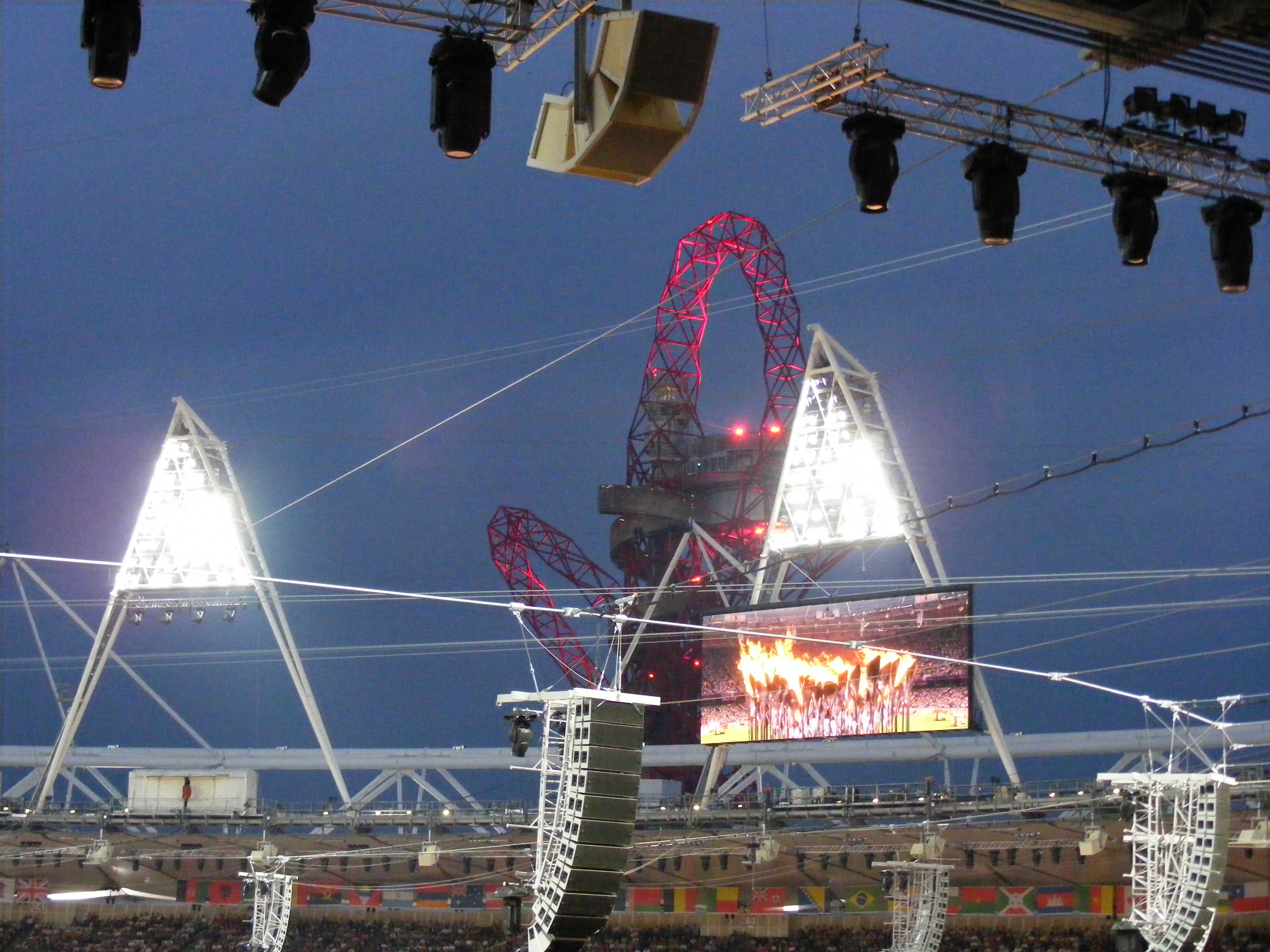
My lone seat has an amazing ariel view from the very back row of what was intended to be press seats, just above the 100 metres’ track. There’s good news and bad news, I don’t like heights but I am under cover if it rains – it doesn’t. With the aid of binoculars I am able to see the other three on the opposite side of the stadium, including watching them looking for me. ‘World record weather’ is announced. Amongst other things we see the women’s shot put F54/55/56 final, the men’s javelin F33/34 final and the Irishman Jason Smythe win the men’s T13 100 metre final. It is a little worrying to note that the javelin area has been situated between the two shot pools. I wonder if they will hit each other. In between jumping up and down (‘as is customary will those who are able please stand’) for medal ceremonies there is plenty of British interest. In the absence of anyone from team GB we are quite happy to forget the history of the past 90 years and pretend that the Irish are still British. Failing that, the Australians will do, indeed almost anyone who isn’t Chinese, who seem to win pretty much everything. And clearly Oscar Pistorius must be British, especially when he breaks the world record in the T44 200 metre heats. As soon as Pistorius has run, people begin to leave and a third of the stadium is empty by 9.30pm. Although this will make leaving the stadium and our journey home easier, I still find it very irritating. Lovely to see the Olympic park illuminated at night and great that Becca and Graeme have been able to enjoy the Olympic experience like the rest of us.
Sunday 2 September

4.00am and Chris is chasing the resident peacocks off the caravan roof. He returns to the van just in time for the cockerels to wake up. The ornithological delights of this site are beginning to pale. It is drizzling when leave home and at least two of our party are wondering if the £4.50 a day parking charge at the station might have been a good idea, to avoid the walk. This weekend seems to have involved quite a bit of walking one way and another and I have developed some interesting looking blisters. After an uneventful journey we divert to M & S at Stratford in the hope of acquiring Martha some gluten free food. This endeavour fails miserably but Chris and I decide to avail ourselves of some pasta salads for consumption later. The downside of this plan is that the pasta salads are not equipped with forks and pasta is a tad tricky to eat with ones fingers. I begin a foray for something suitable. With one eye on the security cameras I acquire some plastic forks from the café. Martha says these are meant for take away salad eaters but I still feel like a shoplifter as I secrete them in my bag.

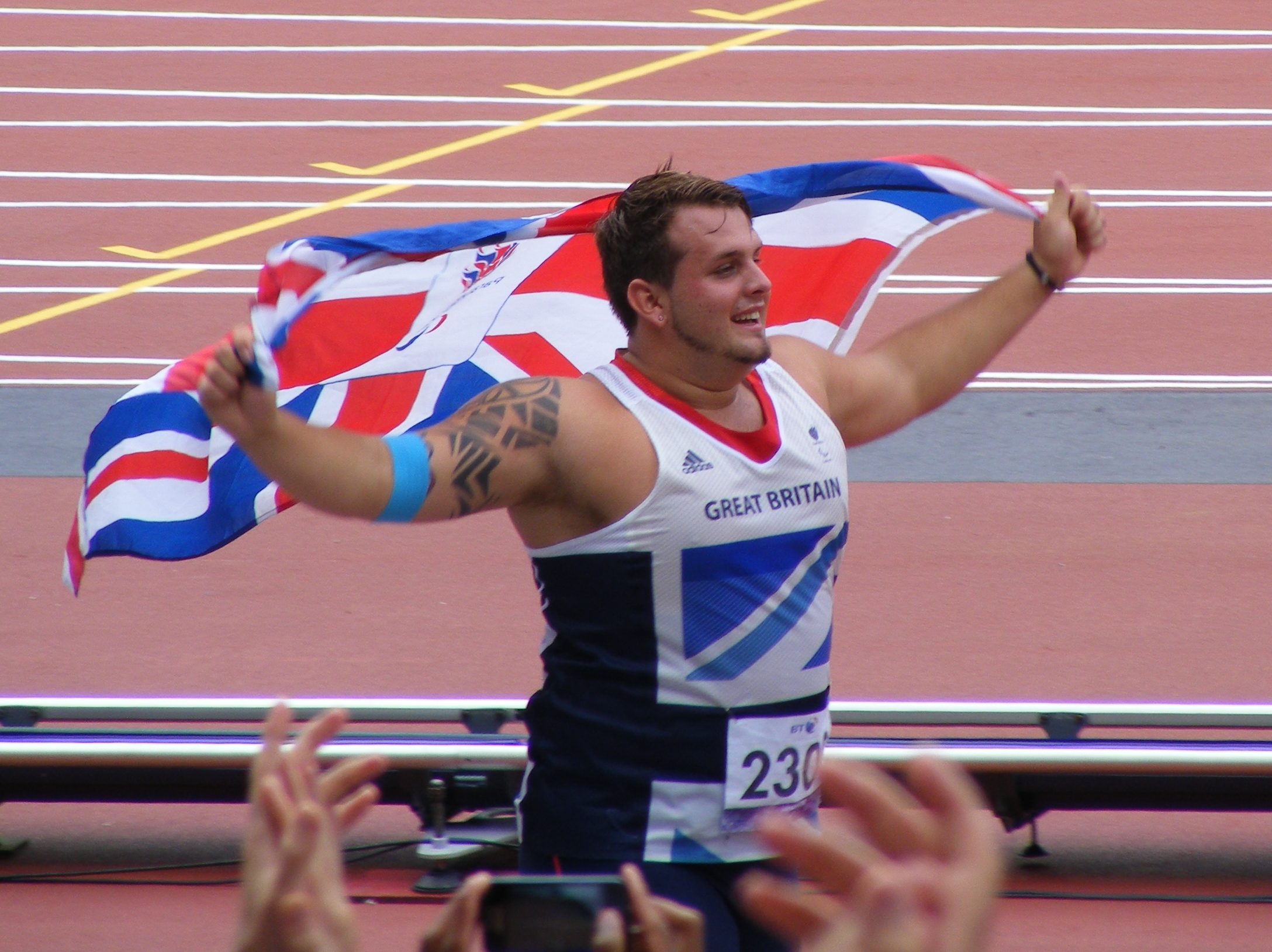
We join the thousands of people heading for the stadium and find our seats near to the front, by the 100 metre track. The commentator is having trouble with some of the more exotic names; should he not have been practicing? Unfortunately for the commentator, if last night is anything to go by, it will be those with the most unpronounceable names who win medals. The commentator has clearly been on the beer. He is introducing the long jump finalists ‘and third to throw is…’. Not only do we have the continual getting up and down for victory ceremonies but as we are on the end of a row we have to get up for those closer to the middle to leave their seats. They do this with such frequency that Chris is heard to question why he bothered to pay for a seat when most of his time is spent standing up. Our neighbours’ recurrent trips to the refreshment stands are followed by the inevitable trips to the toilets. I decide that no one who is incapable of remaining in a seat for three hours should be allowed in the middle of a row. We watch Aled Davies win gold for GB in the discus.

In the over-long gap between our two athletics session we make a trip to Canary Wharf on the DLR so Martha can eat. The only difficulty comes when Chris tries to find his travel card. He does have a travel card, in fact he has several including, one from our 6th August Olympic trip and two for tomorrow, just not today’s. Finally he finds it and we are on our way. Back at the Olympic park we decide to go in to the stadium nearly two hours early so we can sit down. We are back in block E, high above the 100 metres track and finishing line. There is plenty to watch to pass the time. Mistress Efficient is training games makers in synchronised lane marker and block arranging. They also practice retrieving the lane markers quickly so they are not mown down by wheelchairs completing the first lap. Not easily satisfied Mistress Efficient.

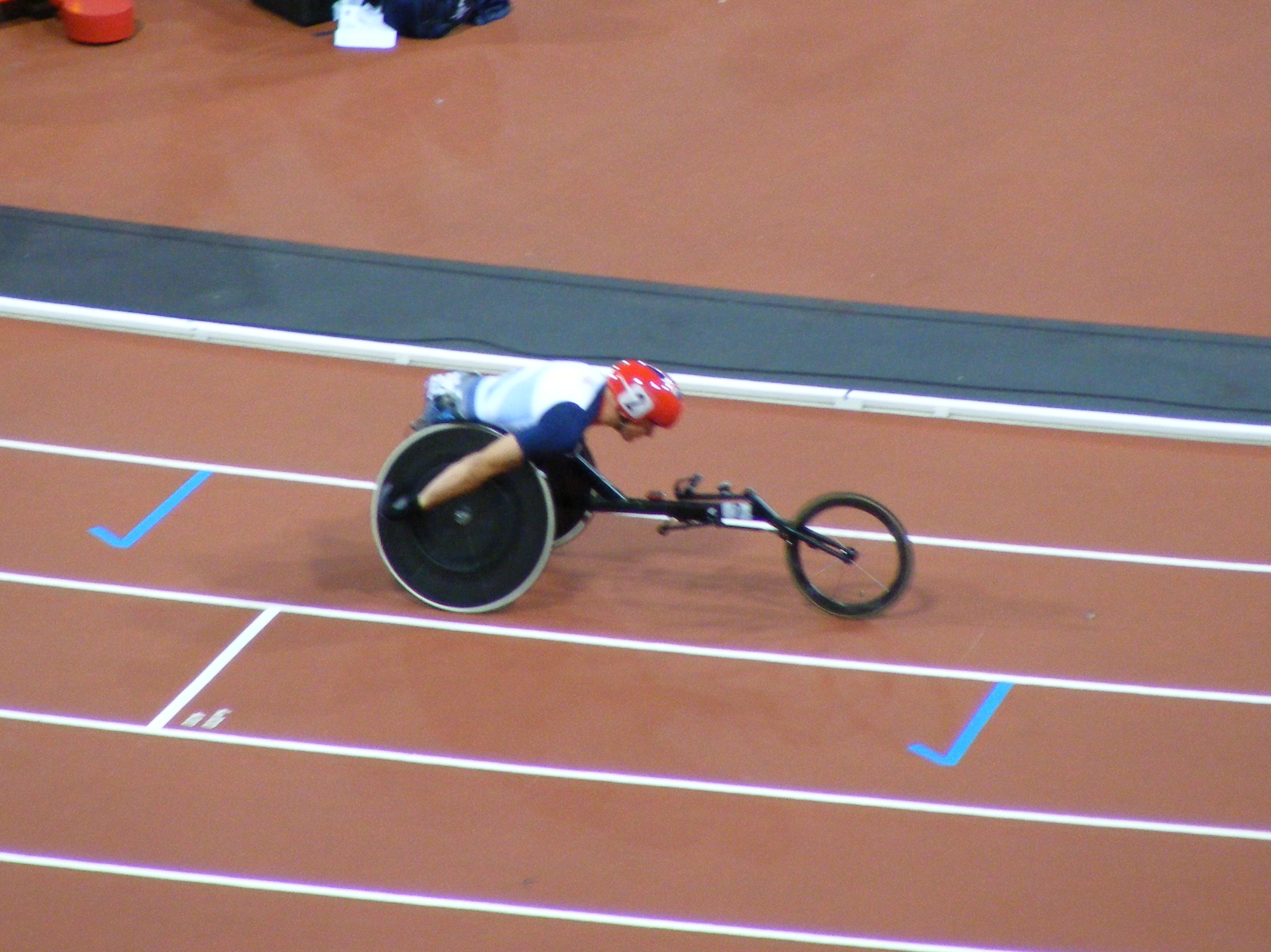
The evening weather is announced as a ‘blank canvas’ and apart from the drizzle first thing, the weather has been lovely. There is plenty going on. The Cuban national anthem is quite jolly. The Brasilians have obviously been practicing, perhaps with an eye on Rio and they do quite well. Oscar Pistorius upsets the form book and is beaten for the first time in nine years by Brasilian, Olivera. We have a good view of Pistorius being interviewed by Channel 4. Martha gets a text to say he is complaining about length of Brasilian’s blades. There is a complicated formula to ensure that blade length is compatible with legs if they had any. The highlight is David Weir’s 5000 metres gold medal. Everyone is on their feet and the stadium is in uproar, this is definitely the best side of the stadium on occasions like this. More excitement follows as the Duchess of Cambridge comes out to present the medal to Aled Davies. What an incredible day.

Oscar Pistorius
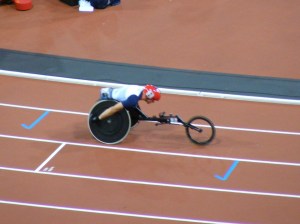
David Weir

Monday 3 September

The morning Olympic weather forecast is ‘very promising’ and it is a glorious day. Back in very back row, we observe that every Brasilian athlete seems to be called Santos. The F11/12 (visually impaired) discus is in action. Some of these athletes have no sight at all and guides line the competitors up and some are shouting and clapping to give the athletes a sense of the direction in which they should throw. Paralympic GB continue to do well with Mickey Bushell conclusively winning his 100 metres heat and David Devine winning the 800 metres T12 heat. There is a curious medal ceremony where the Ukranian silver medallist is conspicuous by her absence. It turns out that there had already been one ceremony for this event and the Ukranian had initially been awarded gold by mistake because of a calculation error.

Again we have a six hour gap between sessions. Rather than add to my blisters and return to Canary Wharf on what is a very hot day, Martha nobly agrees that M & S sandwiches will suffice. Chris is suffering from his avian induced sleep disruption and falls asleep every time we pause for a few seconds, including in M & S. Back in the park we sit by the big screen with a better view this time. Inevitably, Chris, who is sitting a little way away from us, dozes off. Next thing we know, concerned games making first aiders are checking to ensure that he isn’t dead. He doesn’t seem to be, so Martha and I resume watching Mandeville and some GB judo players, Ben Quilter who won bronze and brothers Dan and Mark Powell.

We arrive early for the evening session again and watch one of the officials failing to resist the temptation to run on the 100 metres track. We pass the time trying to identify the flags and it takes us a while to realise that they are in alphabetical order. By this time the weather is ‘as promised’ and Mickey Bushell takes the T53 100 metres gold for team GB. Not quite on a par with David Weir, perhaps because it was a shorter race but exciting none the less. The women’s F20 long jump is taking place on the far side of the stadium. This is for athletes with an ‘intellectual impairment’. Martha is excited to see one of the competitors walking along a white line in pigeon steps as this is something she can identify with. She is a little less excited when we point out that the girl is just pacing out the distance for her take off marker. This is an exciting competition and the eventual Polish winner breaks the world record four times in five jumps. The first long jumper lands awkwardly and is injured. Previously Martha and Graeme had discussed which Olympic sport was the most dangerous and Martha had opted for long jump, so she is now vindicated, ‘I told you long jump was dangerous’. Mind you her grounds for selecting long jump were that she was worried that athletes might drown in the sand. We do witness two other non-sand related injuries.

The F42 (one leg amputee) men’s high jump was truly inspirational with several athletes clearing 1.74 metres merely by hopping. The gold was won by Fiji. Then a table appears on the track which is somewhat strange until we realise that it is for the sponges for the T12 5000 metre runners. We cheer on the Argentinian competitor and his guide who complete the final 1½ laps on their own. Greg Rutherford appears on the big screen; he is in the stadium signing autographs. George Osborne arrives to present a medal and is greeted by boos. There is a much better reception for Tanni Grey-Thompson who follows him. Afterward we see her again as we make our way out of the stadium.  It really was the experience of a lifetime and it will seem strange that it is all over.

Now back to historical shenanigans.
The History Interpreter’s Paralympic Adventures Part 1

Thursday 30 August

Thanks to my helpful colleagues, I manage to abandon life in the seventeenth century early so we can head back to the big smoke for our Paralympic experience. A relatively straightforward journey and we arrive at a farm near Ilford. Quite a surprise to find a farm within a mile or so of the tube network and it all looks very pleasant with peacocks strutting round the pond and fancy bantams in an aviary. The site is distinctly lacking in facilities but that’s ok, we have our own. We park up as darkness descends. Our first attempt means that the caravan roof is being hit by an overhanging branch every time the wind blows, which is frequently. The novelty of this is going to wear off very quickly so we shove the van over a bit to be out of reach of any foliage. This works well and we are now only troubled by the occasional sycamore bract landing on the roof. Is it autumn already? I seem to have missed summer somewhere along the line. I am reminded that summer was last Thursday – silly me. I am just a bit worried by the part of the site information leaflet that says they will not pull the caravan out if we get stuck – mmm – given the amount of rain we’ve had lately that could be an issue.

I touch base with Martha to warn her what to expect, or rather not to expect, when she joins us on Saturday. Apart from no extra-van washing or toilet facilities there is also no television signal. This is partly our fault for not being prepared to exceed our weight allowance by dragging around an aerial that fills the whole van.

Friday 31 August

We discover the disadvantage of our rural idyll. The fancy bantams start crowing a good two hours before the first glimmer of daylight. There could well be a discreet pile of feathers under our van by tomorrow morning.

We set off for Greenwich in plenty of time, of course. The journey is quite straightforward so we are, inevitably, too early. We pass the Cutty Sark on the way to the venue and join a queue. Arriving early is a little more important for the equestrian events as the seats are not allocated so it is first come first served. We clatter across the specially erected footbridge to reach the security stations. The bridge does shake somewhat and I wonder how many people stood on it when it was tested. We needn’t have worried about getting good seats as we are in the front row. Today seems to be the day when everyone has brought along their under 5s in the hope that they will enjoy watching the horses. They do but the novelty wears off after about ten milliseconds and they begin kicking the backs of the seats in front of them and getting on and off  the tip up seats so that the whole row judders frequently.

Cutty Sark

The introduction to Greenwich by the passing the time commentator claims that Charles I was married to Anne of Denmark. My knowledge of the seventeenth century tells me that this would be illegal – Anne of Denmark is Charles I’s mother. The women behind us is talking incessantly and very loudly. As the first competitor’s routine draws to a close she asks if it has started yet. She can’t understand why the horses aren’t dancing ‘like on the tele’. Fortunately she is so disappointed in this that she takes herself and her unruly brood off after only a quarter of the proceedings are completed.

Continuing the ‘find a desirable job’ game from our Olympic trip we identify moving the fence surrounding dressage ring so that the horses can go in and out as a possibility. Chris is disappointed that tractors don’t feature quite so much in Paralympic equestrian events as they did in the Olympics. The people next door’s snack of choice is chocolate covered dohnuts; this may not be wise as it turns out that summer is today. The temperature reaches 75 degrees. It is just a bit of a pity that I have chosen to wear a t-shirt, a roll necked jumper, a fleecy jumper and a water proof coat. I send Chris off to purchase an attractive Olympic themed base ball cap so I don’t die of heat exhaustion. I can’t see me wearing it beyond this weekend. I then worry that he won’t be able to get back in again as I have his ticket safely secreted in my bag. This appears to be no problem. He also returns with new bottles of water; given out for free as the water fountains have broken.

Sophe Christiansen

I am fascinated by the use of ‘friendly horses’, who are brought into the ring to pacify the competition horses. In order not to scare the horses we are instructed to wave rather than clap certain competitors. The stadium, despite allegedly being sold out, is half empty. Apparently this is because the organisers felt that it the logistics of getting 20,000 people out after the morning session and back in for the afternoon session were too problematical so sales were limited. My only disappointment is that Lee Pearson, the only Paralympian equestrian competitor of whom I have heard, is not in the classifications that we will be seeing today or tomorrow. This is made up for when our girl in classification 3, Deborah Criddle, comes second and Sophie Christiansen in grade 1a gets nearly 10% more than the next best competitor. She goes on to win three gold medals.

On the way home a wasp decides that it will consume a chunk of my hand. I try not to draw attention to myself. The DLR halts outside Stratford, just by the warm up track so we can see athletes for tonight’s session getting ready. The train announcement tape seems to have got stuck and we get an echo effect with each half announcement being repeated several times. Good job we can recognise Newbury Park when we see it.


House History, Historic Newspapers and other Research

Still overwhelmed by all the Who Do You Think You Are? fall out and contacts – over 1000 website hits now. My fame may even last until Wednesday when the next episode is shown! Time to leave behind the celebrity status and get back to the day job. Most of today was spent preparing a House History course for Clovelly Community Archive Association next month. I am wondering what possessed me to book quite so many talks for September. One of those ‘seemed like a good idea at the time’ things.

I really need to write up the results of recent research commissions, so much history, so little time. Not that my latest research trip was an unmitigated success. Looking for an obituary in the local newspapers in a specific month should have been straightforward, shouldn’t it? Someone’s law dictated that the one page I needed had somehow escaped the scanning process. Do the Record Office hold the originals? The dreaded law strikes again – no. Whilst on the subject of old newspapers I should mention that I enjoyed looking at samples of old newspapers kindly sent me by Historic Newspapers. Seeing what happened on certain days in history helps to provide that all important context for family history. They also do teaching packs – always keen on anything that can help me encourage young people to take an interest in history. I can even give you a discount code should you want to order any – 15TODAY – they hold UK and US titles including some regional papers. Perhaps I should ask if they have my missing page!

Next research task involved looking at microfilm of some burial registers. I did notice one for the pre 1813 period that had a strange printed format, including columns for age, cause of death and parents’ names – just a shame that the incumbent hadn’t filled most of them in. Next, another burial register, totally illegible microfilm this time and yes you’ve guessed it, the originals are held elsewhere. Refraining from any tendency to seek out the nearest wall against which to bang my head, I moved on. Looking out some unusual Clovelly items including a list of the poorest inhabitants of Clovelly from the 1820s that will be interesting to transcribe. There are caustic comments against each name – even better. Did I bring my camera so I could photograph this? No. Can it be photocopied? No. Ah well better luck next time.

The History Interpreter Creates a Media Storm

Wow! I can’t claim that my blog post about ‘Who Do You Think You Are?’ has gone viral but it certainly could be described as a mild indisposition. 444 views on the blog yesterday and people retweeting the link like mad. Thanks everyone.

Yesterday I nonchalantly sauntered to the family history section of a famous magazine distributors and leafed through the publications to see if my ‘Coffers, Clysters, Comfery and Coifs: the lives of our seventeenth century ancestors’ had been mentioned. This process would have been easier if I wasn’t encumbered by a large (that would be very large) carrier bag containing a boxed electrical item but I think I managed to keep it subtle. Pleasant review in Family Tree Magazine. So while I have the attention of the world, well at least some of it, buy the book guys, please – the pile is going down nicely but there are other things I could put in the place where the 20+ boxes are stored and I expect the publishers would like to see their even larger pile continue to diminish too.

And now back that quirky existence that consititutes ‘normal’ in my life. Surely dressing in C17th costume and watching my colleagues chop off arms is normal ….. isn’t it?