In search of a mill and a trip to Lindisfarne

As we seem to be fitting more in to each day than planned, we decide we can find time to visit the archives at Berwick on Tweed, as advised by our friend from Norham. This has to be today as they only open twice a week. Typically the weather is better today than any we’ve had so far. Although tiny, Berwick archives ranks up there with the best I’ve been to, certainly in terms of the helpfulness of the staff. The tithe schedule suggests Norham mill was not on the site of 95 year old Bill’s house but on the opposite side of Norham’s main street. I can still not be certain if this was the mill associated with Peter Eadington. I manage to find reference to Peter in some manorial records and in the 1798 Land Tax, now available on ancestry. We exhaust the possibilities of the archives in good time and plan to return south down the coast road. We then realise that we have time to visit Holy Island today, instead of leaving it until later in the week.

From Lindisfarne causeway

I was imagining something akin to St. Michael’s Mount but Holy Island is much larger, with dwellings and shops, more like one of the smaller Scilly Isles. We drive across the causeway, park up and walk to the Tudor castle, another link in the chain of border defences. Following the union of the crowns it had less significance. It is sunny at last and I am very taken with the panoramic views and clear skies here in Northumberland, not dissimilar in some ways to Australia. The Castle too is unexpected, much more like a residence, having been converted to a holiday home in 1902 by Edwin Lutyens. The kitchen has a high backed curved settle that takes my fancy. It even incorporates a useful cupboard in the back, originally for hanging bacon. I wonder if anyone will notice if I take it home with me. I haven’t worked out how I would get it through my front door but that’s probably the least of my worries. There is an exhibition of tiny cotton bound figures, clothed in Fimo, by Laura Johnson, scattered throughout the castle’s rooms.

We walk across to look at the walled garden, designed by Gertrude Jekyll, which is about 500m from the castle. This was formerly the vegetable garden for the garrison. Apparently, having a garden a distance away from the house is not unusual in this area. Chris examines the cobles and other boats in the harbour. There are several upturned hulls that have been turned into sheds. The priory is next on the list. Of course Lindisfarne had a very important role to play in the establishment of Christianity in Britain; Aiden arriving from Iona in 635. The present priory was built in the C12th on the spot where St. Cuthbert had been buried before his body was taken with the monks fleeing Viking raids. At the height of the wars with the Scots, the priory was embattled. It fell into ruin about two hundred years ago.

Eadingtons, Jacobites and a co-incidence

Even further north today as we head for Norham, former home of the Eadington family. There is a beware of the otters sign near the camp site. Chris says our neighbour has seen one so maybe we will go otter hunting one day. We do see some roe deer on our journey. We arrive at St. Cuthbert’s Church in Norham, which is inevitably covered in scaffolding. 4 x great grandfather, Peter Eadington, was the local miller. I have ascertained that the mill no longer stands but Chris is asking locals where it used to be, without success. We enter the church where the vicar and two parishioners are pew moving. The vicar sports two earrings (in the same ear); he’s my kind of vicar. The wooden predecessor of the current church was reputedly brought from Holy Island. The Lindisfarne monks took refuge in Norham from the invasion by Hubba the Dane, bringing with them the body of St. Cuthbert. The church was badly damaged in the border raids associated with the Battle of Flodden of 1513. The Parliamentarians also caused some minor damage when they were in the village with Cromwell in 1648 and 1649. I already know that there are no relevant gravestones, which is a shame as gravestones in the area seem to contain quite a bit of information. Many also seem to be eroded in the centres in a strange way, presumably because of the sandstone that has been used.

Amazing co-incidence, one of the pew movers lives in the miller’s house! He kindly asks us back to examine his deeds. He shows us ‘Miller’s Path’, alongside his house and the alleged former mill. This is now named Tower Cottages, inhabited by 95 year old Bill, who comes to the door just as the vicar arrives; the vicar must think we are stalking him. I had been thinking water mill but apparently the mill that was Bill’s house was a windmill. There is some controversy over whether the mill actually was a mill or whether it was a dovecot. Our benefactor’s home is lovely, with a large and eclectic selection of books. His deeds do clearly state that the owner in the late C18th was a miller. Unfortunately no mention of Peter Eadington but maybe he was an assistant miller, or worked at another mill. It turns out that our helper is a fellow member of the Guild of One Name Studies.

We take a look at the exterior of Norham Castle, now closed for the season. It was an important part of border defences. We decide to take a long way round back to the van so I can visit Scotland, which I’ve never done before. We drive past Jedborough Abbey; Jedborough was the former home of Mary Queen of Scots. Next is the Kielder Forest with panoramic views and a glorious rainbow; a complete arc that is actually revealing both its ends. Next a detour to Great Tosson, one of the settings of the novel Devil Water by Anya Seton. This was my favourite book as a teenager and it recounts the story of the Radcliffe family’s involvement in the Jacobite Rebellion. I am re-reading it in honour of our trip. Our journey back to the van takes us through Rothbury, where the Jacobities rallied before the rout at Preston in 1715.

In search of the Pearsons of Warkworth

Today we are in search of the ancestral haunts of the Pearson family. My great great grandmother Elizabeth Pearson gave her place of birth as Togston Barnes, which I have identified on my trusty OS map, so off we set so I can take a photograph. Finding what is now Togston Barnes Farm was not the problem. It was more the three German Shepherds and the warnings of possible dire fates should anyone trespass. Nor was I reassured by what I assume are the dogs’ names, Tinker, Lizzie and Rosie, carved on the gates. I decide that our best course of action might be to pretend we are lost, followed by a hasty retreat. This is not Chris’ modus operandi and he winds down the window, that would be the window on my side of the car, to talk to the lady who has come out to investigate why the dogs are pacing threateningly and barking quite a lot. She a great deal friendlier than the dogs and the signage, not that that would be difficult. She tells us that there is a lack of grazing in the area because insufficient top soil was put back following open cast mining in the area. It seems likely that the Pearsons lived in cottages attached to the farm rather than the farm itself but who knows.

We move on to the nearby coastal town of Amble where Isabella Pearson, mother of Elizabeth, lived with her children when she was widowed. Chris enjoys looking at the harbour and we see some moulds for fibre glass boats. There are many sea birds in the estuary of the River Coquet and I spot an eider duck. I try to photograph some typical Amble cottages, such as Isabella might have inhabited. Unfortunately it is recycling day and I have trouble finding any that do not have bright blue bins outside. I have a cursory but unsuccessful look for a welly selling shop to solve the leaking shoe problem. Difficult to retain dry feet when looking round churchyards.

Next stop is Warkworth, just up the road. We look round the church then visit Warkworth Castle, originally built c. 1200 by Roger Fitz Roger but later the home of the Percy family who made many additions including the impressive tower and the Lion Gate. Warkworth was the first market town to declare for James, the Old Pretender, during the 1715 Jacobite Rebellion.

Lion Gate, Warkworth Castle

Finally we move on to Alnwick, the ‘big town’ where Isabella Eadington and John Pearson married in 1809. On Martha’s recommendation I visit Barter Books, a wonderful emporium in the old railway station. There is a distinct lack of parking and we are not in a designated parking space so Chris elects to stay in the car. Apart from the books, the atmosphere is great and there are opportunities to sit in front of  the open fire with a coffee and read. The shop owners were responsible for re-popularising the wartime ‘Keep Calm and Carry On’ slogan that has now caught on. The church was locked but we wander round the town and then home via food shopping. I manage to escape the book shop without parting with any money so I risk the antiques centre. I am obviously feeling restrained as I don’t buy anything there either.

From west to east

The morning breaks and this is what passes as a dry day in Cumbria so we decide to walk in to Coniston before setting off for Northumberland. It is predictably muddy and there is the odd shower but we have at least got out on foot. Chris spots a couple who look remarkably like our friends Dave and Gloria from Essex; that would be because they are our friends Dave and Gloria from Essex. What a shame we are leaving today so we can’t meet up.

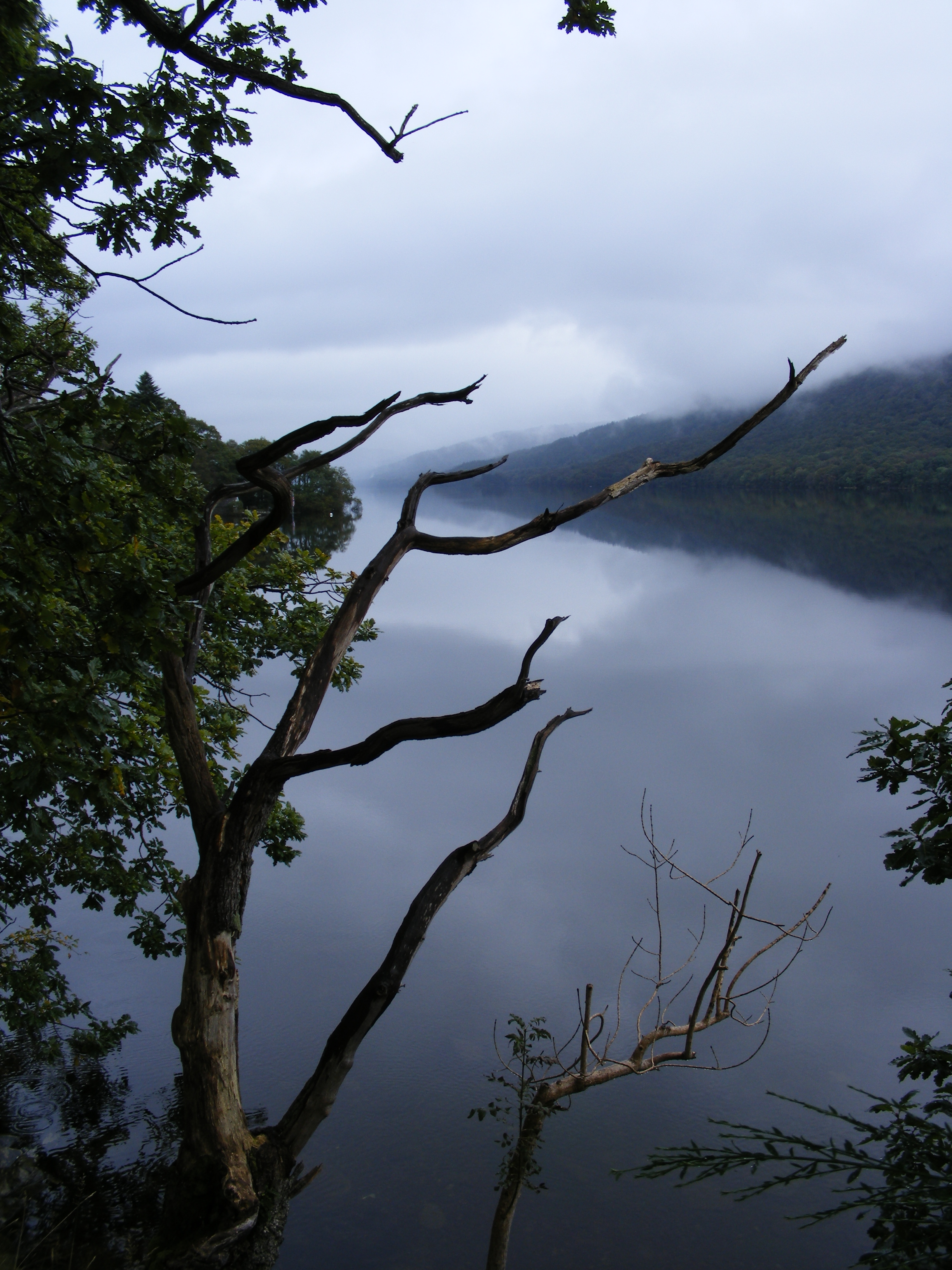
Overlooking Coniston

We set off on our 145 mile, four hour journey to River Breamish near Alnwick. As we travel eastwards on the A69 the scenery changes and become less barren and we see our first dry roads for a week. The views are beautiful as we drive along parallel to Hadrian’s Wall, although glimpses of the wall itself elude us. We cross the River Tyne, with no fog in sight. As we get nearer to Newcastle there are some signs of industrialisation. We then start travelling northwards on the A1 and the lovely scenery reappears and even better it is bathed in sunlight. The drystone walls have disappeared and the building style is very different from further east, with plenty of yellowish stone. This is the furthest north I have ever been and I am excited at the prospect of treading in the footsteps of great grandfather John Hogg and his ancestors.

The site at River Breamish is lovely, with plenty of wildlife promised. I spot what I think may be a blackcap. Unfortunately, as I was already pushing it with the number of books I have on board, I left the decent bird book at home so a positive identification will have to wait. The site is within a mile of an antique centre and the nearest town is home to one of the largest second hand bookshops in the country, perhaps staying here should have a government health warning. We go for a brief walk round the nature trail attached to the site. Although today is the best weather we’ve had since Tewkesbury, there are clear signs of the heavy rain that also affected this area last week. I am still having problems with my boot leaking and I point out a possible crack in the sole. Chris is unconvinced but nonetheless decides to test my theory by attempting to insert the handle of a teaspoon through the alleged hole. The spoon handle disappears convincingly. Gratifying though it is to have been proved right, I am yet to be persuaded that this was the most sensible course of action. The hole may be repairable but probably not within the next week. Inspired by the lack of rain I do some washing at the site laundry, where the sinks are designed for vertically challenged persons with very long arms. I wonder if the designers own shares in the local chiropractor.

Mistress Agnes burns the candle at both ends

More torrential rain over night and this continues the next day. No longer can this be described as showers or drizzle and we exercise caution, staying in the van for the morning. We then take the short journey to Troutbeck, near Windermere to visit Townend House, home of the Browne family for over four hundred years. This is certainly one of the gems of the National Trust. The basis of the house is late C16th, with later additions. There is plenty of mock Jacobean carving, done by Victorian owner George Browne. Browne had delusions of grandeur and made up his own coat of arms. The property has an extensive library dating back 500 years. Chris is fascinated by the full length musket and a pike that looks a little thin for use. Apart from the wood and the books, I am taken with the smoke hole above the chimney, the weaving looms and the rush light holder. There are also large glass bowls of water, which, when placed near the candles, helped to concentrate the light. I finally manage to get a photo of a rush holder. In extravagant households both ends of the rush would be lit – hence ‘burning the candle at both ends’. A fascinating property, all the better for being a real home and some interesting guides to chat to.

Townend, Troutbeck

Mistress Agnes takes a train

By this stage, we are no longer taking any notice of the weather forecast. I would like to place on record however that no Carol, we did not experience the best day of the week with sunshine everywhere. We leave the van promptly and head back across Wrynose Pass and continue on to the Hardknott Pass. There are various notices warning us that this is pretty much unsuitable for almost any form of traffic but it sounds like fun. A very narrow winding road with hairpin bends at a gradient of 1:3; who needs theme parks? I can’t help wondering how long it must have taken to build all the miles of drystone walls that we see and how long they have been there.

On the way to Hardknott Pass

Chris is dressed for the weather forecast, a mistake. I have been a little more cautious but I soon change my mind about getting out of the car to look at the remains of the Roman bathhouse that was attached to a fort in the middle of the pass. This ‘unmissable’ site will have to remain missed, or at least only viewed from a distance. Apart from the drizzle, there is a very keen wind making the conditions raw. One can only have sympathy for the Roman soldiers, fresh from Mediterranean climes, who were stationed at what is believed to have been called Mediobogdum. The Romans were allegedly responsible for this road, which connected their fort at Ambleside to the coast at Ravenglass. The twists and turns are certainly not reminiscent of the Romans.

With perfect timing, we arrive at the prosaically named Boot to board a train at Dalegarth Station. This is the terminus of the Ravenglass and Eskdale Steam Railway. Always a sucker for a preserved railway, we plan to take the return trip to Ravenglass, the only coastal town in the National Park. A three foot gauge railway was built on this route in 1875, primarily to carry iron ore. This short-lived line was replaced by a 15 inch railway in 1913. It is one of the oldest and longest narrow gauge railways in the world. As predicted by the timetable, our outward journey is by diesel locomotive. We can choose between an open carriage, a fully enclosed option or an open carriage with a roof. With an eye on the darkening clouds, we opt for the roofed open carriage. Chris is finding this a tad chilly but I am putting on a brave face and wishing I hadn’t left my 1646 spun and knitted hat in the van. I am pleased that our return journey is accomplished courtesy of a steam engine, the River Irt. Built in 1894, this engine is the oldest narrow gauge engine in the world. This time we succumb to the luxuries of first class; padded seats and an enclosed carriage.

Back at Boot, we drive across Eskdale to Wast Water, another on the ‘unmissable’ list and billed as ‘Britain’s favourite view’. From here we can see Scafell, if only we could work out which of several peaks it is. Chris braves the elements in his three quarter length walking trousers to help a damsel in distress who is unable to lift her bike over the stile. Despite the weather conditions, there are several divers in Wast Water. There is also a line of orange floats, which look like something out of an extreme challenge. No one is trying to cross the lake by leaping from float to float though. It turns out that these are to facilitate getting an electric cable across the lake.

We drive back out to the coast, head northwards and return to the van in a large clockwise sweep, taking us past Helvellyn, also not identifiable, Grasmere, famous for Wordsworth and Ambleside.

Walking in the rain

Rashly believing the weather forecast, which stated that today should be rain free, we set out for what might be described as a proper walk. Why we should think today’s forecast should be any more accurate than those for preceding days I have no idea and there are squally showers. We are planning on taking a walk recommended by the guide book; a four mile circular walk from Elterwater, around Loughrigg Tarn. Maps often prove handy on occasions such as this and we have plenty. Forethought means that I have arranged to borrow several maps from Becca and Graeme prior to the trip. The only snag is that none of them cover this area. Based on our experience so far, which suggests that things are pretty well signed, we hope to be able to manage without. We avail ourselves of the National Trust car park. We have probably recouped our life membership fee on car parking savings for this trip alone. The walk we were planning seems somewhat devoid of signage but we follow herds of other walkers hoping that they know more than we do.

Near Elterwater

It is a pleasant walk, not too spoilt by the showers, although Loughrigg Tarn is conspicuous by its absence. I am solving the leaking boot issue by judicious deployment of a Morrisons’ carrier bag; never let it be said that I don’t recycle. We head out of Elterwater and seem to be going the right way. We get as far as Colwith Force where we meet a couple from Kent who are also trying to get back to Elterwater. They even have what passes for a map, well a least a bit of one, downloaded from the internet. We don’t do too badly, notwithstanding the sudden disinclination of the footpath signposts to have place names on them. Eventually we return to civilisation and are encouraged by seeing signs for Elterwater once again; albeit the four mile walk is nearer to six. We decide not to take the route that is signed ‘Ambleside challenging’ and manage to rediscover the car without getting soaked, despite some seriously threatening clouds.

Mistress Agnes meets Brother John

The weather forecast is much more encouraging for today, promising sunshine; sadly it is wrong and it is raining again. We are fast running out of even vaguely indoor things to do but start off for Furness Abbey in the hope that it will clear up. It is nominally dry by the time we arrive and we are able to squelch round the site with only our feet getting wet. We are very impressed with the scale of the abbey, built again from red sandstone and containing some intricate carving. There is a door sill with a Nine Mens Morris board carved on it and two rare effigies of knights with full faced helms. Furness Abbey is currently undergoing extensive renovation; underpinning on a grand scale. It was probably established here in 1127, founded by Stephen before he became king. The Abbey belonged briefly to the Savigniac order before becoming one of the richest Cistercian foundations in the country, with a huge sphere of influence. Its wealth was based on sheep, iron, salt and peat and its position was chosen in order to encourage the Normanisation of the area. Furness was one of the first abbeys to be dissolved, after the monks were implicated in the Pilgrimage of Grace.

Furness Abbey

At the Abbey, there is a school party being entertained by ‘Brother John’, a Cistercian monk. We have long and very interesting, chat with him about the history of the Abbey, medicinal cures and historical interpretation. We walk along to see the C15th Bow Bridge then decide to return to the van via the pretty route. The map suggests that this will be narrow, winding and steep; it is not wrong. We wind our way up through Ulpha to the Wrynose Pass. Initially the landscape is desolate and barren with no trees. The drivers coming in the opposite direction display some interesting driving abilities and the cars appear to lack a reverse gear.

Coniston

A Busman’s Holiday for Mistress Agnes

Today there is a strange golden orb in the sky – hurrah. We set off, heading northwards again. We cross Kirkstone Pass, at 1489 feet the highest road in the Lake District. It is named for a rock that is thought to look like a Church Steeple; we don’t identify this. A beautiful drive and lovely to see the scenery no longer shrouded in mist. We pass Ullswater, thereby crossing off number two on the what not to miss list and stop at Aira Force, both credited with having inspired Wordsworth. Force is derived from the Viking word Fors, meaning waterfall. The rain of the past couple of days is now acknowledged as the worst for thirty years so waterfalls are in full flow. We are encouraged by the fact the we overtake quite a few people on our walk up to the waterfall; encouraged that is until we realise that the people we are passing are twenty years our senior. This land was once part of the grounds of the Duke of Norfolk’s C18th hunting lodge, Lyulph’s Tower.

On the way to Kirkstone Pass

We reach our destination at Acorn Bank near Penrith. It turns out that the premises has no electricity today, I said it was becoming a theme. The building is constructed from red stone, which is quite common here. It was renovated by owners John and Lucy Dalston in the C17th. Dalston was a supporter of the Royalist cause during the Civil War and was subsequently declared a delinquent. He and Lucy had twenty one children. Although not historic, the gardens are noted for their collection of medicinal herbs, the largest in the north. This has obvious appeal for the Mistress Agnes in me and we admire the many species that they have. I remember I have some copies of ‘Coffers, Clysters, Comfrey and Coifs’ in the car boot, following Saturday’s course. Nothing ventured, I approach the staff with a view to them stocking it in the shop. They sound quite keen and I leave a message for the buyer. We then walk through the woods to the mill. Although the present building is nineteenth century, there has been a mill on this site since at least 1323, when it passed from the Knight’s Templar to the Knight’s Hospitillars.

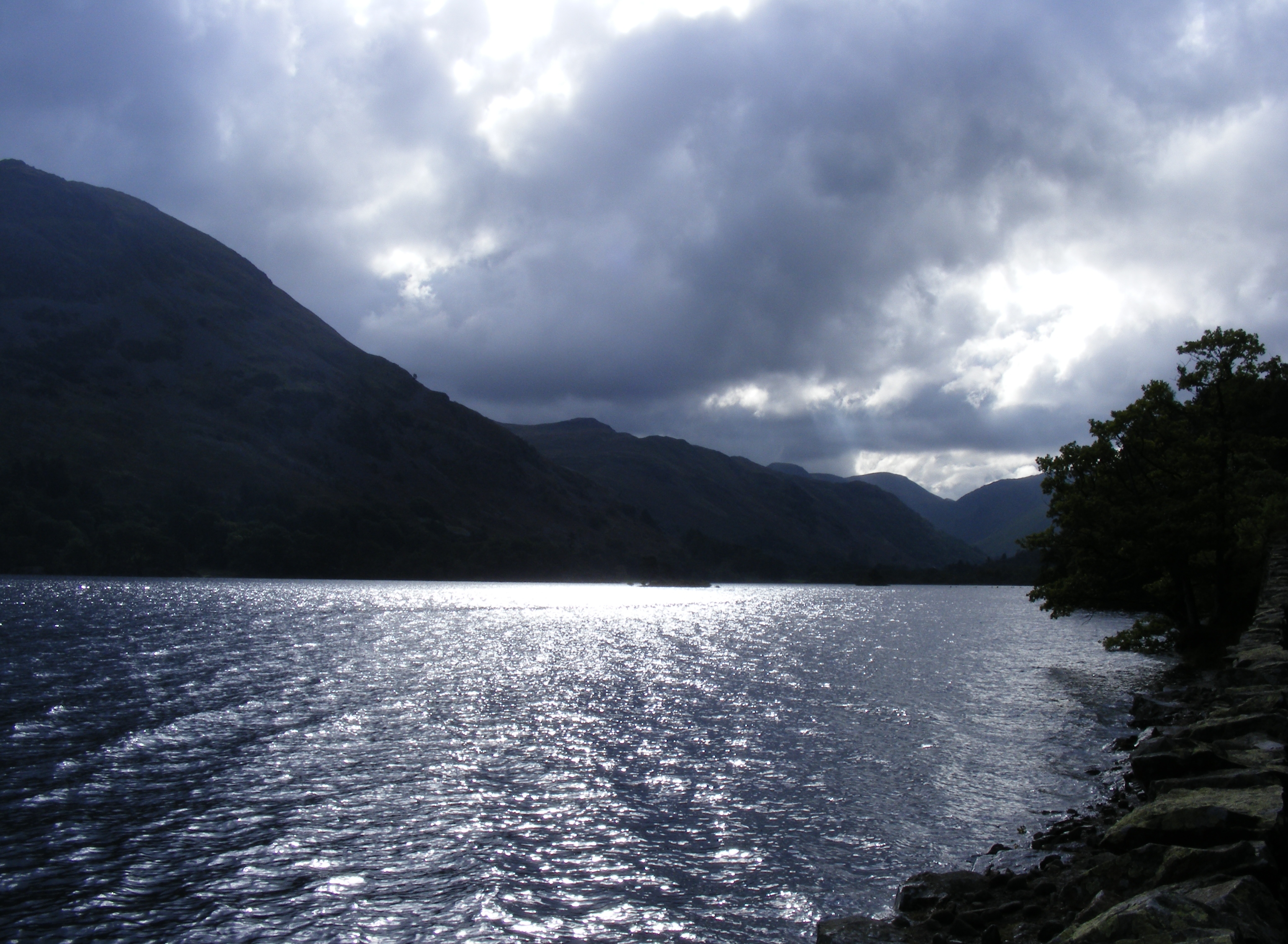
Ullswater

The SatNav takes us back a slightly different way and it has been a lovely day, even though it begins to rain again as we set off for home.

More Rain

We wake up to find that our new pitch is adjacent to a river. Oh, no, that would be a road. There has been incessant torrential rain all night again, although by day it eases to a persistent drizzle. There is surface water everywhere and it will test the 4×4 capabilities of Chris’ vehicle. Martha sends a message to say that 80 houses have been evacuated in Morpeth; fortunately we are not due there until next week. The local press are now reporting a whole year’s worth of rain in the last couple of days. The rivers are certainly racing and very full. There is water rushing down the hillsides in places where it wasn’t visible yesterday.

We travel north towards Keswick, it was nearly Kendal owing to my poor eyesight and a slight mishap with the SatNav but I realise in time. We see notices warning us to look out for Racing Santas. Racing Santas? This is September. We don’t actually see any but who knows how long the notices have been there. We then head westwards, past Derwentwater and are now in the remote, mist clad Borrowdale. We cross Honister pass, home to the slate quarry and museum. By coincidence, this was the subject of a BBC4 television programme last night. Sadly the former owner, a risk-taking maverick called Mark was killed in a helicopter accident. The substance of the programme was the ongoing difficulty of balancing the needs of the tourist industry with preserving the natural beauty of the area. The slate clad slopes, just visible in the mist, are very impressive.

Honister Pass

I venture out of the car on a couple of occasions in order to take photos. The rain doesn’t matter as Chris has successfully glued my left walking boot in order to stop it letting in water. Last time I wore them I had to put my foot in a carrier bag first, which rather defeated the object. I discover the hard way that, unfortunately, my right boot is now leaking instead. Judging by the number of Jersey registered cars that tear past the whole population of the island are holidaying in the Lake District. We see a red squirrel which for me was almost on a par with seeing my first kangaroo in Australia. The sheep are breeds that are unfamiliar to us. Some are blue-black in colour and many have their tails intact. Others are black with white faces.

We detour via Workington in order to find a Morrisons to replenish our stores and to get some petrol at a vaguely acceptable price. Despite the detour being a fairly long one it has saved us money as fuel is 10p a litre cheaper than in the National Park. All this holidaying is affecting Chris as he tries to do the washing up using shampoo. The forecast suggests that there may be less rain tomorrow – here’s hoping.