Manuscripts, Webinars, Wills, Nominations and Peacock Dung

Well no sign of life calming down then. It has been all systems go trying to get the manuscript of Remember Then: women’s memories of 1946-1969 and how to write your own to the publishers. Yesterday really was the deadline if there was to be any chance of a pre-Christmas (Christmas 2015 that is) publication date. There are still no guarantees but it has been sent and I have given it half a chance of being available for you to put on your Christmas list. I was quite demob happy until I looked at the 3 volume novel that is the list of things I need to do before my trip to Canada. It has been a great project (the book not the to do list, despite them being similar in length) and I am so grateful to all the lovely ladies who have been helping me. My Google search history has been diverse as I finish this off. ‘Slang words for drugs 1960s’; ‘UK church attendance 1951’; ‘Mrs Dale’s Diary’ and ‘Civil Defence Corp.’ to name but a few. I have had a bit of trouble with auto-correct – why it would think I meant ‘supine’ when I actually typed ‘tuppence’, I have no idea.

On the book front I was very excited to learn that Family Historians’ Enquire Within has been nominated for the Chartered Institute of Library and Information Professionals (CILIP), Information Services Group Reference Award 2015. No, I’d never heard of it either and I hope that I don’t have to be able to memorise what must be the longest award title in the world but it is flattering to have been nominated. Not that I can take any of the credit, as this volume is really the work of others. It only has my name on the front because I updated it ready for the latest edition, which was the first reprint for nearly 20 years. Apparently the award is for (deep breath) ‘outstanding works of reference in print or electronic format that are available and relevant to the library and information sector in the UK, and published in 2014.’

I have also been giving a talk to Australia. Sadly no all expenses trip round the globe for this one as my presence was virtual. It was great fun and I do hope that I might be asked again. The system used by the Australian Society of Genealogists means that participants can see my computer screen but can’t see me. Wish I’d known that before I tidied up. I could have been wearing my pyjamas, picking my nose or eating a sandwich and no one would have known. In fact I was doing none of the above and the tidying up bit was stretching the truth somewhat as well. I have though started to empty and sort the contents of my loft. I have a sneaking suspicion that most of it will be returned from whence it came but a small selection has found its way to the tip so far.

I learned this week of an exciting project to index the Principal Probate Registry wills by place. What a wonderful one-place resource that will be. There is only a very small date span available so far but I found several that interested me. Every encouragement needs to be given to those who are making this index available.

And next week? Well it is back to the seventeenth century, although I have been having a taste of that (fortunately not literally) with a medicinal recipe book that someone is transcribing with me. Well, in the interests of honesty, she is transcribing it for palaeography practice and I am ‘marking’ her excellent efforts. Peacock dung for convulsions or wax from the head of a sperm whale (what do you mean, you don’t have any in your medicine cabinet?) for bruising anyone? Oh and if anyone knows what Benjamine Laddarell is please tell. It appears to be an ingredient and is written with upper case initial letters. It is definitely Benjamine (which may refer to a form of benzoin) but I am willing to stand corrected on the second word.

The Final Frontier – days 13-15

210 Pudding 22 July 2015We got up at the crack of dawn to hear Chris Paton speak on ‘The Godly Commonwealth’. Unfortunately Chris did not get up quite so early, having had an alarm clock malfunction when moving to a new time zone. Nonetheless, the session was well worth waiting for. I give my penultimate talk on emigration from North Devon in ‘Celebrity Central’. This was followed by ‘Using Manorial and Parochial Records’ from Caroline Gurney and the story of Miss Monk’s ‘bride ships’ from Tricia Fairweather.

UTP Authors

UTP Authors

After lunch, my final session and Mistress Agnes made an appearance once again, extolling the delights of life in the seventeenth century. The day was not yet over. Chris Paton again, on ‘Irish Land Records’, Paul Milner speaking about ‘Maps and Gazetteers’ and then Cyndi Ingle encouraging us to ‘Build a Digital Research Plan’. After our final evening meal, we foregathered in the Sky Observation Lounge to hear Carol Becker’s hilarious ‘So you are married to a Genealogist’. Then it was time for sad goodbyes. Most of the others will meet again on future cruises but sadly we are unlikely to be able to travel to Australia to start another UTP event.

On Saturday morning we played our very last game of ‘Guess the Lift’ and wait in the Eclipse Theatre for our disembarkation slot. The gangplank is on deck 5. At one point the Australian announcer suggests that a group head to deck 15, then realises her mistake. We have visions of people leaping on to the quay from deck 15 but she hastily corrects herself. ‘I don’t mean deck 15, there is no gangplank on deck 15, please don’t go to deck 15’ she pleads. We wonder how many tourists are still aimlessly wandering around deck 15 looking for a way out.

DSCF3041There are the inevitable issues as Chris tries to reclaim his confiscated equipment. He lacks the required receipt therefore the box has not left the ship and there is a distinct lack of security persons who can fetch it for him. As Chris has been officially disembarked there seems no way he is going to be allowed to return to fetch the box himself. The wait does give me a chance to use Southampton Port’s free wifi and download over 1000 emails. It has been a great trip. I have visited seven countries, listened to 46 lectures, drunk several gallons of coffee and made some amazing new friends. I also proved that I can go internet free (you can scarcely count half an hour’s limited access at Vasa Museum) for two weeks and survive.

All at Sea and Wonderful, Wonderful Copenhagen – Days 11 & 12

Towel Origami

Towel Origami

Up early to listen to Chris Paton talking about Scottish Civil Registration. It doesn’t seem to matter that I have no Irish interests and very little connection to Scotland, I still enjoy his sessions. We learn that Frank, our lost party-member, has been located and will rejoin us a Copenhagen. In between preparing for my own session, I listen to Shauna Hicks taking about ‘Family History on the Cheap’. No sooner had Shauna started than the Captain’s voice comes over the tannoy, at full volume, giving details of where we are, ship’s speed and weather conditions. This goes on for a considerable time. Just as it seems that Shauna can continue, the events’ manager starts encouraging us to attend demonstrations of towel folding by the housekeeping team. This towel folding, in the shapes of various animals, is quite fun but we don’t really want to listen to all this. Every onboard event of the day is described in minute detail. Even then we are not free to continue our session as this all has to be described again in Spanish!

Fruit Sculpture

Fruit Sculpture

Barb Toohey gives an interesting presentation on producing family history charts. I am convinced that this must be much harder than she is making it seem but she has done some fascinating work. Afternoon sessions include Chris Paton again, on Scottish Land Records this time – note to self – but look at the Statistical Accounts. This is followed by another research help zone and then Cyndi’s interesting presentation about timelines. I leave this rapidly to descend ten decks for my own presentation on one place studies. A surprisingly large audience considering that it is 5pm and there is another session on at the same time. I try to ignore the fact that I appear to be losing my voice. Our conference day concluded after dinner with Helen talking about interviewing granny.

Relaxing on Deck

Relaxing on Deck

Apparently, just after midnight, we passed under ‘The Bridge’, of ‘Nordic Noir’ fame, with only 5 metres’ clearance. It seems that this was accomplished without incident as Deck 14 is still visible. Bizarrely, the first four km of the bridge are in fact a tunnel. Today we are group ‘Purple 9’, with Ivi, a hilarious older lady, as our guide and Freddy as our driver. Due to a cancellation, this is a replacement for our original choice of excursion and it seems that we have chosen well. We pass a new version of The Little Mermaid, nicknamed ‘Dolly Parton’. Ivi explains that this mermaid has had the benefit of silicon implants. We travel across the main island of Seeland. There is a photo opportunity at the real Little Mermaid, sculpted in bronze and granite by Edvard Eriksen and donated to Copenhagen by brewer Carl Jaconsen in 1913 as a representation of the character from Hans Christian Andersen’s fairy tale of the same name.

183 Little Mermaid, Copenhagen 22 July 2015

Little Mermaid, Copenhagen

Bishop Absolon founded Copenhagen in 1167 and built the first fortification there. Many older buildings on some of the sandy islands stand on a bed of oak foundations. We pass the Citadel, which was built By Christian IV in the 1600s in the shape of five pointed star. In 1658, when the Swedes attacked, they were unable to get across the ice-filled ramparts. Christian had twenty three children, some of whom were illegitimate but all were acknowledged. We also see his summer house and garden. Although the Second World War had less impact on Denmark than other countries, there is an ‘angel monument’ to ships lost by mines in the Baltic. 7000 Jews were evacuated to Sweden to escape being rounded up by the Nazis occupiers; thus almost all escaped. We do see the Gestapo HQ, that was bombed by the RAF. We learn that the Danish fleet was the 2nd largest in Europe after the UK, although I am not sure at what date this applied.

Northgate Station, is of interest for the plants growing on the roofs of all the shelters. Denmark’s terrain means that it is another country where cycling is popular but there was not a safety helmet in sight. Again we have tried to pick a tour that takes us out of the city centre. And we have coffee and a Danish pastry in Dragor. This is a picturesque C13th fishing village, with a preponderance of hollyhocks. The fishing was primarily for herring and this began to decline in the C15th. In 1517, twelve Dutch farmers were imported to use the land and the Danish families were moved out. These incomers specialised in vegetables.

Hollyhocks, Dragor Village

Hollyhocks, Dragor Village

The hotel at Dragor has four toilets, so 100% improvement on previous trips and we are the only coach in sight; other destinations have seen our coach as one of forty. Dragor is the site of a former fortress. Legend states that St. Martin was reluctant to be a bishop, so he hid with the geese but their noise gave him away so he was forced to become a bishop. He therefore ordered the slaughter of the geese, which us a traditional dish on St. Martin’s Day and on Christmas Eve. Dragor means ‘a place where geese are reared‘. Barley and strawberries are grown, the latter are late this year due to the cold spring. Here Lent is celebrated with tilting the quintan.

Heading back to the city, we drive under runway of Copenhagen airport, Scandinavia’s busiest, just as plane takes off. The proximity of the airport to the city (12km) means that tall buildings are discouraged in the city; few are more than six stories high. We pass a Christmas Tree farm and visit the square, with its four identical Royal places, built in 1750 and see the changing of the guard by the Royal Lifeguard. Although there are still many tourists, it is a little less than overwhelming than at some of our previous destinations.

We do not have time to visit Tivoli Gardens, which were created in 1843 and resemble Battersea Funfair. The Gefion Fountain is impressive. This is based on the C9th legend of the Norse Goddess Gefjun or Gefion. The Swedish king Gylfi said that Gefjun could have as much land as she could plough in a night. Her four sons were turned into bulls thus allowing her to plough the whole of what is now Seeland.

We return to the ship for a very good talk about occupational and guild records from Paul Milner.

Of Seatbelts and Ships – Stockholm and the Vasa Museum – Day 10

After an extra hour’s sleep we leave the quay through a very small turnstile. I think some of our fellow cruise-goers could have difficulties with this but we squeeze through with only minor damage as the turnstile revolves onto the backs of our ankles. Our ‘Purple 7’ tour requires us to use the tightest seat belts in the world; Stockholm is clearly only for the ultra-skinny. Juggling said seatbelts with the headsets that have been provided, cameras and sea-pass lanyards means that we are in danger of being garrotted. Just as we negotiate these hazards the coach stops for a photo opportunity and we have to extricate ourselves once again.

Stockholm

Stockholm

Some of the facts that we glean are that Stockholm was established in the C13th under Danish rule. Fifty seven bridges join the fourteen islands of central Stockholm. 8% of Sweden’s area is lakes and a further 30% is forested, making forestry a major industry. A number of the building are painted a deep red that is by-product of copper mining and acts as a wood preservative. The city is full of attractive tree-lined streets and parks; apparently house plants are also important in apartments. We see the Royal Mausoleum and the City Hall, which was built between 1911 and 1923. At 196 metres high, it required eight million 7kg bricks to build and is where the banquet is held following the nobel prize awards. This takes place in the ‘blue room’, which was initially painted red; due to a reluctance to change, it is actually still red despite retaining the ‘blue’ name. We also see the Concert House in King Street, where the nobel prizes are actually awarded. Cultural activities are key in Stockholm, which contains 85 museums. We pass the Nordic Museum, the Abba Museum, where one can sing and dance along with Abba, supposing one would want to and a museum that sounds a little like St Fagans and would have been interesting.

Popular Swedish food includes meat balls, sausage, salmon and cod. Very little fried food is eaten, although there are MacDonalds and the Swedish equivalent ‘Max‘, which uses local produce and serves smaller portions. Swedish dining traditionally finishes with coffee and seven sweet things – sound eminently sensible to me. Sweden is a family orientated country; one year’s ‘maternity’ leave on 85% pay is shared between parents and at least two months of this must be taken by the father.

Our shore excursions were chosen in haste, rather than being the result of informed consideration and I chose today’s because it mentioned ‘maritime museum’ and I was considering my travel companion. It turns out that a trip to the Vasa Museum was ideal for us as the Vasa is a C17th ship and the museum was all about ‘our’ period. The Vasa was built from 200 oaks on the orders of Gustav II in 1624, during the war between Protestant Sweden and Catholic Poland. The boat was a symbol of status and contained 700 painted wooden sculptures, including a lion figure-head to represent Gustav. When it was launched in 1628, the Vasa sailed a mile and then sank. This was because a second, lower, row of cannon ports were added and these ended up below the water line. There were unsuccessful attempts to apportion blame for this epic example of bad planning. The ship was found by divers in 1956 and was then raised, rebuilt and preserved over many years, very similar to the Mary Rose. Many artefacts had been looted but a number remained.

Sadly, this is another tourist sausage-machine and a good proportion of the 1.3 million annual visitors to the museum seem to have chosen today. We had an hour to look round but could easily have spent four. Unfortunately, we missed the part which told the stories of individuals based on the skeletal remains. We were advised not to leave visiting the shop to the last minute because of queues. Never mind the shop, the length of the toilet queue was only exceeded by the queue to get in, for those not in a pre-booked group.

I had taken my laptop in the hope of free wi-fi and wandered round the museum downloading over 200 emails that had arrived since I left home. Microsoft, in their wisdom, recognised that I was logging in from an unusual location and refused to download from my primary email account – goodness knows how many more emails there were in there. I did not have the chance to rectify this so did not know what I was missing.

We see the Royal Palace with its 608 rooms, which is bizarrely covered in net. Outside they are changing the guard but we have to view this from inside the coach, perhaps just as well, given the seatbelt issues. Then there is a slight panic as I realise that my sea pass is not in its holder round my neck. Hmm, not only will I not be able to get back on board but someone could be running up a huge bill at my expense. Fortunately I discover it down the side of the seat. Perhaps it fell victim to the seatbelt struggles.

Back on board, we laze on deck 12, slightly more sheltered than the upper decks and affording protection from sudden thunder storms. Unsurprisingly, given our latitude, the rapidly changing weather is similar to that in Scotland. We watch running passengers and speeding taxis screeching to a halt, as the time for our departure nears. Once afloat, it transpires that one of our party has been marooned in Stockholm, causing concern.

175 Black backed gull leaving Stockholm 20 July 2015]Sailing out past the many islands of the Stockholm archipelago is very beautiful and black-headed gulls wheel past, accompanying our ship for a considerable way. This provides a distraction for Jane’s audience when she is talking about restoring photographs but she copes well and the session is very interesting.

Porvoo and Helsinki – day 9

A fairly early start today but now we are not bombarded with door banging all night, we can cope. We form part of ‘Red 3’ and leave Harbour 39, Melkinlaituri, for a tour to Porvoo, with guide Reila. Over 10% of Finland’s population live in the capital but Helsinki is in shut-down as it is the middle of the two and a half month school summer holidays and most people have left for their summer chalets by the 188,000 Finnish lakes. Many of Helsinki’s buildings date from 1895-1915 and are Art Nouveau in style. There are many parks in Helsinki and we see the 1952 Olympic Stadium.

Helsinki was founded by King Gustavus Vasa of Sweden to rival Hanseatic Tallinn. After Swedish rule, Finland became annexed to Russia as an autonomous Grand Duchy in 1809, finally gaining independence in 1917. This was followed by a civil war in Finland, between the red and white armies. In 1939 the Russians declared war on Finland. Although Finland lost, they were allowed to keep their independence, in return for some territory and reparations. The remaining map of Finland resembles a woman with an outstretched hand, so the country is known as ‘the daughter of the Baltic.’ Languages are key to a Finnish education and the constitution specifies four official languages, the linguistically unusual Finnish, Swedish, Sami and sign language. Finnish, Swedish and English are all compulsory from the earliest stages of schooling and an fourth language is added at high school level. For 5% of the population, Swedish is their first language, so signs are normally in Finnish and Swedish, similar to signs in Wales.

Although church going is not particularly common, three-quarters of the population consider themselves to be Lutherans and a further 1% Russian Orthodox. A tax of 1% is automatically deducted from pay and given to the designated church. Those who choose to save on the tax and align themselves to neither religion are not entitled to marriage or burial in the churches.

Two thirds of Finland is forested and related industries are important. Between 30,000 and 60,000 moose are culled each year. Other wildlife include lynx and, in the east, grizzly bear. This year is the coldest summer for fifty years but it is another lovely day as we drive for about an hour east of Helsinki to the medieval town of Porvoo. It is compulsory to drive with lights on at all times and winter tyres must be used in season. Schools are never closed because of snow as road-clearing schemes are so good in bad weather. There are 800 wooden buildings in old Porvoo and these are highly desirable and rarely come on the open market. In 1760 200 of Porvoo’s then 293 wooden houses were destroyed in a fire when a cooking pan of fish soup was left unattended. The cobbled streets of Porvoo are reminiscent of Clovelly, although here cars are allowed.

130 Poorvoo 19 July 2015

Porvoo

We see the Old Town Hall in the Town Square. This dates from 1764, although the tower is later. The Cathedral was built in the 1450s, on the site of an earlier church. It was granted cathedral status in 1723 and restored following a fire in 2006. The wooden shingles on the steep roof are tarred to help preserve them. Fire was a continual hazard and there is a watch tower by the side of the fire station. In Mannerheiminkatu are the old wharves, where dried fish and furs were traded.

Next we are off to a farm, whose name translates as ‘Clay River’. There has been a farm here since 1450 and twenty seven members of the same family currently live on site, where they run an equestrian establishment and riding school. They swapped from dairy farming in 1963, when the butter mountain meant that the government ordered the sale of cows. Their dairy herd was ‘sold’ to Russia but they received not money but horses in exchange. We see some of the farm’s horses, which are sold throughout Europe, primarily for dressage. Each horse has to be taught to respond to commands in the appropriate language before sale. This will be useful. My experience of riding a Finnish horse told me that what I thought was stop, was in fact ‘hurry up’. We then have lunch in the farm house. Although the menu does not sound too appealing I decide I should be sampling local cuisine so tuck in to stinging nettle and fish soup, some other kind of fish dish, accompanied by very salty vegetables and cake and berries.

We head back to Helsinki and learn more about life in Finland, where sauna culture is key. Who knew that sauna (sore-na in the UK) is here pronounced ‘sow (as in female pig) na’? It is normal to remove shoes on entering a Finnish home. In the 1600s tar was an important export. In the 1640s the population of Helsinki was only 300-400 but it began to grow in the 1750s when the fortress was built. There are 330 islands front of Helsinki. All the ports freeze in winter and are kept open by eight ice-breakers. A special area is set aside for the washing of carpets and this is still done.

We stop at the Rock Church, which was blasted into the rock in 1969 and has an impressive copper roof. It seems a shame that this is a tourist attraction, and no longer feels like a place of worship. We stop off in the Senate Square and visit the market place.

After more informal dining, our evening talk is Helen Smith on researching your health history.

Two days in St. Petersburg – days 7 & 8

Hurrah, at last, a proper night’s sleep. Apparently stern words have indeed been had and it has worked, at least for one night. Maybe they were threatened with abandonment in darkest Russia. Despite forecasts to the contrary, we are able to sit on the solstice deck in the sun – I could get used to this relaxing lark! Plenty of signs of industrial St. Petersburg on shore and swifts flying everywhere.

It’s a good job that we allowed plenty of time, as is my wont, to get through customs, which here involves lengthy passport checks and the issuing of paperwork. It is neat that we now know what our names look like in Cyrillic. ‘Green 9’ tour today and our guide is Helen, or Elena, who is Greek. She tells us that St. Petersburg, with a population of over five million, is Russia’s second largest city, after Moscow and that it was the capital until the Russian Revolution of 1918.

In 1703, the settlement was created by Tsar Peter I, known as ‘the Great’. The city was not named after him but after St. Peter. Initially there was a fortress, the Peter and Paul Fortress – site of tomorrow’s excursion, in the delta of the River Neva. The town soon grew up and by 1712 it was the capital. St. Petersburg is known as ‘The Venice of the North’ and is built on canals and rivers; there are 42 islands and eight canals or rivers round the city. Peter’s original plan was for it to resemble Venice more closely but problems with flooding prevented this. The River Neva was a key trading route, making the site geographically important. The wooden building of the original city meant that cigarette smoking was only allowed on one particular bridge in the C19th. We learn that June is the month of ‘White Nights’, with very little darkness.

058 St. Isaac's Cathedral 17 July 2015

St. Isaac’s Cathedral

Our first stop is at St. Isaac’s Cathedral, with its impressive gilded dome, which is a landmark all round the city. Built in 1818, it has not been re-gilded since the 1850s. St. Isaac’s was built after the Russians beat the French in 1812, in an attempt by the Russian royal family to impress. It is a Russian Orthodox Church, so there are no pews. It is the fourth highest cathedral in Europe, took forty years to build and has 114 solid granite columns weighing 100 tons each. The weather is sunny but the forecast is less optimistic and there are some dark clouds looming. Our guide says that the locals normally wear many layers of clothing to cope with the changeable climate; giving rise to the expression, ‘you look like a cabbage’. I guess that is the equivalent of being a Michelin man in the UK. We see a monument to Nicholas I, sited on a 100 metre wide bridge. The bridges are all open at night to allow vessels through but it does mean that then there is no way of accessing some islands. There are also many monuments to Peter the Great and we cross through Alexandra Gardens to see one. Peter was responsible for bringing coffee and potatoes to Russia and is also known as the father of the Russian navy. The enormous, yellow-painted admiralty building, indicates just how important this was. Peter is also credited with introducing a more western style of dress. Peter established the first museum in the city, known as ‘The Chamber of Curiosities’; allegedly visitors often required a stiff vodka to recuperate after a visit.

070 Admiralty 17 July 2015

Admiralty Building

The golden spire of the St. Peter and St. Paul cathedral is clearly visible. It was designed by an Italian architect, Domenico Trezzini and no one is allowed to build anything higher in the vicinity. I am impressed by the flashing light strips at the kerb side, which replicate the colours of the ‘little green men’, indicating when it is appropriate to cross. Some of our party do not seem to have grasped the idea that a ‘walking tour of St. Petersburg’ means they have to put one foot in front of the other and are complaining after the first 500 yards.

We see the famous Winter Palace at Palace Square, the winter residence for the royal family from its construction in 1756 until the revolution. It is the third palace to be built on this site and has over 1000 rooms. We enter a tourist shops with Matryoshka dolls, decorated eggs, amber and too few toilets. Thunder has been threatening and a severe storm converts our walking tour to a coach tour, which is a shame from the point of view of photography. Trying to photograph lightening, of which there is a great deal, behind St. Peter and St. Paul’s spire is as tricky as photographing whales and one’s shutter clicks just after every flash.

080 The Winter Palace 17 July 2015

The Winter Palace

There are some depressing run-down flats on way back to port, highlighting Russia‘s contrasts. We have been warned of pickpockets on this trip and we see several ‘working girls’ on street corners.

Back on board I feel obliged to sample 3½ desserts in the buffet dining room on deck 14, which we prefer to the more formal waiter service. Not only is there more choice but portion size can be controlled. Chris does somehow manage to press the emergency button in lift on the way back down. He reassures the anxious enquirer over the tannoy that all is well but I wonder how they know I am not being held at knife point. This evening’s talk is an informative session from Helen Smith on researching Australian and New Zealand WW1 soldiers.

Pavement Advert

Pavement Advert

Today our guide on ‘Orange 19’ is Julia, who arranges our tickets in a rather OCD-like neat fan, as she collects them. We drive to get our boat for our trip on the canals. As we walk through the city, I am fascinated by the spray-painted, stencilled adverts on the pavements. Arriving at the wharf by Trinity Pier there is no sign of our boat. Heated conversations in Russian ensue and plans and explanations change by the minute. The boat is in the wrong place because of last night’s storm. The boat has broken down. We will wait, we will drive to another pier, no we will wait. To allay grumblings amongst some potential passengers, Julia walks us across to see the Summer Gardens, created in 1704, whilst we wait. This is not the hapless Julia’s day, as they turn out to be closed. There is only so much that poor Julia can tell us about what we can see from the quay at Trinity Pier, which was constructed in 1903 by the same company that built the Eiffel Tower. Finally, not but one but two boats arrive and we need to cross the first to reach the second. This is done by means of some decidedly Heath-Robinson gangplanks, with no hand rails. As we are amongst the most agile of our party, this is interesting.

From the Canal in St. Petersburg

From the Canal in St. Petersburg

At last, we are afloat on the River Neva, which is 74 km long and 11-24km deep with 21 drawbridges. During severe floods of 1777 and 1824 the river level was raised by 4 metres. Julia’s day does not improve as one of the passengers get stuck in the boat’s toilet. Passenger duly released by a crew member, we journey up Fountain River past the Summer Gardens. The garden’s marble statues are dismantled each winter to preserve them from the weather. We travel along the Winter Canal and the Moika River, which was specifically designated for laundry. Contrary to yesterday’s information, today’s version is that vodka was used as an inducement to persuade people to enter the Chamber of Curiosities, rather than an aid to recovery afterwards.

St. Peter and St. Paul Cathedral

St. Peter and St. Paul Cathedral

The dry land part of our trip takes us to the St. Peter and St. Paul Bastion, built on Hare Island in the Neva delta in 1703. The Trubetskoy Bastion section was a political prison until the C20th and prisoners included Fyodor Dostoevsky, Maxim Gorky and Leon Trotsky.

The Cathedral was built in 1712 to Tressini’s design to commemorate victory over Sweden. Unusually the bell tower is integral to the church, whereas they are normally a separate structure. This makes the cathedral the tallest orthodox church in the world. Inside are the tombs of the royal family, including Peter the great, Nicholas II and Catherine the Great. We also see the memorials to the hapless Romanovs, whose remains were exhumed and identified by DNA.

This evening’s entertainment is a session on British and Irish Newspapers by Chris Paton.

More from our Neighbours and Tallinn, Estonia – day 6

Another all night session from our neighbours, with their stateroom door slamming approximately every ten minutes between 12.15 am and 4.30am. This is like some sort of sleep deprivation torture and I reach the stage of not wanting to go to sleep because I know as soon as I do doze off, there will be a rude awakening. We are beginning to regret handing back all Master Christopher’s tools. By morning and after approximately three hours broken sleep, I am far from my usually tolerant self. We complain (again) to the lovely Emma on Guest Relations – words will be had!

We foregather in the theatre prior to our tour of ‘Tallinn Town and Country’ and join ‘Pink 8’ group, led by Tanel, who is a university lecturer earning extra holiday money. The Old Town of Tallinn was granted UNESCO World Heritage status in 1997 and its Medieval importance was as a key port of the Hanseatic League. Country first though and we head out of Tallinn, learning about Estonia as we go. There are signs of Neolithic settlement in Tallinn, which was then a fishing village. Changes in sea level mean that the site of this area is now inland. In 1246, the King of Denmark gave city status to Tallinn and the limestone fortifications were built, making Tallinn a walled city until the middle of the C19th, when building outside the walls began. By this time, Tallinn had lost its military importance, so defence was not so vital. The original wall was 3km long and incorporated 60 watch towers. Now only 1km of wall and fourteen towers remain, including ‘Fat Margaret’.

049 The Dome Church, Tallinn 16 July 2016 (18)

The Dome Church

The Estonian language is very different from most European languages, bearing the closest resemblance to Finnish. Some German vocabulary found its way into Estonian, as German was the language of the upper classes, Estonian being spoken only by the peasants in Medieval times. We are reminded that Estonia is a similar latitude to Alaska and the Shetland Islands.

053 Lower Old Town, Tallinn 16 July 2015

Lower Old Town, Tallinn

We arrive at Esko Farm, which is a dairy farm that produces its own products for sale rather than selling the milk. They also have some beef cattle and we notice that most of these retain their horns. For Esko, diversification has included becoming involved in tourism and also providing the location for a famous long-running Estonian soap opera – not famous enough for it to have been heard of outside Estonia but famous nonetheless. We sample some of the produce – yoghurt and strawberry jam, Gouda and Feta-like cheese (you can’t call it Feta as it is not produced in Greece). There is also a drink called Kama powder, which is a mixture of rye, wheat, oats, peas, yoghurt and sugar and is singularly revolting – resembling a concoction of Complan and bran flakes. A hero of the Estonian soap narrates a video explaining how Saku cheese is made on this farm; it takes 10 litres of milk to make 1kg of cheese.

Leaving the farm, we drive through Saku, which is also well-known for its beer and vodka production. Hunting has become an important aspect of tourism, predominantly bear, wolves and lynx. We are taken to visit a typical, ordinary Estonian home, although my guess is that ‘typical comfortably-off Estonian home’ might be a better description. Peter, the owner, has obviously learnt how to cash in on the tourists and who can blame him. Mind you, I would not want a coach load of tourists traipsing round every room in my home. Apart from the library on the large landing, this is sparsely furnished and décor is reminiscent of the 1960s. The building itself is clad in plastic, wood-effect sheets.

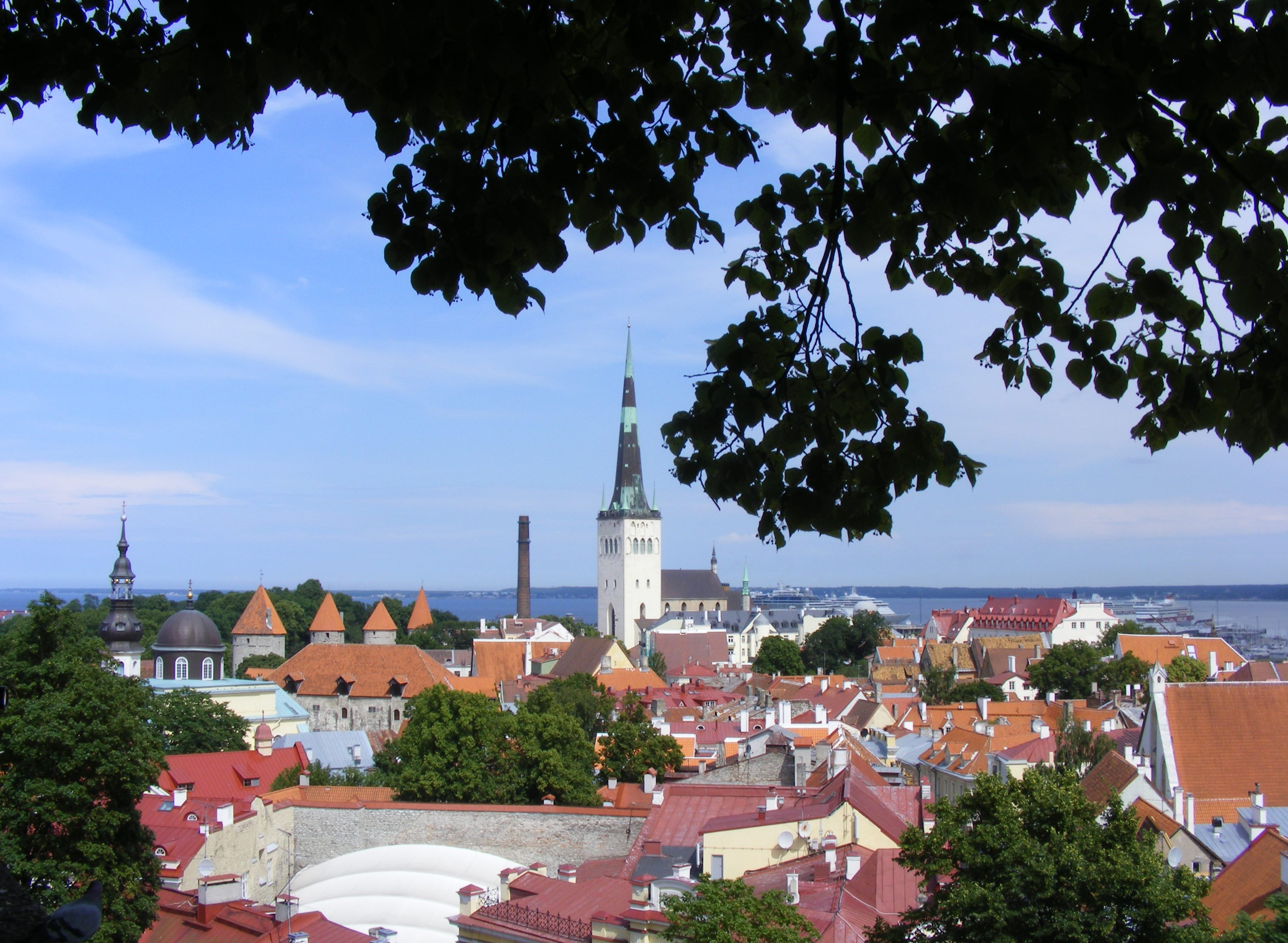
We move on to the Old Town of Tallinn itself and visit the Cathedral of Saint Mary the Virgin, also known as the Dome Church, which contains many heraldic carvings. We also see the church of St. Olaf, whose spire was once the highest building in the world at 159 metres. Following numerous lightening strikes it is now reduced to 123 metres. Formerly a Catholic cathedral, it is now a Baptist congregation. We pass the Danish Crusaders’ Castle, Toompea Loss and the impressive, Russian Orthodox Alexander Nevsky Cathedral, built in 1900 as a sign of Russian domination. There have been suggestions that this should be pulled down because of what it symbolises. With a population of 400,000, 25% of whom are Russian, Tallinn is the largest city in Estonia. Traditionally Lutheran in belief, the religious landscape includes, Russian Orthodoxy, Baptists and Catholics.

Most of the tourist shops are selling amber jewellery and Matryoshka or ‘Russian’ dolls. I pass on one and succumb to the other. As we leave Tallinn to return to the ship, someone lies down in the road in front of the coach. Is this some sort of anti-tourist protest we wonder? Our driver manhandles said individual to one side – apparently he has just imbibed too much vodka.

The evening session is another entertaining one from Cyndi Ingle, on Google Maps.

Inflicting Pain on our Fellow Travellers – day 5

Although our neighbours were somewhat quieter during the night, at 5.30am (this was 4.30am for those who had forgotten to alter their watches), there is a noise in the corridor. After an hour, being already up, we investigate. Four Spanish teenagers in underpants are playing some sort of game involving distributing all the metal-covered room-service dishes down the corridor. On seeing us they hide round the corner and Chris stands guard whilst I summon security. My body clock allows me to be more tolerant of the early morning escapade than the constant all night door slamming.

On moving from floor to floor we play an ongoing game of ‘Guess the Lift’. There are four lifts together at each end of the ship but there is a communal button to press. When the lift is summoned you have to stand in front of the one that you think will arrive first; I rarely predict correctly. We listen to Helen Smith talking about DNA and then go to give ‘Guest Relations’ fair warning of our need for our confiscated items to be returned in time for tonight. Two men from security stagger forward with our surgeon’s kit and we are allowed it straight away – a whole day in which to run amok with sharp tools! We enter the lift. Another couple enquire what the box contains. Do they really want to know that they are trapped in a lift with people who have access to knives and axes?

Despite a serious accident whilst on shore yesterday, Shauna Hicks bravely gives her ‘Caring for Family Archives’ presentation; excellent once again. This is followed by Rosemary Kopittke on ‘Directories and Almanacks’. After lunch it is time for my ‘’Til Death us do Part’ session, which was well attended, with sixty-five delegates foregoing the sunny deck-side to hear tales of vomit, pox and purging. Other interesting sessions follow: ‘Getting the most out of Google’ from Rosemary Kopittke; Paul Milner on ‘Parish Registers’ and Chris Paton with ‘Irish Records Online’.

DSCF2704

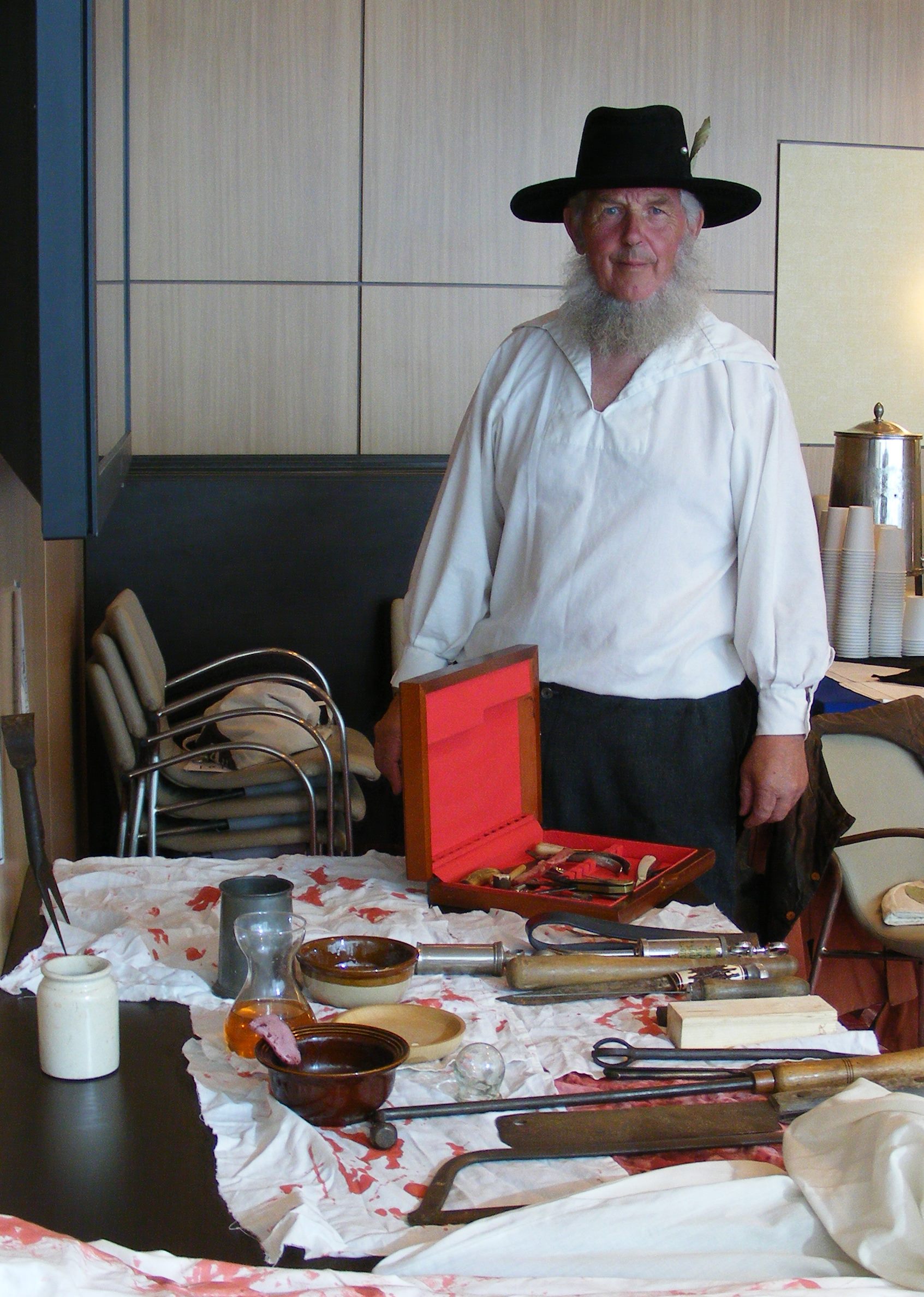
Master Christopher Preparing to Operate

It is another formal night but we are eating informally and are already in C17th costume ready for Chris’ session. None-too-bright British cruise goer to Chris: ‘Are you in National Costume? Where do you come from?’ Chris to none-too-bright cruise goer: ‘Devon’. He didn’t know how to respond! We also overhear muttered comments about the possibility of the Wurzles performing tonight but we take it all in our stride. Many people deprived themselves of dessert in order to flock to seek Master Christopher’s medical advice. To say it was well received is an understatement. We return our weapons of mass destruction and a rather under-sized security officer struggles manfully away with our box. No one has any idea what is meant to be inside (although we have a list, we have not been asked to produce this), nor do they know how many axes and knives have been hidden about our person instead of being returned to the box. The answers is none but we could easily have retained any number. I guess some sort of effort has been made and that is sufficient to prevent people successfully suing the cruise line if we inflict injury on our fellow passengers.

Molli Steam Train, Warnemunde, Germany – day 4

Up early for a lovely breakfast on deck 14, where there is the world’s biggest buffet and hence portion sizes to suit. We watch as we enter Warnemunde Harbour earlier than scheduled, as someone had to be taken to hospital. The windmills are incongruously juxtaposed against power stations and there are plenty of shipping movements to observe. An unheard of experience for us – dozing and reading on deck for the morning; we had forgotten how to relax.

Our ‘Historic Mecklenburg’ tour, ‘Purple 28’, is being led by Ann and driver Roland. We leave the fishing port of Warnemunde, which has just finished hosting the equivalent of Cowes week. This state comprises the Duchy of Meckenburg and part of the former Duchy of Pomerania (most of which is now in Poland). Although it is the largest state in terms of area, it is relatively sparsely populated and lacks natural resources, so focuses on agriculture. Rhubarb is farmed locally, as organic rhubarb juice is the latest health fad. Beef cattle are reared, primarily for MacDonalds. Crops include, wheat, barley, rye and oil seed rape. Under the socialists, farming was collective. Although basic necessities were cheap, anything deemed to be a luxury (e.g. televisions, cars, tinned pineapple) was prohibitively expensive. We are told that, since unification, west Germans have been resentful of money spent on rejuvenating and updating the east.

In 1323, the Duke of Mecklenburg sold Warnemunde to neighbouring Rostock, who wanted to secure access to the sea. Measures have been taken to prevent the area becoming overloaded with second homes and holiday lets and no new ones are allowed. The centre of the town, with its apartments, has now been surrounded by suburban housing. The shipyard and tourism are the main employers in the area. Local ‘allotments’, were created so that apartment-dwellers could have outdoor space. These all seem to have full blown chalets erected on them.

In the C12th, Slavs from modern day Russia, who were settled in the area, were driven out by Germans from further south, leaving the area with a Slavic/Germanic ethnic mix. The Duchy of Mecklenburg was in the same family, through the uninterrupted male line, for eight centuries. During this time, the Ducal family has intermarried with most royal families of Europe, including providing George III with his bride, Charlotte.

In the 1820s, iron-laden turf was collected from the riverside and was used for its health giving properties, it seems as some sort of poultice. It is still used by a local sanatorium. The locals complain about fuel and house prices but they are significantly cheaper than ours, despite average wages being similar.

023 Molli Train 14 July 2015

Molli Steam Train

We board the ‘Molli’ steam train, which uses Polish coal and runs on a line that was originally constructed to link the Duke’s residence at Bad Doberan to the nearby coast at Heiligendamm. Disconcertingly, it runs along the road through the town. We return to the coach, thankful that we are not on coach 29, which has a particularly officious guide, shooing her charges along. Heiligendamm was a destination for European nobility from 1900. The first sea bathing was popularised here in 1793, when the fad was brought from Brighton.

We drive to Kuhlungsborn’s prestigious three kilometre beach, This is the largest resort in Mecklenberg, it was created, in 1938, from three small villages. Under the Nazi regime, supporters were rewarded with holidays and the accommodation was state run by the Central Tourist Agency, who allocated accommodation to holidaymakers. There are about fifty watch towers along the Baltic coast. Under the socialist regime, they were reputedly to protect Eastern Germany from the dangers of incoming capitalist influences but were in fact used to spot those attempting to defect to the west.

024 Paddling in the Baltic at Kuhlungsborn 14 July 2015

Paddling in the Baltic

We stop for delicious apple cake and coffee in a posh hotel. The drawback is that three full coach loads into two ladies’ toilets is not a happy equation. Two enterprising American ladies help the situation by using the gents, heavily guarded by one of their spouses. We look at the generic tourist shops, a local craft market and a very crowded beach. There are plenty of basket-weave chairs with canopies that were designed locally in 1882. I dip my toes in the Baltic. Overnight visitors pay a ‘beach tax’ as a contribution towards the upkeep of the resort. School holidays here vary from state to state and are staggered on a rotational system, to avoid overcrowding.

We drive down the linden (lime) tree avenue towards the minster at Bad Doberan. The avenues marked the routes and also provided shade. In the wealthy west these were felled in order to widen the roads but the pre-unification east could not afford to do this, so they have retained their avenues and narrower roads. Cistercian monks arrived at Bad Doberan from France in 1186, to evangelise amongst the non-Christian Slavs. They dried out the swamps for farming and a settlement grew up. The original monastery was quickly rebuilt and enlarged in 1260, taking thirty five years to complete. Unusually, at this date, it was built from 7kg bricks made on site, which was an easier alternative to transporting stone. The façade has noticeable holes for scaffolding poles. All that is left of the monastery, following the Reformation in 1552, is the minster (or church) itself. It was retained because it was the burial place of many members of the ducal family. The minster, now a Lutheran Church, is 100 feet high, the soft ground making the deeper foundations necessary for a higher building, impractical.

026 Bad Doberan 14 July 2015

Bad Doberan

Inside, the lay brothers, or working monks, were separated from the choir monks, who performed religious duties. Each stall has a unique carved roundel, which may have related to a specific individual, who would sit in that place. We see Frederick Francis’ enormous granite sarcophagus. There is no inscription because it was designed following his instructions and he considered himself to be too well known for this to be needed. The internal walled have been painted to emphasise the bricks. Paintings of Slavs, depict them unrealistically in Turkish attire, as this was how non-Christian were portrayed. Some of the tombs of C13th-C15th monks have carved images of the deceased. They are all shown at the perfect male age of 38, regardless of their age at death. All the surviving medieval glass has now been put together in one window. There is also an allegorical C15th triptych showing the Eucharist mill’ – the word of God being made suitable for the laity. Unlike communist Russia, the socialist regime in East Germany did allow churches to remain open, although Christians were discriminated against.

We drive back to the ship and learn that there is an imminent Frank Zappa festival to be held locally. Our re-entrance to the Celebrity Eclipse is hindered by a local ‘Ooompa Band’ struggling through security, complete with instruments. To commemorate our stop in Germany, a Wurlitzer is playing in the restaurant on deck 14. There is also an impressive ice sculpture on display and a German themed menu; Chris devours five meat and one veg for tea. I then listened to another writing session by Carol Baxter in the evening, whilst Chris explored the fishing village of Warnemunde.

Scenic Flanders and Sleep Deprivation – days 2 & 3

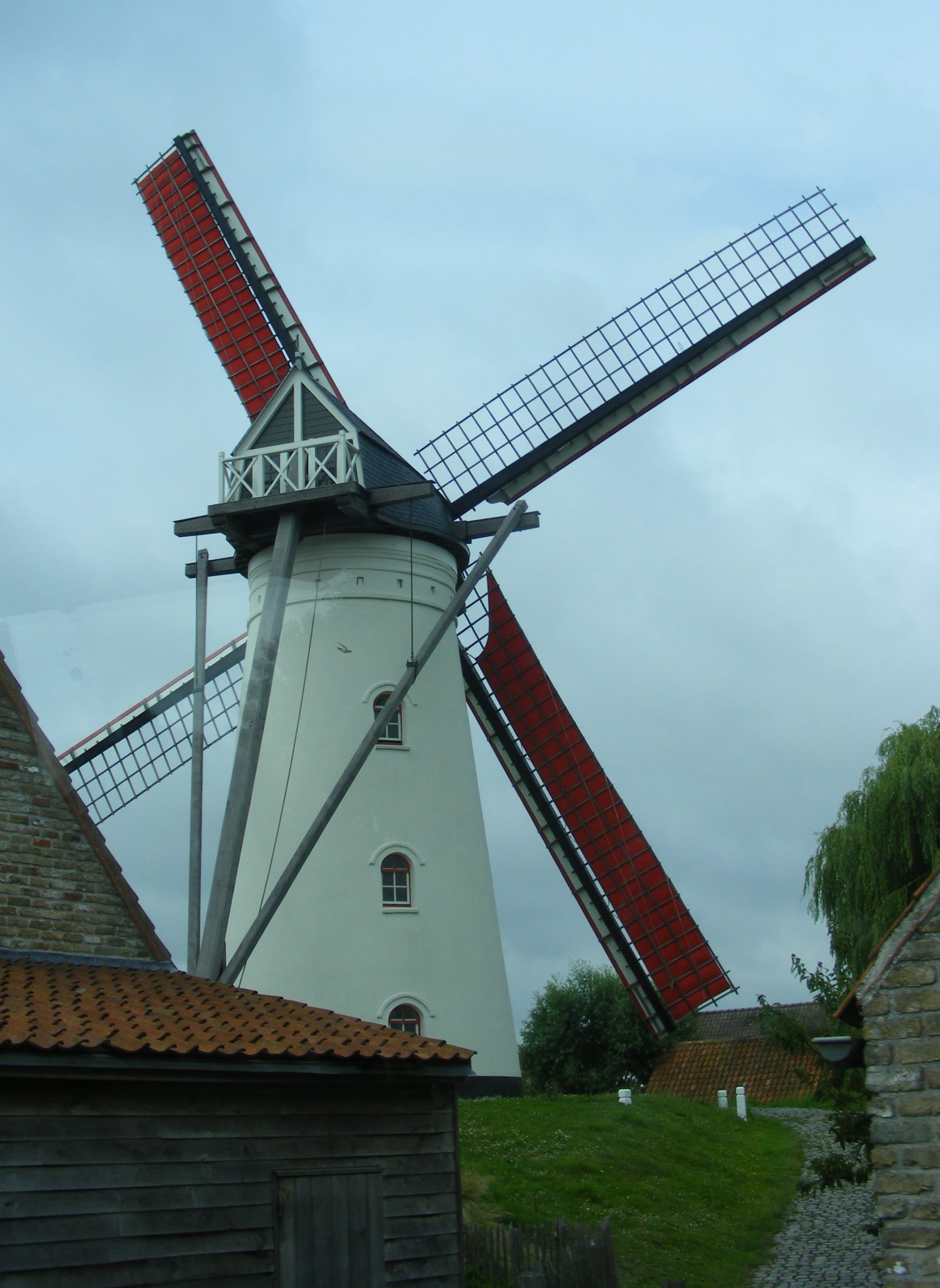
003 Ramskapelle C17th Grain Mill 12 July 2015

Ramskapelle

For breakfast I attempt the granola. I have managed to circumvent the normal menu and on request get, guess what, yoghurt to accompany it. Let’s just say that the granola was more like sugar puffs – an acquired taste that I have not yet acquired.

We dock in Zeebrugge, yet another port associated with an appalling sea disaster, this time the Herald of Free Enterprise. Along with two of our dining companions, we join folk with yellow stickers in group 26 for a tour of ‘Scenic Flanders’. Clearly seat belt wearing is not an option on Flemish coaches and off we set on a grey Bruges day. For a while, Flanders is looking anything but scenic but our brilliant Flemish guide, incongruously called José, manages to make a virtue out of driving through a port. He tells us that Zeebrugge is the entrepot for the car industry. Over a million cars have already been transhipped from here this year. 6000-8000 cars are loaded onto each ship for onward transportation; these ships take 100 drivers four hours to empty. We drive through Ramskapelle (Church of the Ram), the site of a celebration yesterday commemorating a Flemish defeat over France in 1302. We also pass the C17th grain mill at Ramskapelle. Most of the buildings use very small bricks, similar to Elizabethan bricks in the UK.

We see the poplar-lined canals known as ‘The Blinker’ and ‘The Stinker’; the latter is so named because it used to take the garbage out of Bruges. The landscape is predictably flat and there is wheat and sweet corn being grown for animal feed. The tops of several of the Medieval church towers were used as lighthouse beacons. We alight to tour the Medieval city of Damme. The town hall, outside which some kind of horse drawn carriage rally is taking place, was built in 1388. In 1468, the Duke of Burgundy (Charles the Bold) married Margaret of York in Damme. We visit the site of the old herring market, where 33 million tons of Scandinavian salt herring was shipped in. I failed to grasp over what time period. On occasions, this saved the area from starvation, notably when the potato crops failed at the same time as the more well known Irish Famine. A dog appears on the flag of Damme as, allegedly, a dog was once used to plug a hole in a vital dam from which the town gets its name. Damme is the Hay-on-Wye of Belgium and there are many book stalls. We also view the ruined church at Damme, which was sacked and burnt by Protestants in 1582. In the grounds of the church is an impressive sculpture by Delporte.

Next stop is Roose’s chocolate factory. The chocolate making demonstration is carried out by someone who is neither wearing gloves nor head covering. Maybe they don’t have food hygiene certificates in Flanders. We don’t buy any chocolate! We move on to the neo-gothic ‘Castle’ of Loppem or Lophem. This was designed by Pugin in 1856 for the Catholic Baron de van Calden. At this time, a member of the Braund family was working with Pugin and we wonder if he had any hand in the furniture design but we can find no proof. This is certainly neo-gothic in the extreme, with Catholic iconography overload, some very nice tiles and wooden carved banisters that took two men ten years to complete. A stuffed grizzly bear in the entrance hall was once an inhabitant of a local zoo. We learn that the treaty of Versailles was prepared here.

On our return, we listened to a very amusing presentation by Chris Paton on his Scottish/Irish identity crisis, followed by Cyndi Ingle, of ‘Cyndi’s List’ fame. Then a quick change to try to appear ‘formal’ for dinner. Lacking a ‘cocktail dress’, I hide behind Chris and we are deemed acceptable. I have some very appetizing lamb chops and we repair upstairs for a talk by Carol Baxter, which engenders some heated and very interesting, debate about genealogy standards.

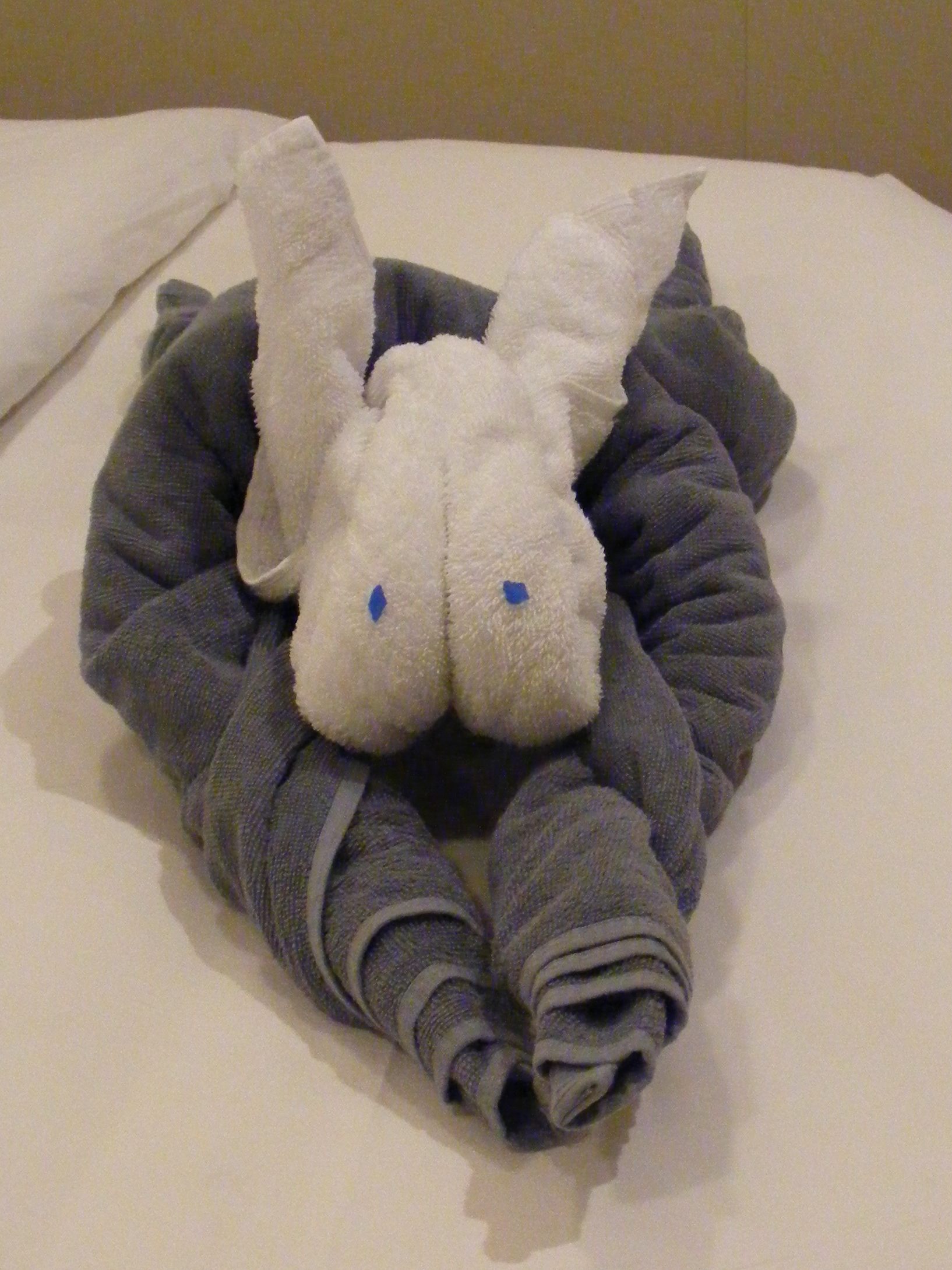
017 Rabbit Towel by Jeffrey 12 July 2015

Towel Origami

Jeffery, our stateroom attendant, has left chocolates on our pillows and an origami towel creation, which is very impressive.

We chose our stateroom because it was on the end of a corridor in the bow (that’s the pointy end to you and me) and we would only have one neighbouring stateroom. Unfortunately, our one set of neighbours are the proverbial neighbours from hell. The first night was bad but last night they went in and out of their stateroom about twenty times between 1.00am and 5.30am. This was accompanied by jiggling of locks and slamming of doors. Add to this the loud music and chatter, together with periodic falling against the adjoining wall and no sleep was had by all. It even kept Chris awake, something that I thought was impossible. Mine could be the first after lunch presentation where the speaker falls asleep. I finally got to sleep at 5.45am, only to wake again briefly at 6.30am and eventually get up at 7.50am. Sadly, this meant missing the first session of the day and being semi-comatose for most of the rest of it. Very interesting session by Shauna Hicks on records of emigrants (or from her perspective immigrants) to Australia. Then I retired to try to get some sleep but I find sleeping in the day difficult, so I gave up the attempt.

Back to the fray to listen to Jane Taubman on Family Historian and then after lunch it was my turn. A to Z of family history sources this time. I am competing with an art auction next door but despite mis-pronouncing Wagga Wagga (why it should be said Wogga Wogga I will never know), it seemed to be well received and there was a good crowd. Another session from Shauna Hicks, this time focussing on diaries and letters, excellent once again. Paul Milner’s informative presentation on the Parish Chest and time for our evening meal; Chris continued to work his way through his cow.

After dinner today was Cyndi Ingle talking about her eponymous list, in a very entertaining vein. And so to bed and blessedly only twenty minutes of door slamming at 1.15am this time.