So what happened there? I blame the rubbish motel internet – I am too mean to pay for the upgrade. Thanks to the 200ish people who looked at a blank post yesterday let’s hope this works!
So it is officially the hottest week for decades and here I am stuck in a motel room in that northern industrial city once again. For the benefit of my overseas readers, these rooms are not equipped with air-con and the windows only open a couple of inches because they are afraid of being sued if guests jump out. Normally, the rooms are equipped with fans. I appreciate that all these do is move hot air round the room but it does give the illusion of slightly less heat. My travelling companion sweet-talking the receptionist, resulted in the provision of an industrial strength, floor-standing fan, which I think may have deprived the receptionists of a breeze. Even with this on all night, the temperature did not dip below 28 degrees. I know, I must have looked at the thermostat at least once an hour. Now it is 7.30pm and still 29.5 degrees, a good fifteen degrees above my ideal bedroom temperature.
In other adventures: in an effort to look vaguely respectable for ‘work’ I brought a suit to wear. As I went to put it on, I discovered that the trousers were missing. I have no idea at what stage they escaped from the dry cleaner’s polythene bag in which they were ensconced but they are not there now. That put paid to the professional image I was trying to create. Anyone seen a pair of trousers lying abandoned at some point between home and here?
A bit of a win win in the motel restaurant though. In the crowded dining room last night we patiently waited foodless for 45 minutes after ordering. When food arrived for a table who had ordered 25 minutes after us, we politely enquired as to the whereabouts of our dinners. We’ve been involved in the hospitality industry, we understand that these things happen. Cue grovelling apology, full refund of the price of our dinner, the appearance of our meals and the offer of a compensatory bottle of wine. Being virtual non-drinkers, I ask if we can have free breakfasts instead. Yes, is the reply. Today we descended for a our free breakfasts to be greeted with a bottle of wine as well! – that’s another for the book launch collection (permission for serving of alcohol permitting). It was 7.30am; we nonchalantly sauntered out of the restaurant looking like it was normal to be carrying a bottle of wine about at that hour.
 I have noticed that, as I struggle with all this marketing lark for Barefoot on the Cobbles, it seems that the way to get a reaction on social media is to post gratuitous pictures of the fisherman of my acquaintance. Forget images of cute animals, I have cracked the latest trend! So here is a random picture that has nothing to do with my post but which will get folks rushing to click on their like buttons – maybe.
 In the novel, Rose Cottage is the home of William and Mary and their two adult sons. We encounter the Cottage and its inhabitants in the first chapter of Barefoot on the Cobbles. The name is used anachronistically; this small fisherman’s cottage at the top of the village of Bucks Mills was given the name Rosie’s Cottage in the mid-twentieth century. It is now known as Rose Cottage and in the absence of a contemporary name, it seemed appropriate to refer to William’s home by its current appellation. In the summer of 1890, when Eadie comes to join the family, Rose Cottage was a four roomed, thatched, cob cottage, typical of others in the village of Bucks Mills. It is set back from the road, next to the former ale house, The Coffin Arms and a small terrace of cottages known as Forest Gardens. Rose Cottage was to remain in the family for another seventy years.
 Captain William Pengilly has long since met with an unfortunate end by the time he is mentioned in Chapter 7 of
  The Independent Order of Rechabites is a friendly society, founded in 1835. These societies provided a form of health insurance and death benefits to members in the era before the welfare state. The village inn was often the focus for friendly societies, who might have a dedicated Club Room in the local hostelry. By contrast, the Rechabites upheld the values of the Temperance Movement. It does seem however that the Clovelly branch did have an association with the New Inn.
 ‘Crumplefoot’ Tommy is referred to in the first chapter of
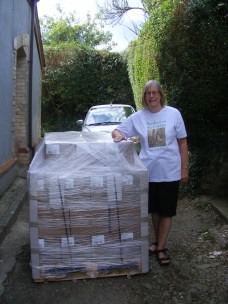 I am an inveterate reader. Despite an unavoidable serious cull when I drastically downsized, I still have 11 six foot high bookcases full of books in my bedrooms. I now have more than 1000 books in my living room as well. The only snag is that they are all the same one and I have read it numerous times! This week saw the arrival of THE novel. In an attempt to ensure that copies were ready for the 17 November launch, various contingencies were allowed for. Rather too many contingencies as it turns out. Now I have to find house room for 54 boxes for three months, before I can start selling. Obviously, I will be pleased to think that anyone might want to read it but I am really hoping that not all purchasers will go for digital copies or Amazon orders, as this will not deplete my stash. Currently, when I sit on the settee my knees are in the fireplace, as the boxes are piled behind said settee.
 You will meet William in the pages of the first chapter. William is a taciturn fisherman, who is content, providing there is a meal on the table and no-one disturbs his afternoon doze. He has lived all his life in the fishing hamlet of Bucks Mills, where he fished alongside his father and grandfather and now runs a small Bucks Ledge Boat with his two sons. By the time the story opens, he has lived in Rose Cottage at the top of the village for about three years. He was born in 1837 at the now ruined cottage The Bluff but grew up in King’s Cottage overlooking the sea. When he married, he moved to John’s Cottage and spent a few years at Mark’s, before settling at Rose Cottage, where he died in 1906.
 Much of
  The History Interpreter - Janet Few