
#100daysofbfotc Day 18: Mr C S Carnegie

Scales_Of_Justice.svg

Image from Wikimedia – used under creative commons

Claud Cathcart Strachan Carnegie is the magistrate presiding over Bideford County Sessions Court in Barefoot on the Cobbles. He was born in Leamington Spa, Warwickshire in 1849, to a Scottish family of some repute. His wife, Mary Breakenridge, was Canadian and their two children were born in Scotland. Carnegie held the rank of major in the 5th Brigade, Scottish Division of the Royal Artillery and was a JP for both Forfarshire in Scotland and Devon. He lived in the twenty four roomed mansion, Clevelands, in Northam, which has now been demolished and replaced by a housing estate. The census returns show that he habitually employed eight live-in servants. He was renowned for his good works and was a patron of the local hospital. He died in 1930.

There could not have been a greater contrast between Carnegie, a member of the gentry and those who were on trial in his court room. He was articulate, well-connected and rich, with a life-style that was far removed from the fisherman and his wife who stand before him in the final chapter of the novel.

‘Then Carnegie had announced, ‘There are some twenty witnesses to be called. We are not ready to go on with the case today and the defendants will, I understand, be legally represented. It is only fair that they should have time to prepare their case.’ ’

Barefoot on the Cobbles will be published on 17 November 2018. More information about the novel can be found here. Copies will be available at various events in the weeks following the launch or can be pre-ordered from Blue Poppy Publishing or the author.
 

#100daysofbfotc Day 17: Vera Wentworth

Vera wentworh 2

Wikimedia used under creative commons

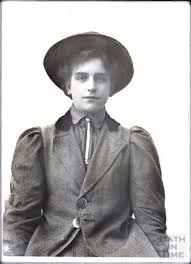
Vera Wentworth makes a dramatic appearance in Chapter 5 of Barefoot on the Cobbles. Born Jessie Alice Spink, in 1890, Vera was a member of the Women’s Social and Political Union, the militant arm of the woman’s suffrage movement. She came from a middle-class family; her father was a London chemist. At the time she appears in the novel, although still in her teens, Vera had already spent several spells in Holloway Prison for her beliefs. She was based in the south west and together with Elsie Howey and Jessie Kenney, made the Prime Minister, a particular target. Her militancy was such that she alienated other members of the movement.

Her 1911 census entry shows that she attempted to avoid being enumerated but the entry was later ‘Inserted by instruction of the Registrar General’. After the incident that is narrated in the novel, Vera attended St Andrews University. She continued to campaign actively and went to America to aid the cause there. During the First World War, when the suffragettes agreed to suspend their activities, Vera is reported to have worked as a VAD nurse but she does not appear on the Red Cross database.

In 1939 Vera was living in Argyle Street, St Pancras with her life partner, Daisy Carden and Vera described herself as an authoress. She died in 1957.

‘Now Daisy had a better view of the women, she could see that the speaker was not much older than she was, perhaps still in her teens. Her nose was rather too prominent for her to be considered a beauty but her straight dark brows and striking eyes drew attention.’

Barefoot on the Cobbles will be published on 17 November 2018. More information about the novel can be found here. Copies will be available at various events in the weeks following the launch or can be pre-ordered from Blue Poppy Publishing or the author.

#100daysofbfotc Day 16: Peppercombe

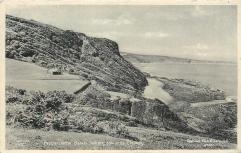
PeppercombeThe Wakely family, who feature in the early chapters of Barefoot on the Cobbles, live in Northway, at the top of the beautiful Peppercombe Valley. The small hamlet of Peppercombe nestles on the north Devon coast, between Bideford and Clovelly. At the time of the novel, fishermen put out from the rocky beach, In the lee of the looming red cliffs. Further up the wooded valley, straggled a handful of small cob cottages, inhabited by fishermen and labourers. As the track nears the main road, a mile from the shore, the landscape opens into farm land. Peppercombe has been inhabited for centuries, as is evidenced by the remains of an iron age fort, now named Peppercombe Castle. There was a large house of the same name in the village but this no longer survives. Little remains of the limekiln that would have been working in the valley when the Wakelys first lived there.
The valley now belongs to the National Trust and some of the cottages are available as holiday lets. There is a short history of Peppercombe, together with some photographs, on the Devon Perspectives website.

‘The lane was edged with pungent cow parsley; red campion and rose-bay willowherb set the hedgerows aflame. The cloudless sky had a shimmering intensity that comes only when a hot day tips inexorably into eveningtide. The gentle insect hum, the birdsong and the surrounding beauty, raised her spirits and gave renewed purpose to her stride as she struggled to catch up with her father.’

Barefoot on the Cobbles will be published on 17 November 2018. More information about the novel can be found here. Copies will be available at various events in the weeks following the launch or can be pre-ordered from Blue Poppy Publishing or the author.

#100daysofbfotc Day 15: Aunt Matilda

Aunt Matilda, along with other characters, provided me with an opportunity to explore the issue of mental health. Matilda lived all her life in a cottage in Bucks Mills and assumed the traditional youngest daughter’s role of caring for her elderly parents. After her parents died, she lived quietly with her elder sister and they served refreshments to holidaymakers from their home. When that sister too died, matters began to unravel for Matilda.  I was very excited to discover detailed case notes relating to Matilda’s time in Exminster asylum. As well as outlining her condition, these documents also included a physical description. So, although no photograph survives, I know that she was old, well nourished, with marked cavities, a slight beard and moustache, dark eyebrows, blue eyes, a pale complexion, flushed cheeks, a far-away, slightly worried, expression and that she weighed 7 ½ stone.

Exminster aslylum

Exminster Asylum

On 28 January 1908, Matilda was admitted to Exminster Asylum, with what was described as a first attack of mania. She was found to be suicidal and frequently had to be restrained from injuring herself; she kept scratching her face. She admitted to having tried to get out of a window and claimed to have heard roaring noises in her head for years, which was worse if she had catarrh. In addition, she heard voices and believed she was going to be killed. She frequently gave way to swearing, saying that the devil had changed her tongue. Matilda was recorded as being a dissenter, at this date, almost certainly a Methodist and had been happy in her faith but now believed she was going to hell. She also said that she had lost the use of her legs and that she did not want to live. She was described as being dull and melancholic in manner, with a defective memory. Other comments on her condition reveal that she slept badly and was noisy at night. She suffered from constipation and said that she had only a little bit of a tongue and no stomach, so nothing could go through her.

As you can imagine, this was wonderful background information for a writer and a true incident from her time in the asylum is described in chapter 4 of Barefoot on the Cobbles. Some may wonder why she appears in the novel at all. Apart from wanting to tell her story for its own sake, it also helps to explain why the spectre of the asylum haunted the other characters.

 King’s Cottage was also home to Aunt Matilda, their grandparents’ youngest daughter, who cared for her parents in their old age. She was a strange little woman, slight and swarthy, with rotten teeth and the faintest suggestion of a moustache. The poor woman was inoffensive enough but she dwelt in the corners of Eadie’s nightmares, chilling and dark.’

Barefoot on the Cobbles will be published on 17 November 2018. More information about the novel can be found here. Copies will be available at various events in the weeks following the launch or can be pre-ordered from Blue Poppy Publishing or the author.

#100daysofbfotc Day 14: Merelda Badcock

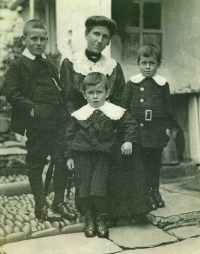
Merelda Badcock nee Dunn widow of Frank (died 1919) with William (left) Arthur and Charlie c 1916Merelda Badcock née Dunn is a mariner’s wife, whose life has been shaped by the rugged North Devon coast. She was born in Clovelly, into a seafaring family, on 3 March 1882 and married Frank Badcock in 1905. Over the years, she watched her menfolk risk their lives on the ocean. Her three sons were all born in a small Clovelly cottage. We meet her at the end of the book, when, desperate for food, her husband, having just returned from the war, puts out to sea on New Year’s Day. Merelda is left waiting anxiously on the shore, as her husband’s fishing boat, the Annie Salome, sets off into a storm.

‘There was silence as Merelda Badcock and Rose Harding arrived at the lifeboat house, hands clasped, faces white and strained. The women had grown up together on the quay and were well used to the tragedies of the sea. Now they were united in fearfulness, husbands in danger and brothers attempting the rescue.’

Barefoot on the Cobbles will be published on 17 November 2018. More information about the novel can be found here. Copies will be available at various events in the weeks following the launch or can be pre-ordered from Blue Poppy Publishing or the author.

#100daysofbfotc Day 13: Torquay Town Hall Hospital

Torquay Town Hall HospitalThe military hospital that was set up in the Town Hall in Torquay at the beginning of the First World War was one of the largest in the country. The climate in Torquay was thought to be particularly suitable for convalescing soldiers and there were a number of other hospitals in the town. The hospital is mentioned in Chapter 10 of Barefoot on the Cobbles as Daisy’s friend Winnie has been working there as a VAD nurse. Unlikely though they may sound, Winnie’s experiences, that are described on pages 200-201, are based on the memoirs of a real volunteer at the hospital. Although family information suggests that Daisy nursed whilst she was in Torquay, there is no record of her having been attached to the Red Cross as a VAD, in the Town Hall Hospital or elsewhere. I have therefore given her a slightly different role.

More information about the wartime work of the Red Cross volunteers and the auxiliary hospitals that they manned, can be found on the British Red Cross website.

‘ ‘What’s so bad at the hospital?’ asked Daisy. ‘I mean, I know that the men are fearfully wounded and that …. and that some of them …  well, some of them don’t get better. But surely it is wonderful to be part of it all? I feel so useless. There’s all the men risking their lives, off to war and all I can do is polish the brass and empty chamber pots.’ ’

Barefoot on the Cobbles will be published on 17 November 2018. More information about the novel can be found here. Copies will be available at various events in the weeks following the launch or can be pre-ordered from Blue Poppy Publishing or the author.

#100daysofbfotc Day 12: Daisy

0U9A3415Daisy is arguably the heroine of Barefoot on the Cobbles, she is certainly the catalyst for the main events. It is particularly poignant to post about her today, as this would have been her 124th birthday. Co-incidentally, it is also the birthday of her younger brother, Leonard. Daisy was born in the North Devon fishing village of Clovelly, the eldest of eight children. Much of Daisy’s story, as retold in the novel, is based on fact, including minor incidents, such as her throwing her hat out of the train window. Other aspects, including her early employment history and her nascent romance, are products of my imagination. I have given Daisy a personality that I feel fits with the known events. I hope that her restlessness and desire to break free from her background, sits well with her move to Torquay, a world away from her Clovelly home. Writing about Daisy’s illness was a challenge, although I was helped by detailed newspaper accounts. I hope that my interpretation of her mental state does her justice. So, happy birthday Daisy. It has been a privilege to bring your story to a wider audience.

‘Daisy was a child of the season, delighting in the heat and the chance to discard her boots in favour of skipping over the cobbles in her bare feet. She loved the feel of the hard stones as she curled her toes round each pebble, like a bird poised for flight.’

Barefoot on the Cobbles will be published on 17 November 2018. More information about the novel can be found here. Copies will be available at various events in the weeks following the launch or can be pre-ordered from Blue Poppy Publishing or the author.

#100daysofbfotc Day 11: Laura Kate Cornelius

Upton Road

Upton Hill, Torquay

Kate Cornelius straddles an awkward social divide. In the Barefoot on the Cobbles, I have used her character to explore the issue of social mobility in early twentieth century Britain. She was born Laura Amelia Kate Mayers or Meyers, in January 1881, to a working-class family; her father was a packer on the railway. She spent her childhood in Upton Hill, Torquay and it is here that we meet her, in Chapters 10 and 11, as the First World War is drawing to its close.

Laura’s working life began as ‘Kate’, a nursemaid to the Gilley family; as such she was associating with Torquay’s elite. Mr Gilley, of Aylwood, ran a railway cartage business and it is likely that he employed Laura’s father. Kate moved on to work in a smaller household in Babbacombe, as a servant to Mrs Macphearson. In 1913, already in the thirties, Kate married a local butcher, Percy Cornelius. This gave her a new respectability and she was able to employ a servant in her home, back in Upton Hill. By the time of the novel, the Cornelius’ first child has been born; they later go on to have two further children. Kate also appears in the final court scene, as a discomforted witness. She lived to reach the age of 91, dying in Torquay in 1972.

‘Mrs Cornelius exhibited all the snobbery of the social climber. Kate Cornelius would be horrified if these securely middle-class matrons realised that she, Kate, was formerly one of Aylwood’s servants.’

Barefoot on the Cobbles will be published on 17 November 2018. More information about the novel can be found here. Copies will be available at various events in the weeks following the launch or can be pre-ordered from Blue Poppy Publishing or the author.

#100daysofbfotc Day 10: The Red Lion, Clovelly

Steps-Archway-Red-Lion-Hotel-CLOVELLY-Devon

The Red Lion is one of the two Clovelly inns that feature in Barefoot on the Cobbles. Formerly a row of fishermen’s cottages, by the time of the novel, it was a flourishing hostelry, providing accommodation for tourists and refreshment for visitors and locals alike. Its dominant position on the quay at Clovelly, meant that it became a meeting point for the elderly fishermen of the village, who would sit outside the Red Lion with their baccy and beer, yarning about their days at sea. In inclement weather, they would huddle under the archway, which also provided shelter for the Clovelly donkeys. The Red Lion housed the Mariner’s Union Club Room and although inquests were known to be held there, the inquest that features in Barefoot was held elsewhere. The Red Lion’s publican, Mr Moss and his daughter Mary, are mentioned in the book.

‘The old fishermen, ruminating in the shade of the Red Lion’s archway, nodded sagely and muttered that the dry spell would break before the week was out.’

Barefoot on the Cobbles will be published on 17 November 2018. More information about the novel can be found here. Copies will be available at various events in the weeks following the launch or can be pre-ordered from Blue Poppy Publishing or the author.

#100daysofbfotc Day 9: Mrs Emily Powell

Western Gazette 3 July 1891 page 4 col advert for servant in Chuudleigh villas col b

Western Gazette 3 July 1891

Emily Powell is a woman whose life is beset with adversity. Her respectable, middle-class home at Chudleigh Villas in Bideford hides her struggle to maintain the illusion of gentility. Coping with her husband’s mounting debts and alcoholism is secondary to her inability to come to terms with the death of her daughter. The loss of Florence, which occurred just before we meet Emily in Chapter 2 of Barefoot on the Cobbles, pervades every aspect of her life. In an attempt to cope with her grief, Mrs Powell all but ignores her other children, who are constant reminders of her loss. Her resulting attitude to motherhood is to have a lasting effect on her young servant, Polly.

Mrs Powell was tall and thin with swept back, wispy, fair hair, and a harassed expression. She was dressed in the deep lilac of half-mourning. Polly knew, from having spent a week listening to Lydia’s raptures about the latest fashions, that Mrs Powell’s gown, although elegant, was not new.’

Barefoot on the Cobbles will be published on 17 November 2018. More information about the novel can be found here. Copies will be available at various events in the weeks following the launch or can be pre-ordered from Blue Poppy Publishing or the author.