I have been so busy actually doing my experimental archaeology course that there hasn’t been time to wite about it. It is fascinating and I am having great fun with a group of mostly matureish students from seven different countries, with an intriguing range of backgrounds and experiences. So far (this is week 3), we have introduced ourselves and the course, looked at the changing definitions of experimental archaeology and thought about reconstructing houses. Interesting that when an Iron Age house burns down the roof falls in and then the walls collapse on top, meaning that future archaeologists will excavate the structure walls first and then roof. Never say you don’t learn anything from reading my ramblings. Next stop pottery.
A few technical issues, such as repeated emails urging me to collect my student ID card from room whatever, which is in …..… Dublin. Wondering how my fellow students from Australia and the US will go about this. Then, having ordered a book in time to take on holiday, randomly I get an email from the dreaded online bookseller saying there had been a problem with delivery and it was being returned. I am roughly translating this as ‘we couldn’t find your house and couldn’t be bothered to ask’. Or even ‘I wanted to be home early and couldn’t be bothered to drive to the wilds of nowhere on a wet afternoon.’ Annoying but I implemented plan B and have now got the book and a message thanking me for returning the book I didn’t want to return and assuring me that I will be refunded in the next week. Most of the reading is available to us electronically, although I do prefer paper and I have the beginnings of a library appearing now.
I am currently immersed in the first assignment, a study of the different definitions of experimental archaeology. Essay writing seems to take much longer than it did in the 1970s, maybe because I am more of a perfectionist now. Ok – or maybe just because I am old. I am also already looking ahead to assignment two which requires us to critique experimental archaeology projects on a similar theme. It is suggested that we might like to link this to our work in the final term, when we have to make something. Thinking of my own interests, I have ruled out experimenting with bewitching people – not sure that would get past the ethics committee. I could make some herbal remedies but the fun would be in testing them and I am not sure that would go down well either. So, do I do something girly and get my spinning wheel out (I really must do some spinning when I have time – try about 2024)? In a continuation of my post mid-life crisis, I am now going rogue. I have suggested to a fisherman (and boat-restorer) of my acquaintance that we might like to build a coracle in the garden. He has long been trying to persuade me to build a garage (people who know my house and garden are now questioning how on earth that would work – it wouldn’t) and I think he was keen on the boat idea thinking it might require a garage to put it in. Ok, so a boat could be a tad ambitious, it seems to involve lots of animal skins that might be difficult, not to say expensive, to acquire. Maybe fishing nets or fish traps though….. My search history now contains some slightly dodgy sites as a result of me searching for ‘where to buy hemp’.
Two days at home, two presentations given and now we have also spent a couple of days in South Devon, primarily to attend a Fisherman’s Friends concert. This was an adventure in itself as it marked our first venture indoors with a crowd of people. We had been warned by the venue that we would need vaccination certificates, or evidence of recent negative lateral flow tests to be let in, which was reassuring. I did wonder if we really would have to produce these but yes, long queues were already amassing outside the theatre thirty minutes before the concert started. Everyone’s status was checked and people were being turned away or provided with tests. I wish there was more of this sort of thing. As a bonus we got inside before the rain started. I was planning on wearing a mask throughout but I just couldn’t see. As we were in the front row, we weren’t too hemmed in so I decided to go without, along with 95% of the audience.
While we were down south we took the opportunity to visit Stover Country Park. We managed to dodge the showers and do some more experimenting with the new camera. We also went to Compton Castle but were less lucky with the weather here. It is a small but fascinating National Trust property. The Medieval house was the property of the Compton family. It was transferred to the Gilberts through marriage in 1329 and the house was enlarged in the 1450s and fortified in 1520. This is the family of Sir Humphrey Gilbert the explorer who sailed to Newfoundland in 1583, two years before his half-brother Walter Raleigh attempted to set up a colony on Roanoke. The Gilberts also helped to establish a settlement in Maine. The family had moved to Bodmin by 1800 and Compton was sold. Its extensive acreage was farmed but the building fell into ruin, with only the chapel retaining its roof. By a twist of fate, the house was reacquired by the Gilberts in 1931 and fully restored. It is still lived in today. There was plenty of heraldry on display and costumed interpreters in the rooms. We also spotted some Harry Juniper pottery form Bideford. Now a full on couple of weeks of presenting before our final trip of the year.
The next outing was to Gressenhall Workhouse and Farm. The workhouse opened in 1777 and catered for the poor of the hundreds of Mitford and Launditch; previously, each parish had provided for its own paupers. This pre-dated the Gilbert Act, which advocated parishes combining to provide for the poor. Known as the Mitford and Launditch Incorporation House of Industry it was described as a ‘pauper’s palace’. Subsequent masters of the workhouse, particularly after the Poor Law Amendment Act of 1834, took a rather different view and implemented the principle that life inside the workhouse should not be preferable to life outside. The workhouse was converted to an old people’s home in 1948 and closed as an institution in 1975.
I was particularly impressed with the telling of the stories of real people associated with the workhouse. There was a compelling sampler on view, stitched by an inmate, Lorina Bulmer. The ‘stream of consciousness’ words give some indication of her mental state. A reconstructed 1950s home brought back memories.
There is also an extensive rural heritage museum, with many farming artefacts on display. Across the road, we walked round the farm that was once worked by inmates. We got out feet wet walking through the long grass to say hello to the Suffolk Punch heavy horses.
The next day and we set off to Thetford, to look at the priory, founded by Roger Bigod in the early years of the twelfth century. It was a Cluniac foundation until the dissolution, eventually falling into disrepair. It is also the burial place of Thomas Howard, Duke of Norfolk, who was a commander at the Battle of Flodden. We spotted a muntjac deer, unfortunately too far away for the Zoomless camera to photograph. Next our pre-booked session at the Ancient House Museum in Thetford, or, as it turned out, not. After a bit of banging on the door marked ‘closed’ it turned out that they were unable to open due to staff shortages. We couldn’t rearrange as our holiday was almost at an end so we returned to the site and walked through the forest instead. I have to say that the museum was very swift about refunding our entrance fee.
So to home and being thankful that the delays on the M5 were less serious in our direction than they appeared to be for those leaving the West Country. Fortunately, we managed to get the fuel needed to get us home in Bristol as, by the time we reached Barnstaple and Bideford, garages were either closed or had ridiculous queues as people unnecessarily began panic buying fuel.
Update on the injuries/damage. I now have a fully working camera, body not so much. One hand is healing nicely, the other is still a bit grim, one knee has an impressive bruise and my ribs are ‘interesting’. Still, I now have thirteen talks to give in eighteen days, which will take my mind off it!
Another day of ancestral church visiting, this time in the vicinity of Great Yarmouth. Having driven through a torrential storm, we arrived at our first church, Stokesby, in the sunshine. This is a thatched church pretty much in the middle of nowhere. Next stop Filby. The inhabitants of Filby are obviously gunning for a Britain in Bloom title and boy do they deserve it. I think that every begonia in the country must now be in Filby in a very impressive display.
As we weren’t far away, we decided to call in to Caistor. In some inexplicable manner, I managed to leave a fair amount of skin on a sand-covered concrete walkway by the beach. No idea how or why I left the vertical but it was a spectacular five point landing, two palms, one forearm, one knee and my ribs. This sounds impossible to achieve but achieve it I did. I even managed to escape with just a small scratch on the casing of the new camera (see below). Ouch was a rough translation of what I said. As I was now dripping blood fairly dramatically, we returned to the car and I attempted to wash my wounds in some handy toilets. Not actually in the toilet, that would not be hygienic, although urine is of course a steriliser. In this case it may have been more effective as the taps required me to press down with my palm, which was injured, in order for a meagre trickle of water to appear. Never fear, there will be a first-aid kit in the car. Indeed there is a first-aid kit in more than one car in our possession, just not this car. I wonder if facemasks, of which I have several in my bag, might be adapted for the purpose of staunching wounds. In the end large, cleanish handkerchiefs managed to stop me dripping gore over the car for the journey home. Glad I have never taken to tissues.
We abandoned the idea of going into Great Yarmouth itself and a final church on the itinerary was elusive due to a diversion that basically had us going round in circles. The journey home was also hampered by a twenty minute delay due to roadworks.
Having washed half a beach out of my hands, we went for a short walk in the forest, following the ‘Desert Rat Trail’, with interpretation boards telling the story of the Desert Rats who were stationed here in World War Two. An evening meeting, the sixth in the eight days that I have been away, reminds me that I really should look up the definition of ‘holiday’.
With my left hand still oozing interestingly and a distinct pain in my side, suggesting that all may not be hunky dory in the rib department, we nonetheless set off for Pensthorpe Natural Park. This is a great place to photograph birds. It was also where I realised that the damage to the new camera was a little more extensive that I hoped. The Zoom function no longer works and the camera automatically shuts down with a ‘lens error’. So the bird photography left a little to be desired but we still had a lovely day wandering round the site at a pace that my ribs would allow. There was a good array of woodland birds on display, as well as the wildfowl. Pensthorpe have a breeding programme for red squirrels, which are then released in the wild on Anglesey, where competition from grey squirrels is not a problem.
Back in the van, I unsuccessfully try a few self-help suggestions for rectifying lens errors, refraining from the more invasive, which basically seem to come down to hitting it. Just to add to the not going brilliantly theme, we receive an email to say that our October caravan holiday has been cancelled due to work on the site. We manage to come up with a more expensive and less convenient alternative. Still worse things happen at sea, as they say. Not sure who ‘they’ are and it is a pretty stupid expression but I am well aware that many people are worse off than I am. Onwards and Upwards!
More walking in the footsteps of ancestors as we head off to visit parishes on the outskirts of Norwich. One of these turned out to be right in the centre of the city, involving us in getting to grips with a multi-storey carpark, where, randomly, you had to go to the top floor to pay for you ticket before departure. We didn’t stay any longer than was necessary as our dislike of spending time in cities was confirmed.
In the afternoon, we went for a walk in Brandon Country Park, much more our sort of thing. This, like our caravan site, is part of the ‘Brecks’, or Brecklands, characterised by heathland. In the Country Park a large area of forest has been cleared to reinstate a heathland landscape. When Brandon Park Estate was purchased by Edward Bliss in 1820 it was devoid of trees and he set about introducing a wide variety of native and non-native species, planting eight million trees in just six months. His wealth came from the manufacture of gunflint, which was in high demand during the Napoleonic Wars, although the industry declined rapidly in peacetime. Bliss was able to use unemployed gunflint workers to plant his trees. His mausoleum is situated in the park but the remains of Bliss and his wife were moved to the local churchyard when the estate changed hands. I managed to spot a mandarin duck amongst the mallards hiding in the reeds.
I’d planned a visit to West Stow Anglo-Saxon Village, together with some of my descendants, before I knew it was going to be mentioned in my new course. The course itself is continuing professional development; does this mean the entrance fee is tax-deductible? We had a lovely day involving performing feats of daring on the adventure playground, well for some of us at least. We investigated the reconstructed Anglo-Saxon houses, uncovered archaeological finds and looked at an astounding array of locally excavated artefacts. It was a shame there were no Anglo-Saxon historical interpreters to add to the experience but it was well worth a visit nonetheless.
There were some Napoleonic re-enactors in the shape of the 95th rifles on site, which did seem rather out of period but gave some of our party the opportunity to compare musket firing experiences. We followed the Beowulf and Grendel trail; coincidentally one of the younger members of our party had been learning about the story in school. We also walked round the lake but this was a bit underwhelming, as it is geared up for angling rather than enjoying lakeside views, which were intermittent at best. There was a group clearing reeds from the river and examining the river quality. The had caught some non-native crayfish, which were a cause for concern.
All in all it was an excellent day and the lovely weather was a bonus.
In a change to the planned itinerary, we called in at Grime’s Graves. We’ve been passing the brown sign to it on our travels and having looked it up, it sounded worth a visit, especially as it was only four miles away. This is the site of an early C20th rubbish tip but also a Neolithic flint mine. So it seemed like a good idea to continue our early history theme from yesterday. The mine was in operation from 2600-2300 BCE, about the time that Stonehenge was being constructed. As bronze and iron began to replace flint for tools, the mines which are between six and twelve metres deep, were used for burials. The miners used antler picks and scapulas as shovels. The flint axe heads, arrow heads and knives were ceremonial and symbolic as well as functional. The name ‘Grimes’ comes from the Anglo Saxon god Grim, another name for Woden. In Anglo Saxon times, the site was important as an administrative meeting point but its Medieval use was as a rabbit warren.
We started by looking at the explanatory interpretation boards. Michael Rosen had written some powerful poetry about the site. Then it was time to descend the mine. We were equipped with token hard hats but as there was no under chin fastening, I am not sure what good they would have done if we’d fallen down the mine. I have no idea what part of me decided that it was a good idea for someone who really doesn’t like heights and isn’t too keen on enclosed spaces to descend twelve metres (it felt like about two hundred) down an almost vertical metal ladder but descend we did. Even my companion isn’t super keen on being underground. I ensured there was photographic evidence and then returned to the surface pretty swiftly.
Then back to the itinerary and a drive to the coast at Blakeney. We managed to avoid following the sat-nav to Blakeney in Gloucestershire. It was convinced it must be that one we wanted as we’d been there earlier in the year. Blakeney is noted for its bird life. Despite a calf-killing walk across shingle for a mile or so, all we saw were a few seagulls.
On to look at Sheringham, where I visited as a child. There seemed to be some kind of 1940s fiesta going on, with plenty of people in period costume, including an impressive scout troop, complete with appropriate uniforms. We also saw the heritage steam train pass by. Another drive through Cromer, this time in the sun and then it was time to turn for home. The forecast rain began to materialise but we managed to stop off at a church to look for a tomb for one of my students. Sadly, although the family were well represented, the one we sought was elusive.
We drove northwards, passing a large field full of pig arcs and hundreds of pigs. We also passed Sandringham estate but decided not to call in. It was interesting to see several sunflower fields. As we travelled along roads in the middle of nowhere much, I was reminded how much I enjoy following along on an OS map. We began our series of stops along the north Norfolk coast at Shepherd’s Port, near Snettisham. Here we found an RSPB reserve that had been created from a former gravel pit. Accessing the obligatory parking ticket was a challenge. Parking was free for RSPB members. I pressed the appropriate button, expecting to have to input my membership number or perhaps scan my card. I was hoping it wouldn’t be the latter as I have a ten year old life membership card, which doesn’t have any kind of scanability function. After much button pressing and card waving, it turned out that it was sufficient just to say you were a member; there was no necessity to prove it. I wonder how many people abuse that system?
This stop was the opportunity for a pleasant walk but not a great deal of wildlife. There were definite signs of autumn. Not only are the leaves and bracken tinged with rust but rosehips, elderberries and blackberries dot the hedgerows. We worked our way through Heacham, Hunstanton and Holme to Brancaster. Not on foot I hasten to add; our days of longer distance walking are over. On the way we passed a sign to another RSPB reserve, complete with car park full notices. Having turned round at Brancaster we decided to ignore the car park full signs and see if this was indeed so. It wasn’t. We availed ourselves of one of several free parking spaces and set off to explore Titchwell Marshes. Here we found birds a-plenty and an opportunity to try the 50x Zoom on my new camera. I discovered just how many photographs of a far distant, swimming avocet with his head underwater it is possible to take before getting one with his beak showing. The answer is a lot. My camera does have a rapid-fire function somewhere, which might have helped, I just need time to read the 186 page manual.
The next day it was off to another RSPB reserve, this time at Lakenheath. After taking the ‘pretty route’ – ok we got slightly lost – we set off to explore. A lovely four or five mile walk round the reserve was worth every step when we found a kingfisher posing so I could photography it. Less success seeing bitterns, cranes and otters, all of which frequent the reserve but I’ll settle for the kingfisher and a quick fly past by the bearded tits.
We returned to the van early so I could attend the first lecture of my experimental archaeology course, now I am really excited, definitely worth missing half a day of the holiday! More of that in its own post.
Some more recent travel adventures for you, this time to Norfolk. We left home slightly later than we might have, as I began the day by chatting to the lovely Helen Tovey of Family Tree Magazine, making a recording that will be available on their website. Then the inevitable lengthy, cross-country drive. We arrived at our caravan site in Thetford Forest about 5pm and had time for a quick walk in the forest.
A holiday isn’t a holiday without some family history so, the following day, we set off westwards across the county to Aylsham, the birthplace of my great great grandmother. The landscape was what you would expect from Norfolk, flat, large fields and the vernacular brick and flint cottages; there seem to be plenty of new housing developments on the edge of settlements. Having parked somewhere that probably wasn’t a parking space we looked at Aylsham church, then investigated the marketplace, where my ancestor had a grocer’s and draper’s shop in the 1830s.
Next to Felbrigg Hall, a National Trust property, built in the 1620s by John Wyndham, on the site of an earlier house. It was subsequently added to by later generations. The house passed to a step-son, who changed his name to Windham but the estate was lost by the profligate William Frederick Windham, who married a woman of dubious reputation and then lavished thousands of pounds worth of jewellery on her. His uncle’s attempt to have him declared a lunatic failed. The property was sold, complete with contents, in 1863 and coincidentally found its way back to a Wyndham descendant through marriage.
Our first port of call was the church, to try to identify John’s memorial trees that were planted nearly thirty years ago. At the time, it was easy to spot them, as they were the only young oaks in the vicinity. Now it is a little more tricky. Just how large should a thirty year old oak tree be?
We walked round the extensive walled garden. I thought it was a shame that there were so many more recently introduced non-native plants on show but it was impressive. In order to sit down, we forced ourselves to eat cake (me) and a bacon butty (my comrade in arms). There was a handy undercover outside space for this purpose. It had been drizzling all day and it seemed that everyone wanted to be undercover, so there were large queues, both for the café and the house itself. Although we had avoided indoor public spaces up until now, we decided we would go round the house, especially as almost everyone was wearing masks. As a glasses wearer, this does actually mean I can’t see where I am going, as despite purchasing masks described as ‘anti-fog’, I still steam up. I did discover that I could alleviate this by walking round holding my nose. Holding my breath also works but clearly this is not sustainable for more than a few seconds. Holding my nose not only makes me looks slightly ridiculous but comes with its own issues. I am contemplating purchasing one of those nose clips, as worn by synchronised swimmers.
The highlights of the house for me were, of course, the library, with thousands of volumes, including many travel books, brought back by a Windham after an extended Grand Tour. I did wonder how many had ever been read. The ‘enlightened’ family provided a library of twenty five books for their servants. This did seem a bit underwhelming, given the size of their own library. The eighteenth century Chinese wallpaper was also interesting. Apparently it was peeled off the walls and sent to Cambridge for cleaning, before being reapplied. There was also some floor-covering on a bathroom, that had what appeared to be a nursery rhyme theme. As usual, the servants’ quarters had their appeal. A quick look round the second-hand book shop led to the obligatory purchases, including a book by a friend of mine.
With a months’ rainfall forecast for the late afternoon, we decided walking round Cromer might be best left for another day. We did drive in to see where the sea would have been if it wasn’t masked by heavy cloud. Cromer was gridlocked with those who had taken to their cars to escape the rain, so we resolved to return later in the week if we have time. The evening saw the first of a series of planned, how easy is it to Zoom using pretty ropey caravan site wifi? experiments. Possible it seems, as long as you don’t want to say anything or be seen.
Following on from my previous account, for once it seemed that my passport photo passed muster, so that was one hoop successfully negotiated. Then, last week, the excitement of registering for my modules. Randomly I do seem to be registered for something entirely different as well but that is a bridge to be crossed, probably if I seem to be expected to pay for it. I am sure that a graduate certificate in world heritage conservation is all very interesting but ……..
Yesterday I conquered, at the third attempt, applying for Commonwealth Games tickets. I thought I was all prepared for this, having registered as soon as it was possible about two years ago. It seems I failed then to click on the ‘confirm your registration’ link in an email I never received and certainly don’t have now, so I am not registered at all and my application kept stalling as I was told that I needed to verify my account. Never fear, thinks I, I’ll just reregister with one of my many other email addresses – there are advantages to having several. But no, it seems, as you have to give your name, address, date of birth and probably your inside leg measurement, so they think I am already in the system. I reapply as a fisherman of my acquaintance, hoping that my using my own card details but his address won’t mess things up. He will only attend under sufferance; I can hardly expect him to pay. At regular intervals throughout the whole debacle, I was exhorted to ‘click on the (ridiculously blurred) images with traffic lights/stairs etc.’, to ensure that I am not a robot. Maybe a robot could make a better fist of navigating the system.
Anyway, after all that, I’d had my fill of technological challenges for one week but embarking on an online university course comes with a whole set of challenges all of its own, before you even get to the actual studying. Yesterday I clicked on various links I’d been sent and discovered that course material was available. With a holiday in the offing, I gleefully began looking at this, thinking that I might be able to get ahead. There is in any case a debate about whether the course started yesterday, next Monday or next Tuesday – take your pick from advertised dates. It was a tad confusing, as this material seemed to refer to a similar, in-person course that ran last year. Despite the excitement, I was reluctant to go too far down this route in case I was spending time on the wrong course. Today I seem to have got the correct material, so that is a relief and also slightly scary, well, okay, very scary.
I filled in my student profile, choosing to upload my Mistress Agnes picture for this. They might as well know from the outset that I am weird. I added some biographical information as requested, confirming my weirdness status. This involved changing my Facebook username to something that actually was my name, before sharing the link, tick in that box. What the heck is my Google URL? Nope, no idea – I tried several likely combinations but all just lead back to a Google advert. I decided to leave that box blank.
I read the module handbook and ordered two very expensive books. One even might arrive before I go away if the mighty Amazon do as they claim. Other suggested books can be downloaded. I much prefer actual books to reading online but in the interests of economy, I downloaded some more. One helpfully tells me that it will take me 594 minutes to read. That seems awfully precise; if I had nothing better to do I’d time myself. I am quite thankful that I am a speed reader. I am also increasingly aware that I haven’t done any proper taught courses since the mid 1990s. I don’t count the PhD where you basically make it up as you go alone and devise your own questions.
There are weekly Zoom tutorials. Thankfully, only one of these clashes with a pre-existing engagement but I am concerned that I will be in the middle of a field with questionable wifi for the first ones. The first assignment is due in six weeks. I am starting to wonder if Ireland has a different calendar to us as in one place a least, the due date is a day/date combination that don’t exist. I am a submit early person, so hopefully this won’t matter anyway.
So I am off to read for 594 minutes, or maybe 593 if I am lucky.
It is difficult to find illustrations for these blog posts, so you will have to put up with a gratuitous ‘practicing with the new camera’ picture – so far the most significant challenge with that has been trying to thread the strap through a teeny tiny slit.
Saturday was the all-day Mayflower 400 International conference. The eagle-eyed mathematicians amongst you will note that it is in fact 401 years since the Mayflower sailed in 1620. The conference was originally scheduled for last year and was to be a live event. It was delayed by a year and finally converted to an online format. This meant that there were attendees from across the globe, many of them watching at hours when most self-respecting folk were asleep.
After a very interesting and relevant introduction from Charlie Courtenay, Earl of Devon, Master Christopher and Mistress Agnes chatted about their lives in Devon in the fifty years since the Mayflower sailed. For various logistical reasons we had pre-recorded this, amidst a certain amount of issues, such as very loud, large tractors driving past, or the phone ringing at inopportune moments. Cue take 3, or 4, or 10.
After us, Cor de Graaf gave the Leiden perspective. I am so in awe of people who can present in a second language. After some friendly lunchtime chat, that is characteristic of Devon Family History Society meetings, Phil Revell told the story of the More children from Shropshire, who were dispatched across the Atlantic on the Mayflower, having been taken from their mother.
This was followed by Debbie Kennett, explaining the uses of genetic genealogy. Then a thought-provoking session from UK based, American TV journalist, Jim Boulden. He was analysing why lineage societies, such as that for Mayflower descendants, are so popular in the US.
Jo Loosemore told us about the problems of curating the Mayflower Exhibition at The Box in Plymouth, during a pandemic. Hearing about the ethos behind the exhibition, which incorporated heavy involvement from the Wampanoag, was fascinating. Unfortunately, now the day was virtual and therefore extended into the evening, I didn’t get to stay for Nick Barrett’s closing session, a real shame as Nick is always an excellent speaker.
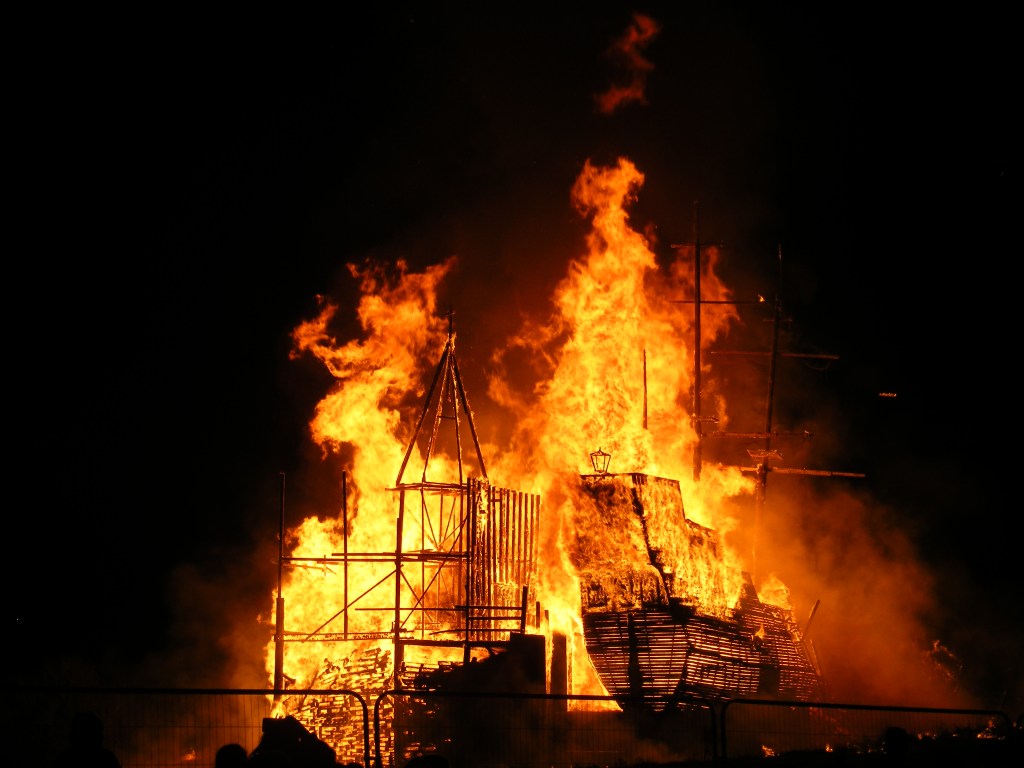
Two years ago, I purchased tickets for the Torrington Bonfire. If you are thinking, pile of sticks, add a match, you couldn’t be further from the truth. I have been to three previous bonfires and these are truly spectacular events. They are organised by Torrington Cavaliers who spend two or three years building elaborate constructions, which are then burned, raising thousands of pounds for charity. Previous models have included the Victory, a Medieval castle, Trumpton and London’s Pudding Lane. So convincing was this last construction that a local estate agent was approached by someone trying to purchase one of the new houses that were being built on the common. This time, in another delayed event, it was the Mayflower that was to be consigned to the flames. The first thing of note was that this was a full-scale model and it really brought home just how small the Mayflower was and how hazardous that transatlantic journey would have been.
I am now going to get a bit ranty, so you may want to stop reading here. First, some context. In the past week Devon and Cornwall have been declared an area requiring enhanced response measures, due to levels of COVID that are twice the national average. In my immediate area, nearly half of all recorded COVID cases have been in the past month. Our major hospitals are on red alert. Although nothing is mandatory, extra caution, including continued mask-wearing, reducing social contact and regular self-testing is being advised. I have been doing all this as a matter of course anyway.
We debated whether it was sensible to attend a large scale event (the actual attendance was 9000). This would be the first time in eighteen months that I had intentionally put myself in a situation where there would be more than half a dozen people together. We reasoned that it was outside and we could remain on the outskirts, or even come home if we wanted to. We also decided to miss much of the preliminary activity and go later than we otherwise might have. Stupidly, we also thought that the recently announced need for particular caution might mean that people would be more considerate. Naturally, we resolved to wear masks.
We did indeed station ourselves on the periphery, in a place where we could see many of the other 9000 or so attendees passing by. We were several metres from anyone else until the very end when a raucous, large family pushed in front of us, despite there being plenty of space elsewhere. I passed the time waiting for the fireworks people watching and then with incredulity, counting the mask wearers. You might expect older people at least to be more cautious (nope – not one person who appeared to be over fifty, apart from us, with a mask). The first aiders then, they’d need to wear masks, wouldn’t they? No again, one out of the four that I saw. Out of 9000 people, of whom I estimate I saw well over 2000, sixteen, just sixteen were wearing masks, most of them children. I know we were outside but closer to the centre of activity, people were crammed in. Then, in what I thought was the height of irresponsibility, one of the live bands encouraged the audience to sing along. Bear in mind that most of the non mask-wearing audience were shoulder to shoulder with strangers.
I know I am over cautious, I know people are desperate for things to be ‘normal’ but I was shocked at the total lack of awareness and concern. I also know that mask wearing isn’t pleasant. It was the first time I had worn mine outside for several hours and as the night grew colder, I was either viewing the spectacular fireworks through a fog or wiping my glasses every ten seconds. No it wasn’t pleasant, yes it was a pain but I did it and willingly. Not only because I want to reduce my risk of being seriously ill, requiring hospitalisation or dying but I also want to reduce risks for others. I too want to go back to ‘normal’. I want going out to be safer for those with vulnerable, as yet unvaccinated, children and my immune-compromised friends for whom vaccines are unlikely to be effective and for whom COVID would be extremely damaging or fatal. I guess others who feel like me chose to stay away from Saturday’s event and attending was certainly out of character with my behaviour over the past eighteen months. I am still not sure if I regret going. I felt that for the most part, we minimised risk but it shouldn’t just have been up to us. This is a community issue and everyone should be playing their part. Vaccination helps but is not immunity. Outside helps but is no guarantee that infection won’t spread. Take care of yourselves people, take care of each other. So, a great event; the fireworks were particularly impressive, shame about the audience. I am sure if each one of those people was asked what they would do to save the lives of their children, grandparents, loved-ones, they’d say ‘anything’. We are not being asked to donate our kidneys, to do ‘anything’, we are being asked to be careful, considerate, human. I am not ‘living in fear’ or being dictated to, I am making informed personal choices and taking reasonable precautions to keep myself safe, in the same way that I wear a seatbelt, or exercise and eat reasonably sensibly. I can’t understand the thinking behind the behaviour I witnessed on Saturday night. I can only assume they think the risk is minimal that the odds are ‘it won’t happen to me’. I hope for their sakes their gamble with those odds pays off.
I am not sure which is more experimental, the archaeology or the adventure. Before I wrote Barefoot on the Cobbles it was a toss up between writing a novel and doing an experimental archaeology course and back in 2016, I opted for the former, which was at least cheaper! Two novels on and I was all set to begin novel number three. I had an idea (I still do) but it just wasn’t working. Time, thinks I, to put it to one side and return to the experimental archaeology course idea. This may well ensure that the creative novel three juices begin to reflow any time about now. Of course, in the intervening five years the world has changed. Despite all the awfulness, I now had more scope because there were courses that I could attend virtually. I looked for possibilities and came up with what seemed to be just what I wanted, at University College, Dublin. To be honest the course details were sketchy in the extreme but it specifically mentioned that it was suitable for historical interpreters, so I decided to take the plunge.
The first hurdle was circumnavigating the online applications process. Not hugely difficult but I needed an academic reference at a time when all universities were effectively closed. I also needed it quickly as it seemed that it was pretty much a ‘first come first served’ for suitable applicants. Not only was it the Easter vacation but everyone was working from home. It was also more than ten years on from my PhD, would anyone remember who I was? After a few phone calls and emails, I finally secured a reference that implied that I might be capable of Postgraduate level study.
Shortly after, I was given a place and began to wonder quite what I had let myself in for; it was still all a bit of a mystery. There were a couple of introductory Zooms over the summer. I ‘met’ the professor responsible for the course and he seemed to be my sort of person. I lurched between excitement, sheer terror and putting it to the back of my mind.
Then, this week, it all began to take off. I had several generic emails telling me how to stay safe on campus and explaining about all the great activities that I could take part in, or of course, not, in my case. It was time to formally register. This was mostly straightforward but I needed the dreaded passport photo. This came with all the usual, plain background, don’t wear a hat, don’t look sideways, don’t have your hair in front of your face and worst of all, don’t have a reflection in your glasses, instructions. I didn’t have anything remotely suitable but fortunately Martha was on hand to produce something that, for a passport type photo of someone who is 100% not photogenic, actually looked half decent. I tried to upload it. Error message. ‘Your photo must be less than 50KB. Hmmm that is really pretty small. I tried taking a screen shot of the 2.5MB photo. Ah, that was considerably smaller but still 62KB. The registration paged offered the option of an online photo size reducing thingy. Now I looked like something out of a hall of mirrors. A few more attempts and success. Now I am waiting to see if it meets with approval; it had better, as this is as good as it gets. Next, I have to decide if I want to give my parents access to my academic record. I am tempted to say yes but decide that might be tricky as they’ve been dead for 56 and 10 years.
Finally, I get a summary of the three modules that make up the course. Now I am really excited. Fortunately, they look brilliant, especially ‘Crafts, Making and Storytelling’, which comes in the summer trimester (or term as we English say – trimester sounds like I am pregnant). I also have a shiny new academic email address to add to the many that I already have. I wonder if we get to keep it post course. I have now had academic email addresses in two different countries, which is weirdly thrilling.
No book list yet, which will be the next excitement. In anticipation of needing extra shelf space and cash to purchase the new books, Martha has been helping me with a book cull. If anyone wants some heraldry books at bargain prices please get in touch.#
I may be a bit stuck for pictures for this series of posts but here I am being vaguely experimental. No, no idea why it looks like I am praying.



 The History Interpreter - Janet Few