Day 9 Tromsǿ
I’ll admit that a late-night trip followed by an early start wasn’t great planning; this is exacerbated by the fact that I’ve had a really bad night, so have been awake since about 3am. It is raining as we set out at 8.30am for a trip billed as ‘Idyllic Sommarǿy’. This time we are in group one led by Lucia who is studying both history and marine biology at the university, which seems an unusual combination. Sommarǿy was an area that was used for summer cattle grazing, hence the name. It is also a busy fishing village, located on an island to the west of Tromsø.
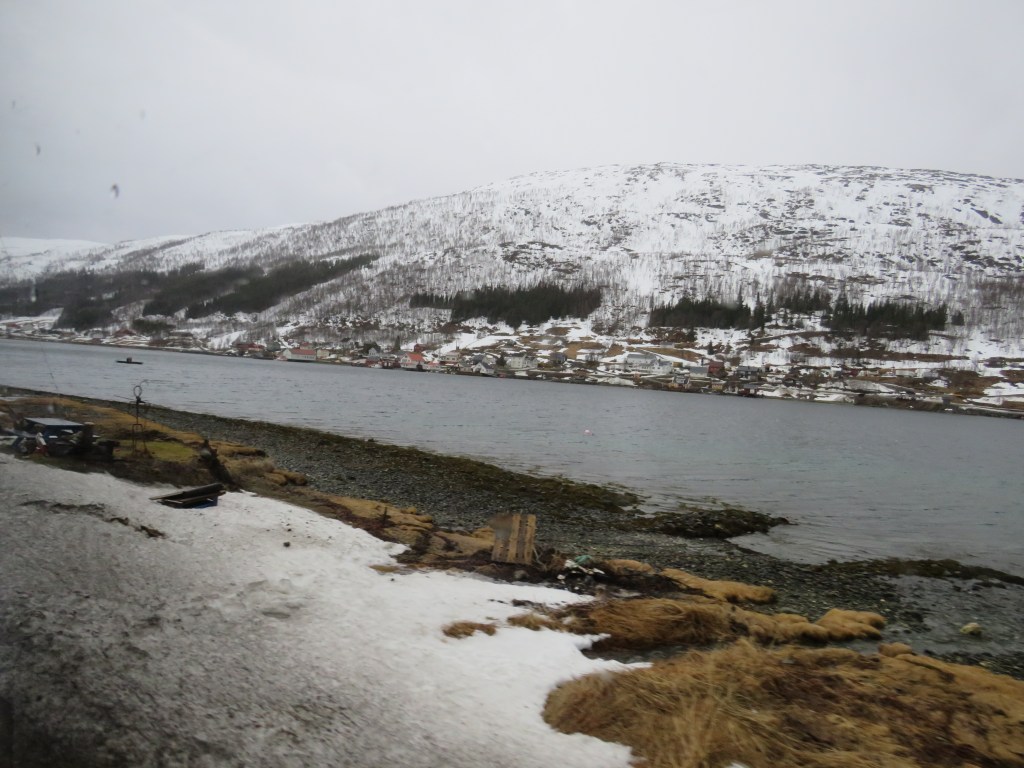
We pass the large hospital, that is the biggest employer in the city; the next nearest hospital is a seventeen-hour drive away. We cross the Sandnessund Bridge that links the island of Troms to Kvaløy or Whale Island, heading for the Arctic island of Sommarøy. We are driving through some beautiful scenery, which is somewhat marred by mist and rain. Tromsǿ was a centre for the export of salt cod, which predominantly went to Catholic countries such as Spain, Portugal, Italy and France. We are excited to see three sea otters and later some reindeer. Reindeer are free range but are owned by Sami groups. There are 500 wild bears in Norway, all of which are recorded and protected. This contrasts with 5000 in neighbouring Finland. ‘Viking’ is now sometimes erroneously regarded as an ethnicity but it is really an activity carried out by the Norse or North men. It literally means to travel from bay to bay in order to trade. It is pointed out that, if we have bought souvenirs on our trip, we have been a-Viking.
There are fewer than 600 inhabitants on Sommarǿy. We arrive at the hotel and despite the rain, I fully intend to go on the forty-minute guided walk that is on offer. On getting out of the coach, I discover that the wind is so strong that I can barely keep on my feet, so I abandon this idea and after a quick look at the fishing fleet, we remain in the hotel and the coach. As we head back to port, a message comes through to say that we have left someone behind. To be fair to this person, we did leave slightly early, having been counted and deemed to all be present. We begin to retrace our steps. Fortunately though, a second trip has arrived at Sommarǿy and the missing passenger can return with them. I suspect that the Ambassador representative who counted us on our trip may be in trouble.
There is more to learn about the area. There is a significance to the traditional painted houses. Red is the predominant colour, dating from when the wood was preserved by coating it with fish blood. White was reserved for the most prestigious homes, as it was imported. The more of your home that was painted white, the higher your status. Historically, the traders were wealthier than the farmers and fishermen, now the money is in fishing. Present generations are likely to live in houses that are the same colour as those of their ancestors, even if they are now of a different social standing. Some houses in northern Norway are built with vertical planks and some with horizontal. This reflects the building style in the ports with which they traded. Bergen is very wet, so horizontal planks are used. This means that, when the bottom of the houses start to rot, one or two planks can be replaced. Vertical planks would mean that every plank would need to be renewed. Ports that regularly traded with Bergen copy this style. We also see duck houses, which are built to encourage eider ducks to nest, so that their feathers can be used. Like us, Norway’s royal family are under a bit of a cloud at the moment, with the step-son of the crown prince in court and Epstein links also tainting the Norwegian royals.
We make a photo stop to see some rock carvings that are between 4000 and 6000 years old. When they were discovered in the 1950s and 1960s, the outlines were coloured in to make them easier to see, this impacts on their authenticity and the paint is not now renewed. We are already running a little late due to starting to return for the missing passenger and there are further delays when we are pulled over for a spot check by the police. It seems that there have been instances of, for example, drivers not having the equivalent of the PSV licence and of coaches being sub-standard.
After lunch, I catch up on some sleep in the cabin. Evening meal today was salad for me and roast turkey for Chris.
 The History Interpreter - Janet Few