Day 5 Åndalsnes, Romsdalsfjord
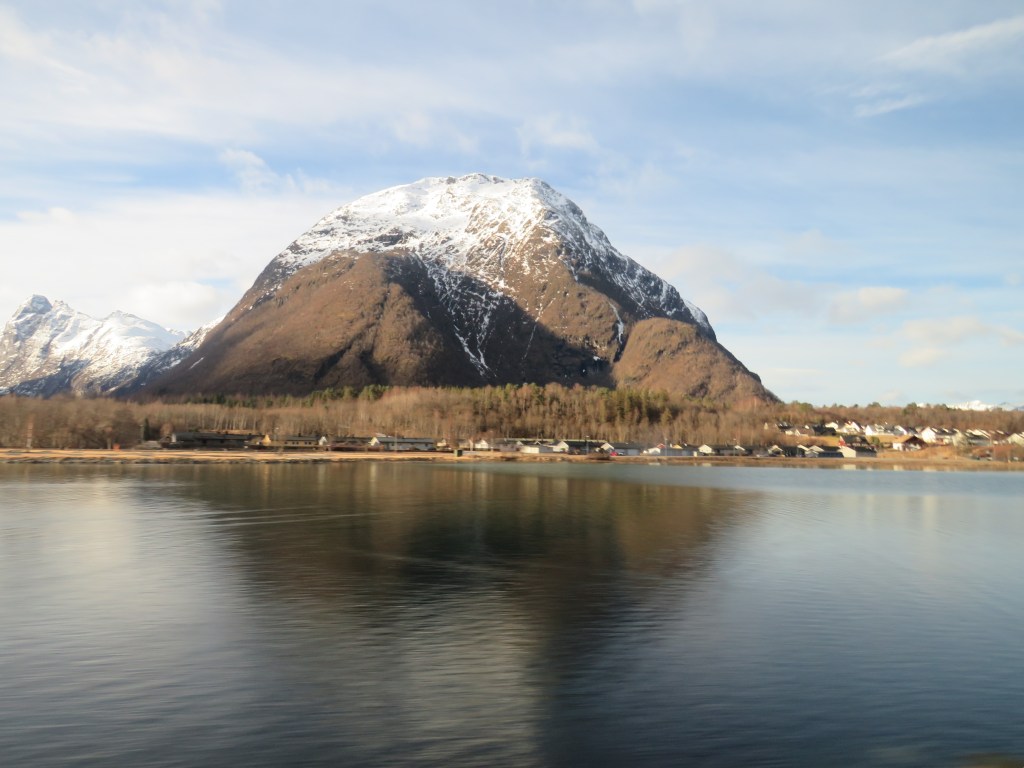
We are travelling up Romsdalsfjord as we wake up and soon, we anchor at Åndalsnes, surrounded by mountains. In April 1940, British troops landed here and 160 buildings were destroyed during the bombing raids. Twenty-six tons of Norwegian gold were shipped out of Oslo, via Åndalsnes, during the war, to be stored in Britain and then North America. Åndalsnes was the railway terminus. Now, the significant industry is furniture and textiles.
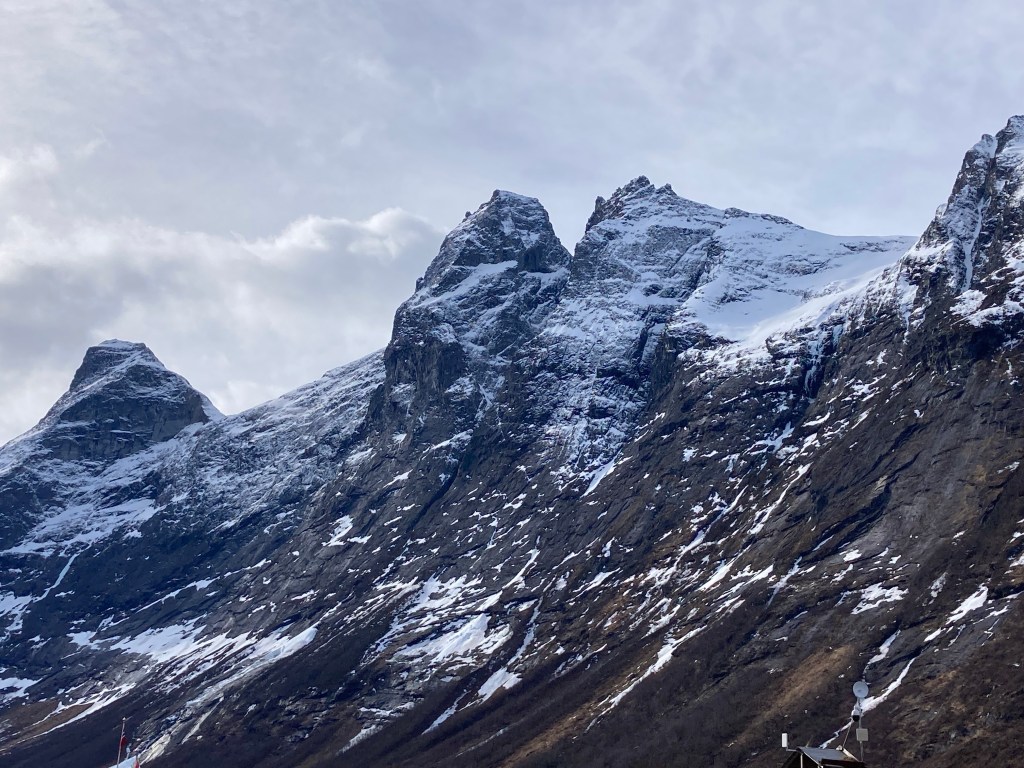
Our tour group today is group one, with Roxanne from Michigan. While we are waiting to depart, we watch the ship’s windows being cleaned; this looks like a precarious process. We board the coach near the unusual-shaped building that houses the climbing wall museum. We drive alongside the Rauma river, noted for salmon, with towering mountains on either side. The river is still frozen in places. Mount Romsdalshorn is on our left and the Trolltindane peaks are on our right; both are over 5000 feet high. The HEP infrastructure can be seen. We stop at Slettafossen waterfall, perhaps less impressive than it might be, as it is frozen. I intended to change my shoes from my softer trainers to my more substantial trainers before leaving the ship but I have neglected to do this. It is eight degrees and a little icy underfoot but fortunately we don’t have to walk far today. Silver birch, Scot’s Pine and golden coloured grass are features of the landscape. The tree line stops at 600 metres. The area is renowned for its strawberries and farming. I drag the word transhumance from the O level geography depths of my mind. Goats in particularly are kept for their milk and cheese making.
Having passed the Trollveggen (Troll Wall), a vertical, overhanging rock face over 3000 foot high, on the way out, we pause here for a photo stop on the way back. The legend is that the king of the trolls held a wedding party for his daughter on the top of the cliffs and so distracted were they with dancing that the dawn came up and they turned to stone, creating the peaks on the top of the cliffs. Here, we are in the Reinheimen National Park, which was created in 2006 to protect the biological diversity that is found in the area; it is the third largest national park in Norway. The name means home of the reindeer but we don’t see any. The reindeer were vital to the hunter gatherers who first settled here after the end of the last ice age, about 8000-9000 years ago.
Photographs taken, we cross the Sogge Bridge into the Isterdal Valley, viewing the King, Queen and Bishop peaks. We were supposed to view the Trollstigen (Trolls’ Path), a winding road with eleven narrow, hairpin bends carved into the mountainside. This feat of engineering won awards when it was constructed in 1901. Unfortunately, the road has been blocked by a fall of snow, so we can’t see this and the coach driver has to reverse more than a mile back up a single-track road before he is able to turn. We stop at the Trollstigen holiday complex, with its carved wooden trolls.
The area is noted for its stave churches, constructed from wood in the twelfth and thirteenth centuries, often without the use of nails and incorporating wooden staves but these are as elusive as the reindeer. Returning to the port, we have a quick look round but almost everything is shut as it is Sunday. We see the iconic Golden Train and a chapel that is an old railway carriage. Inside, the crucifix is fashioned from pieces of track and the altar is made from sleepers. The altarpiece is symbolic; a tear of blood represents sacrifice and the lifegiving force, the fountainhead of the river of life. Continuing the eating too much theme, I have something that passes for a meal at lunchtime, a rather odd vegetable patty and chips, whilst my companion has roast beef. I also have a kiwi cheesecake that I am counting as one of my five a day. The decaff coffee machine is on the blink; this was also an issue yesterday but it seems to give up its hissy fit after a while. We are thankful that we opted for a cabin with a balcony; we’ve never had so much as a window on previous cruises, mainly because we were busy on sea days and spent very little time in our cabin. This time, the balcony has definitely been worth the additional money. It is even sunny and warm enough for Chris to sit out there for a short while. I confess to having a siesta in the afternoon, followed by beef bourginon for an evening meal, as well as more wrestling with the coffee machine. This time, Chris has bream.
 The History Interpreter - Janet Few