Just as a warning to those who are following along, there were seventeen days to this holiday and you may need to hold on to your seats,
Day 4 Ålesund
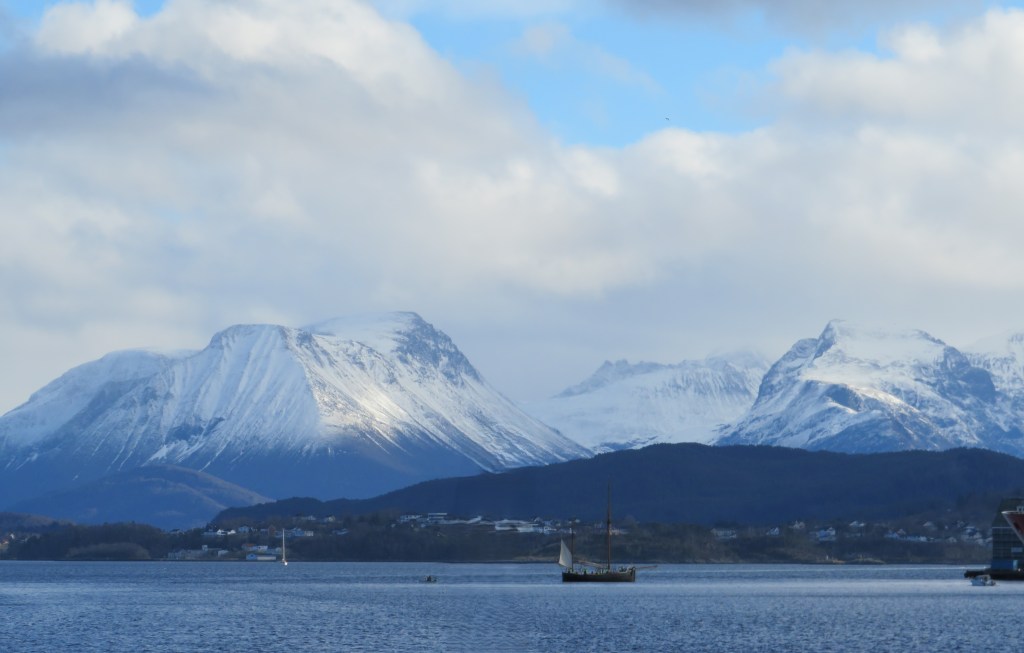
We wake up in time to see us drifting into the first port, which is Ålesund. Today, we are part of group three and our designated trip takes us through Ålesund, via a series of tunnels and bridges, to the islands of Giske and Godǿy. To be honest, I am not the world’s greatest fan of tunnels and some of these are quite long but I manage. We learn that blasting tunnels proved to be cheaper than building bridges. The tunnels are seventy-four metres below the level of the fjord. When they were first built in the 1990s, tolls were payable on both bridges and tunnels but once the construction costs were paid for, they became free. Taxes are at twenty-three percent, half of which goes to central government and half is local taxes, the equivalent of council tax. Good use was made of the excess granite from creating the tunnels, including as the basis for reclaimed land.
Our guide is Rudolph, of German and South African extraction and he asks us not to mention reindeer. Ålesund is renowned for its Art Nouveau architecture, as much of the town was rebuilt after a serious fire in 1904, which fortunately resulted in only one casualty. One house, known as ‘the miracle house’ did not burn. Kaiser Wilhelm frequently holidayed here, so sent aid after the fire. It was stipulated that rebuilding must not be of wood but there was a lack of knowledge about building with alternatives. Expertise came from other European nations, notably France, hence the adoption of the Baroque, Art Nouveau style. Carvings of fish and dragons are a testament to old Norse heritage.
Rudolph imparts various nuggets of information about Norway. The population is about 5·8 million, 43,000 of whom live on the seven islands that make up Ålesund. It is Norway’s largest fishing harbour, with fifty percent of Norwegian salt cod exports leaving from here. Salmon is also exported, mostly to Japan. You are only able to buy up to 4·5 proof beer and cider in Norwegian supermarkets; anything stronger has to come from the equivalent of an off licence and these are government owned. There is also no ‘to the door’ postal delivery; letters are collected from boxes at the end of the street and parcels from the post office. Displaying flags is common in Norway but they have to be taken down by 9pm. There is no charge for water, only for waste water, when tanks are emptied. With the benefit of hydro-electric power, much of Norway’s power and transport is electric. The country was relatively poor until the discovery of North Sea oil and gas in the 1970s. Brown cheese is popular; it is made from goat and cow milk and is caramelised, hence the colour. Here, silage is wrapped in white plastic, giving the bales the nickname Trolls’ marshmallows, or alternatively, tractor eggs.
Giske, pronounced Yishker, is known as the ‘Saga Island’ and is famous for being the birthplace of the Viking Chieftain, Rollo, who was given Normandy by Charles the Simple of France in the hope that he would protect France from incursions by other Northmen. Rollo is potentially an originator of the Braund family. Giske is very flat, with just one hill at twenty-five metres above sea level. We arrive at Giske Church, which was built about 1130. It is Norway’s only marble church. Some of the marble is local, some came from Italy. It was probably ballast when ships returned from selling fish. The marble is covered in plaster to protect it from the salt air.
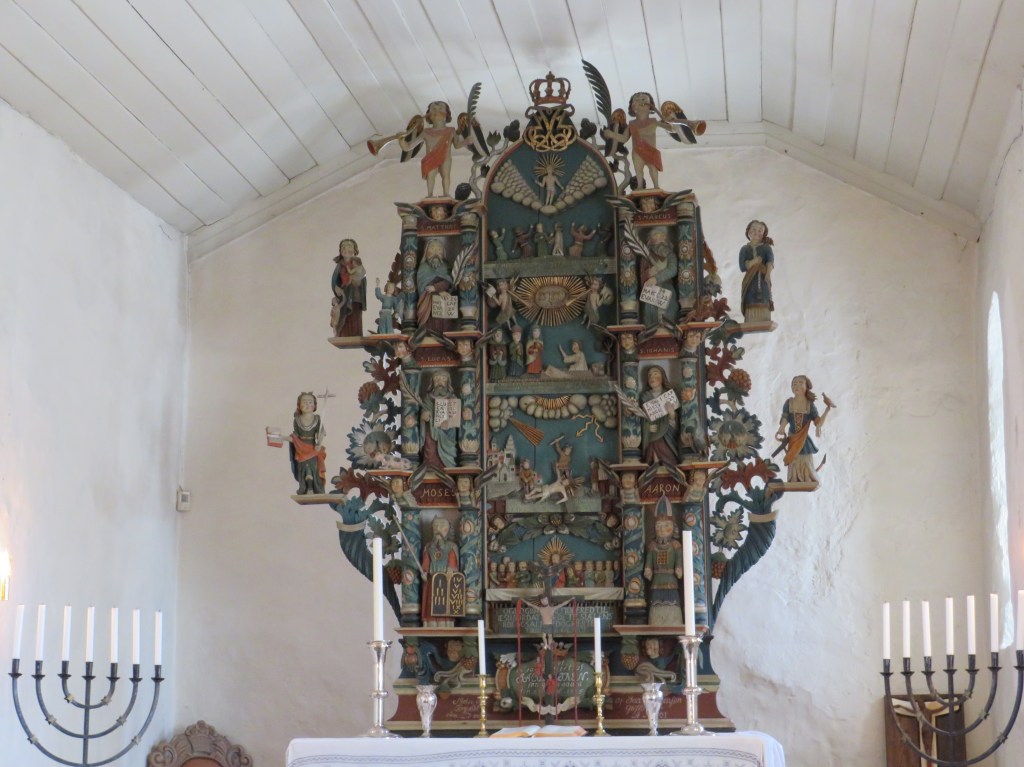
Enid is waiting to tell us about the impressive wooden carvings inside the church. By the eighteenth century, the church had fallen into disrepair and restoration began in 1756. A twenty-two-year-old man carved the altarpiece depicting scenes from the crucifixion to the ascension. The same carver, Jacob, produced the pulpit in the 1790s and both these were painted in 1801, using paint mixed by ‘Altarpieces Jacob’, who also carved altars elsewhere. They were later over painted in white, as the colours were thought to be a distraction but in the 1930s, the colours were redone, using Jacob’s recipes. There is also an altar cloth that dates from 1688 but this is too fragile to display. Outside, there is one of only six of the country’s protected gravestones, thought to belong to the church’s builder. Giske was a place of pilgrimage and crosses on the outside wall are believed to have been carved by fourteenth century pilgrims. The church has been Lutheran since the Reformation in 1536. Graveyards can’t be reused in Norway but fortunately there is space to spread. Rudolph is of the opinion that the idea of Viking boat funerals is a myth.
We see a few of the historic, turf-roofed houses. Next, a brief sighting of some reindeer as we drive to the island of Godøy and the small fishing village of Alnes, site of the twenty-two-metre-high lighthouse, built in 1937. Then it was home via the island of Heissa. We go back to the ship for lunch and then walk round the town by ourselves, managing to acquire some sew on badges for my collection. There are several carved, plaster or wooden trolls on street corners.
Having sampled afternoon tea yesterday, it seemed rude not to do so again. My companion has what is billed as a cream tea, although the clotted cream isn’t quite what he is used to. Definitely more by luck than as a result of any informed choice, we have picked what for us seems to be an ideal cabin up the blunt end of deck 10, two floor down from the casual dining and three floors up from the main lecture hall. Despite no longer having stairs at home, three floors worth of stairs seems doable and helps to counteract the effects of the amount we seem to be eating. It is four floors down to the craft room, that’s when I decide that I prefer to take the lift.
 The History Interpreter - Janet Few