It was time for the holiday proper to start as we headed north in the footsteps of the Romans on what is now the A1. Roadworks made the journey more protracted than we might have hoped but we arrived in Powburn in the early afternoon. Having spent five hours sat in a car, we went for a quick walk round neighbouring Branton lakes. ‘Lakes’ there certainly are but sadly, vegetation means that glimpses of said lakes are few and far between.
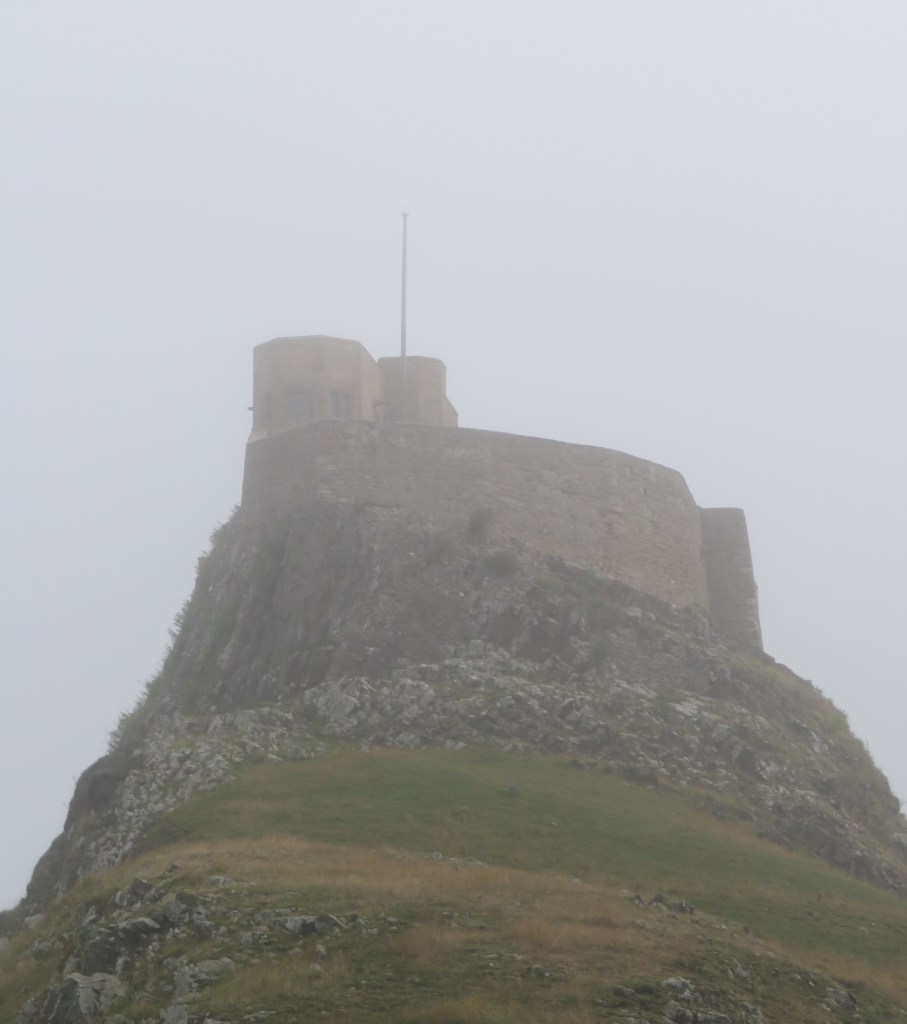
The next morning’s weather was not so much fog on the Tyne but fog across the whole of Northumberland. Undaunted, we set off to Lindisfarne admiring the hedges as we passed, which was about as far as we could see. We crossed the causeway to Holy Island just after it opened. We walked round the island past the old boats that have been upturned to use as sheds, then doubled back to walk toward the Castle. We had to get pretty close before you knew there was a castle and could see it looming through the mist. Built as a fort, the castle was converted into a holiday home by Edward Hudson, showcasing the work of Edward Lutyens as he did so. The garden was designed by Gertrude Jekyll. We had visited before and as one of our party was not in full health we decided to give climbing to the top to not see anything but fog a miss. We did look round the ruins of the priory and the accompanying exhibition.
Holy Island’s first monastery was found by St Aiden from Iona in 635. In the 670s, Cuthbert became the prior and the island developed as a destination for pilgrims visiting Cuthbert’s shrine. It is perhaps best known as the place where the beautifully illustrated Lindisfarne Gospels were created about 1300 years ago. A Viking raid in 793 resulted in the monks leaving the island, together with Cuthbert’s remains and the monastery’s treasures. They settled, first in Chester-le-Street and finally in Durham. Lindisfarne was still revered as a holy site and was probably the burial place of Northumbrian nobles. It was reinforced by a community from Durham Cathedral, who built the priory that can be seen today in the style of Durham Cathedral. In medieval times cattle were farmed on Lindisfarne, perhaps so that their skins could be used as vellum. Holy Island remained as a centre for religion until the Dissolution of the Monasteries in the 1530s. Unlike many religious houses, the priory was not destroyed on the orders of Henry VIII because he wanted to use the building for defensive purposes. This was largely because of its proximity to the Scottish border. With the fog starting to lift, it was good to see some wading birds as we re-crossed the causeway.
A supermarket stop was next on the list, so we drove down the coast road to Alnwick, where I was pleased to remember exactly where the supermarket of choice might be found. In the absence of having coffee and cake out, I treated myself to a most acceptable Lidl’s tiramisu muffin.

 The History Interpreter - Janet Few