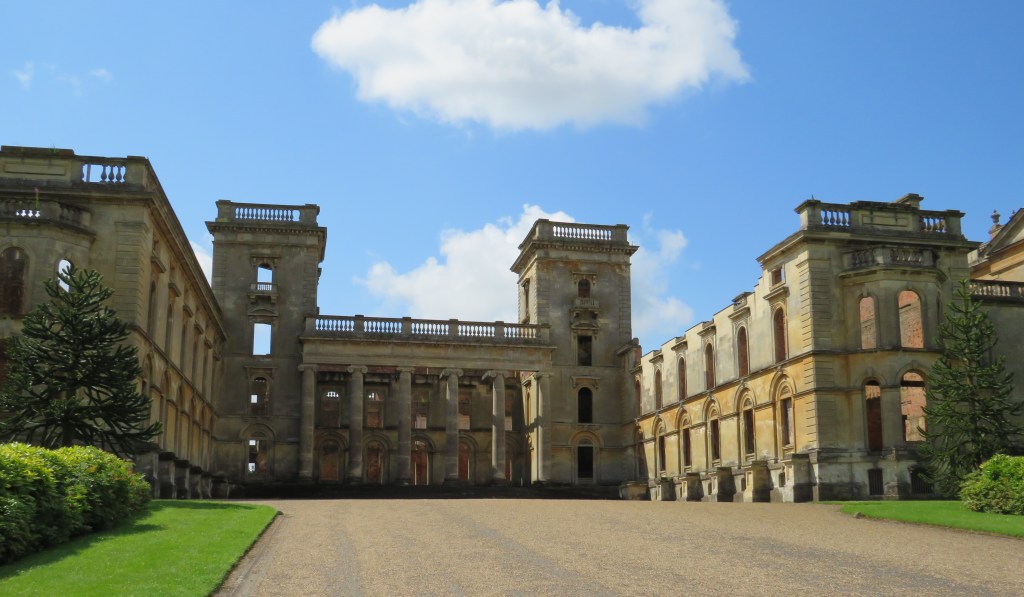
We ventured north again and after a minor satnav fail we arrived at Witley Court, this time exploiting our English Heritage life membership. After a walk up through the woods to the house we were just in time for a short talk about the history of the house by Stephen. Built on the site of a Medieval Manor owned by the Cooksey family, who married into the Russells, the current Witley Court began life in the 1630s as a redbrick Jacobean manor house. The Russells supported the king in the English Civil War and Witley was sold in 1655, probably to pay the price for being on the wrong side.
Eight generations of Thomas Foleys then owned the house. Their money came from iron works and as such they had to strive to become accepted as landed gentry. To this end, they purchased a great deal of land, as well as making substantial additions to the house. In order to be fashionable, the red brick was covered with stucco. In the early nineteenth century, an advantageous marriage provided funds to employ John Nash to design a huge portico and make other changes.
In 1833, the estate was sold to William Ward. The owner of more than 200 coal mines, William was one of the richest men in the country, due in part to the enslavement of others. He was knighted to become the 1st Earl of Dudley. In the 1850s, Ward employed the architect Samuel Daukes to make further alterations in the then popular Italianate style. This include a new curved wing and a large conservatory. At the same time, the stucco was replaced by a facing of Bath stone. Lavish entertainments were held, with the Prince of Wales (later Edward VII) and his entourage visiting. Guests would stroll round the gardens between banquet courses and find that whilst they were eating one course, the gardeners had replanted the beds with different plants.
In 1920, Sir Herbert Smith a carpet manufacturer bought the court. He had been knighted for chairing the little known carpet rationing committee in World War One. The house was only partly used and a devasting fire in 1937 destroyed half the house. Lacking the funds to repair the building, the contents of the remaining half were sold off and some of the building materials, including the lead from the roofs, were sold for scrap. Neglect took a further toll and eventually, in 1972, the forerunner of English Heritage acquired the site and began a programme of preservation.
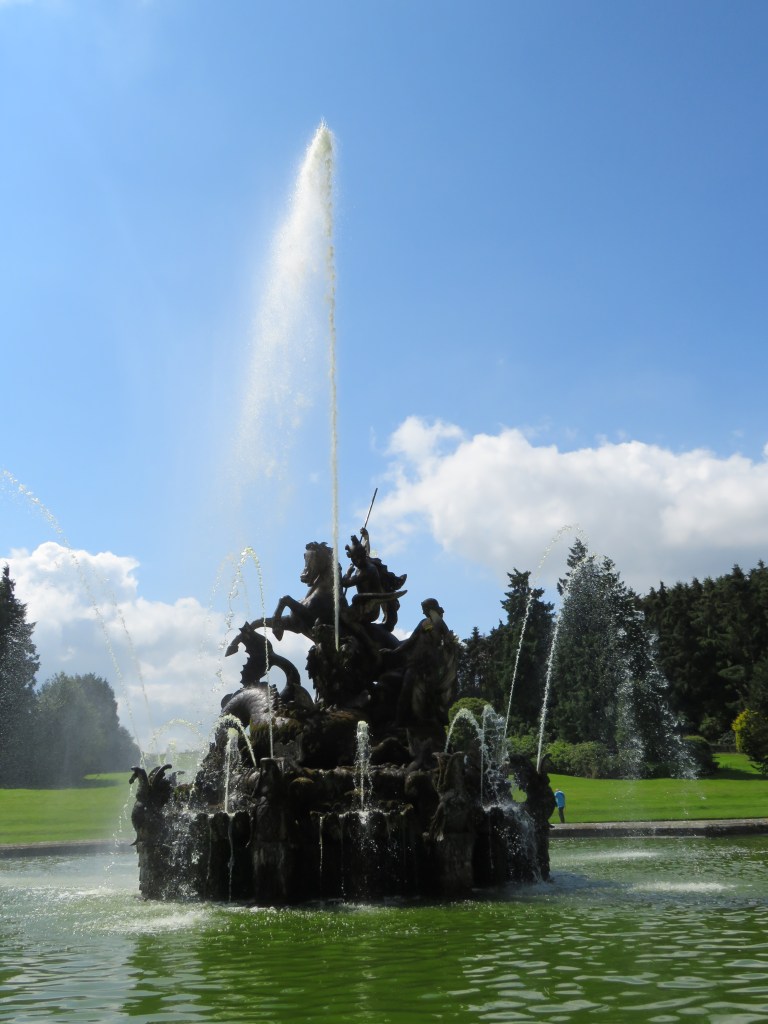
We had a long chat with the head gardener who told us that the elaborate formal garden is an exact copy of that designed in the 1850s by William Andrews Nesfield. This included replicating the mistakes in the elaborate swirling box hedges that were planted in the nineteenth century. Nesfield’s enormous Baroque fountain is quite a feature. The sculpture is based on the story of Perseus and Andromeda and on the hour each hour the fountain plays for about ten minutes. The main jet reaches more than thirty five metres high. The pumps were originally steam driven but since restoration in 2002, they are electric. Witley village was in the area where the fountain now stands but not wanting to be too close to the villagers, the family had the occupants moved out and the cottages demolished.
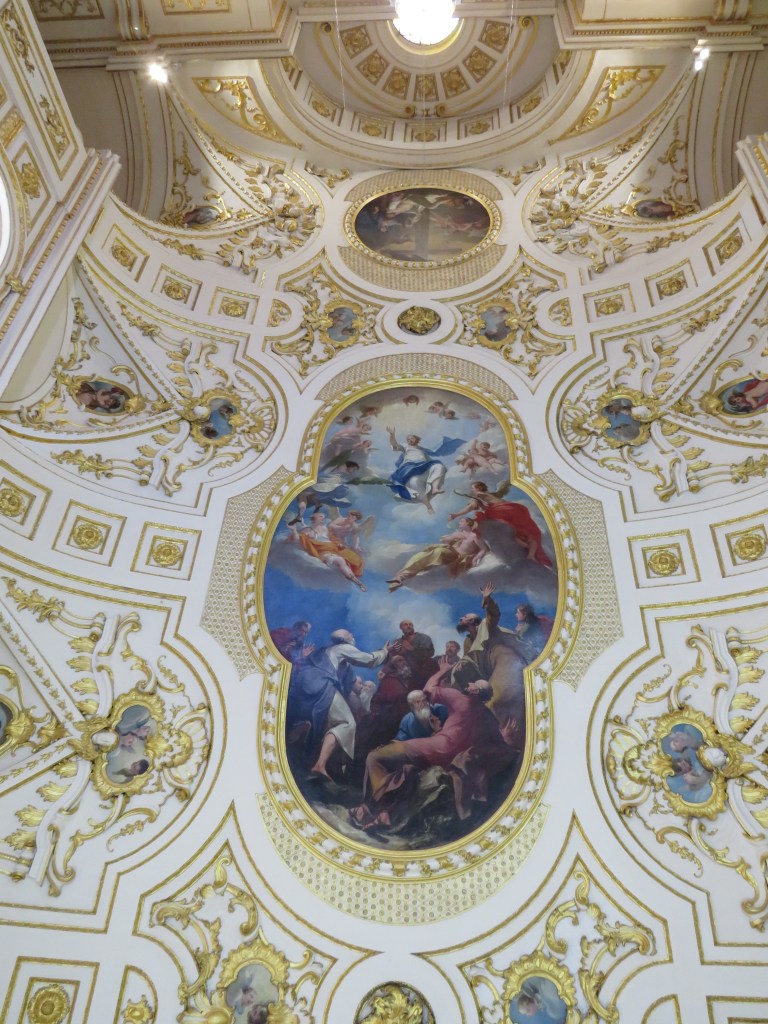
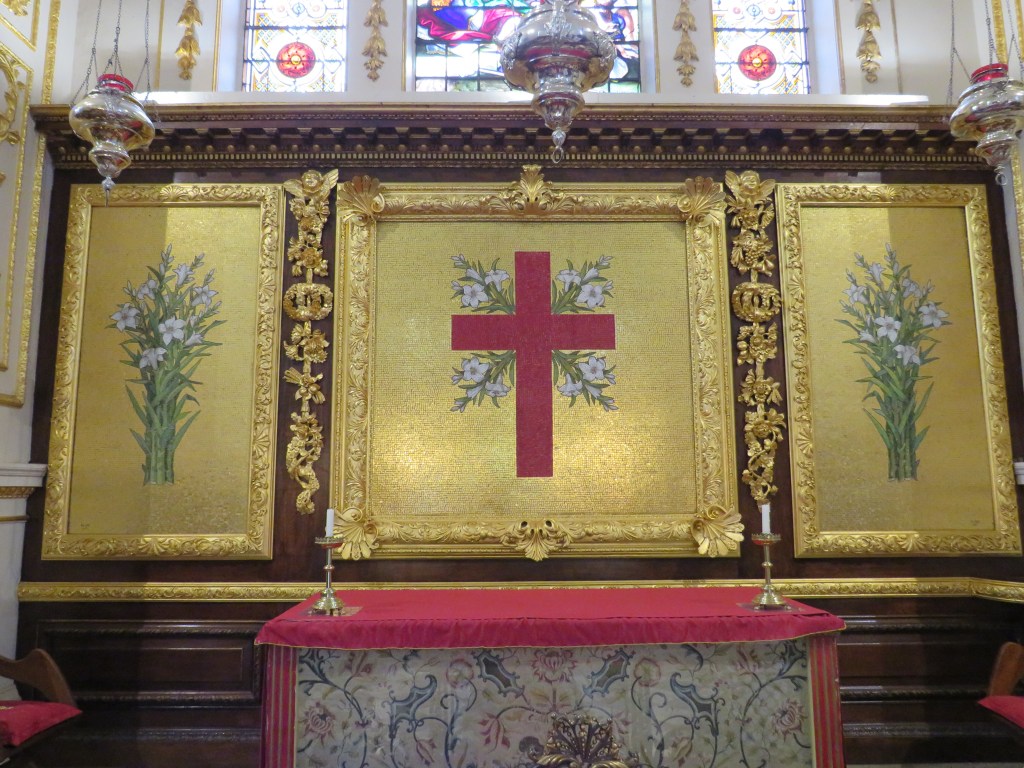
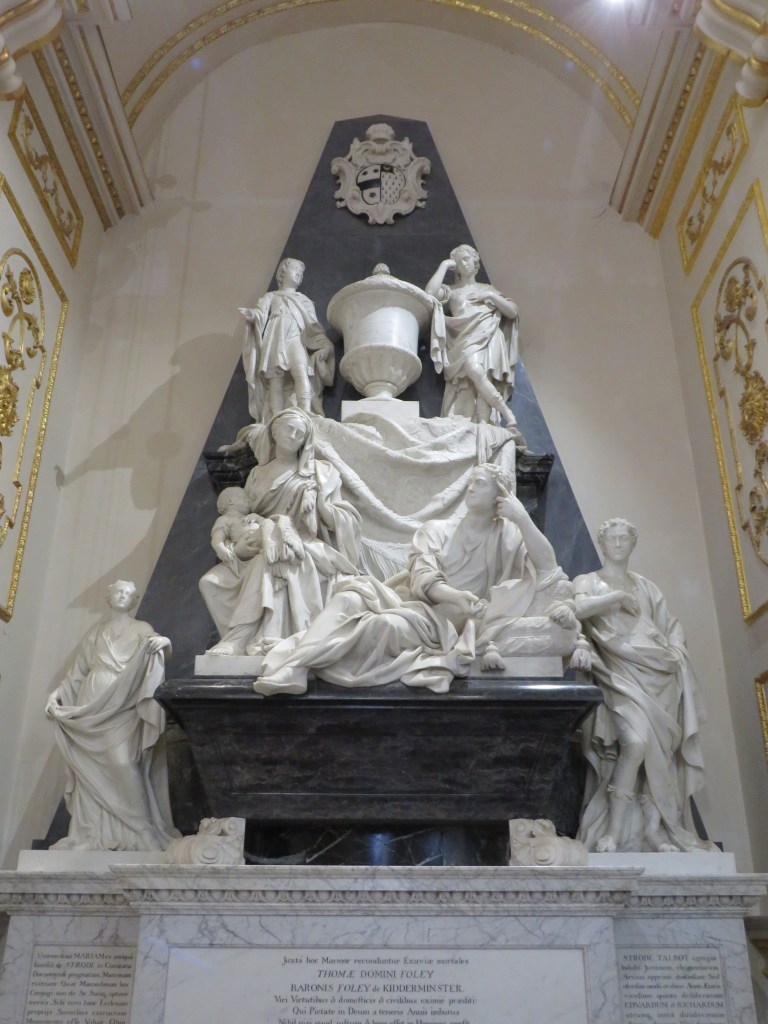
We were told that the neighbouring church, which is still a functioning parish church, was ‘not like other churches’ and Stephen was not wrong. Built by the Foleys in 1735, to replace the previous church, many of the fittings were purchased twelve years later from a private chapel at Cannons Park in London. Billed as ‘the finest Baroque church in the country’ this is probably not an extravagant claim. If we thought the church at Brockhampton was ornate, it had nothing on this. With painted ceilings by Antonio Bellucci, and copious amounts of gilding, it was to be seen to be believed. The church is now designated as a Major Church, one of the 320 most significant in the country.
Then the obligatory cake sampling trip to the tea rooms. Today’s toffee cake rated highly.
We started our last day by travelling westward to St Wulstan’s RSPB Reserve where we had a brief walk amidst a distinct lack of wildlife. We drove up to the base of the Malvern Hills and arrived a little early to visit Picton Garden. We were allowed in anyway. This small garden is home to the national collection of Michaelmas Daisies. To me a Michaelmas Daisy is a Michaelmas Daisy but no. The nursery cultivates 430 different varieties. Michaelmas Daisy was on my plants wanted list so I chose one. A bit more of a drive through the Malvern Hills. The clue is in the name and we felt that hill walking might be a little strenuous for us. In addition, the weather was a bit uncertain, so it was off to visit a final family history related parish before returning to the van. Then home the following day.
 The History Interpreter - Janet Few
What a fountain! Beautiful church decorations. Poor villagers, kicked out for spoiling the view!