Irish Adventures Days 5 & 6

Day 5

Another day of glorious weather and we walked along the beach before heading seventy five miles north to the Hidden Valley site at Rathdrum. This is more of a holiday complex than our usual sort of site, although we did managed to secure a relatively quiet pitch. Here I can shoot people with lasars, play crazy golf, leap across a large swimming pool on inflatable thingys, pay €1 for a shower and indulge in numerous other ’attractions’ but despite hundreds of people on site and the publicity saying there was wifi, I can’t check my emails. My phone is no good as a substitute. I can connect to a network to make calls but not to access the internet. We did take a short walk round the site  but then decided it was a bit hot to go far so had a quiet afternoon in the van.

Day 6

Today was scheduled to be a visit to Kilmainham Goal, built in 1796 and noted for housing and executing Irish political prisoners. This meant braving Dublin and overcoming the stated lack of parking. An hour’s run up the N11 to begin. The roads are in much better condition than ours at home and much less congested. My trusty chauffeur had no trouble negotiating the streets of Dublin. Amazingly, we found an on-street parking place within a few hundred yards. We checked carefully to ensure it wasn’t residents only but all seemed to be fine. That was the end of the good news. Our itinerary had been carefully planned and everything that advised prior booking was prior booked. When I looked at the website back at Christmas I am certain there was no indication that we needed to book. We needed to book. There were no vacancies until 4.30pm. It was at this point 10am. We gave up and headed for home.

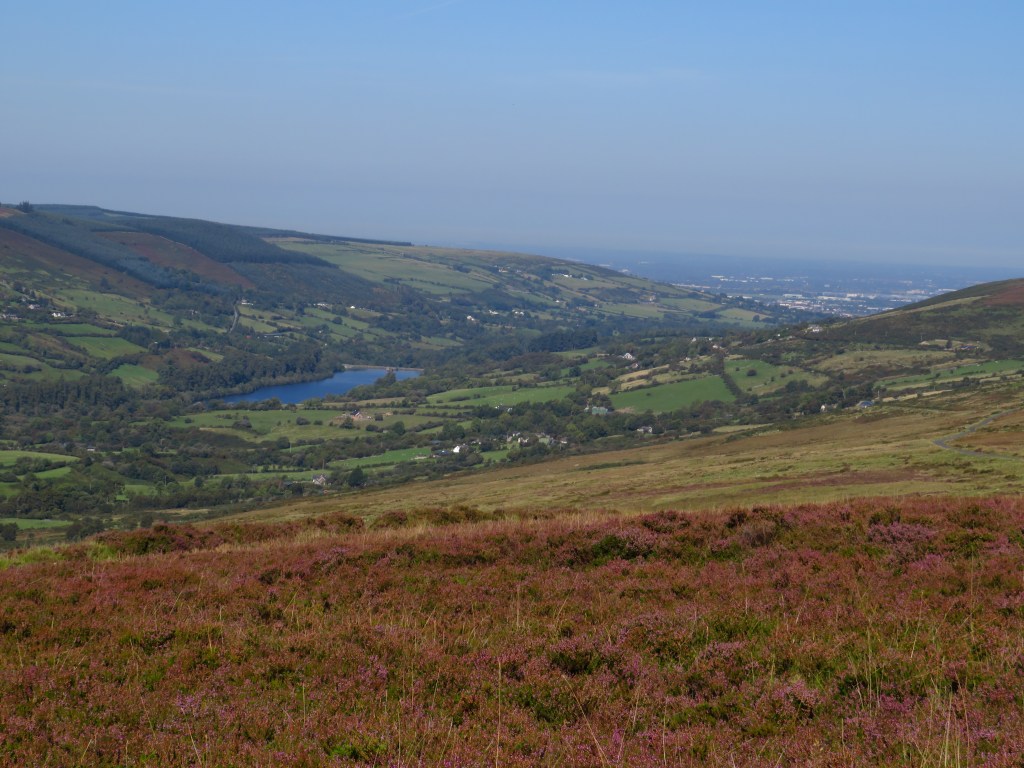
The plan was to drive back through the scenic Wicklow Mountains. The sat-nav was clearly incredulous that we could possibly want to go that way. Normally in situations like this I ask it to take us to some tiny place on the route we actually want to take. In this case there were no tiny places marked on the map that were big enough for the sat-nav to recognise. Cue map. Although the maps we had were smaller scale that I would normally use to navigate, especially as I wasn’t 100% sure where I was starting from, beyond south Dublin, I attempted to get us on to the R115. We had been loaned maps by friends that proved adequate for the job and we were rewarded with the spectacular scenery of the Wicklow Mountains, with the heather turning purple on every side. We saw very few other vehicles and plenty of sheep. Sadly, it was spoiled by litter in almost every pull-in. Given that you’d be very unlikely to be on the road unless you were a fan of out-of-the way places with breathtaking views, this is hard to square with travellers who think it is in any way ok to empty the rubbish out of their car and on to the roadside.

We stopped off for supplies in Rathdrum, where the car thermometer agreed with that outside the local chemist, telling us it was 31 degrees.
Irish Adventures Day 4

A thick mist descended as we set off for the Irish National Heritage Park but fortunately, another sunny day broke through after half an hour or so. The Heritage Park contains reconstructions of buildings representing Irish history from 7000BCE to 1200CE. We have learned that if a guided tour is on offer, take it, as you learn so much more than just wandering round under your own steam. As we arrived as the park opened, we were in time for the first of three tours on offer and began by learning about pre-historic Ireland from the enthusiastic and knowledgeable Ciaron. We were the only two on this tour and the next, which covered the early Christian era. By  the time we got to the tour that covered the age of the Viking and Norman invasions, Ciaron had built up quite a crowd and was in full dramatic flow, epitomising the Irish story-telling tradition at its best. He did talk and walk pretty fast but we managed to keep up on both counts.

Here are just some of the take-aways I gleaned from Ciaron; I hope I’ve got it right! The human habitation of Ireland dates back about 9000 years and the first reconstruction we saw was of a campsite from that era. We then moved on to a New Stone Age Farmstead, representing a time when the people were clearing the forest for farmland. A Megalithic Dolmen tomb was next, of a type that was used when bodies were being cremated. Apparently it would have taken 700kg of wood to cremate a body. I can’t help wondering how anyone knows; surely this would be taking Experimental Archaeology a little too far. An excavation of a similar Irish tomb discovered the remains of twenty two people, both adults and children. DNA analysis has shown them to be an extended family group, one of whom had Down’s Syndrome. Climatic changes about 4000 years ago made Ireland a land of bogs and water. Water was revered and sacrifices were made, resulting in the bog bodies that have been recovered. A Bronze Age Stone Circle was the final prehistoric site. Apparently these are found in the south-west of Ireland and in north and mid-Ulster but rarely in between.

We moved on to the Early Christian Era sites. Unlike most of Europe, the Christianisation of Ireland was peaceful, with pagan traditions being adapted to suit Christian worship. An Ogham stone provided an example of early written Irish from about 1700 years ago. The alphabet is based on Latin and the stones are said to have magical associations. There was an early Medieval Ringfort, although it was more of a protective enclosure than a fortification. Next came a reconstruction of an early monastic site, complete with herb garden and sundial. The working corn drying kiln was fascinating, as was the watermill with the horizontal wheel submerged by the stream. Legend attributes the introduction of water mills to Ireland to C3rd Cormac MacArt. He allegedly sent for craftsmen from overseas to construct water mills, to spare his pregnant slave from having to grind corn by hand. In fact evidence for the first mills in much later than C3rd.

Ciaron’s account of the invasion era was peppered with people with unpronounceable names that are definitely beyond my spelling capacity. I clung to Henry II, who was featured in there somewhere. Viking raids from 795-1014 led to the building of long forts. A member of the powerful O’Neill clan destroyed all those in the north but in the south they led to the development of Waterford, Wexford, Cork, Limerick and Dublin. In the C11th Ireland was becoming more centralised, with fewer fragmented kingdoms. Robert FitzStephens was one character in the story whose name I have probably got right. He built an earthwork fort on the site of the Heritage Park c.1170. There was loads more but you will just have to go for yourselves to find out. Putting the Heritage Park on your itinerary is definitely recommended and to get the full benefit, availing yourself of a guided tour even more so.

Having underestimated the distance yesterday, today we drove to Lady’s Beach. This is a pilgrimage site and the pilgrimage season is now on. Lady’s Island used to be called the Island of the White Women and was a Druidic centre. The early Christians preserved it’s heritage as a site of female worship and dedicated it to the Virgin Mary.  The missionary, St Abban, designated it as a place of pilgrimage. There are remains of a Norman Castle on the island; the monastery on the site was destroyed by Cromwell in 1649. We followed the pilgrimage route, accompanied by suitable piped music. This took us past the Lady’s Island lake and bird sanctuary. Lake yes, sanctuary maybe, birds not so much, apart from some swans, a few choughs and a solitary heron. Returning to the site it was off to the Common Room to get email access and see what I have been missing.

Irish Adventures Day 3

Will be drip feeding these to you over the next few weeks – you can have a too much of a good thing!

Day 3

It turns out that the sat nav doesn’t recognise full Irish postcodes and we only had a general address for today’s destination, which is not on the map. Nevertheless, with the help of the site owner, we made the short journey to Wexford Wildlife Reserve with only one wrong turning. The reserve is small and free to enter. Unless you plan on spending a long time in the hides, you can exhaust its possibilities in about an hour but it was definitely an hour well spent. Most notable amongst the birdlife were the many swallows, readying themselves for journeying south. There was also a SBJ (small brown job) that by dint of taking many photos, I decided afterwards was a reed warbler, although not with 100% level of confidence. I am reasonably good at bird recognition, although hopeless at bird song. I do however struggle to tell my willow warbler from my chiff chaff.

Best of all, the reserve is a centre for the preservation of hares. Imagine our delight when we not only saw several but one stopped within a metre of my feet, despite me sporting my bargainous fluorescent orange coat, acquired at 75% off the recommended price in the end of season sale when in the Lake District last year.

When looking in vain for the wildlife reserve on the map, I spotted that Tintern Abbey was nearby. This was a surprise as I was pretty sure Tintern Abbey was on the Welsh borders. It turns out that THAT Tintern Abbey is indeed in Monmouthshire but this is a related Tintern Abbey. As we had plenty of time we went off plan and headed to Tintern Abbey, which had the added advantage of belonging to the Office of Public Works, which has a reciprocal arrangement with English Heritage, so entry was free.

The Monmouthshire Tintern Abbey was founded in 1137 and William Marshal, Earl of Pembroke, set up the Cistercian Abbey of the same name in Wexford, with monks from the Monmouthshire foundation, in about 1200. After a perilous sea crossing to Ireland, the establishment of the monastery was Marshal’s way of giving thanks for his survival. Having been remodelled, the abbey was partly abandoned in the C15th.

Anthony Colclough (later to be knighted for services to the crown) was granted Tintern Abbey and more than 5000 acres of land by Henry VIII and was part of the attempt to secure parts of Ireland that were beyond the Pale (around Dublin) for England and the Protestant religion. He converted the abbey into a fortified manor house. As the need for fortification lessened, it became more of a country house.

Judicious marriages by Sir Thomas Colclough established both Protestant and Catholic branches of the family in Wexford. During the C17th Civil War, Tintern was a refuge for 200 Protestants but was temporarily taken over by the Catholic Colcloughs. After the New Model Army’s massacre of  thousands in Wexford, Cromwell restored ownership to Protestant Sir Caesar Colclough. The last Colclough to reside at Tintern was Lucy Marie Colclough, ‘Miss Marie’. She gifted the parts of Tintern that had not previously been sold off to the nation in 1963.

Having explored the Abbey, we took a short walk to the nearby walled gardens, formerly part of the Colclough estate, which were also worth a visit. The many apple trees produce a local cider.

Back to the van for some refreshment and we decided to do a circular walk to the nearby beach and bird sanctuary. We had been warned that the map was not to scale. This was not wrong and we did end up going rather further than intended and still not making it to the bird sanctuary. The beach at St. Margaret’s Bay is just my sort of beach, wide expanses of sand and very few people. We stopped to examine the local fishing boats and headed inland for rather a long way. Despite the odd shower earlier in the day, all while we were in the car, the late afternoon was glorious, with real strength in the sun. It was lovely to relax in the sunny van after our walk.

Irish Adventures Days 1 & 2

As always, you get my holiday news with a time lag but here is the start of our Irish adventures.

Day 1

Things were not looking good as yesterday the sat nav decided it would wipe itself clean instead of updating and we only have a small scale maps of Ireland, so the prospect of getting from a to b was looking challenging. After an hour with the ‘not actually any help’ guy, whose main aim seemed to be to claim we needed to buy extremely expensive anti-virus software, the sat nav did at least turn on and recognise where we were. We decided we were safe to head to Pembroke (or possibly somewhere else if the sat nav wasn’t actually working). Despite a very convoluted diversion on the link road, the journey was uneventful. We realised that Irish speed limits are probably going to be in kilometres. Chris’ car speedo is in miles only. We envisaged plenty of dividing by eight and multiplying by five, or is it the other way round?

Once in Wales, I attempted to translate some of the bilingual signs, on the strength of my knowledge of Cornish, which can be similar. We arrived at our overnight stop, a very peaceful, small site, with a friendly owner and the bonus of wifi. It seemed odd to have nothing to do. I have resolved to put house not-moving to the back of my mind and rejoice in the fact that my paperwork is pretty well up to date, so there won’t be much work I have to do while I’m away. It will be very unusual to have a trip with no family history element, although my dad was stationed in Ireland in the war, so I may just take a look at where he was billeted.

On the advice of the site owner, we ate at the nearby Carew Inn before battening down the hatches for the night.

Day 2

As the ferry was not until mid-afternoon we decided to make a quick bonus visit to nearby Carew Castle. The persistent drizzle wasn’t particularly conducive to ruined castle exploration but we managed a good look round. We did pass on moving on to the tidal mill, as that was a ten minute soggy walk away. The current mill is thought to date from the early C19th, although there was a mill on the river in the sixteenth century.

Carew Castle was built in wood on the site of an Iron Age fortification at the end of the C11th by Gerald de Windsor, constable of Pembroke Castle, who wanted an additional fortification further up the river. He made a dynastic marriage to Princess Nest. Nest was abducted in an ambush by Prince Owain who she lived with for several years before returning to Gerald. Gerald escaped capture because he was in the garderobe.

The stone castle was largely the work of Nicholas de Carew who died in 1311. C15th additions were made by Sir Rhys ap Thomas. He was a favourite of Henry VII, after aiding him at Bosworth and it is said that it was Rhys who killed Richard III. Rhys was made a Knight of the Garter and held a massive tournament and five day feast in 1507 to celebrate. Sir Roland Rhys was allegedly killed by his pet ape, which is said to haunt the castle.

Finally, the castle was developed into an Elizabethan manor house by Sir John Perrot. Perrot’s role was to clamp down on piracy and smuggling but he ended up becoming involved himself.  During the Civil War, Royalist Sir George Carew owned the castle and it changed hands several times during the conflict. The castle and mill are now administered by the Pembrokeshire Coast National Park authority.

There was supposed to be signs of a Nine Men’s Morris Board carved on the wall in the chapel. The theory was that if the devil came in the window he would be distracted by playing the game, rather than entering the chapel. I am not convinced that the faint line that I spotted was it. We learned of the legend of the giant, Skomar Oddy, who lived in the Preseli Hills and rescued sea creatures in the Daugleddau Estuary from sea monsters. It is said that the giant’s footsteps formed the nearby inlets and beaches. The castle is designated as a Site of Special Scientific Interest because of various wild flowers and also because it is inhabited by bats. In order to keep dry, we watched a horrible histories style presentation about the castle’s worst jobs. It was a shame the enthusiastic staff didn’t have a larger audience.

We headed off for the ferry in good time, as is our wont and just as well, as it took half an hour to travel the final two miles to the dock. A quick search of the van and boot by customs and we were on board. Despite being used to ferry crossings, this one was very boring. The limited free wifi didn’t seem to materialise. Even the progressively drunken students, making liberal use of the duty free, didn’t offer much by way of entertainment value. We did break the monotony by having an early evening meal on board. Good job we made it early, as the catering shut up shop a good hour before the ferry docked.

Another realisation whilst on board. Although somehow going to Ireland doesn’t seem like really ‘abroad’, it is. For the first time it dawned on us that we will probably need European plugs, not so much for our appliances as the caravan has conventional sockets but in order to connect the caravan to the electricity supply, we may need an adaptor. Chris has one of these, hurrah. Unfortunately it is at home in one of his many garages.

We made our way to St Margaret’s Beach campsite, just a few miles from the ferry terminal. It is a very pleasant small site with a mixture of static and touring vans. We had a warm welcome and even better, our electricity cable was compatible with the socket provided.