Sorry, there’s more you still have a little way to go and this now seems like a distant memory.
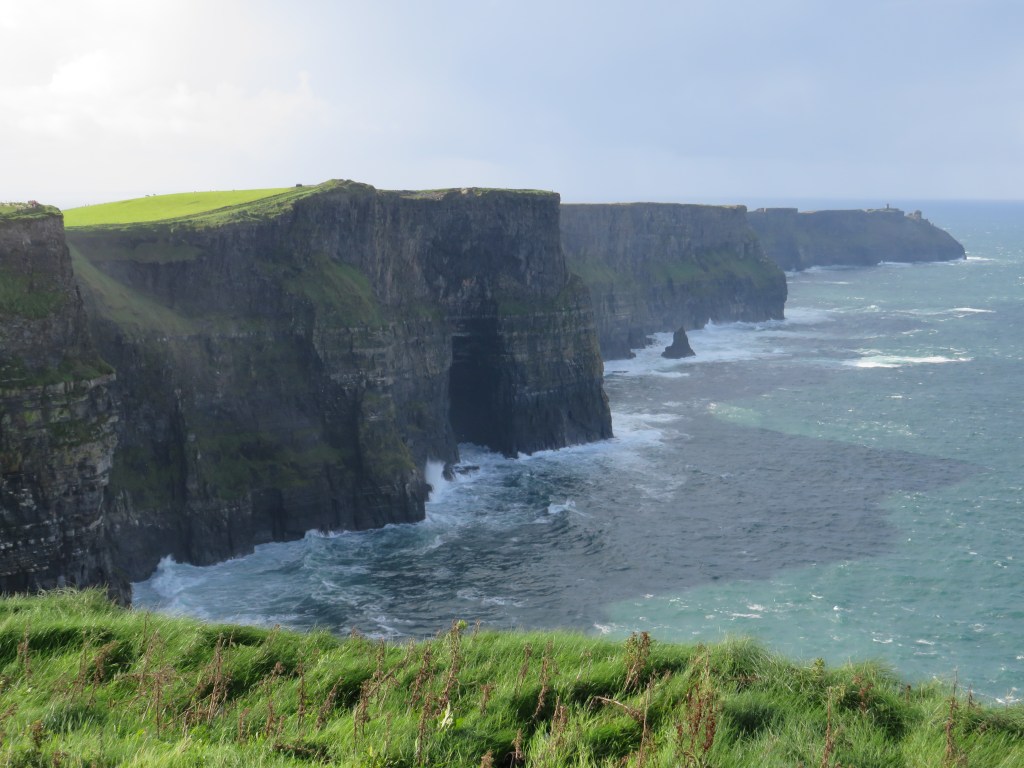
The Cliffs of Moher rank at number 4 in the top ten things to see in Ireland, according to our guide book, so despite them being sixty miles away, we had booked for the ‘experience’. Together with the Burren nearby, the cliffs are a UNESCO Global Geopark; an area with outstanding geology and local culture. The cliffs are 200 metres high with the crashing Atlantic below. The flagstones found on the cliffs were quarried in the nineteenth century and many are now paving English streets. Five hundred men were once employed in this industry but it was made redundant by the invention of concrete. The name comes from ‘Mothar’, meaning ruined fort; there was an Iron Age fort on the site. Storms led Spanish Armada ships to be wrecked along this coastline. Around the bottom of the cliffs are various spots that are allegedly where Spanish sailors were executed and buried. The tower at the highest point of the cliffs was built by Sir Cornelius O’Brien. It was intended as a viewing point for visitors. He also provided a piper to entertain them.
The weather was alternate sunny spells and squally showers, with high winds. We managed to walk to the top of the cliffs in the dry and the visibility was better than anticipated. There are quite a lot of steps but golf buggies were transporting those who couldn’t manage the walk. If you visit and think you might need one, do check out if they need to be booked in advance, there didn’t seem to be very many considering the number of people visiting.
The cliffs are allegedly home to buskers but they were not in evidence, perhaps deterred by the weather. Strong winds and salty air doesn’t do their instruments a lot of good, so these are either custom made to help withstand the conditions, or replaced frequently.
We went back to look round the visitors’ centre. We watched a slightly sick-inducing film of the bird life of the cliffs and the marine life below. This was projected across three screens at angles to each other. It was probably meant to be ‘immersive’ but it had a similar effect to being carried from room to room by someone on a Zoom call. There was the opportunity to have our photograph taken, superimposed on a Cliffs of Moher landscape by using a green screen. You could then email it to yourself. This involved ‘swiping right’ to find your own picture amongst everyone else’s. To me if photos are in a horizontal strip and it says ‘swipe right’ and there is even an arrow pointing to the right, you push them across in the same direction as you’d read a line of text. We failed to find our photo. My trusty companion insisted ‘swiping right was the opposite direction. My argument that that wasn’t right, or indeed correct, fell on stony ground when he located our picture. Good job I am not on Tinder, or should I worry why said companion knows how to ‘swipe right’? The resulting photo has us looking decidedly fuzzy and out of focus in front of a lovely background.
No one can blame Ireland for exploiting everything they’ve got to attract tourists but this was definitely a tourist honey-pot and you couldn’t escape the commercialisation and dozens of coaches in the carpark. A bit like the Giants’ Causeway and Land’s End, this is no longer the wild unspoilt landscape it should be. To be fair, the visitors’ centre has been built into the cliff in an effort to disguise it but I prefer more out of the way places, some of which, close to home, are equally spectacular. More than 1½ million people visit each year, compared to 100,000 in 1978; perhaps I should have visited in 1978! You’d think therefore that there might have been a few more toilets, larger café facilities and more pay stations in the gift shop. Given that the height of the tourist season has passed, the queues were ridiculous.
We debated heading up the cliffs in the opposite direction but at this point it decided to rain a little more aggressively, so we headed back to the car. We have finished The Story of England and have now embarked on Tales from the Green Valley, the seventeenth century prequal to Victorian Farm.
 The History Interpreter - Janet Few