Yes, there’s more, although this now seems like it happened a very long time ago.
In a thick haze, we returned across the border to go to Newgrange and Brú na Bóinne. In theory, the journey takes an hour. We allowed an hour and three-quarters. Thanks to rush hour in Newry and a road closure it was a bit touch and go but we arrived just in time for our 10am slot. Brú na Bóinne, or Palace of the Boyne, has mythological connections and is associated with the goddess Boand, the god Dagda and their son Oengus Mac Ind Oc, the boy god. Oengus and his beloved, Caer, were transformed into swans and we did see a swan on the Boyne as we walked across the bridge. First, a look round the exhibition, then a short bus ride to Knowth, where Rodney was our guide. The neolithic burial mound was created some 5000 years ago by early farmers who introduced wheat, barley, cattle and sheep to Ireland. Knowth is the largest site of this type in Western Europe, with nineteen smaller mounds surrounding the largest mound. The passage graves contained cremated remains. DNA extracted from unburnt bones indicated that these people had ancestral connection to Anatolia, in modern day Turkey. This type of tomb was used over many years. Twelve generations of one family have been found in a similar grave in Sligo. I do wonder how anyone knows this. The excavations at Knowth, under Professor George Eogan began in 1962 and lasted several decades.
There have been some modern adaptations to preserve the neolithic carvings that are on many of the kerb stones round the circumference of the main mound. These are abstract designs, featuring spirals, curves and concentric circles. Despite speculation, no one knows what they symbolise. One has twenty nine crescents and circles that might be representative of the phases of the moon. Two-thirds of all western European neolithic art is at Knowth, which is why Brú na Bóinne is designated a World Heritage Site. Some of the stones used in the creation of the original mound come from as far away as the Wicklow Mountains. These were moved before the horse or wheel and were probably transported by raft and then rolled on logs. The estimated weight of the mound is 250,000 tons. It is twelve metres high and ninety metres across. Of 300 similar monuments, only fifteen have solar alignment. At Knowth, the two standing stones on the eastern and western sides cast shadows on the centre of the entrance stones at the spring and autumn equinoxes. There is evidence of settlement here that pre-dates the mounds. In the ninth century, regional kings lived in fourteen houses built on top of the great mound. The area was farmed by nearby Mellifont Abbey in the twelfth century.
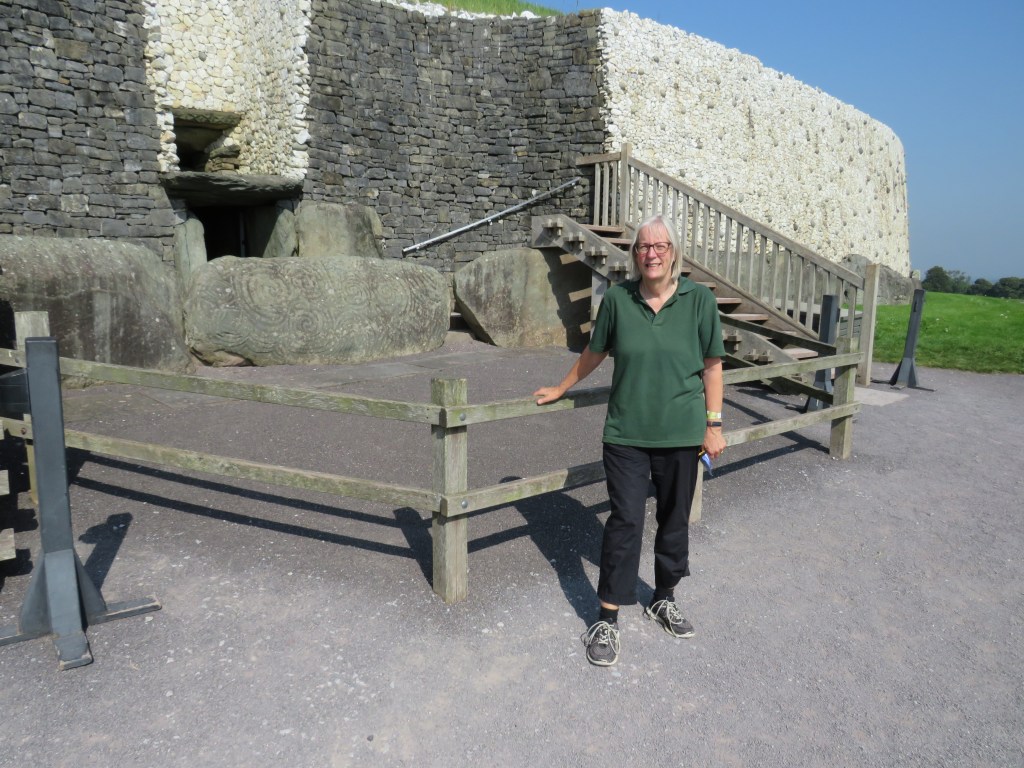
Another short trip and we were at Newgrange. There are a few carvings here, notably the triple spiral symbol, which is unique to Newgrange. The impressive part of this site is the burial chamber with its solar alignment, which floods the chamber with sunlight at sunrise on the winter solstice. There is a slight uphill incline as you squeeze your way up the passage, minding your head at various points. This means that the ‘roof box’ over the entrance is the same height as the floor of the main chamber. The effect was simulated for us using artificial light. The gradual northward drift of sunrise at the winter solstice means that by c.5000CE this phenomenon will cease. The domed roof of the chamber is six metres high and is completely watertight.
It was incredibly hot with not a scrap of shade. The car thermometer that measures the outside air temperature at one point reached thirty six degrees. Even allowing for some slight inaccuracy, that is pretty hot. Despite the heat, we decided to go ahead with our plan to visit the site of the Battle of the Boyne, the largest single battle to take place in Ireland or Britain. We circumvented the road closure to find the site. There isn’t a great deal to see but it was worth a visit and entrance was free with membership of English Heritage. A Georgian house, Oldbridge House, has been built on the site and contains as small display. Having led students through coursework on the Battle of the Boyne for several years, you’d think my retained knowledge of it would have been better than it was. It was fought between William III, aka William of Orange and his father-in-law, the deposed Catholic James II in 1690. James had support from France and Catholics in Ireland and his troops numbered some 23,000. He was outnumbered by William’s 36,000 better trained men, including Dutch and Huguenots. William’s victory was effectively the end of James’ attempt to regain the throne and he fled to France.
The walled garden was a suntrap and as such a bridge too far in thirty degree plus temperatures, so after a brief look from a distance we headed back to the van.
 The History Interpreter - Janet Few
Thank you, Janet. That was really fascinating – what an amazing place.
I’ve been to Knowth !!! It is fabulous! Cheers, Brenda Turner