Sorry, there’s more you still have a little way to go and this now seems like a distant memory.
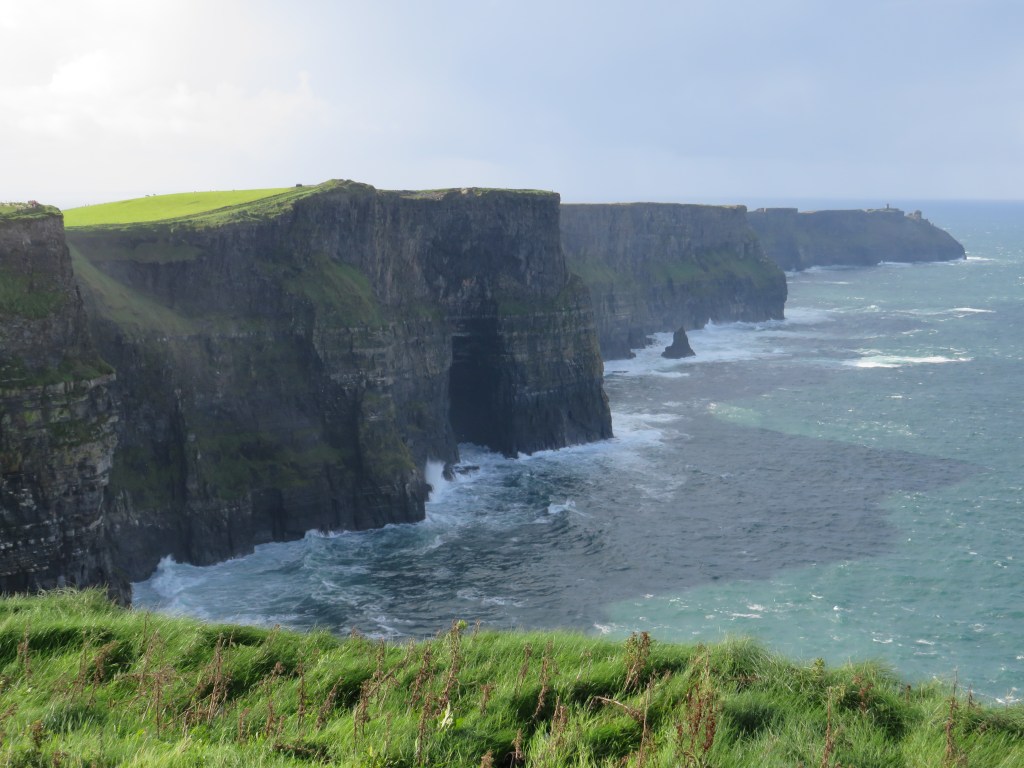
The Cliffs of Moher rank at number 4 in the top ten things to see in Ireland, according to our guide book, so despite them being sixty miles away, we had booked for the ‘experience’. Together with the Burren nearby, the cliffs are a UNESCO Global Geopark; an area with outstanding geology and local culture. The cliffs are 200 metres high with the crashing Atlantic below. The flagstones found on the cliffs were quarried in the nineteenth century and many are now paving English streets. Five hundred men were once employed in this industry but it was made redundant by the invention of concrete. The name comes from ‘Mothar’, meaning ruined fort; there was an Iron Age fort on the site. Storms led Spanish Armada ships to be wrecked along this coastline. Around the bottom of the cliffs are various spots that are allegedly where Spanish sailors were executed and buried. The tower at the highest point of the cliffs was built by Sir Cornelius O’Brien. It was intended as a viewing point for visitors. He also provided a piper to entertain them.
The weather was alternate sunny spells and squally showers, with high winds. We managed to walk to the top of the cliffs in the dry and the visibility was better than anticipated. There are quite a lot of steps but golf buggies were transporting those who couldn’t manage the walk. If you visit and think you might need one, do check out if they need to be booked in advance, there didn’t seem to be very many considering the number of people visiting.
The cliffs are allegedly home to buskers but they were not in evidence, perhaps deterred by the weather. Strong winds and salty air doesn’t do their instruments a lot of good, so these are either custom made to help withstand the conditions, or replaced frequently.
We went back to look round the visitors’ centre. We watched a slightly sick-inducing film of the bird life of the cliffs and the marine life below. This was projected across three screens at angles to each other. It was probably meant to be ‘immersive’ but it had a similar effect to being carried from room to room by someone on a Zoom call. There was the opportunity to have our photograph taken, superimposed on a Cliffs of Moher landscape by using a green screen. You could then email it to yourself. This involved ‘swiping right’ to find your own picture amongst everyone else’s. To me if photos are in a horizontal strip and it says ‘swipe right’ and there is even an arrow pointing to the right, you push them across in the same direction as you’d read a line of text. We failed to find our photo. My trusty companion insisted ‘swiping right was the opposite direction. My argument that that wasn’t right, or indeed correct, fell on stony ground when he located our picture. Good job I am not on Tinder, or should I worry why said companion knows how to ‘swipe right’? The resulting photo has us looking decidedly fuzzy and out of focus in front of a lovely background.
No one can blame Ireland for exploiting everything they’ve got to attract tourists but this was definitely a tourist honey-pot and you couldn’t escape the commercialisation and dozens of coaches in the carpark. A bit like the Giants’ Causeway and Land’s End, this is no longer the wild unspoilt landscape it should be. To be fair, the visitors’ centre has been built into the cliff in an effort to disguise it but I prefer more out of the way places, some of which, close to home, are equally spectacular. More than 1½ million people visit each year, compared to 100,000 in 1978; perhaps I should have visited in 1978! You’d think therefore that there might have been a few more toilets, larger café facilities and more pay stations in the gift shop. Given that the height of the tourist season has passed, the queues were ridiculous.
We debated heading up the cliffs in the opposite direction but at this point it decided to rain a little more aggressively, so we headed back to the car. We have finished The Story of England and have now embarked on Tales from the Green Valley, the seventeenth century prequal to Victorian Farm.
Despite the forecast for 70% or more chance of rain all day every day for the next eight days and an early shower, we left Carrowkeel to a cloudless sky. We opted to avoid the toll charge on our drive south to Adare. It isn’t that we are pathologically adverse to paying toll charges, it is just that this often has to be done online and we weren’t sure that we would have access to online. By now we have got the hang of the pulling over and travelling on the hard shoulder to let faster traffic pass, which is how things are done in Ireland. We are limited to 80kph when the caravan is on the back. I spend our travelling time translating the kph to mph, which fortunately our satnav does, even if the car is unhelpful in this respect. We drove through Galway and Clare to arrive in another new county, Limerick.
In theory there is only wifi at reception at this site. When choosing our pitch, I opted for one as near as possible to reception. My travelling companion is less keen, ‘we will get all the passing site traffic’, says he. ‘Oh’, I say , innocently, ‘but look it is lovely and sunny and has its own picnic bench.’ Yes, it does also have one teeny tiny bar of wifi from within the caravan, enough to download emails at least. Not that that was a consideration of course!!! It did prove useful as we hadn’t been able to book a site for our last five nights, when we wanted to be in Cork or Waterford. Sites we tried were either closed by the end of our stay, only took camper vans not caravans, or were no longer operating. That teeny tiny bar of wifi enabled us to find somewhere for the final leg of our trip. Slightly longer stays for our last three stops and it feels like we are on the downhill slope now, as indeed we are. The site also provides us with breakfast blackberries.
Day 21
With the forecast rain more in evidence, we retraced our journey from yesterday a short way to visit Bunratty Castle and Folk Park. Fortunately, by the time we arrived, the rain had virtually stopped and we manage the tour without getting soaked.
The site began as a Viking trading post and then a wooden fortification was built at Bunratty, overlooking the river Shannon, in 1251 by Norman, Robert de Muscegros. A stone castle was built in 1277 by Thomas de Clare and the present building was erected in 1425 by the MacNamaras and was later taken over by the O’Briens, who were to become Earls of Thomond. It has been much altered since and was seriously damaged by troops fighting with Oliver Cromwell and later William III. The castle and land passed to Plantation families and had been abandoned by 1800 until it underwent significant restoration in the 1950s, by which time it was little more than a shell. You’d kind of think that if you’d seen one castle you’d have seen them all but there is something a bit different about Bunratty. There is a huge contrast between the large central rooms, including 10,000 year old Irish Elk antlers retrieved from a bog, some very odd light fittings, that are apparently called leuchterweibchen and are German in origin and the tiny rooms in the towers, which are accessed up some fairly perilous, narrow spiral staircases. Definitely not recommended for those with mobility problems and I did wonder how many visitors had to be rescued having got stuck somewhere in the warren-like one-way system.
In the 1960s, improvements to aircraft, meant that refuelling stops at Shannon airport were no longer necessary and an active campaign to attract foreign tourists to the area began. Much of this revolved round medieval banquets at the recently restored Bunratty Castle, which were offered to visitors for free, along with a coach tour and overnight accommodation to anyone who stopped over at Shannon airport. The banquets continue, although are no longer free and many celebrities have attended over the decades.
The castle is now part of a folk park, with reconstructed Irish dwellings. We’ve been to a few of these now and a bit like castles, you’d think it would be seen one, seen ’em all but we are not yet Folk Parked out and each one offers something slightly different. Here at Bunratty there were farm animals to see and a few costumed characters including a loquacious blacksmith telling tales of the little folk. There was also a shopping street, where some of the shops were also doing duty as retail outlets for crafts people. The last building of the tour was the tea rooms where I opted for an enormous slice of coffee cake. It is very rare for me to be beaten by such things but delicious though it was, I did admit defeat. I couldn’t even offer it to my companion as he is allergic to coffee.
Where to start with the story of our visit to Strokestown? There was so much to take in. As per the weather forecast, there was mist and drizzle as we headed eastward along the N5 to Strokestown, taking us into a new county, Roscommon. This is the home of the Famine Museum and as such tells the story of a significant part of Ireland’s history and also the blameworthy role of the English. This is definitely somewhere that should be on the itinerary of anyone touring Ireland. We arrived just after it opened and were disappointed to see that the house tours were fully booked by coach parties but it was the museum we were most interested in. In general, I am not a fan of audio guides but you definitely need one to get the full benefit of the experience. This is the third iteration of the museum, which was established in 1994; this version was only opened last year. It is excellent, telling the harrowing story in an evocative and informative way. When Jim Callery purchased the estate in 1979, from the Mahon family, who had owned it for three centuries, he discovered 55,000 documents, recording the full extent of the Mahon’s occupancy and being particularly informative about the famine years. One of the documents at Strokestown was the 1846 Cloonahee petition, signed by starving peasants begging for work and seeking action from the Strokestown District Relief Committee.
There was a significant population rise in Ireland between the 1740s and 1840s, with Roscommon seeing a 300% increase, putting a strain on resources, even before the famine took hold. By 1847, there were approximately 12,000 people living on the Strokestown estate. There was a strict hierarchical system, with Protestant ‘Ascendancy’ families owning more than 70% of the land in Ireland. Middlemen rented large tracts of land from the landowners, then sub-let to cottiers at inflated prices, with leases that gave the cottiers few rights and many were unable to pay their rents. In 1845, about a third of the population were cottiers. Spalpeens or labourers worked for the farmers, in return for the chance to grow potatoes. A labourer would eat 14lb of potatoes a day, making up 90% of his calorific intake. Most of these were Lumper potatoes, a high yielding variety but susceptible to blight. Such reliance on a single crop made it all the more catastrophic when it failed. There were failures of the potato crop across Europe at this time but the impact was softened by the availability of other crops.
The Great Hunger of the 1840s led to one million deaths and two million emigrations from Ireland, at a time when the total population was under nine million. Major Denis Mahon inherited the Strokestown estate in 1845, by which time it was £30,000 in debt. This was not unusual and many landowning families were in a similar situation. Denis Mahon did provide relief for his tenants , in the form of weekly doles of corn, this cost them a penny a pound, or in some cases was freely given. Nationwide, over three million people a month received relief in the summer of 1847. The landowners were not happy about the cost of relief; some refused to pay the poor rates, leaving workhouses without funds. The British government felt that free doles made the peasantry lazy, so road building or ditch digging was expected in return for relief. Many of the poverty stricken were too weak to undergo this work, leaving the over-full workhouses as the only option. Aided by his land agent, John Ross Mahon (no relation), Denis Mahon instigated a mass emigration scheme, as this was cheaper than keeping people in the workhouse. The least productive tenants were those who were given assisted passages.
In summer 1847, 1490 emigrants left from the 32 townlands that formed part of the Strokestown estate. The heads of household are all named outside the museum. This is very much a theme of the museum, with many individuals commemorated by name and their stories told, or words recalled. Despite Denis suggesting that they depart from Sligo, John Ross Mahon arranged for the emigrants to walk to Dublin, more than 100 miles away, then leave from there, via Liverpool. The walking route is alongside a canal. Assuming the canal was built then, why were they not allowed to travel that way? A memorial trail, The National Famine Way, now marks their route. The emigrants left on four vessels for Grosse Ile in what is now Canada, as this was cheaper than America. Half of the emigrants died on the journey or whilst in quarantine.
Secret societies, such as the Molly Malones, aimed to disrupt the system of rent, taxation and the payment of tithes. Denis Mahon was murdered in November 1847, allegedly by members of the Molly Malones. The Museum gave a very balanced picture, showing Denis as someone who did try to help his tenants to a certain extent, whilst, at the same time, he was condoning John Ross Mahon’s mass evictions. The family went to extreme lengths to get tenants to give evidence regarding the murder. Those who did so were given free passage to Canada, those who refused were refused relief or evicted. Three men were hung and one imprisoned for the crime; the alleged ring leader was last heard of in Canada but was never caught. Denis’ English son-in-law, Henry Packenham Mahon inherited Strokestown and evicted many tenants.
We hit the 30% no rain window as we finished looking round the museum, so walked round the large walled garden. Unlike the museum, which was very impressive in many ways, the garden has been sadly neglected. We also followed the Woodland Walk. As we returned to the complex, looking for refreshment, we saw that there were spaces on the 2pm house tour, so decided it was worth a leisurely refreshment break and an hour’s wait. We paid the extra few euros to take the house tour and did another quick tour of the museum while we waited. We were very glad we were able to see the house as well.
Our young and enthusiastic house guide, John, was typical of guides we’ve had elsewhere and told a lively story of Strokestown Park House and the Mahon family. I sensed a definite ‘atmosphere’ in the downstairs of the house, although we were told no ghost stories. A young American visitor also remarked how cold it was. Nicholas Mahon was born in the south of Ireland and was a mercenary solider. He was given land at Strokestown for his support of the Cromwellian plantations of Protestant English in Catholic Ireland. He rebuilt the house in 1696. It is a Palladian style edifice with seventy three rooms, designed to portray wealth and status. Later generations of the family were better at spending money than acquiring it and there were insufficient funds to support the lavish lifestyle. Maurice Mahon the first undertook several expensive building projects, including rebuilding most of Strokestown to try, unsuccessfully, to create the widest street in Europe. We did notice on our way in how ridiculously wide the main street was. Another innovation was a tunnel between the stables and servants’ quarters, so scurrying servants wouldn’t mar the view from the windows.
The last Mahon in residence was Olive Packenham Mahon, who struggled to maintain the estate. She began by selling off art work and replacing it with reproductions. When she could no longer afford reproductions she made excuses for the gaps on the walls. Latterly, she tried to run the house with just two servants and was reduced to living in one or two rooms. The old-fashioned kitchen was unworkable and plans were made for the installation of a smaller, modern kitchen. Fortunately, the old kitchen was not removed but was boxed in, with a smaller kitchen being constructed within it, thus preserving the original range and other features, which were later rediscovered. Unusually, the kitchen had a gallery, from which the lady of the house could observe the servants at work. When the property was sold, it was on the condition that Olive could live out the rest of her life there. Most of her furniture and artefacts passed to the new owner when she moved to a nursing home for the last months of her life. This meant that almost everything in the house was original to the building. Sadly, it seemed that those on coach tours had been encouraged to prioritise the house. This is definitely worth seeing and we were very glad we waited to do so but this meant that most tourists were doing a quick wander through the museum, without an audio guide and missing so much of its significance.
Just a short episode this time as day 19 needs a post to itself.
With the weather forecast predicting 70% chance of rain all day every day for the following week and there being, the forecast claimed, just one more day of decent weather, we tweaked the itinerary slightly. First a visit to the nearby National Museum of Country Life, which was set up to complement the Dublin museums. Entry is free although donations are encouraged. Here, in this C21st building next to Turlough Park House, the emphasis is on the story of the people of rural Ireland. The contrast between the romanticised rural idyll and the reality of grinding hard work was emphasised. Many crafts were featured and it was brought home just how many skills have been lost. We began with a video presentation, then looked at the exhibits. Information about Curragh making and using heather bushes to make lobster pots went down well with the fisherman of my acquaintance. I was fascinated by the folk traditions, such as the straw boys, which have associations with mummers plays. Wearing conical hats that rest on the shoulders, obscuring their faces, the straw boys appeared at celebrations and parties. My one criticism of the museum was that many of the artefacts were unlabelled, so you were left thinking, ‘that looks interesting, what is it?’
After a shopping trip, we drove to Connemara National Park. We passed the fisheries at Killary, one of Ireland’s three fiords. One who knows identified that mussels were being farmed. The beautiful mountain scenery was different again, much greener and with little heather. The narrow roads, complete with potholes, were reminiscent of home. We looked round the exhibitions in the visitors’ centre, which explained the formation and importance of the bogs and the adverse impact of acid rain. A short stroll round the park and it was time to return to the van.
Ah ha! – you thought that was it didn’t you but no, I have more to come.
Day 15
After shopping for supplies and diesel, we left Northern Ireland and headed West back to the Republic. Our destination was Killybegs Holiday Park and we only had an imprecise address. The sat-nav recognises most campsites as a point of interest but not this one. There was also a lack of helpful signage. We got a little diverted round some hairpin bends in Killybegs before finally spotting a sign and heading up through what seemed to be an industrial estate. We arrived in pouring rain. This is a remote, terraced site and certainly the quietest we’ve been on. The guide book describes Donegal as ‘bleakly beautiful’ and that seems to be pretty accurate. There was a clear view of the Atlantic Ocean and lighthouse from the van, when you could see through the driving rain that is. We had a quick drive into Killybegs so the fisherman of my acquaintance could view the boats.
Day 16
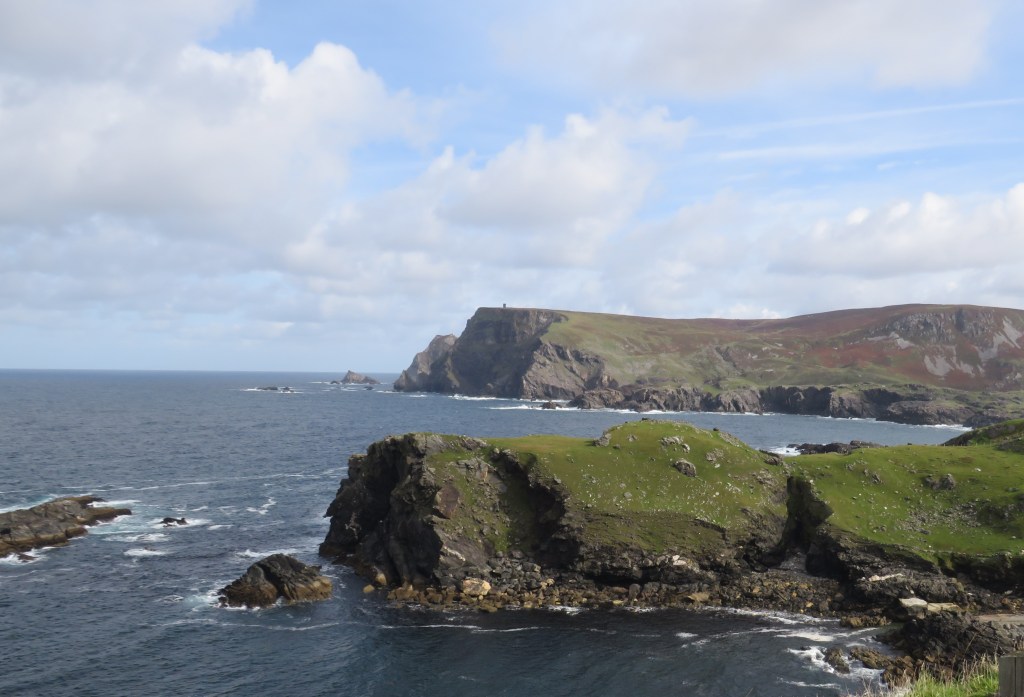
After a wild, wet and windy night, the sun shone and we drove along the Wild Atlantic Way through the Slieve League Mountains. This is the area that many tourists miss and there were very few vehicles on what was, for much of the way, single track road. The scenery was rugged and dramatic, combining the rocky Atlantic coast with the mountains. There were signs of peat cutting, wild fuchsia in many hedges and several abandoned dwellings, some looking like they had been left derelict more recently than others. We came across the Glencolmcille Folk Museum and stopped to look round. This was very different from the slick, government supported museums we had already visited but certainly worth a look. It paid tribute to the local priest, Father James McDyer, who did much to try to preserve the community spirit and provide a sound economic basis for the inhabitants of Glencolmcille from his arrival in the 1950s. He lamented the negative impact that emigration had had on the area and was instrumental in instigating the building of homes, bringing electricity to the community and establishing a knitting collective to supplement family incomes.
The Folk Park was founded by Father James in 1967. There were seven buildings to look round, illustrating typical Irish cottage life from the 1700s to the mid-nineteenth century. The roofs were made from a layer of bog timber, a layer of scraw, which is the top layer of the bog and then straw. The thatch is roped on and tied to stones that protrude from the walls. The cottages had St. Brigid’s crosses, made from straw, over the door. These were made each 31st January and were to protect the house from storms, fire and evil. We stopped at the Park for refreshment. The ‘Breakfast Baps’ were road-tested and given the seal of approval by Chris. They contained not just bacon but a fried egg and sausage as well.
We went the long way back to the site, driving up into the mountains as far as Doocharry.
We discovered after we’d had it for about five years that the television we use in the caravan played DVDs. We have very few DVDs but it turned out that I had put some in the van when we made the discovery about the television, in case we might watch them. One of these is Fisherman’s Friends, which we’d already watched on real TV this holiday. So, in the absence of a television signal and in complete ignorance of how to actually make the DVD player work, we settled down to watch part of Michael Wood’s story of England, based on Kibworth, which has an enviable set of documents. Talk about the perfect one-place study. There is three hours worth of this series on each DVD. Not wanting to watch it all, we managed to work out how to pause it, hoping we aren’t back at the beginning again when we come to watch the next installment
Day 17
We left our sea view behind at Killybegs and travelled through Leitrim and Sligo to County Mayo. This took us through Yates country and past the strangely shaped Benbulben, which is, says Google, a flat-topped nunatak rock formation. Any the wiser? No, me neither. On this site our choice of pitch was dictated by which one allowed us wifi in the van.
And there’s more – you are still a long way behind!
A proper day of mist and mellow fruitfulness as we set off early, with the thermometer reading six degrees, a whopping thirty degrees less than it did four days ago. The drive took us across the Sperrin Mountains, along the length of the scenic route that we failed to find on the previous day. We remarked on the trend for ostentatious gateposts that seem common on even quite modest dwellings.
After a lovely drive, we arrived at the Ulster American Folk Park. This should definitely be on everyone’s itinerary. It consists of period houses, almost all of which have been re-erected having been transported from elsewhere, including some from the States. These are used to tell the story of the widescale Irish emigration to the United States and Canada in a graphic and accessible way.
Although we think of mass emigration taking place in the famine years, prior to that, between 1815 and 1845, 1 million people left Ireland for North America, 400,000 of them from the counties that now make up Northern Ireland. A further million left during the famine years 1845-1851, over 300,000 from Ulster. In the eighteenth century, linen production was an important part of the Irish economy. Competition from American imported cotton, impacted on the linen producers and was an impetus for emigration. Agrarian unrest and the slump in the demand for Irish linen, led to 30,000 emigrants leaving Ulster in the 1770s, beginning chains of migration. Strangely, the main ports of departure were not on the west coast but the north and east, with ships leaving from Belfast, Newry, Derry, Portrush and even Dublin. By the 1820s, most Irish emigrants travelled first to Liverpool and then left from there.
The experience began with an indoor exhibition, focussing on the stories of real female emigrants, then we moved to the park. The whole site was very carefully arranged so you passed through the ‘Old World’, with typical Irish buildings first. Some of the buildings were inhabited by costumed guides who explained the history of the building and told the story of the emigrants who lived in that house. Only the Irish home of the Mellon family is in its original location. It is hard to imagine the logistics involved in dismantling and re-building the others. You then passed down the shopping street in an Ulster port and boarded the emigrant ship, where conditions were cramped and food poor. Those leaving during the famine were usually malnourished and/or sick before they embarked. In 1847, 20,000 Irish emigrants died on the journey. Leaving the ship, you find yourself in the ‘New World’, where the buildings have all been transported from America and include the American homes of the families whose Irish dwellings are also on the site. Pumpkin, sweet corn and tobacco are all being grown on the New World side of the park.
There is a commitment to working towards also telling the story of the enslaved and First Nations people and the exploitation that was a result of mass emigration from Europe. We couldn’t help thinking of the hundreds of tourists at Giant’s Causeway and feeling that they should all be here too but visitors at the park seemed to be few in number, which was a great shame and their loss.
We had a leisurely start to ensure that we didn’t arrive at the new site, a hundred miles or so to the north, before check in time. This saw us skirting Belfast, passing a sculpture called The Rise aka ‘The Balls on the Falls’. The journey was lengthened by lanes being blocked by broken down vehicles and accidents but we arrived safely and settled on to our pitch. The River Bann is behind us but the pitch is slightly marred by being opposite the toilet block/café, so rather busier than we’d like.
A visit to a nearby supermarket to collect supplies followed.
Day 12
Not quite such an early start but, taking into account past journeys, we allowed plenty of time to reach the Giant’s Causeway, so we didn’t miss our allocated entry slot and this time we were early. Our tour guide was Mark, another wonderful raconteur, who managed to successfully walk backwards for part of the route, so he was facing us, without bumping in to the many tourists. The Causeway gets tourists from 175 different countries each year and had nearly a million visitors a year pre-Covid.
The formation of the causeway, another World Heritage Site (two in three days), began 65 million years ago, when the tectonic plates drifted apart and lava bubbled up through the fissures and solidified. Further volcanic activity over millennia created the causeway. There are over 40,000 basalt columns and contrary to common belief, only about half are hexagonal. The others are mostly pentagons and septagons but they range from triangles to one single nonagon, whose location is secret. There used to be another 20,000 columns but these were quarried in the years before the site was protected. Tourists first became aware of the site when it was written about in 1692. In 1739, Susanna Drury painted a series of pictures of the causeway, which won a competition and this greatly increased the interest in the site.
The site is also home to various flora and fauna, including the narrow-mouthed whorl snail, which is unique to only three places and is the size of a grain of sand. The population has to be counted annually. This is done by sampling metre squares. Here you can find fulmars, oyster catchers, otters and stoats. Our haul was a heron and some female eider ducks.
Kelp is farmed in the area but 300 years of salmon fishing declined with the fish stocks and the last commercial salmon fisherman gave up in 2002, by which time the annual catch was about 300 fish a year; this had once been the daily catch.
We were treated to some ‘imaginative’ legends of the giant Finn McCool, credited with forming the causeway. We saw the rock formations known as Humphrey the camel, Finn’s boot, the organ pipes and the chimneys. After Mark left us, we continued to walk round to the next bay before returning to scramble across the causeway itself. There are three causeways of different sizes. I was a bit doubtful of my ability to rock climb safely; varifocals make this sort of thing difficult, so I was pleased to accomplish this without incident but definitely not recommended for those with mobility problems.
After leaving the Causeway we drive round the coast a short way to Portrush before returning to the van.
Day 13
We drove out to look at Lough Neagh. This is not held out to be much of a tourist attraction but we felt we should see the largest lake in the United Kingdom and in the island of Ireland. We viewed it from the west. It is a lake. It is large. That’s about it really. We later learned of the serious pollution problems in the Lough. There are issues with blue-green algae but additional pollution has put it in danger of becoming a dead lake.
We then headed for the Sperrin Mountains, designated as an Area of Outstanding Natural Beauty. We did find our way to the edges of them; yes, beautiful, if not outstanding. Then the sat-nav slightly let us down. We were supposed to end up at a visitors’ centre in the Sperrin Mountains. Owing, we think, to the fact that Ireland seems to have many duplicate place names we ended up driving through the outskirts of Derry, that we were trying to avoid and in the middle of a housing estate. The next plan was to head to a National Trust property on the coast. Again this did not go well. We did have a pleasant drive along the Causeway Coast Road but the only National Trust property wasn’t quite where the sat-nav said it would be and was closed. We decided to call it a day. On the plus side, it was finally a little cooler and less humid, with a few showers.
Yes, there’s more, although this now seems like it happened a very long time ago.
In a thick haze, we returned across the border to go to Newgrange and Brú na Bóinne. In theory, the journey takes an hour. We allowed an hour and three-quarters. Thanks to rush hour in Newry and a road closure it was a bit touch and go but we arrived just in time for our 10am slot. Brú na Bóinne, or Palace of the Boyne, has mythological connections and is associated with the goddess Boand, the god Dagda and their son Oengus Mac Ind Oc, the boy god. Oengus and his beloved, Caer, were transformed into swans and we did see a swan on the Boyne as we walked across the bridge. First, a look round the exhibition, then a short bus ride to Knowth, where Rodney was our guide. The neolithic burial mound was created some 5000 years ago by early farmers who introduced wheat, barley, cattle and sheep to Ireland. Knowth is the largest site of this type in Western Europe, with nineteen smaller mounds surrounding the largest mound. The passage graves contained cremated remains. DNA extracted from unburnt bones indicated that these people had ancestral connection to Anatolia, in modern day Turkey. This type of tomb was used over many years. Twelve generations of one family have been found in a similar grave in Sligo. I do wonder how anyone knows this. The excavations at Knowth, under Professor George Eogan began in 1962 and lasted several decades.
There have been some modern adaptations to preserve the neolithic carvings that are on many of the kerb stones round the circumference of the main mound. These are abstract designs, featuring spirals, curves and concentric circles. Despite speculation, no one knows what they symbolise. One has twenty nine crescents and circles that might be representative of the phases of the moon. Two-thirds of all western European neolithic art is at Knowth, which is why Brú na Bóinne is designated a World Heritage Site. Some of the stones used in the creation of the original mound come from as far away as the Wicklow Mountains. These were moved before the horse or wheel and were probably transported by raft and then rolled on logs. The estimated weight of the mound is 250,000 tons. It is twelve metres high and ninety metres across. Of 300 similar monuments, only fifteen have solar alignment. At Knowth, the two standing stones on the eastern and western sides cast shadows on the centre of the entrance stones at the spring and autumn equinoxes. There is evidence of settlement here that pre-dates the mounds. In the ninth century, regional kings lived in fourteen houses built on top of the great mound. The area was farmed by nearby Mellifont Abbey in the twelfth century.
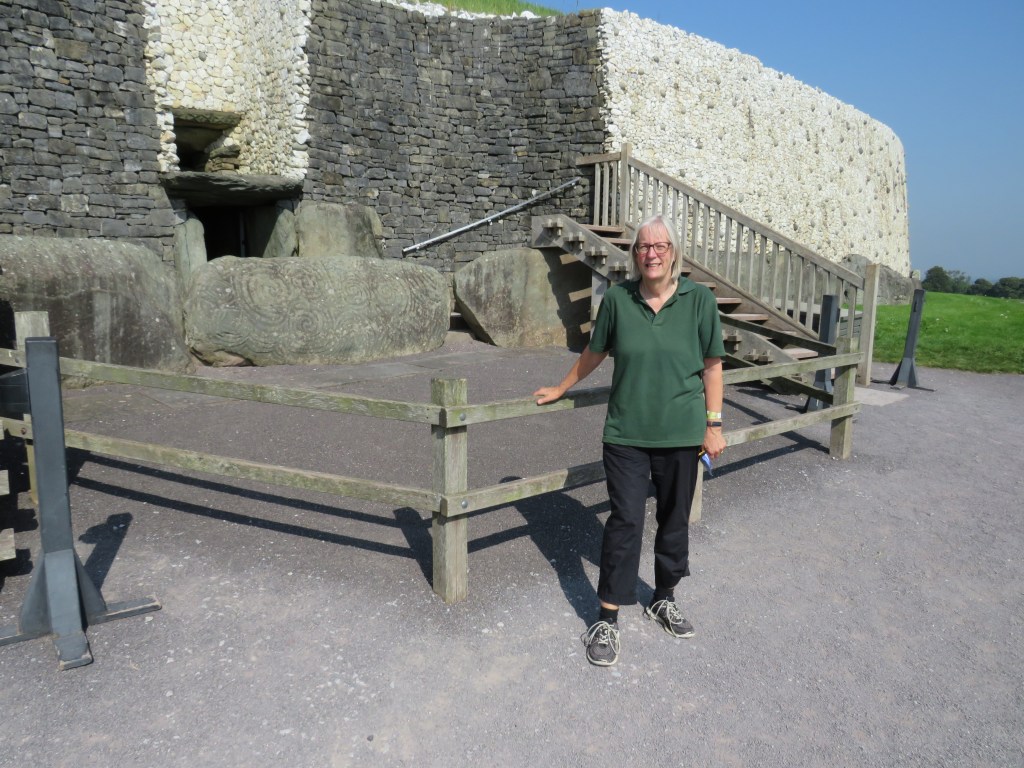
Another short trip and we were at Newgrange. There are a few carvings here, notably the triple spiral symbol, which is unique to Newgrange. The impressive part of this site is the burial chamber with its solar alignment, which floods the chamber with sunlight at sunrise on the winter solstice. There is a slight uphill incline as you squeeze your way up the passage, minding your head at various points. This means that the ‘roof box’ over the entrance is the same height as the floor of the main chamber. The effect was simulated for us using artificial light. The gradual northward drift of sunrise at the winter solstice means that by c.5000CE this phenomenon will cease. The domed roof of the chamber is six metres high and is completely watertight.
It was incredibly hot with not a scrap of shade. The car thermometer that measures the outside air temperature at one point reached thirty six degrees. Even allowing for some slight inaccuracy, that is pretty hot. Despite the heat, we decided to go ahead with our plan to visit the site of the Battle of the Boyne, the largest single battle to take place in Ireland or Britain. We circumvented the road closure to find the site. There isn’t a great deal to see but it was worth a visit and entrance was free with membership of English Heritage. A Georgian house, Oldbridge House, has been built on the site and contains as small display. Having led students through coursework on the Battle of the Boyne for several years, you’d think my retained knowledge of it would have been better than it was. It was fought between William III, aka William of Orange and his father-in-law, the deposed Catholic James II in 1690. James had support from France and Catholics in Ireland and his troops numbered some 23,000. He was outnumbered by William’s 36,000 better trained men, including Dutch and Huguenots. William’s victory was effectively the end of James’ attempt to regain the throne and he fled to France.
The walled garden was a suntrap and as such a bridge too far in thirty degree plus temperatures, so after a brief look from a distance we headed back to the van.
Still drip feeding you with news of our recent Irish holiday.
Day 8
Time to move to Northern Ireland. The sat-nav asked if we wished to avoid a toll road. We said we did. We probably didn’t. Avoiding the toll road took us back to the dreaded Dublin outskirts, abounding with bus lanes and traffic lights. Fortunately we made it through and headed north on the N2. We even managed to find some services where wifi was available. Yay! 212 emails to wade through.
Our next home was a site in the Kilbroney Forest, on the edge of the Mountains of Mourne. Now this really was our kind of site. Wonderfully friendly and helpful staff, a very special setting and wifi, albeit a little shaky at times. I could see the sea from my caravan bed; wonderful. Somehow I didn’t expect it to be so picturesque. Apparently, Rostrevor used to be called several other things, including Castle Rory. It became Rostrevor in 1613 when Sir Edward Trevor married Rose Usher.
I was particularly keen to see the area as my dad was stationed here during the war. His letters to my mum, whom he had just met, survive and it seems he mostly peeled potatoes, got bored and joined the camp choir. He was billeted at Ballyedmond, which is now a private residence. We managed to find it and the CCTV no doubt led to some alarm as I skulked around outside a fair bit. I realised that I wasn’t sure what he was doing here, apart from the peeling potatoes but it seems that Ballyedmond was a US air force base so that kind of makes sense as he was with the RAF regiment. Though why the US couldn’t service their own base I am not sure. I definitely need to find out more. We also drove along the forest drive and admired the view. The temperature was still in the high 20s, so it was quite cosy.
We had a television signal for the first time since Pembroke and channel hopping discovered the first Fisherman’s Friends film was being shown, so that was us set up for the night.
Day 9
A leisurely start and we set off round the Mourne coastal road to Murlough. The sand dunes here are believed to be 6000 years old and there is evidence of human habitation in the area for 4000 years. The dunes are home to rabbits that were harvested in the middle ages for fur and meat. The area has been protected since 1967 and is in the care of the National Trust, which means we get to park for free. We set off looking for the yellow marked poles that designate the South End Nature Trail. We hadn’t got very far when we lost track of the yellow poles. We had white poles. Have they perhaos run out of yellow paint? We slogged up and down sand dunes in weather that was really too hot for this. We did however find the spot where the Mountains of Mourne sweep down to the sea. It was hazy, so the mountains were not very clear. I noted that the guide said that this route was wheelchair friendly. No way was where we were wheelchair friendly. We were lost. We found our way back to the car park and decided that one can have too much of hot sand dunes so consoled ourselves with a chocolate muffin (me) and a bacon bap (Chris).
We drove to Silent Valley in the Mourne Mountains. You have to pay £5 per car to enter. The nearby dam took 2000 men forty years to construct and was opened in 1933 to provide Belfast with water. The granite Mourne Mountains are beautiful but more barren than the Wicklow Mountains and I think the Wicklow Mountains have the edge for me. There are some interesting dry boulder (as opposed to drystone) walls edging tiny fields. The Mourne Mountains are a location for game of Thrones apparently; having never watched it, that doesn’t make much impact. We followed a short ‘Nature Trail’, spotting some long-tailed tits and then walked up to see the dam. There was supposed to be a café and visitors’ centre but these were either very well disguised or closed. We then attempted to drive round the Ring of Gullion Trail, we managed to find our way on to it. The landscape was greener here but it probably wasn’t worth the diesel.
Still posting about out recent holiday in Ireland.
Allegedly it was to take an hour to get to Dublin for our 11am tour of Trinity College and the Book of Kells. We were supposed to be there ten minutes in advance. We left at 9am. There seemed to be a lot more traffic on the roads than the previous day and driving through the centre of Dublin, negotiation bus lanes, trams and a million sets of traffic lights was not the best idea we’ve, ok I’ve, ever had. We had been lulled into a false sense of security by yesterday’s foray into Dublin, albeit the southern outskirts. I won’t say it was stressful, for me at least but I have vowed never ever to suggest we drive into a city again. If I have my way we won’t ever venture into a major city on any terms ever again. I will make an exception for the cities on whose outskirts my children live but that may well be it. Then there was the issue of where to park. The sat-nav obliged us with a ‘car park near your destination’ and we manage to only accidentally get stuck in one bus lane on the way (we think). We are now waiting to see how many fines we get. The tiny out-of-the-way car park had very tight turns to access it but we made it at 10.35pm and there was space. Of course we then had no idea how to get from there to Trinity College. We managed to pick people to ask who knew the answer and arrived at exactly 10.50am, fortunately with time to dash to a toilet before beginning our tour with Paul.
Paul was great; if you have a tour of Trinity College, Paul is your man. The university was set up in the C16th by Elizabeth I, who wanted a university for the sons of the Protestant aristocracy. As such, the university was aloof from the surrounding area. It was two hundred years before Catholics were allowed to study there and 1904 before women were able to graduate, even then it was ahead of its time and women came from England in order to be awarded degrees. Initially, the schools of study were Divinity, Law, Medicine and Science. Notable former students are Oscar Wilde, Bram Stoker and Samuel Beckett. The university boasts many active societies. The History Society has been meeting since 1770 but the Philosophical Society have met every week without a break since 1683. No idea how this worked in times of war, rebellion or COVID.
Currently there are 20,000 students from 110 countries. Ireland’s current population is seven million about ten percent of whom are fluent Gaelic speakers but this is on the increase. There are some small settlements in the west where Gaelic is the first language.
The oldest surviving building dates from 1701. The 100 foot bell tower was built in 1852 and the students are wary of passing under it, as the legend is that if you walk underneath when the bells rings, which it does unpredictably, you will fail your exams. The chapel at Trinity College is the only multi-faith place of worship in Ireland. The iconic Old Library, which houses 200,000 texts, some of which date back over four hundred years, is being renovated. The process will take three years. A year to move the books safely, this is already underway, a year to renovate the building and a year to replace the books. It is an amazing building, even with only some of its contents. On display was the Brian Boru harp, which actually is not anything to do with C11th high king of Ireland Brian Boru. The harp, in fact from the late middle ages, is the oldest surviving Irish harp and one on which the Irish national emblem has been based.
We joined the million people each year who view the Book of Kells, which dates from 800CE. Fortunately, not all one million were there on the day of our visit, even though it felt like it on the streets of Dublin. There wasn’t even a queue. The Book of Kells, an incredibly illustrated version of the Bible, was created in a monastery on Iona. Viking raids led monks to relocated to Kells in County Meeth. Kells was plundered several times and in 1007 the Book was stolen, being recovered, with some damage, a few weeks later. It is incredible that the Book survived as there were repeated fires at Kells in the C11th and C12th. It was 1653 before the Book was sent to Dublin, to keep it safe during the Cromwellian raids. It was presented to Trinity College, Dublin in 1661. It is estimated that 185 calf skins were used to make the vellum for the Book; the original binding has not survived. Every three or four months a specialist page turner sees that a new double-page spread is displayed to visitors. Although the current pages were not particularly decorative, it did seem appropriate that it was Luke 3 vv32-8, the genealogy of Jesus.
I am sure we should have walked the streets of Dublin, exploring the archetypal bars, listening to music and quaffing Guiness but to be honest, we just wanted to get to somewhere more remote. Fortunately, getting out of Dublin was a little more straightforward than crossing it and we headed home down the coastal road. Although we did get a couple of glimpses of the sea, this wasn’t particularly inspiring but it did mean we saw a different Irish road.






 The History Interpreter - Janet Few