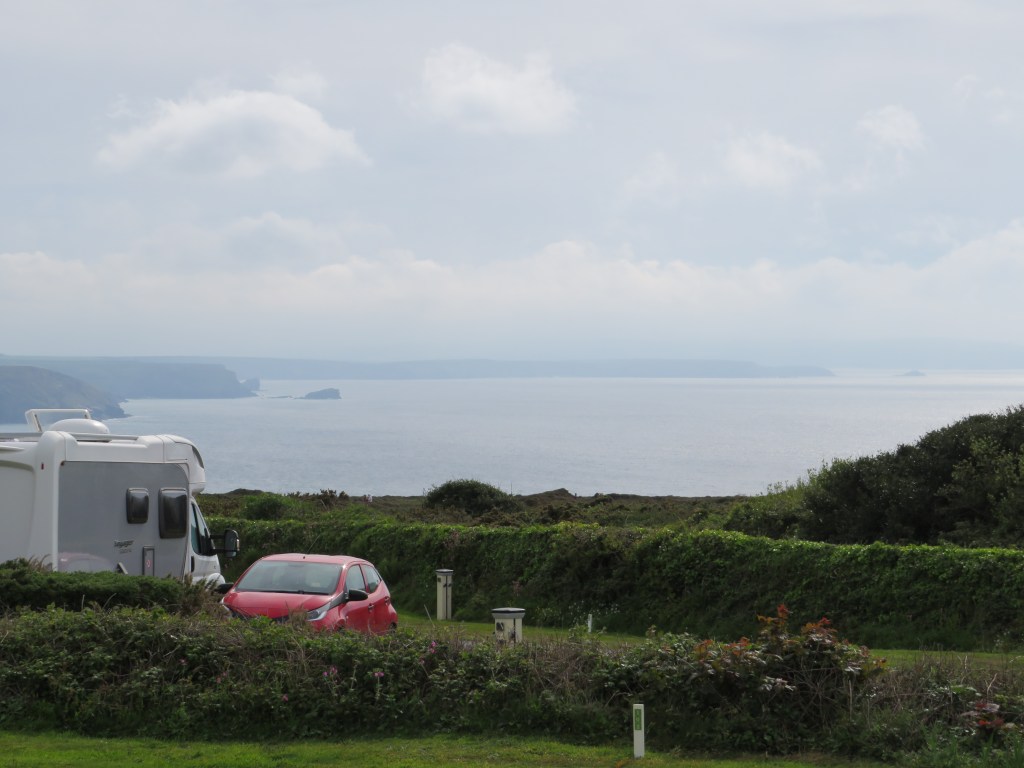
As always, you aren’t getting these posts in real time so apologies if I am saying it is glorious sunshine and it has been pouring with rain with you. May was supposed to be a quietish month so we booked a trip to Cornwall for some R & R. So much for quietish! I have four meetings to attend this week and a heap of writing to do. Nonetheless it makes a change to be somewhere different. As Cornwall is next door and earliest entry to caravan sites is 1pm, we had a leisurely start. I did have a slight panic when, despite what the website implied, on checking the site handbook for directions, I discovered that the wifi was hot spot only. All was well however as by choosing our pitch judiciously, I could avoid standing on one leg under a tree whilst attending my meetings. At least I hope I can. Internet and emails are slow but working, so fingers crossed that Zoom works too. As a bonus, we have one of the best views on site, looking out across the spectacular north Cornish coast.
Arriving at lunchtime provided opportunities for exploration in the afternoon so we set off for a gentle stroll along the south-west coast path, close to the caravan site, heading for Porthtowan, which, on the map, looked about that close (when ‘that’ is not very far). I really should know better. The clue is in the name. We are staying at St, Agnes Beacon. Beacon = high up. Porth = port = sea level. In between there was a lot more upping and downing. We really are too old/too out of practice for six or seven strenuous miles of sliding up and down cliff paths with plenty of loose shingle as an added hazard. The bonus was our encounter with the iconic Cornish coastal landscape, compete with granite cliffs, abundant wild flowers and abandoned tin mines. Limping and panting back to the van, we decided we should have settled for the mid-point at Chapel Porth instead. We survived but resolved not to try that again.
Looking for something somewhat gentler on day two, we drove to the south coast seeking Pendennis Castle, which after a slight detour, we located. It is nearly forty years since my last visit. Pendennis is one of forty Henrician forts, erected in the sixteenth century, as Henry VIII fell out with many European neighbours. The impressive wooden portcullis was constructed from oaks felled in 1541 but it did seem that wood might not have been the greatest idea if the enemy arrived with fire-power. Guide David took us on a tour of the Tudor part of the fortifications. The castle was built on land owned by the Killigrew family, who provided the first three captains of the castle. The site was subject to continued development, with the large garrison block dating from the early twentieth century and this was still in military use until 1956. There were more incredible views across Falmouth Roads to the companion castle at St Mawes.
After some refreshment, we completed the ‘moat walk’ amidst more spring wild flowers and climbed down to see ‘Little Dennis’ another bastion on the shoreline. Then time to return to the van, via a short walk at Wheal Coates, close to the van. There are records of mining here that go back to the seventeenth century but the buildings that remain are nineteenth century. The tin mine finally closed in 1914.
 The History Interpreter - Janet Few
How I envy you Janet. My mining ancestors came from St Agnes, Three Burrows and Blackwater.
Sue in Sydney