A Day of Culture

An ancient monument to start the day. No not myself or my travelling companion but Chysauster village, which was inhabited for about two hundred years, two thousand years ago. This was just in case we hadn’t already had enough of steep slopes and uneven paths, as the village is in a prominent hill-top location. The climb is made worthwhile by the impressive views and as the glorious weather continues, we can almost see from coast to coast. I have been here before but I am not sure we actually got to the village then. I know we found the fogou as there is photographic evidence but that may have been it. In those days it was an unattended free site, with no interpretation boards beyond a metal sign saying ‘fogou’ and no arrows to the village above. What is a fogou? I hear you ask. You did ask didn’t you? If only I, or indeed anyone else, knew. It is an underground passageway of unknown function, possibly for storage or, alternatively, it may have had a ritual function.
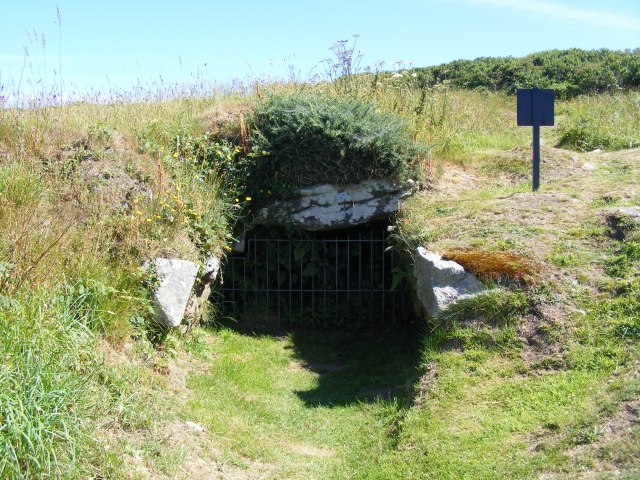
019 5 July 2019 fogou Chysauster

A Fogou

Chysauster itself is a group of stone houses, which were home to 50-70 people, who were perhaps involved in the tin trade. It reminds us of the time we spent in the Neolithic era. One of the roofless houses was used by itinerant Methodist preachers in the nineteenth century. The congregation must have been pretty dedicated to slog all the way up here, as there are not many settlements in the vicinity.
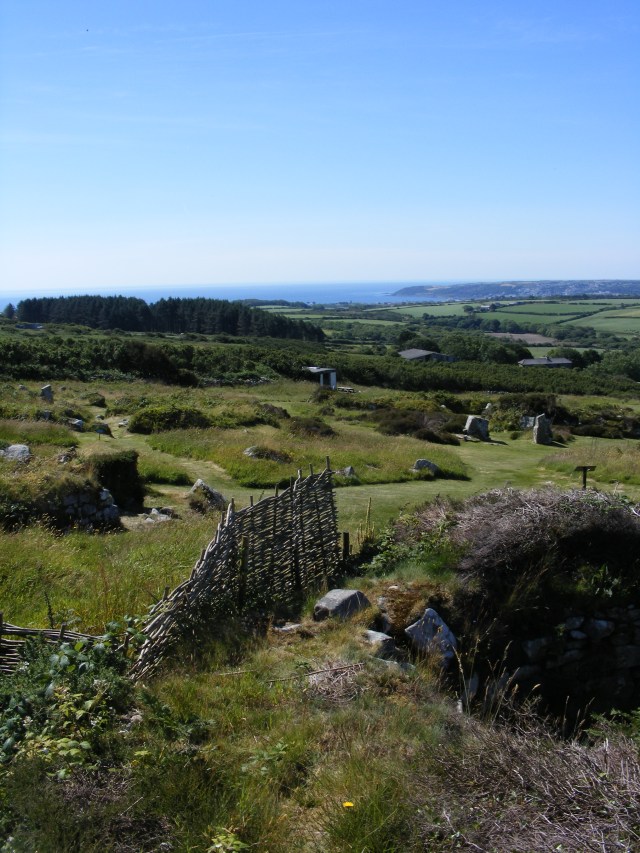
018 5 July 2019 view from Chysauster

We drive down into Penzance and secure the last parking space in Penlee Park. We are here to listen to my friend Liz Shakespeare talk about her book The Postman Poet. This is not just any book as it features my kitchen in a cameo role. We share a pleasant lunch in the sunny park afterwards, then relax (that word again) in the park to wait for evening. Had it been less cozy, we might have walked down to the centre of Penzance but we decide against this. The evening treat is an open-air concert by Fisherman’s Friends. Open-air and England can be a dodgy combination but we could not have had better weather for it. Being somewhat of a chilly mortal, I have come armed with socks, trousers and fleeces but I am able to survive without any of these extra layers, as we listen to shanties and other songs of the sea.
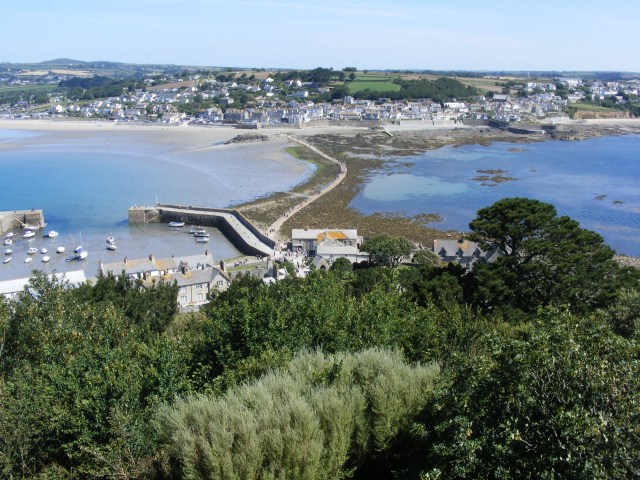
St Michael’s Mount

The fixing the water pump thing requires us to make a trip to a nearby electrical accessories store, which we do. Paying the water pump-fixing man means we also need to find a cash point and we manage that too. Then it is back to Marazion in time for the causeway to St Michael’s Mount to become passable on foot. St Michael’s Mount is one of the most visited tourist attractions in the country and it seems that most people have chosen today. It is quite a slog up the steps to the castle, folk making the ascent are getting a tad warm. We are then squished into small rooms in the castle in close proximity with said fellow visitors, hmm. Eau de sweaty humanity is not pleasant.

010 4 July 2019 from St Michael's Mount-2

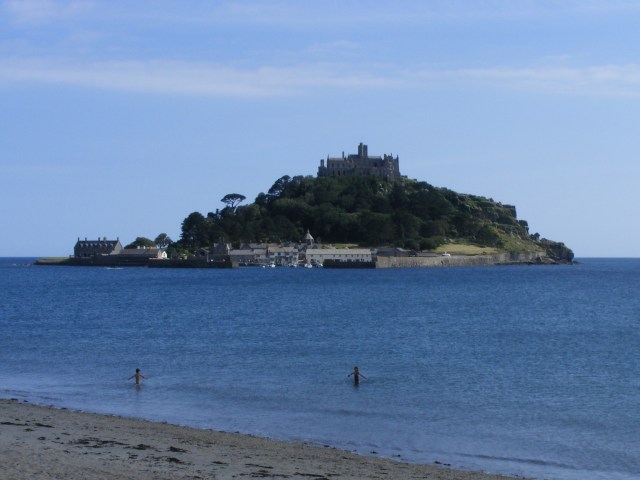
St Michael’s Mount is iconic and its similarity to France’s Mont St Michel is not a coincidence, as monks from Normandy, settled on the Cornish version, building a priory here in the twelfth century. The steep rocky island is just off-shore from Marazion and is cut off by the tide for half the day. A Medieval Castle dominates the island, which, after the Dissolution of the Monasteries, passed into the hands of the Crown. It was briefly owned by Elizabeth I’s favourite Robert Cecil and then by the Bassets, who strengthened its defences when fighting for the Royalist cause during the English Civil War. When the garrison surrendered to the Parliamentarian forces, the St Aubyns took up residence and became the owners in 1659. Almost every generation was John St Aubyn but although they shared a name, the temperaments of the various Sir John’s varied from one who was hailed as ‘the least corruptible Member of Parliament’ and another who fathered seventeen children on three women, none of whom were, at the time, his wife. In the nineteenth century the St Aubyns took the title Lord St Levan and they still inhabit the island today.

We hear the story of the eighteenth century clock, which shows the state of the tides as well as the time. A Medieval skeleton of a man, seven feet in height, was found buried in the chapel. The remains were re-interred in the churchyard. There are several ‘giants’ legends associated with the island. If ascending the steep, uneven stone steps and cobbled paths was hard work, the descent was more difficult, not helped by wearing varifocals but I reach the bottom relatively unscathed.

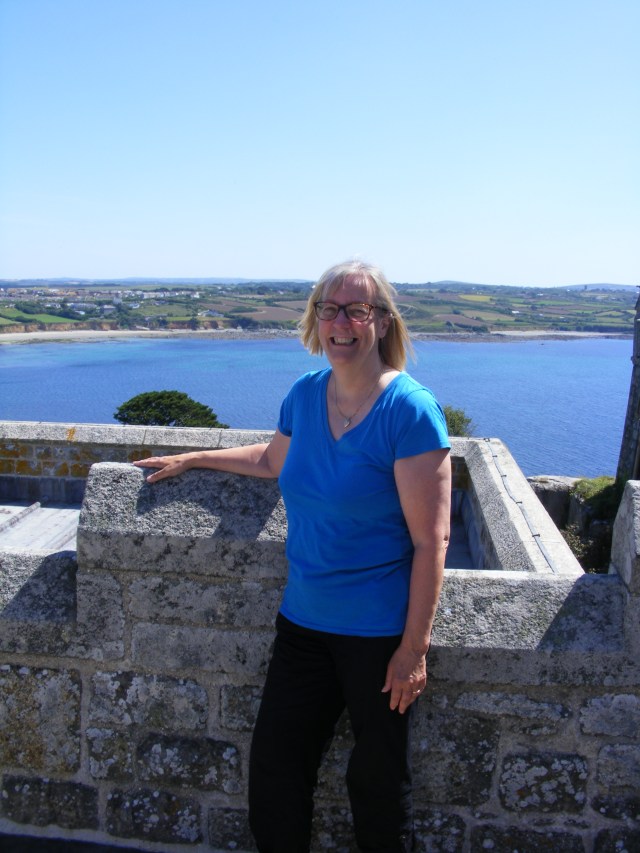
012 4 July 2019 At St Michael's Mount

On previous visits to the mount, I seem to have missed touring the gardens. These are a huge challenge for the gardeners, who have to adapt to steep slopes, very little soil and salt-laden winds. They have nonetheless done a great job. My legs have barely recovered from walking steep Devon streets and ‘racing’ for life so up and down the rocky paths in the heat of the day was somewhat strenuous but worth the effort. We then return to the van to take part in that rare activity ‘relaxation’, whatever that is. Felt obliged to sample the wares of the site’s mobile fish and chip van.


Heading Westward

So, having spent some time in the most north-easterly county of England, we headed instead for the most south-westerly. Both are in my top three English counties. It seemed everyone else had the same idea and traffic was heavy in western Cornwall. I realised that I had inadvertently booked a site with only ‘hot-spot’ internet. Last time we were lucky enough to pitch on one of only three spaces where there was signal. Will we be as lucky again? If not I am going to spend much of my time balancing on one leg in a field trying to log on, as the job we must not mention requires wi-fi and is not yet over.

On arrival, we chose a pleasant, shady pitch (which had wi-fi – yay!) and sited the caravan, skilfully lining up with the marker peg as required. Pleasant and shady it may have been, flat it was not, even our super-dooper, self-levelling legs (that’s the caravan’s legs not our own) couldn’t cope with the incline. It was clear from the marks on the grass that a previous resident of this pitch had parked considerably to the left of the marker, so we did the same. The legs could cope with this so the van was no longer reminiscent of the Crooked House (Blackgang Chine aficionados will understand what I mean). In order to comply with the ‘park with the back corner to the peg’ regulation we judiciously moved the peg.

The next issue was the water pump, or lack of the same. There are two operative words here – ‘water’ – yes, ‘pump’ – no. The helpful warden took a look. We dismantled bits of the van. We summoned a mobile caravan water pump fixing person. Hurrah! We had running water once again – probably just as well as the temperatures are soaring.

In between all the pump fixing we drove a couple of miles to Marazion. We passed a horse rider who commented that the road was melting. She was not wrong, as there were clear impressions of horseshoes on the tarmac. We wandered through Marazion’s narrow street in beautiful sunshine. Mount’s Bay was looking glorious. Marazion’s name was once thought to originate from ‘Market Jew’ and there is a Market Jew Street in the town. It is now thought that the name comes from ‘Marghas Yow’ or Thursday Market. Until Medieval times, when Penzance became dominant, Marazion was the principal town in the area. It is an ancient settlement, whose economic activity was centred on tin smelting. It is held out to be one of the oldest charter towns in England, having been granted a charter by Henry III in 1257. It is forty years since my first visit to Mount’s Bay, when I stayed in a Penzance guest house. The abiding memory of that trip is the whitebait that was served for breakfast each day; I have not eaten whitebait since.

001 3 July 2019 St Michael's Mount