#100daysofbfotc Day 84: Temperance Lloyd

Hanging WitchesIt is fitting that today we should mention Temperance Lloyd, noted as being one of the last people to be hanged for witchcraft in England, in 1682. Her name has echoed down the centuries and together with Susanna Edwards and Mary Trembles, she lives on in North Devon folklore. What is she doing in a novel set in the early twentieth century? She appears in Barefoot on the Cobbles as a reminder that elderly women, women whose names may well have been known to my characters, were convicted of capital crimes. Precisely what Temperance was, or was not, guilty of is debatable. Like Polly, hers too was a crime that hinged on the accusations of others. I do have another reason for mentioning Temperance, one that may become clear in the coming months but for now, that is a secret.

Here is Polly, on her way to court in Bideford: ‘Then there was the old cemetery, the school, and the site of the house where it was said the witches used to live. Polly was not the only parent who had threatened her recalcitrant small children with tales of how Goody Lloyd would cast a spell on them if they did not behave. Temperance Lloyd and her co-accused had been hanged outside Exeter jail. Reminders of capital punishment were hardly reassuring.’

Barefoot on the Cobbles will be published on 17 November 2018. More information about the novel can be found here. Copies will be available at various events in the weeks following the launch or can be pre-ordered from Blue Poppy Publishing or the author.

#100daysofbfotc Day 83: Postman Branch

BranchPostman Branch is somewhat of an interloper in Barefoot on the Cobbles as he did not actually live in Clovelly. As Leonard makes up his mind whether or not to join up, I used William Branch as a well-known local figure who was a prisoner of war.

William Henry Branch was born on 8 May 1888 and baptised at Northam on 21 June. He was the son of James and Mary Ann Branch née Heard. At the age of seventeen, William joined the army reserve as part of the 4th Battalion of the Devonshire Regiment. At the time, he was living at 6 Hazel Terrace Northam and working as a labourer for Mr Ashplant, a shoemaker. William was just under 5 foot 6 inches tall and weighed 129lb, with brown eyes and brown hair. He described himself as a Wesleyan Methodist. It appears that, six months later, on 19 June 1905 he was part of the regular army. 1911 finds William serving in India as a Lance Corporal in the 13th Hussars.

He married Ethel Mary Bowden in 1912 and they had one son. At some point, he was attached to the 2nd Life Guards. In the early days of the First World war he was taken prisoner. Whilst he was a POW at Wittenburg Camp, he was shot through the hand so that he would be unable to use a gun. He was discharged in July 1916 and awarded the Silver War Badge.

He became the local postman, walking the route from Bideford to Buckland Brewer daily. He used to stay in a hut at the back of the Methodist Chapel whilst he waited for the outgoing letters to return to Bideford. By coincidence, it may be that this shed is now in my garden, although other sheds are available! He also worked as the local lamplighter. By 1939 he was living at 3 Rickards Row in Buckland Brewer. He died in 1963.

 Now the old men pontificated about the war, what so-and-so should or shouldn’t have done, how our brave boys would win through and wasn’t it a pity about Postman Branch, who’d been taken prisoner.’

Barefoot on the Cobbles will be published on 17 November 2018. More information about the novel can be found here. Copies will be available at various events in the weeks following the launch or can be pre-ordered from Blue Poppy Publishing or the author.

#100daysofbfotc Day 82: Upton Hill, Torquay

Upton RoadUpton Hill features in Barefoot on the Cobbles as the home of the Cornelius family. In chapter ten, Daisy arrives at 48 Upton Hill, to take up her role as parlourmaid. Upton Hill rises steeply on the northern outskirts of Torquay and number 48 is in the middle of a short terrace. At the time of the novel, the end property of the terrace was a small grocery store.

‘Daisy’s box had been sent on ahead, so she was unencumbered by heavy luggage as she wound her way up the street above Torre Station. The steepness of Upton Hill caught many a visitor unawares but Daisy was accustomed to the Clovelly cobbles, so she was barely conscious of the gradient. Another glance at her instructions informed her that she would find number 48 on the left hand side of the road, three doors up from Bertram’s grocers’ shop.’

Barefoot on the Cobbles will be published on 17 November 2018. More information about the novel can be found here. Copies will be available at various events in the weeks following the launch or can be pre-ordered from Blue Poppy Publishing or the author.

#100daysofbfotc Day 81: Dr Toye

Capture

Western Times 28 January 1938

Dr Toye is one of several medical men who grace the pages of Barefoot on the Cobbles.

Edwin Josiah Toye was born at 8 Bonner’s Park, Bethnal Green, London on 3 November 1871. His father, another Edwin Josiah Toye, was a chemist. His mother was Jane née Buggel. Edwin trained at St Bartholomew’s Hospital and specialised in opthalmics but was also awarded a gold medal for his achievements in the field of obstetrics. He worked as a house physician at the Metropolitan Hospital before coming to Bideford as a locum to Drs Rouse and Gooding.

After the death of Dr Rouse, Edwin became Gooding’s assistant and later a partner in the practice. He is credited with owning the first car in Bideford, in 1902. Dr Toye was a leading Rotarian and served as mayor of Bideford in 1925. It was during his tenure that the building of the new Bideford Hospital was begun and Bideford Bridge was repaired. On 8 September 1903, married an older lady, Mary Ellen Keene née Greatorex, in Northam and they lived at Stanhope in Northam Road. She already had children but they had none of their own. Dr Toye died suddenly at Stanhope on 2 January 1938.

‘Dr Toye was a tall, brusque man in his forties. When Dr Kay called, you felt that he was visiting for a cosy chat, Dr Toye was very different; he was business-like, hurried, eager to give his verdict and to move on to the next patient.’

Barefoot on the Cobbles will be published on 17 November 2018. More information about the novel can be found here. Copies will be available at various events in the weeks following the launch or can be pre-ordered from Blue Poppy Publishing or the author.

#100daysofbfotc Day 80: Police Sergeant Ashby

Police Sergeant Ashby is the bearer of bad news when he arrives on Polly and Albert’s doorstep in chapter fifteen of Barefoot on the Cobbles.

CaptureJames Charles Ashby was born on 1 January 1874 in Holsworthy, the son of James and Grace Ashby née Jones. James followed in his father’s footsteps and began his working life on a local farm. In the mid-1890s he joined Devon Constabulary.

James married Hannah Mary Luscombe in Wolborough on 27 December 1899. They are believed to have had three children. In 1901, he was working as a police constable in Highweek, Newton Abbot, he is also known to have worked in Bishop’s Nympton and Dawlish. He was serving in the Bideford area at the time of the novel but moved to Budleigh Salterton before his retirement in 1922. In 1939 he was living at 7 Imperial Road, Exmouth and was working as a caretaker. He died in Honiton in 1959.

‘Polly was unable to raise her gaze above the middle of the policeman’s chest. Her mind was captivated by insignificant details, the shiny buttons that marched down Ashby’s tunic, the red weal on his neck, left by the chin strap of his helmet. Everything about the man’s attire seemed too small for his formidable frame. His collar was tight, the leather belt with its metal clasp, was stretched across his ample stomach, even his boots were taut and misshapen by the bunions that were a legacy of past years on the beat.’

Barefoot on the Cobbles will be published on 17 November 2018. More information about the novel can be found here. Copies will be available at various events in the weeks following the launch or can be pre-ordered from Blue Poppy Publishing or the author.

#100daysofbfotc Day 79: Nelson

Lime KilnNelson was the youngest of Polly and Albert’s four sons. He was born in Chapel Street Clovelly on 16 August 1908. Nelson’s story features in chapter four of Barefoot on the Cobbles and it would spoil the novel if I were to recount it any further here. So I will leave you with an extract from that chapter.
‘Bertie, with his younger brothers Mark and Nelson, had spent the long, light evenings after school scrabbling for rusty buttons or broken bits of plate and bickering with friends over who had spotted a particular treasure first. As they ranged across the beach, using old branches to make dens above the water’s reach, their unbroken voices mingled with the raucous cries of the gulls and echoed back.’

Barefoot on the Cobbles will be published on 17 November 2018. More information about the novel can be found here. Copies will be available at various events in the weeks following the launch or can be pre-ordered from Blue Poppy Publishing or the author.

#100daysofbfotc Day 78: Arthur Wakely

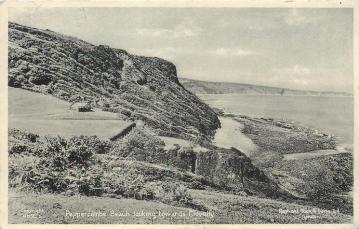
PeppercombeThere are only brief references to Arthur Wakely in Barefoot on the Cobbles. His escape from his Devonshire home, to become a coachman in Midlothian, Scotland, was an example to Albert that there was a world beyond the fishing villages on the north Devon coast.

Arthur William Wakely was the eldest of the Wakely family and the only surviving son in a family of girls. He was born on 21 April 1861 in Peppercombe Valley. Initially he moved to Bideford and worked as a painter but shortly afterwards changed his occupation. In 1882, he married a Scottish girl Mary Eliza MacAulay in London, where they had no doubt met whilst in service. They moved with the family to their Scottish home in Edinburgh, by which time Arthur is working as a coachman. Arthur and Mary had at least eight children. We lose track of Arthur and his family after 1901.

‘It was from Polly that he learned that there were two more sisters at home, Ada and Ethel and a brother, Arthur, who was making his own way in the world.’

Barefoot on the Cobbles will be published on 17 November 2018. More information about the novel can be found here. Copies will be available at various events in the weeks following the launch or can be pre-ordered from Blue Poppy Publishing or the author.

#100daysofbfotc Day 77: Clovelly Lifeboat

HA_TC_A3P3-003 (2)The lifeboat that features in the penultimate chapter of Barefoot on the Cobbles is the Elinor Roget, or ‘Elinor Rocket’, as she was affectionately known. The Elinor Roget II replaced the first lifeboat of that name in 1907. She was a rowing lifeboat and the crew’s only protection were their cork lifejackets. In the novel, it is Albert who forms part of the crew but depending which account you read, it may have been his brother Alfred instead. Having tried to untangle the conflicting lists of the men who manned the lifeboat on New Year’s Day in 1919, it seems the crew is likely to have been: Tom Pengilly (coxswain), William Prince (Bowman), Oscar Abbott, Herbert, Albert (or Alfred), Charlie Headon, Philip Dunn, Richard Headon, R Hortop William Hamlyn, Fred Headon, Tom Jenn, Captain James Jenn, James Jenn junior and Arthur Shaxon. We do know that some of the crew stood down to be replaced by fresher men, when the lifeboat put to sea a second time. The new men were probably Richard (Dick) Cruse, Sidney Abbot, Richard Foley and Steve Headon. Despite there being a policy of not taking more than one man from each family, the Headon and Jenn families made a significant contribution to the crew. In fact, in a community such as Clovelly, where the families intermarried over successive generations, most of the crew were related in some way.

‘Albert was amongst the fourteen men with oars at the ready, cork lifejackets tightened. The watching crowd, apprehensive and fearful, strained to see the struggling fishing boat dipping and tossing in the distance. The lifeboat listed alarmingly as the oarsmen fought to maintain a steady path through the waves.’

Barefoot on the Cobbles will be published on 17 November 2018. More information about the novel can be found here. Copies will be available at various events in the weeks following the launch or can be pre-ordered from Blue Poppy Publishing or the author.

#100daysofbfotc Day 76: Captain James

Captain James with telescopeCaptain James appears in the first chapter of Barefoot on the Cobbles when he is visited by his grandchildren Albert and Eadie. Born in 1809, James spent his whole life living in Bucks Mills. He went to sea at the age of eleven and was a fisherman and pilot. He was credited with saving the lives of several local fishermen who had got into difficulties in Bideford Bay.

In 1836 he married his first cousin Mary and they had eleven children. He probably began his married life in a property known as The Bluff, before building King’s Cottage, next to his father’s home in 1845.  He died in 1898.

The grandfather, Captain James, was held in high regard by the villagers, most of whom were relatives of one kind or another. He could no longer row out to pilot boats in over the bar, or rescue ships in distress, these glories were now merely memories to be shared with the next generation. The old man might still potter in the bay, handline for fish from the shore or sit in the porch and ponder on the past. He would raise his telescope to scan the sea that had been his love and his master for more than eighty years.

Barefoot on the Cobbles will be published on 17 November 2018. More information about the novel can be found here. Copies will be available at various events in the weeks following the launch or can be pre-ordered from Blue Poppy Publishing or the author.


#100daysofbfotc Day 75: Hon. Margot Asquith

We meet the Honourable Mrs Asquith, the wife of the Prime Minister Herbert Henry Asquith, in Clovelly Church on an early summer morning in 1909. The Asquiths were regular guests at Clovelly Court, where their hosts were great supporters of the Liberal political cause.

https://upload.wikimedia.org/wikipedia/commons/5/55/Margaret_Emma_Alice_%28%27Margot%27%29_Asquith_%28n%C3%A9e_Tennant%29%2C_Countess_of_Oxford_and_Asquith.jpg

Photographer Adolph de Meyer used under Creative Commons

The Mrs Asquith who appears in the novel was H H Asquith’s second wife. Alice Emma Margaret (known as Margot) Tennant was born on 2 February 1864 to Sir Charles and Emma Tennant née Winsloe. The family were from Glen House, Traquair in the Scottish Borders. Margot married Asquith on 10 May 1894 in St. George’s Hanover Square. She had a reputation as a wit and a socialite. She was also a writer, although her works were not greeted with universal acclaim. Margot bore Asquith five children but only two survived to adulthood. In the 1920s, Margot amassed significant debts and she tried various money making schemes, including advertising Wix cigarettes. She died on 28 July 1945 and is buried in Sutton Courtenay.

‘The service dragged on, the sermon began and Daisy struggled to focus on what Reverend Simkin was saying. She became aware of some scuffling in the Asquiths’ pew. Mrs Asquith was scrabbling in the beaded reticule that dangled from her wrist. She appeared to be writing something down. Perhaps she was making notes on Reverend Simkin’s rather turgid address, which advocated duty and forbearance.’

Barefoot on the Cobbles will be published on 17 November 2018. More information about the novel can be found here. Copies will be available at various events in the weeks following the launch or can be pre-ordered from Blue Poppy Publishing or the author.