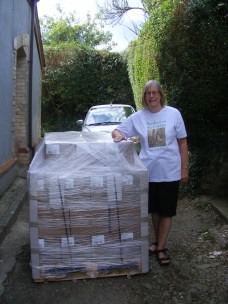
 I am an inveterate reader. Despite an unavoidable serious cull when I drastically downsized, I still have 11 six foot high bookcases full of books in my bedrooms. I now have more than 1000 books in my living room as well. The only snag is that they are all the same one and I have read it numerous times! This week saw the arrival of THE novel. In an attempt to ensure that copies were ready for the 17 November launch, various contingencies were allowed for. Rather too many contingencies as it turns out. Now I have to find house room for 54 boxes for three months, before I can start selling. Obviously, I will be pleased to think that anyone might want to read it but I am really hoping that not all purchasers will go for digital copies or Amazon orders, as this will not deplete my stash. Currently, when I sit on the settee my knees are in the fireplace, as the boxes are piled behind said settee.
Delivery of the pallet load of books was a challenge. Would you think that a delivery company with a thirty foot lorry might have invested in one of those handy sat-navs that allows you to input the dimensions of your vehicle, to prevent you becoming inextricably stuck? It seems this is an unreasonable expectation. When the delivery driver first rang for directions (it seems he did not have any form of sat-nav or indeed a map but was relying on signposts) he was already a long way down the ‘I really wouldn’t go that way’ route. Despite this, he did eventually arrive in my not very wide road, via some even less wide roads. Book delivery is never straightforward as I do not have a drive but I borrowed the church path temporarily and 54 boxes later, the pallet was empty. Fortunately, I had enlisted the help of a pallet loving fisherman of my acquaintance. The conversation began, ‘Would you like a free pallet?’ I didn’t get to the ‘you have to move 54 boxes first,’ bit.
All I can say is, it is a good job I don’t live in East Portlemouth. We travelled to the south coast to recruit troops for the Siege of Salcombe this week. They were a lovely mixed age audience and it was wonderful to be able to perform to those from 5-85 years old. The journey was ‘interesting’ and yes we do have a sat-nav that takes account of our width. We are used to narrow roads. We are used to very narrow roads. These were debateably not roads at all. Coming in the opposite direction were the ‘I am in a hurry to get home from work’ brigade, who were clearly not expecting anyone to have the audacity to go the other way along the seven foot wide tracks. Then there were the sheep who were wandering along the road for some considerable way. Fortunately, I was not behind the wheel on this occasion, although give me that kind of driving over motorways anytime. I know how to find reverse!
 You will meet William in the pages of the first chapter. William is a taciturn fisherman, who is content, providing there is a meal on the table and no-one disturbs his afternoon doze. He has lived all his life in the fishing hamlet of Bucks Mills, where he fished alongside his father and grandfather and now runs a small Bucks Ledge Boat with his two sons. By the time the story opens, he has lived in Rose Cottage at the top of the village for about three years. He was born in 1837 at the now ruined cottage The Bluff but grew up in King’s Cottage overlooking the sea. When he married, he moved to John’s Cottage and spent a few years at Mark’s, before settling at Rose Cottage, where he died in 1906.
 Much of
  The History Interpreter - Janet Few