In the spirit of adventure I try the traditional Tamales for breakfast. This is dough wrapped in banana leaves and steamed. There is no indication as to how this should be eaten. I glance round surreptitiously but no one else is tackling these to give me a clue. Does one just cut through the banana leaves? Does one unwrap it first? I am pretty sure you don’t actually eat the banana leaves. In the end I hack at the leaves a bit and extract a small morsel of the dough. The dough can be mixed with a variety of things. In this case it is fish – probably. Despite the fisherman of my acquaintance, I am not a great sea food eater and I don’t think I am going to be a great Tamales eater either but at least I gave it a try. Said fisherman has selected a slightly more recognisable tea this morning.
We have enjoyed our time at Hotel Antigua Miraflores, with its armies of cleaners and we will be returning at the end of our trip. We assemble at the civilised time of 11am for our journey south. My body is still somewhere in British Summer Time, so I have been awake since 2.30am. As we set off, Yuri asks us to ensure we have our passports. I search frantically through the many pockets of my bags. I confess that I can’t actually locate mine. The minibus swings round the block to go back to the hotel. It turns out that I have not forgotten my passport, so after the slight detour we are on our way. I now feel about five years old. You know that thing about not being fit to be let out.
We pass a street juggler on the middle of a zebra crossing, holding up the traffic. Today’s journey takes us along the Pan-American Pacific Highway, which stretches 19,000 miles from Alaska to Argentina, allegedly with a small gap called the Darien Gap. It is a good but fairly monotonous road with the Pacific on our right and mostly desert on our left. Every now and again there are river estuaries allowing cultivation but much of the landscape is barren, with numerous shanty towns springing up. Houses are built piecemeal for financial reasons so most dwellings everywhere seem unfinished. We learn that it may be possible to bribe your way out of a motoring offence, unless you encounter a female police officer. Not that we tried this I hasten to add.
On the way, Yuri tells us more about Peru. An important industry has been mining, for copper and for gold. Oil reserves have been exploited using foreign investment. Fishing is also crucial and sea food is very popular. Farming is more difficult because of the lack of rain, made worse by global warming. They produce quinoa, asparagus, coffee, cotton and non-native pineapples, amongst other things. There are many chicken farms, as rotisserie chicken is the ‘fast-food’ of choice. We also see a few herds of large goats. Food habits have been influenced by the US and turkey has now replaced guinea-pig as the traditional Christmas dinner. An extensive guano and salt petre industry, the latter used, as we seventeenth century types know, for gunpowder, was based on islands that were lost to Chile in the Chilean war, in the early nineteenth century. Peru also lost territory to Brasil and Ecuador. Peru is part of the Asia-Pacific Economic Cooperation.
We hear more of the political machinations and the militant communist Shining Path group. There have also been problems with hyper-inflation and organised cocaine rackets. Things are comparatively peaceful now and the people are optimistic, despite a change of President just last week, when the previous incumbent was found to be using his own road construction company for state purposes. It is hoped that the new President will be less Lima-centric. For example, currently, all overseas travellers have to fly into Lima airport.
Peru is the country of biodiversity and contains 84 of the world’s 104 ecosystems There are 1800 native birds; so far I have photographed two! We are now in the last month of summer when the humidity is less intense.
We arrive in the fishing village of Paracas, just south of the city of Pisco. Pisco was founded in 1640 and is now the main port for the international exportation of oil. A pre-Incan group settled on the Paracas peninsula c.700 BC – 200 AD. They were influenced by the Chavin culture, contemporary to Paracas, who populated the north. They were known for their textile work with Peruvian cotton, this would be dyed using the cochineal beetle. Archaeological evidence has been found for successful trepanations using obsidian. Paracas means sand storm and certainly there is a welcome breeze. General Don Jose de San Martin landed in the Bay of Paracas, with his liberating troops, beginning independence from Spain. He took inspiration for the red and white stripes of the Peruvian flag from the flamingos and I do glimpse some flamingos from the coach window. Paracas is also known as the Cradle of the Flag.
We are staying in the Hotel Emancipador on the Avenida Los Libertadores. Our room has a balcony with a sea view. It seems a shame not to avail ourselves of this and the small shady swimming pool but we are here to see the village. We set off with our guide to explore Paracas. Many of the single-single story, flat-roofed dwelling have cages on top, which contain roosters bred for the popular (well popular here) sport of cock-fighting. My travelling companion is very interested in the fishing boats, which are particularly wide-beamed. We manage to purchase hats that we are clearly going to need. To be fair I did try to buy one before I left home but it is winter in England; sunhat selling season has not yet begun. We manage to source hats at a ridiculously low price. 20% of the likely English cost but the intrepid Brian insists that we should barter, as the items are not priced. He manages to bring the price down even further.
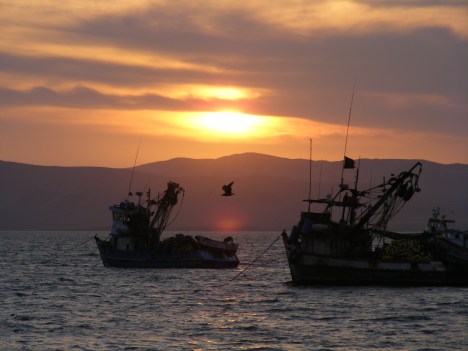 For our evening meal, I settle for a not very adventurous vegetarian pizza. Chris has sea bass in chilli and lime sauce. It really is too hot to eat much. We pay a sol (about 25p) to watch the sunset. We debate what happens if we do not pay – does the sun not set? It sets very quickly just after 6pm and the bay is beautifully peaceful. We have an early start in the morning so we settle down early. It is quite noisy outside and we can hear street musicians but this quietens down but about 10.30pm. We are keeping a tally of how many times we have to fish toilet paper out of the toilet.
 The History Interpreter - Janet Few
Enjoying my vicarious travel with you in Peru. Thanks for the detailed posts
Janet, I follow your posts when you and Chris are traveling on Google Maps Street View. Wonderful to make that drive with you down the coast!
I am forwarding your so VERY interesting blogs to my honourary granddaughter Samantha, whose partner Billy was born here in Canada, but half of his family are Peruvian and he goes there often. Sam just got back last week from her first visit there! We are having breakfast together this weekend so she can tell me about her trip and show me her pictures of Machu Pichu! Cheers to you both, Brenda