As part of my seventeenth century life, I give presentations on the history of witchcraft. When I was researching the topic for Coffers, Clysters, Comfrey and Coifs: the lives of our seventeenth century ancestors, I read a number of excellent books on the subject. For the purposes of this advent calendar, I have chosen just one of them to share with you, Alan MacFarlane’s Witchcraft in Tudor and Stuart England: a regional and comparative study. If you are a family historian who has not a single example of a witch or a bewitched in your family tree, please don’t think this would not be relevant to you. This was the atmosphere of the time and it is important to understand this. Another author on the subject, Malcolm Gaskill, wrote ‘Witch-hunts involved not just savage persecutors tormenting innocent scapegoats, but ordinary neighbours with a close affinity to one another who also happened to believe in witchcraft powerfully enough to act out their most violent fantasies.’ (Witchfinders: a seventeenth century English tragedy) – see it is buy one get one free day today!
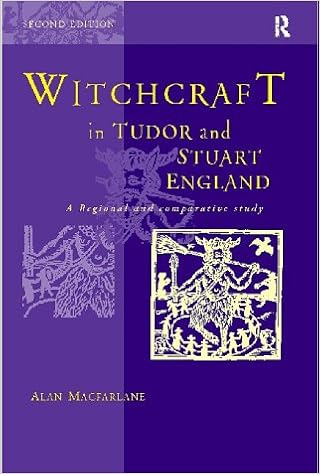 Today though belongs to MacFarlane’s work. This is not just an account of the witchcraft trials of the period. He discusses the sources that can be used, the social background and the conditions that contributed to an increase in accusations. He also looks at the various ways in which people attempted to counter-act witchcraft. The emphasis is on the notorious trials in Essex but these are set in a wider context and the background is applicable elsewhere. I am fascinated by the psychology behind witchcraft accusations and its similarities to today’s culture of bullying. I strive to understand what made people of the past act in a particular way under certain circumstances, so I found the section on the ideology of witchcraft and the anthropological interpretations a particularly valuable addition. There are maps, tables and black and white illustrations throughout the book.
As part of the talk that I give, I include a list of the known indictments for the county in which I am speaking. It was as I was preparing the Devon list, when I first gave this talk, that I spotted a name on the list that also appeared on my family tree. Joanna Elford was baptised in Mary Tavy, Devon in 1612. She was the sister of my 9 x great grandfather. Last week I took the opportunity to try to find out more. In 1671 Johanna or Joan Elford was accused of ‘laming and pining’ Alice Paynter (I presume that Alice was claiming that some form of paralysis and a sensation of being pricked were a result of being bewitched by Johanna). I have to admit that I was a little disappointed that Johanna got off, as this means less documentation. I still can’t be positive that it is the same Johanna/Joan Elford but it is a very unusual name. I am waiting to see if there is any further detail at The National Archives but it may be a long wait as I have no plans to visit in the immediate future. I could be tempted to base a novel round witchcraft accusations but I had better finish the current novel first!
 The History Interpreter - Janet Few