Having vowed not to drive into St Helier ever again, we walked the two miles or so from the apartment instead. We pass numerous early retired couples revolving street maps in their hands and looking puzzled. We’ve cracked St Helier on foot and manage to aid one couple, who were heading for the Botanic Gardens. At least, they were heading for the Botanic Gardens once we had turned them round. Our destination is Elizabeth Castle, on the western side of the harbour. This is only accessible on foot at low tide. It is high tide, so we have to take the amphibious duck ferry. This is quite fun and the safety video features soldiers in Napoleonic era costume. We were sad to learn that the Master Gunner was off sick, so there was to be no mid-day parade today. Master Christopher did offer his services but ……
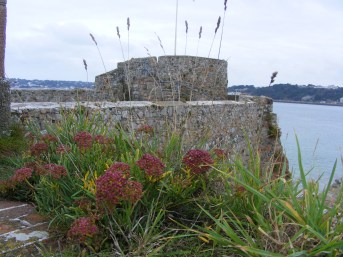 I am about to relate what we learned whilst on the Castle but we did spot a few historical inaccuracies, so, if this is total rubbish, don’t blame me! The rock on which Elizabeth Castle now stands was first built on in 1155, when an abbey was founded here and named after the hermit, Helier, who inhabited an outer rock in the middle of the sixth century. Helier was allegedly decapitated by a pirate and was able to pick up his own severed head, walking 200 yards with it. Helier was later sanctified and gave the principal town of Jersey its name. The Medieval abbey was later reduced to a priory for half a dozen monks and had been abandoned before threats from France and Spain made it advisable to fortify the island. Engineer Paul Ivy was responsible for these early fortifications in the time of Queen Elizabeth I. Labourers came from the parishes, who had to provide men to work twelve hour shifts for three days a week, thus allowing them to work on their own land the rest of the week. The project was funded by taxing island residents. The Governor of Jersey in 1600 was Sir Walter Raleigh and he named the Castle after Elizabeth I, calling it Isabella Bellissima (Beautiful Elizabeth).
There were several additions to the fortifications on the island in the seventeenth century. Fort Charles was built in 1646-7. The then Jersey Governor, Sir Phillippe de Carteret, was staunchly Royalist but there was significant Parliamentarian support on the island. In 1645, Elizabeth Castle provided sanctuary for the young Prince Charles (later Charles II). He returned to the island, with his younger brother James (later James II) in 1649, whilst he was in exile. James remained on the island for a year. The following year, the Parliamentarians captured St Aubin’s Fort and Elizabeth Castle, where nearly 400 people were taking refuge, was besieged. About fifty were killed when a mortar fell on the powder store that was located in the old abbey. George Carteret was forced to surrender. In 1652, a fortified windmill was erected to support Fort Charles. There was also building on Hermitage Rock. This is up some very precarious and narrow steps. It is there, so it has to be conquered and I set off womanfully and unaccompanied to scale the rocky staircase to look in a not very exciting construction. My companion sensibly decided to remain at harbour level. Yes, inevitably, I had the wrong glasses on again but I survived.
By the eighteenth century, Elizabeth Castle was the main fortress on the island. At this time, remodelling was carried out by John Henry Bastide. Plans, in the 1870s, to build a large, two armed harbour stalled due to lack of funds following a banking scandal. The Elizabeth Castle arm remains and we were able to walk along it. The Jersey militia, which has a very long history, manned the castle during the First World War and one of the Castle’s museums tells their story. Not surprisingly, the Germans commandeered the Castle during the second world war and added to the fortifications during the occupation.
I was very exited to find a duck from The Little Yellow Duck project, whilst at the Castle. These are made by anyone who chooses to participate and left in public places to raise awareness of the need for organ donors.
There was plenty to see and discover, even without the gunner’s parade and it was several hours, we returned to the mainland, spotting oyster catchers and an egret on the way.
We wandered back through St Helier, which seems to consist largely of high-end jewellery shops, so not exactly our thing. By the time we got back, we had been on our feet for five of the preceding six hours and had climbed up and down numerous flights of steps, so time to rest.
 The History Interpreter - Janet Few