Today was a day for staying in St. Peter Port. We still needed to identify a 23 hour parking slot for tomorrow. We drove up the town, we drove down the town, we drove round the town. I can report that this quest was a total failure, so, instead, we sought out anywhere where we could park for more than two hours today but this too was fruitless. Finally, we secured what must have been the last parking place in St Peter Port, up a less than savoury back street and on a perilously steep hill. The road looked too narrow for passing traffic but we took comfort from the fact that surrounding cars were wider than ours and that Guernsey drivers do take to the pavements in these situations.
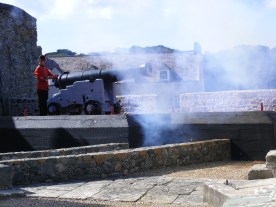 We walked out to Castle Cornet, which guards the harbour. The first Castle was built in the thirteenth century. Initially, it was only accessible on foot at certain very low tides or by boat. Fortunately, there is now a causeway so we don’t have to paddle. Although, in theory, we allowed plenty of time, all the not finding parking places made us wonder if we would arrive before the ‘twelve o’clock gun’, a ceremony when a cannon is fired but we are just in time. A costumed gentleman marches about and does the deed. We are told that today’s twelve o’clock gun was ‘louder than usual’, they are probably not wrong; it was very loud and we are used to musket fire. The historical interpreter invites members of the audience to pose with him for photographs. We aren’t particularly bothered about this ourselves but we do have with us Captain James, who is the travelling toy for members of the Braund family. On the grounds that I am the photographer, I delegate a fisherman of my acquaintance to request that the Napoleonic era soldier poses with a knitted doll. On balance, this may be preferable to some of the over excitable tourists and he agrees.
The gun firing is followed by a living history performance and we have chosen today to come because this is the day for a seventeenth century story. In 1672, ammunition stored in the donjon exploded during a thunderstorm. Seven were killed including the governor, Sir Christopher Hatton’s wife and mother. The island’s governor never lived at the Castle again. The story-teller, from Guernsey History in Action, does a very good job. http://www.ghiac.org/
The Castle is home to several excellent museums and I especially liked the fact that named individuals were mentioned in several contexts. Castle Cornet was the last stronghold to surrender to Parliament during the Civil War and we admire various seventeenth century exhibits. I was interested to learn of Parliamentarian General John Lambert’s imprisonment in the Castle as I had just been reading about him in connection with John Tradescant in Phillippa Gregory’s excellent Virgin Earth. The reconstructed herb garden and plaisance were very well done. The garrison was largely manned by English, rather than local, soldiers. For many years Invalid Regiments (ie those needing light duties) were stationed here. Under German Occupation Castle Cornet was known as Hafenschloss (Harbour Castle).
One museum was dedicated to 201 Squadron but we found the Maritime Museum the most interesting. Here we learn that Guernsey has only been an island for about 9000 years, since after the last Ice Age. It was settled in Neolithic Times and we see a video about the recovery of a Roman ship from the harbour. This was done by the same team who raised the Mary Rose. The boat, nicknamed Asterix, had had a fire on board, which melted the cargo of pitch and helped to preserve the wreck.
Having exhausted the possibilities of Castle Cornet we visit the historic shop that is reconstructed as it would have been c. 1900. It appears that we missed a harbour yesterday so it was home via a quick trip to St Sampson, which is very industrialised.
 The History Interpreter - Janet Few