As our parking place reconnoitres have been unsuccessful, we opt for walking to the ferry. We get up before dawn, rather more before dawn than necessary and reach the harbour just after sunrise. Even by my standards we have arrived early for our journey on MV Bon Marin de Serk. Finally aboard, we find that there are a few locals on the boat and a handful of tourists who, like us, thought it was worth getting up at silly o’clock to have two extra hours on the island, or, more to the point, saving £4 a head.
We arrive before Sark gets up but are first in the queue to book a two hour horse and cart tour of the island. We learn that we have narrowly missed Sark being inundated with cruise passengers. That is scheduled for tomorrow, as is rain and the residents are already girding their loins. I’ve never been sure quite how one accomplishes this (loin girding that is) but I am sure that that’s what they were doing. We take a stroll down the one proper street in Sark, The Avenue and see the golden post box associated with 2012 dressage gold medallist Carl Hester, who was born on Sark. Many of the businesses are empty and up for sale. We hear that the population has been falling rapidly and this is causing concerns about Sark’s economic viability. There are currently about 490 inhabitants, compared to 600 a few years ago. It is sad as it gives the island a run-down air.
We visit St Peter’s Church, built in 1820. Christianity came to Sark with St Magloire. Let it never be said that you don’t learn about obscure saints reading this blog. St Magloire is a sixth century Welsh saint who set up a monastery on Sark. Allegedly, he cured people of leprosy and deafness, miraculously saved a boatload of children and slayed a dragon on Jersey, obviously a multi-tasker. There are two special seats in the church reserved for prisoners. The current two-cell prison, built in 1856, is still used, although crime rates are very low.
We learn that Sark was first inhabited about 5000 years ago. The Black Death wiped out almost all of Sark’s population and it remained virtually uninhabited for two hundred years. The first Seigneur, Helier De Carteret, settled the island with thirty nine other men on behalf of Queen Elizabeth in 1565. Jersey legend says that the boat carrying the children of the first settlers was wrecked and that the cries of the children can still be heard when there’s a storm coming. Is this confusion with the St Magloire story one wonders? De Carteret also built the windmill in 1571. Its sails were removed during the German Occupation; we see what remains. Contrary to the evidence from Castle Cornet, information in the church tells us that Sark and Guernsey were Parliamentarian but Jersey was Royalist during the Civil War. Attempts at a Royalist invasion of Sark from Jersey was foiled. In 1833 there was a silver rush on Little Sark. The mines were short-lived, closing in 1847. Like Guernsey, Sark came under German occupation between 1940 and 1945. We also visit the archaeology room, which is sited in a restored sixteenth century cider press. Land use maps for Sark suggest that twenty-first century changes are causing concern and we find out that a recent unsuccessful attempt to introduce wine production to Sark has caused friction.
It is a shame that the timing of the carriage ride cuts across the day, so there isn’t enough time for a decent walk before or afterwards. We do take the opportunity for a short stroll and are waylaid by an eccentric local on the way. In general we have encountered many friendly people. We do almost make it to the coast, though somehow missed the Pilcher Monument that we were aiming for. Instead we round the Dixcart Valley, returning in time for an ice cream before our trip.
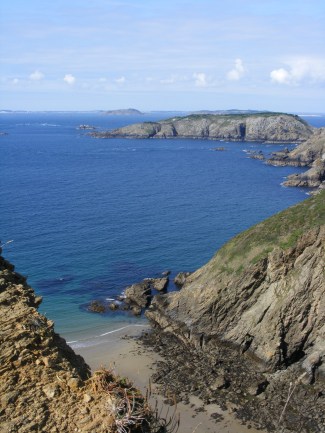 Our carriage ride leaves at 11.30am and we are with Winston aged seventeen (the horse) and Andrew aged sixty something (the guide). We spend a very pleasant two hours rambling round the island. Andrew, a native Sarkese, provides a commentary that needs, in places, to be taken with several large pinches of salt. He descends from one of the original forty 1565 settlers, although he keeps saying 1665. We stop at Banquette Landing in the north of the island to view an ‘Elizabethan’ gun. Said gun is inscribed GR but who’s to quibble; I am familiar with the concept of telling a good story to the tourists. Randomly, also at this location is a flock of emu; diversification rules I guess. There are two dairy herds on Sark and all have to be Guerseys. Sark dairy products resemble those from Guernsey but apparently the butter is different, I am not sure in what way. There are two levels of property prices on Sark and all property is leasehold. Those who have been resident for at least fifteen years pay about half the prices that incomers are charged. Planning permission is required for new builds and building is not allowed on the Cotil, or cliffs. Sark is independently governed and there is no income tax and only a small equivalent to council tax. This is offset by the need for hefty health insurance and private pensions as there is no state funded health or social service. Sark’s ambulance and fire engine are pulled by tractors and these are manned by volunteers. There is a private doctor and two nurses on the island.
After our ride we have some lunch and attempt to visit the museum, which is open between 2 and 4 pm, except when it isn’t, like today. We sit on the quay and relax in the sun. Some porpoises entertain us while we wait. Our ferry is early and although we were the first on the quay we fail to realise that the queue that is forming is for our ferry and not for one to France or Jersey. We hasten to the end of the long queue. The ferry is very full and the captain is gesturing that he will take no more passengers. This is the only timetabled ferry home. It is a long way to swim. Thankfully we are on the right side of the cut off point in the queue and our ferry, groaning with its full load, sets off twenty minutes before time. We do see a small boat heading out towards Sark so we assume that this has been sent to collect those who have been left behind.
We trudge back up the hill and I find a significant amount of the job we must not mention awaiting me, so much for relaxing. Whilst I am tackling this, I send a fisherman of my acquaintance to investigate the laundry in the main building attached to our apartments. He successfully negotiates the technicalities of the washing machine and then transfers our clothes to a dryer, as we have no access to a washing line. After an appropriate interval he returns to collect our clothes. The main building is locked. Efforts to break in via the fire escape fail and we are forced to leave our undies in the machine, hoping we can recover them in the morning.
 The History Interpreter - Janet Few