I had a meeting in St Helier at 9.30am in order to check my venue for the evening. We left in plenty of time. By 9.20am we were within 300 yards of where I needed to be and then the nightmare began. If you are ever contemplating driving in St Helier, don’t. Just don’t. Not ever, probably not even with the aid of a sat-nav. The one-way system was obviously designed by someone on magic mushrooms and the map only indicated some of the one-way streets and none of the pedestrianised ones. Then, just when we thought we had cracked it, there was a diversion. We managed to find our way out of town and tried approaching again, eventually arriving, very flustered at 10am. Needless to say, we overshot the only parking space and I bailed out leaving my hapless companion to attempt to drive ‘round the block’ without the aid of a navigator. I began to wonder if I would ever see him again. The car was necessary because we were carrying equipment and because we wanted to go on somewhere afterwards but it was a serious error of judgement. Never again. Well, actually, we did do it again later for me to give the talk but had it sussed by then and it was so easy when you knew how.
We drove north as our stress levels gradually subsided. Yet more diversions designed to confuse but I don’t think we actually got lost, or at least not much. I think there was only one three point turn when we missed the final junction. We were heading for ‘must see’ sight La Hougue Bie, which is allegedly one of the ten oldest man-made structures in the world, having been built long before the pyramids. La Hougue Bie is constructed on one of the highest points of Jersey (Hougue means mound in Jersey/Norman French, although the word is originally of Norse origin – sorry, no idea what Bie means). La Hougue Bie is a Neolithic passage grave; it was built some 5500-6000 years ago and was re-discovered in 1924.
The lady receptionist explains what there is to see. She adds that a reconstructed Neolithic house is currently being built on site. We have the ‘Neolithic house building’ tee-shirt and relate our experiences. In fact I do actually have the tee-shirt with me on the island but I am not wearing it today. It turns out that the project leader is Luke Winter, who also led our own Neo-building efforts (for full details of this experience and experience it certainly was, start reading here). We go to say hello to Luke and admire the start of a very impressive looking structure. He is only here one week in three, so we were lucky to catch him. Probably just as well I wasn’t wearing the tee-shirt as we work out that it was 4½ years ago that we were involved in our Old Sarum project. This actually makes the tee-shirt comparatively new in terms of my overall wardrobe but I expect it isn’t cool to admit that.
We look at the interesting museums. One relates stories of the archaeology of Jersey. We have already learned that, at low tide, the area of Jersey is 20% larger than at high tide and observations from our balcony confirm that the tide really does go out a very long way. Just popping out for a paddle at low tide is not recommended. Jersey’s archaeology is very diverse. In the nineteenth century, Jersey granite was used to build the Thames embankment. We also discovered that, in the eighteenth century, a passage grave from 4000-3250 BC was discovered at Le Mont de la Ville/Fort Regent and was presented to the then governor, General Conway. He took it apart and rebuilt it in Henley on Thames, where it still stands. Imagine trying to get away with this now; I am surprised Jersey hasn’t asked for it back!
The other museum was devoted to the story of the Jersey Horde. Initially, 12,000 coins were discovered in 1935. Then, in 2012, an enormous mass of coins were found by metal detectorists, in a field in a secret location in eastern Jersey. 66,898 coins (and counting), in a block weighing 1000kg have been excavated, along with gold torques and other jewellery. The torques were hollow to reduce the weight, an amazing feat of craftsmanship for something so ancient. The coins are about 2000 years old and are believed to have been buried by the Gaulish tribes from the St Malo area, fleeing from Julius Ceasar’s invasions. At this time, Jersey was controlled by Coriosolite tribe.
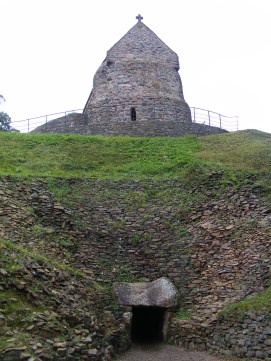 Next, to investigate the burial chamber itself. When it was constructed, the population of Jersey was likely to have been about 3000. The stone came from the eastern part of the island and some of the blocks weigh up to twenty tonnes. The chamber was covered by stones and then earth to form a cairn that is nine metres high and thirty six metres in diametre. The entrance to the burial chamber is a ten metre tunnel that is about three foot high. It is quite difficult to negotiate, especially as overnight rain has left puddles underfoot that need to be avoided but we accomplish this without injury. It was more than just a burial chamber and would have been used for various religious ceremonies. The entrance is aligned so that, on the equinox, the rising sun shines down the tunnel and illuminates the back wall of the chamber. The site was abandoned about 2500 BC and a belief grew up that it was home to a dragon. The legend goes that the Norman Seigneur of Hambye came to rid Jersey of the dragon but was himself slain by his own servant, who claimed the credit for killing the dragon and subsequently married the Seigneur’s widow. She discovered the truth, had the servant executed and a chapel erected in memory of her husband. An alternative story, told to us by the on site historical interpreter, is that it was a Viking pirate, rather than a dragon. Is this a case of make up any story for the tourists and they will believe it we wonder?
The first chapel, the Notre Dame de la Claté, is thought to date from 1155. It contains some Medieval wall paintings. These are very difficult to distinguish with the naked eye but the shape of an angel can just about been seen in the photograph that I took. The Dean of Jersey, Richard Mabon, was inspired to complete the second chapel in 1520, following a pilgrimage to Jerusalem. He staged fake miracles in the chapel to raise money from gullible visitors in order to pay his hefty tithes. The chapels were abandoned during the Reformation, after which Jersey adopted a Calvinistic stance. This led to the demolition of many chapels. At this time, there was a series of very severe winters to the benefit of the islanders’ knitting trade, much of which was exported to Iberia. The Calvinists however banned knitting in church and during the food and seaweed harvests. Knitting might be carried out as a communal activity and these were occasions for the singing and dancing frowned upon by the Calvinist church.
In 1792, Phillippe d’Auvergne acquired the chapel from his uncle, who owned the land at the time. He added a tower and converted it into a neo-gothic country residence known as the Prince’s Tower. It was derelict by 1821 and then became a tourist attraction. It was so popular that a small hotel was built on the site. The tower was finally demolished in the 1920s, to allow for the safe excavation of the remainder of the site. The Germans made use of the site during the occupation and the bunkers are now set up to commemorate the workers, of many nationalities, who lost their lives at that time.
We talk to the historical interpreter who is telling stories of the times of Dean Mabon. She tells us about the chapel and plays a recorder and a dulcimer using a goose quill. Well, obviously she doesn’t play the recorder with a goose quill; that would be weird and probably impossible. I decide that I’d really like a dulcimer and a goose quill, although I can actually play a recorder so maybe that would be a better option.
In the afternoon, we take a short stroll up the coast away from St Helier and then it is biting the bullet that is a return to St Helier by car. This time we know where we need to go but we do still have to circle the convoluted ‘block’, as the on road parking places are full and we need to return to the multi-story car park, which is fortunately free at this time of day. I give my talk to Channel Islands Family History Society. The topic is Writing up your Family History. This particular presentation is a bit full on but is well received. I am looking forward to running the full five week online version for Pharos in three week’s time, when I can go into a bit more detail. Join me, you know that you want to!
 Next stop is Corbiére Point, in the far south west of the island, overlooking the lighthouse. After a quick walk round, we drive on up the west coast and are very disappointed to find that the Wetlands Centre on the nature reserve closed for the winter last week and there is no opportunity for self-guided walks round the reserve. This is the second place we wanted to go to that had already finished its season, the other was the Living History Museum. We understand the need to have enough visitors to be profitable but this seems very short sighted as there are plenty of tourists about – us for example!
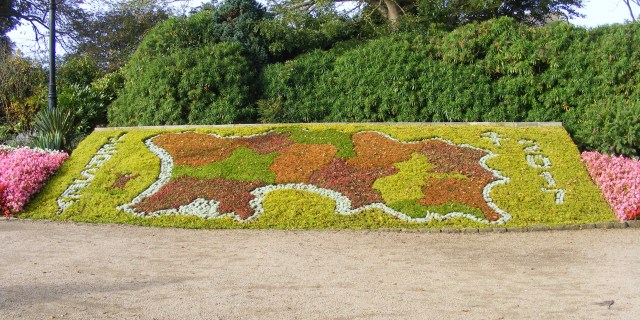 Another hike in to St Helier, this time to visit the Maritime Museum. Our now familiar route takes us through the attractive Howard Davis Park. This used to be a large residence and estate until it was purchased by Mr Davis. As a boy, he was caught scrumping and had been punished by the then owner. Young Davis had vowed that he would destroy the manor house and as an adult he was able to do just that once it came in to his possession.
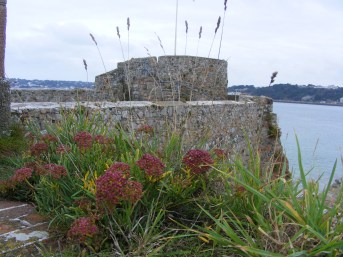 I am about to relate what we learned whilst on the Castle but we did spot a few historical inaccuracies, so, if this is total rubbish, don’t blame me! The rock on which Elizabeth Castle now stands was first built on in 1155, when an abbey was founded here and named after the hermit, Helier, who inhabited an outer rock in the middle of the sixth century. Helier was allegedly decapitated by a pirate and was able to pick up his own severed head, walking 200 yards with it. Helier was later sanctified and gave the principal town of Jersey its name. The Medieval abbey was later reduced to a priory for half a dozen monks and had been abandoned before threats from France and Spain made it advisable to fortify the island. Engineer Paul Ivy was responsible for these early fortifications in the time of Queen Elizabeth I. Labourers came from the parishes, who had to provide men to work twelve hour shifts for three days a week, thus allowing them to work on their own land the rest of the week. The project was funded by taxing island residents. The Governor of Jersey in 1600 was Sir Walter Raleigh and he named the Castle after Elizabeth I, calling it Isabella Bellissima (Beautiful Elizabeth).
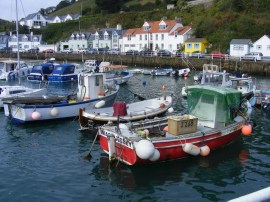 The weather forecast suggests that the rain will hold off until mid-afternoon, so we decide that we can choose an outdoor activity for today and opt for an exploration of the north coast, including a walk along some of the coastal footpath. We start to work our way up the east coast stopping at a few bays on the way, making the most of the fact that parking is free on a Sunday. We stop at Verulet Point and take a quick look at a small craft market. Then it is on to Rozel and Boulay Bays in the north east. At this point the direction finding gremlins strike again. I am sure St John’s village is very pleasant and all that but driving through it from different directions no fewer than five times might have been overkill. Just as we locate the proposed start of our walk and four hours before schedule, it begins to rain. We decide to drive along the coast instead, not that we can see much through the mist. Still, I guess we have been very lucky with the weather so far. A couple more passes through St John’s for luck and we appear to be heading westward.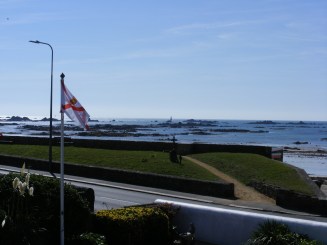
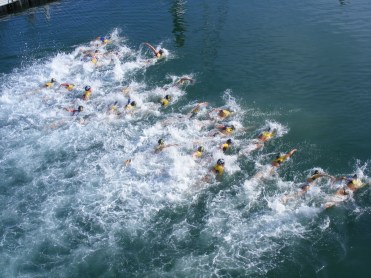 In England, an international event such as this would be advertised from several miles distant but the triathlon is a well kept secret until you reach the course itself. Nowhere is the route advertised, not even in the tourist information bureau. It is being staged in a move to increase interest in Triathlon, I think they may therefore have missed a bit of a trick here. We enquire of a policeman, who looks like an immature twelve year old and position ourselves for the start of the women’s elite race. This is not a traditional triathlon, all the stages are much shorter and are repeated three times with ten minute breaks between each round. It begins at 4.00pm, expect when it doesn’t. We are some twenty feet above a very murky looking marina where the swim is being held. During the twenty five minute wait for the start, I am feeling less and less comfortable gazing down from this dizzy height – I get uncomfortable standing on a chair. Finally, we see the women set off and then we are able to move round to get a clear view of the circuit where the cycling and running take place. I am a bit sorry that this isn’t the men’s race and that we are going to miss Johnny Brownlee but I am pleased to be part of the event.
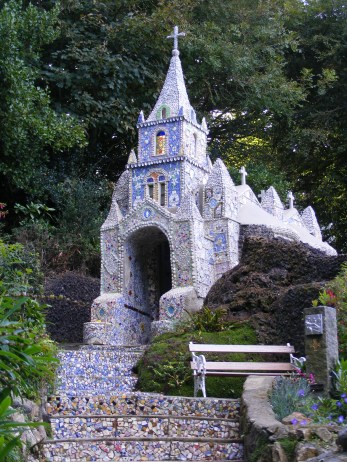 Today was our last day on Guernsey and we aimed for the south coast. On the way we called in at The Little Chapel. This is a fascinating grotto, decorated with millions of pieces of broken china. Low-key it’s not and probably not what you’d want in your back garden but well worth seeing. It was built in 1914 by Brother Deodat and was inspired by chapels at Lourdes.
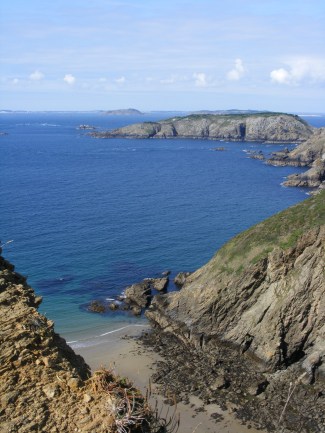 Our carriage ride leaves at 11.30am and we are with Winston aged seventeen (the horse) and Andrew aged sixty something (the guide). We spend a very pleasant two hours rambling round the island. Andrew, a native Sarkese, provides a commentary that needs, in places, to be taken with several large pinches of salt. He descends from one of the original forty 1565 settlers, although he keeps saying 1665. We stop at Banquette Landing in the north of the island to view an ‘Elizabethan’ gun. Said gun is inscribed GR but who’s to quibble; I am familiar with the concept of telling a good story to the tourists. Randomly, also at this location is a flock of emu; diversification rules I guess. There are two dairy herds on Sark and all have to be Guerseys. Sark dairy products resemble those from Guernsey but apparently the butter is different, I am not sure in what way. There are two levels of property prices on Sark and all property is leasehold. Those who have been resident for at least fifteen years pay about half the prices that incomers are charged. Planning permission is required for new builds and building is not allowed on the Cotil, or cliffs. Sark is independently governed and there is no income tax and only a small equivalent to council tax. This is offset by the need for hefty health insurance and private pensions as there is no state funded health or social service. Sark’s ambulance and fire engine are pulled by tractors and these are manned by volunteers. There is a private doctor and two nurses on the island.
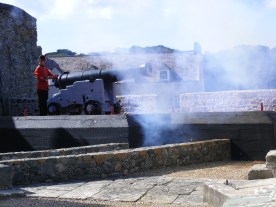 We walked out to Castle Cornet, which guards the harbour. The first Castle was built in the thirteenth century. Initially, it was only accessible on foot at certain very low tides or by boat. Fortunately, there is now a causeway so we don’t have to paddle. Although, in theory, we allowed plenty of time, all the not finding parking places made us wonder if we would arrive before the ‘twelve o’clock gun’, a ceremony when a cannon is fired but we are just in time. A costumed gentleman marches about and does the deed. We are told that today’s twelve o’clock gun was ‘louder than usual’, they are probably not wrong; it was very loud and we are used to musket fire. The historical interpreter invites members of the audience to pose with him for photographs. We aren’t particularly bothered about this ourselves but we do have with us Captain James, who is the travelling toy for members of the Braund family. On the grounds that I am the photographer, I delegate a fisherman of my acquaintance to request that the Napoleonic era soldier poses with a knitted doll. On balance, this may be preferable to some of the over excitable tourists and he agrees.
 The History Interpreter - Janet Few