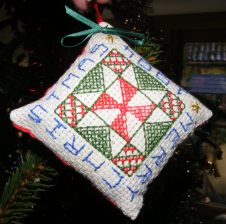
 A shorter post today, trees to decorate, cards to write, as the time of year catches up with me. We have just been to get the Christmas Tree. This is a hugely important activity. It has to be the right tree; I have been known to take one back! Based on my guiding principle that if it fits in the room it is too small, this one is probably too small but it makes up for the fact that there is at least six inches between the top of the tree and the ceiling by its bushiness. The tree came from a nearby farm where you can stomp your way through mud and fallen apples to select your own, which is then cut to order. Now Christmas begins. My Christmas decorating policy would have interiors experts cringing as colour co-ordinated it is not but each decoration has its own significance. I wrote about this three years ago. We even have a plan to keep three small persons and the tree at a respectful distance. I do want to share it with them but it would be preferable if the ornaments survived to be shared again next year.
For today’s advent author, I have drawn from the box one who resounds with my seventeenth century self. Let me introduce Adrian Tinniswood. Adrian is known primarily as an architectural and social historian and most of his books reflect this but he has also written novels. Like a number of my favourite historical fiction writers, his family sagas are based on real people. The Rainborowes tells the story of this family as they travel back and forth across the Atlantic with surprising regularity, during the political upheavals of the seventeenth century, in which members of the family played a significant part. Although political machinations form part of the plot, it is moves way beyond this. The setting for part of the story in Wapping in London’s East End and that is particularly well drawn. It also provides a vivid account of life in the early decades of the New World. Tinniswood’s other seventeenth century offering is The Verneys: a true story of love, war and madness in seventeenth century England surely a novel that has it all. Research for this was aided by the copious correspondence that survives for this Buckinghamshire family. We encounter Barbary pirates, civil war battles and family struggles in an account that gives the women prominence as well as the men. As you might expect from someone who is an historian as well as a novelist, the research is precise and detailed. The atmosphere of the seventeenth century is given definition and a piercing clarity.
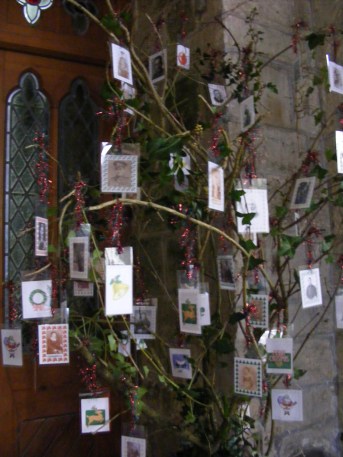 This month, our village is staging a Christmas Tree exhibition. Local groups and associations were challenged to decorate a tree that reflected their activities. Never one to resist a challenge, the history group set out to create something that would be representative of what we do. We debated using vintage tree decorations, which I have but they are too precious to leave unattended and anyway they would be inhabiting my own tree. In the end, our tree became a real joint effort as two members were charged with sourcing a natural ‘tree’ aka suitably shaped branches and greenery. Another member was to provide sand to secure the ‘tree’ in its pot. We did have difficulties with this as an unseasonable three day freeze meant that the sand pile was impenetrably solid. A gravel substitute was found. My contribution was the decorations. For these, we printed out small portraits of former residents, taken from our photograph collection, within seasonal frames. We abandoned the initial idea of putting the names on the reverse side as we feared that the stability of the tree would not withstand viewers trying to access the names. Instead, we provided a key to the identities of those on our ‘decorations’ to put beside the tree and instead put seasonal images on the reverse of the laminated ‘ornaments’. Glittery ties and ivy in lieu of tinsel finished off our entry. It has already attracted favourable comments and now we await the result of the vote for the ‘best tree’ in the New Year.
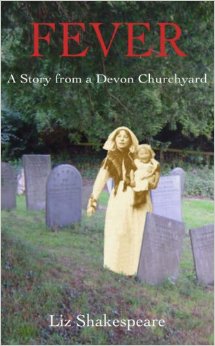 The historical novels out of my advent box today are the books of my friend, local author
  I was finally enticed by
  The waste bits of the scraper look like they have potential for turning in to instruments of witchcraft torture – excellent just what we need. No, seriously, this is not a joke. Deed done. Dilemma. How should I fill out the customs declaration? I am dubious about the etiquette associated with sending bodily fluids through the post. Can I legitimately classify it as a ‘gift’?
 I am hoping to open a history themed book on my ‘advent calendar’ (aka blog) for each day of advent. Some of them will be written by people I know so, to make it fair to my author friends, the order is being decided by drawing the names out of a hat. Today’s offering is
  The History Interpreter - Janet Few