Technological Challenges and the Historical Novel Advent Continues

Apart from moving a few boxes from one pile to another, yesterday was a rest day loft-wise. Time instead to catch up with writing tasks and finish the Christmas cards. In the evening, I was to lead a Hangout-on-air for the Society for One-Place Studies. This was to launch our joint project for 2017, which is to be about faith in the communities that we are studying. Just as I finished my introduction and the general discussion was beginning, something dire happened to my internet connection, basically there wasn’t one. After attempts to reconnect failed, in desperation, I restarted the computer, watching the minutes tick by and realising with sinking heart that I also needed to restart the router. This is no small task as it involves crawling on my stomach and encountering the wasteland that is ‘under the spare bed’. During loftgate this would have been impossible as the entire spare bedroom was packed to the gunnels with boxes but fortunately I had cleared sufficient space to enable me to drag myself forward on my elbows and reach the plug. I managed to rejoin the discussion after the slight hiatus and later repaired to my neighbours’ house where mulled cider was being served to chilly carol singers. Despite my slightly flustered under the bed crawling appearance, I managed to pose as a carol singer with conviction. Any rumours to the effect that my absence from the hangout was due to imbibing mulled cider have been grossly exaggerated.
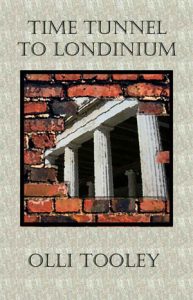
tttlcoversmall-193x300Another Devonian author for today’s offering and this time we are in the first century BC as history and fantasy combine in Children of the Wise Oak, a tale of Celts and Romans by Oliver Tooley. Although the history is well researched, you do need to be prepared for dragons rubbing shoulder with druids and Romans but that is all part of the fun. This is to be the first of a series and I am sure that many readers are eagerly awaiting volume 2. Tooley is also the author of the Time Tunnel series, in the first two of which ten year old David finds himself in Roman London. In Time Tunnel at the Seaside the background moves to a Devon location during World War II. Time Tunnel to West Leighton combines an Anglo-Saxon backdrop with an exploration of Autistic Spectrum Disorders and bullying. In theory, these books are for children and young adults but don’t let that put you off. They are also a great gift idea for any young people in your family who you would like to lead gently into the realms of the past.

Lofty Ideals and Genealogical Mystery Writing

So yesterday I am up early, assisted by my partner in crime, ready to empty the second half of the loft in preparation for the arrival of the loft insulating men the following day. We are just about to open the loft hatch when the phone rings. It is the loft insulating men who are parked nearby looking for the house. I can verify that a nearly seventy year old and a not much younger female with a heart condition can empty half a very full loft in less than an hour. What they feel like afterwards is another story.

I have promised to meet my friend to check a local graveyard for new memorials that have been erected since we indexed the churchyard a few years ago. The loft insulating van is parked right next to my front gate and insulating material is being pumped from it into my loft. I cannot get out of the gate. I do not have a back gate. In fact my house doesn’t have a back at all. Well, that is nonsense of course, it does have a back, I just can’t access it. Hmmm. My only method of escape is to clamber over a wall that divides my garden from my neighbours’ drive. I heave myself on to the top of the wall. Inevitably it has been raining. Sitting on a wet wall is not the most comfortable thing I have ever done. I leap into the unknown before the dampness can penetrate too far. I have had help getting on to the wall, I haven’t worked out how to accomplish the return journey.

After a day of ‘Why on earth am I keeping that?’ my evening was spent talking to a small but perfectly formed local history group. I always like December slots as they usually involve festive fare and sure enough there was restorative mulled wine on offer. I was talking about Remember Then: memories of 1946-1969 and the audience had brought in a lovely array of period toys for display. I also managed to sell books to 40% of the audience, even better!

Another genealogical mystery writer out of the advent box today. Again of course the books are set in the present but hark back to the past. So, let me introduce Steve Robinson. His anti-hero is American genealogist Jefferson Tayte, whose bumbling attempts at relationships echo through the series of books. I have to say that if genealogy was as dangerous a career as these books imply no one would be advised to take it up. Almost every one of Tayte’s cases results in threats to his life. Mind you, the phenomenal sums he seems to be paid may make up for this. Although there are unrealistic aspects to Tayte’s working life, this doesn’t matter. A ‘true’ account would not make good fiction. The first book In the Blood is set in Cornwall; Tayte’s enviable casebook takes him all over the world. A centuries old murder is solved thanks to his efforts. To the Grave sees Tayte in England again, unraveling a secret that has been kept since the days of World War II. In The Last Queen of England, fact and fiction are intertwined as Tayte solves a puzzle, set by members of The Royal Society, relating to the rightful heir to the throne. Then another change of time period, as, in The Lost Empress, he focuses on a 1914 shipwreck that has remained relatively unknown in the shadow of the Titanic and Lusitania. Kindred returns to a World War II backdrop and here we learn more of Tayte’s own search for his family, a thread that runs through all the books. I am eagerly awaiting the sixth book in the series, which is due out in May.
Christingles, Radio Interviews and Historical Novelists

Yesterday was the local Christingle Service. In our church, we are provided with the raw ingredients and we make our own during the service. If you have ever tried inserting a candle into an orange without the aid of a useful implement, you will know that it can’t be done. I have been caught like this before. In my pocket is a potato peeler/apple corer. I ponder whether carrying a potentially offensive weapon such as a potato peeler might be illegal but I am not arrested so it must be okay.

My interview for Tiverton Radio is now live. I have, it seems, acquired a new alias in the process. I wasn’t prepared for the photo, thinking, as it was radio, what I looked like wouldn’t matter – epic fail in this respect then. I do seem to say ‘Yes’ rather a lot. So if you want to hear me rabbiting on imparting words of wisdom and saying ‘Yes’ do click through to the above link.

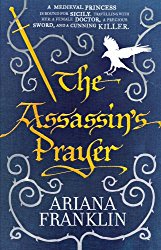
511TFTy83xL._UY250_.jpgI need to be brief, lofts to empty, writing deadlines looming but I need to do justice to today’s historical novelist – Ariana Franklin and her Mistress of the Art of Death series. The heroine is Medieval anatomist Adelia Aguilar so another history/crime combination. To be an anatomist in the 1100s is unusual, to also be a female, adopted into a particularly free thinking family and hobnobbing with royalty does require a stretch of the imagination but not one that detracted from my enjoyment. Some anachronisms do creep into the twelfth century setting. This would normally annoy me beyond measure. The fact that it does not is a reflection of the other qualities of the writing. In The Death Maze Adelia becomes embroiled in royal intrigue as she investigates the poisoning of Henry II’s mistress Rosamund Clifford. The Assassin’s Prayer recounts another royal commission as she accompanies Princess Joanna on her way to a dynastic marriage in Sicily. Relics of the Dead sees Adelia trying to establish whether human remains are indeed those of King Arthur There are four books in the series, the last published posthumously and I am sad that there will be no more.

Ferry Christmas and a Happy 11th Historical Novelist

I think the stress of the pending loft insulation is getting to me. My daughter telephoned the other day. I am one of those dinosaurs who has a land line. The phone resides in the kitchen; this makes all those unsolicited calls truly cold, as I have to leave the warmth of the wood-burner. Next to the phone is the kettle. As the phone rang, I found myself picking up the kettle and wondering why I could still hear ringing. Fortunately, the kettle was not full of boiling water at the time.

We have just returned from a few days on an offshore island. How reassuring that the sat-nav warned us that our route involved a ferry crossing, then told us to take the ferry. Like swimming was an alternative! The ferrymen are obliged to wear hard hats. On this occasion they were sporting seasonal hats perched on the top. I am all for festive spirit but it seems that these employees were all nearing retirement and were not the most cheery looking bunch. The elf ears were therefore somewhat incongruous.

Whilst away we popped in to an out-of-town supermarket for a coffee. I am not sure the staff were keen as they were heard to mutter, ‘Why do they all come here when there are cafés they could go to?’ Well possibly because the nearest one is over a mile away. The system seemed to be that you served yourself coffee from a machine or, in the case of tea, you added hot water to a teabag residing ready in a teapot. Pointing out that there were actually no teabags in the pots resulted in a handful being thrown at us. That’s teabags not teapots – teapots would be dangerous. Then we had the audacity to ask for cups! We were clearly now being quite ridiculous. Sigh.

Today’s historical novelist is fellow North Devonian Susan Hughes whose debut novel A Kiss from France has been very well received. The book is set during the First World War and its aftermath. The principal characters all work in a munitions factory in London’s East End and the tragedy of their intertwined lives makes for compelling reading. The story brings home the appalling impact of the conflict. Susan has another novel in preparation and I am sure it will be included on many people’s ‘must read’ list.

And for my Tenth Historical Novelist ……

the bitter trade piers alexanderOk, so I am going to cheat a little here. Give me a break it is hard working keeping this up on a daily basis in the season of good cheer pre-Christmas rush. I would like to feature Piers Alexander today. I have already reviewed his excellent book, set in the seventeenth century, so all I need to do is direct you to the link. It is really worth the click – it is an exciting plot accompanied by beautiful writing.
Guest Blogging – historical fiction

captureToday I should be making a guest appearance on the blog of author Jenny Kane. I am probably lost in the wilds of the land of no internet so, if this link doesn’t work, it is because I am having to schedule this post in advance and I’m not able to check it as it isn’t live at the time of writing. If there is a problem I will correct it when I can, so do look back and try again.
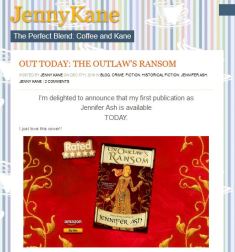
As Jenny also doubles as historical novelist Jennifer Ash, I have deliberately chosen her for today’s advent offering. Jennifer writes Medieval crime with, as she says, ‘a side order of romance’. The Outlaw’s Ransom is so new (it was published this week) that I haven’t had a chance to read it yet, although it did have a previous incarnation, in an abridged form, as part of another work. It is described as a ‘novella’ but if you enjoy it, there is a full length sequel on its way. Jenny is one of several Devon authors who are part of my advent collection. Why should there be such a wealth of talented novelists, many of whom are historical novelists, in Devon? Maybe it is the pace of life; maybe we are just behind the times down here in the bottom left hand corner of the country. It is a privilege to have met, either virtually or literally, many of those I am listing.

Tales from Boxland and the next bout of Historical Fiction

the-scolds-bridle

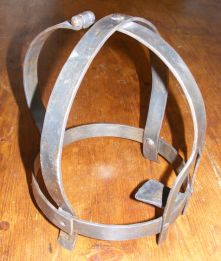
A short post today as I dodge boxes and debris that have been inhabiting my loft and are now impeding everyday progress almost anywhere. Why am I keeping all this? To be fair, a great deal of it is really useful stuff, sets of armour, instruments of torture and so on, that I use in the course of Swording and Spindling. Talking of instruments of torture, I am just about to regal the good folk of Barnstaple with the crimes of the seventeenth century; good job I have my scold’s bridle to hand. Then there is grandchildren appropriate gear: fireguards, highchairs, potties, as well as toys and books that are awaiting their ‘growing into’ – the current toys live in the ‘playroom’ aka conservatory. I have a lifetime’s supply of bubble wrap for dispatching books to my eager readers. There are also though potentially useful empty boxes – because you never have one when you need one, vinal records but no record player, the printer before last etc. etc.. I feel a cull coming on.

Out of the ‘hat’ today is historical novelist Norah Lofts, another who was beloved in my teenage years and is still occasionally re-read. Most of her books are set in fictional parts of Suffolk and I enjoy the fact that the heroes of one novel sometimes make their appearance as minor characters in another. It is a bit like looking for the Gruffalo in other books by Julia Donaldson. I need to make it clear to the uninitiated that, great though her books are, Julia Donaldson is not an historical novelist. If you have no contact with anyone under five you will probably be mystified, so give her a Google (other search engines are available). Back to Norah Lofts. She is probably best know for her ‘House Trilogy’ of novels about the house at Old Vine, which span the centuries in a way that appeals to me. Others that are based on the story of a property are Bless This House and Gad’s Hall. It is very difficult to pick a favourite, although those I have already mentioned have to be amongst the nominations. The task is made harder because my books are currently inaccessible behind piles of loft tat, so I can’t flick through them. Actually, that is probably just as well as it might take all morning!

Box Seven of the Historical Novelist Advent Calendar and How many Boxes can you Fit…..?

Well, the contents of half of my loft is no longer in the loft. I can report that I am still able to squeeze my way from bedroom to bathroom when needed. I am a little concerned about where the other half might go but that is a problem for next week. I am also just about still standing after hefting boxes. The tree, with new lights, is decorated. The old lights cost £12.99 from Woolworths in the late 1970s – that is more than we paid for the new ones! Local radio had a phone-in about old Christmas tree decorations yesterday. The ones that were cited were mere babies compared to some of mine.

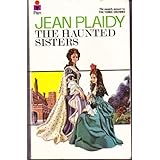
Product DetailsA round up of historical novelists wouldn’t be complete without mentioning Jean Plaidy. Jean Plaidy’s novels formed a backdrop to my late teens as I read my way from her Norman saga to the Victorians, by way of the Plantagenets, Tudors, Stuarts and Georgians. I do still have my near complete collection of Plaidy books; they take up several feet of precious bookshelf. They are amongst the very few books that I still have that I will probably not re-read but I somehow can’t bring myself to part with them. Although I read each one several times when I was younger, I feel I have somehow outgrown them. Tales of the royals don’t hold my interest in they way that those focusing on more lowly characters do. Having said that, I do have to credit Jean Plaidy with giving me a far better grounding in British historical chronology than I could have acquired any other way. They are still in print, with jazzier covers than the ones I have and have now lost out to a certain extent to those by Phillipa Gregory but they still hold a special place in my heart.

In a P.S. to my 2nd December entry. Liz Shakespeare’s forthcoming book about Edward Capern is to be accompanied by a CD of his poems, set to music by Nick Wyke and Becki Driscoll. This is the CD that also has spoken poems on it, narrated by a fisherman of my acquaintance. A seasonal musical track is already available online.


Of Lofts and Lunches, with an historical novelist advent reveal thrown in

A little late in the day for the advent box today as I have been ‘after lunch’ speaking about Christmas traditions. The great thing about this is that a) you get to eat as a bonus and b) with a bit of luck half the audience have been imbibing with their meal so aren’t concentrating on what you are saying. It was a bit of a challenge as the acoustics in the room weren’t of the best and as I began to speak I realised that the winter lurgy had stolen the fortissimo range of my voice and I was without amplification. I managed to sound deep and interesting for the duration and it seemed to go well.

Morian Helmet.JPGYes I know that it is now several hours after lunch. I have been succumbing to sales patter. I am officially barmy. I seem to have let myself in for helping a friend move house at the weekend and then emptying my loft between now and Tuesday in order to have it insulated. My loft contains more than my house, much of this is items like suits of armour that you can hardly pile on top of each other, oh and did I say I am not supposed to lift anything. I have a bad feeling that this could all go horribly wrong.
Today’s historical author is Susanna Gregory. She is responsible for two series of books. Strangely it is not her seventeenth century Thomas Chaloner mystery books to which I am drawn but those set in fourteenth century Cambridge. These feature doctor and university lecturer Matthew Bartholomew who, together with his sidekick Brother Michael, solves crimes in and around Cambridge. A quick word of warning, if you get hooked on this series, there are already more than twenty that will find their way on to your ‘to be read‘ list. Many of the characters actually lived in Medieval Cambridge, although often little is known about them and Gregory has been liberal with their exact dates. The university setting and the medical slant to the Matthew Bartholomew books appeal to me and I am a sucker for a series that I can get my teeth into. If you enjoy a book it is always good to know that there are twenty more in the pipeline. Unlike some authors, this prodigious output has not become formulaic. Although you are pretty sure that at least one and probably several, people are going to have died in mysterious circumstances and that Matthew is going to fail to get the girl AGAIN each book has its unique flavour. Susanna also writes, together with Beau Riffenburgh, as Simon Beaufort.

Christmas Preparations, DNA Progress and another Historical Novelist

Yesterday’s festive disaster was the failure of the Christmas tree lights and yes I do always check them before I put them away. They worked perfectly in January. How can thing ‘unwork’ whilst lying calmly in  box? At a conservative estimate these lights are 35 years old. The price on the box is in ‘new’ money so they must be post 1971 but probably not by much. Scarily, this means they have been on my Christmas tree for more than half my lifetime. I guess this means they don’t owe me anything. Having laboriously checked each of the 40 bulbs, the wiring and the fuse, I concluded that there must be a break in the wire somewhere and conceded defeat. I am now awaiting the arrival of my personal shopper who has been given detailed instructions and I hope will have purchased the ‘right sort of lights’. As the lights have to be on the tree before further decorating can commence, the ornaments remain strewn across the living room floor awaiting their month of glory.

My DNA kit is still somewhere mid Altlantic. I am eagerly checking the company’s website, awaiting its move from ‘Pending Shipment to the lab’ to ‘Pending Lab Results’. In the meantime, I am still re-visiting the paper trail to identify my meagre collection of potential third cousins. My great great grandparents John and Elizabeth Hogg née Pearson’s descendants are noted for their quality rather than quantity. Well certainly they failed on the quantity front so I made up the quality bit! They had four children. One died unmarried and I am the only descendant of another. One of the others provided me with five third cousins, who fortunately have a very unusual double-barrelled surname, so I was able to make contact with one of them. The final daughter had one son. No help from an unusual surname here. I have tracked down three people in my father’s generation who potentially could have produced children to become my third cousins. So, at a guess, between 5 and 15 third cousins on this branch.

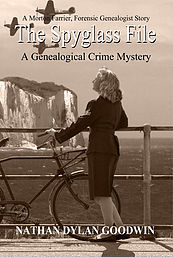
f927db_aa32dccb9ddd43cab3a17d5b08480124mv2It would be strange if my advent historical novelists’ list did not contain several who have a genealogist as their protagonist. You might argue that these are not precisely historical novels and you would be right, as they are largely set in the present. They are however so bound up with the past that I am counting them – my advent ‘calendar’ my rules. These tend to combine an historical slant with crime, another of my favourite genres, so for me it is a two for the price of one scenario. The first for me to ‘unwrap’ is Nathan Dylan Goodwin. These feature the casebook of forensic genealogist Moreton Farrier. I cringe a little at the phrase ‘forensic genealogist’, as to me forensic genealogy is just ‘proper’ genealogy but we won’t go there now and it doesn’t detract from my enjoyment of the books. The first book, Hiding the Past, has an unexpected twist in its tale as Moreton strives to uncover a family secret, with the aid of his police officer girlfriend. The Lost Ancestor slips between the present day investigations and Edwardian Britain, in a case that proves hazardous for Farrier. The third in the series The American Ground is based on a real incident and reflects Goodwin’s other writing, which focuses on the local history of his home town of Hastings. The Battle of Britain forms the background to The Spyglass File,, which has only recently been released and is still on my ’to be read’ pile. A continuing thread throughout the books is Farrier’s search for his own biological family and this, as well as the fast paced writing, makes me eagerly wait the next installment. These are undemanding holiday reads, which is why I still haven’t got to the latest one. That is not meant to be a derogatory comment, they are well researched and the genealogical methodology is accurate and interesting. Once you start one of Goodwin’s books you can’t wait to turn the next page, so not to be begun unless you have time to get to the end, which you will probably want to do in one sitting. A great one for family historians everywhere.