I am making a once in a lifetime exception to my self-imposed embargo on blogging about politics or religion, on a day that I feel may be marked by the historians of the future as a memorable day. Undoubtedly today is a watershed, perhaps a watershed on the scale of the Norman Conquest, Henry VIII’s capricious decision to divorce Anne Boleyn, or the loss of America as a colony. You are probably aware that these were not events that resulted in peace, prosperity and religious freedom for all. Whether today will be memorable for good or ill remains to be seen. In a recent Facebook post, I referred to one of the historical quotations that adorn the headers and footers of my website. Now I would like to draw your attention to the one at the top of the home page, George Santayana’s ‘Those who cannot remember the past are condemned to fulfil it’. Time will tell quite what we have condemned ourselves to fulfil in the wake of the whole referendum debacle. I am not writing this as a passionate advocate or adherent of either ‘Remain’ or ‘Leave’. To be so would be to ignore the all too apparent flaws in one scenario or the advantages of the other. As the campaigns lurched uncertainly into action I sat firmly on the fence. I tried, I really tried, to balance emotional gut reaction with economic reality. Both sides bombarded us with rhetoric, invective and contradictory information. As a historian, I am all too aware of propaganda and spin and we had both in good measure. My working life requires seeking evidence, verifying sources but it seemed that, for much of the information, there was none. It all boiled down to a frying pan – fire decision. The EU is clearly restrictive and broken but the isolationist alternative was fraught with uncertainty and bigotry.
I am actually not so concerned about the outcome of the vote, hardly the overwhelming endorsement some would have us believe. In the end, after much thought, the ‘winner’ wasn’t actually the outcome that attracted my X in the box but that is largely immaterial; I could see pros and cons to both options. My fear, concern and profound sadness today is because the campaign has been accompanied by so much intolerance, bigotry and downright hatred. No one, on either side of this deeply divisive debate, can feel that the run up to what some are terming ‘Independence Day’ has been anything but dirty. The prejudice and fanaticism has been fueled and proliferated by that double-edged sword, social media. Even people I believed to be perceptive have seemed to accept what was clearly errant nonsense as the inveterate truth.
I can respect anyone who cast their vote, in either direction, following thought and deliberation. Sadly many have voted on the basis of scaremongering, or have made their choice because of the alleged charisma of the leading advocates of one cause or the dislike of those fronting the other. Unsupported statements have been hurled by both sides, things got personal, childish, ridiculous. Where was the evidence? The convincing data? Twentieth century political history has never been my favourite period but it doesn’t take an historian to draw the parallels that have already been drawn with the blinkered adulation of Herr Hitler, who was hailed as the saviour of post world war I Germany. He was going to make Germany great. It seemed such a good idea at the time. Now are we heading for our own hate-fuelled Kristallnacht or have the ultra right-wing, who tarnished others who believed ‘Leave’ was the right option, been placated by today’s result? If so, for how long?
I can’t help feeling that those claim that Brexit is the solution to all our problems are being blinded by euphoria. Leave or Remain – either route would have been beset with uncertainty, faction and the need for hard work and compromise. The divisions in our country have become a chasm and it is far from being over yet. There is a mutual back-patting amongst those in the Leave camp and talk of ‘getting our country back’. Beware of what you wish for. We have not ‘got back’ the country of the halcyon pre EU days. Days which lie largely in the imagination. The country we have ‘got back’ is a shadow of its former self; diminished by what will inevitably and understandably be the defection of Scotland. A country fractured by the attitude that those of different opinions, cultures and faiths are somehow of less value. A country where distorted stereotypes are applied to those of a particular ethnicity, belief or sexuality. A country where political hatred sees the murder of a woman who was working for what she believed to be the greater good. A country that seems to have forgotten the concepts of compassion, of compromise, of caring. As for one gloating Leave activist who commented that we had won the country back without a shot being fired, insensitively ignoring Jo Cox’s murder, in one respect he is right, a war has been created. War is never pretty, there are no winners and we can only speculate on who will be the casualties that Brexit and the aftermath will leave in its wake.
If the new Britain, for it will be many decades before it can become Great, is to work it will need every iota of forgiveness and fortitude that we can muster. We will have to learn to accept others who are outside our comfy ‘exactly like us’ sphere and learn to work in harmony. We need to stop moaning about what is wrong and strive to put it right. America is no longer the land of the free, Britannia has long since ceased to rule the waves. World events of the past weeks are destroying people’s faith in humanity. However much you wanted to leave the EU, this is not a time for unadulterated elation. When cloud nine bursts it will become clear that we are embarking on a hazardous journey without sat-nav, survival kit and for some, without a moral compass. We may have done the right thing, this may be an unremitting disaster, while it all unravels and it become clear which of those alternatives is the actuality, the UK needs the healing balm of kindness, understanding and forbearance.
Rant over. If anything is ever normal again normal service will resume shortly.
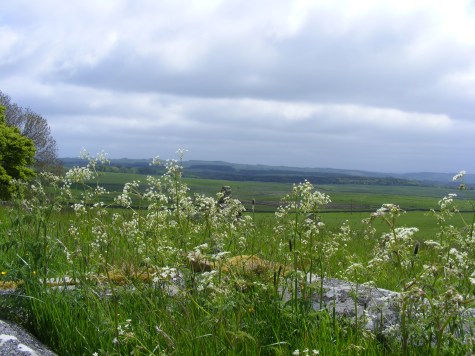 We are heading for Thockrington where the Hogg family lived in the eighteenth century. I am 99% certain that my great great grandfather was baptised here. The grain of doubt comes from the fact that gg grandfather changed his age and birth place at every conceivable opportunity and even swaps John for George on one occasion. Despite having two ‘wives’ one of whom he acquired during the period of civil registration (whoopee, a marriage certificate with a father’s name you’d think) no marriage records have been found. Anyway back to Thockrington. This is an amazing place with views that are virtually unchanged since the Hoggs were here (as long as you stand with your back to the wind turbines). Here you are on top of the world, absolutely the right place to build a church and a truly spiritual place, whatever higher being you might subscribe to. I maintain that everyone should visit here but not all at once, obviously and not when I am here. If you take my advice be prepared for driving a fair way along single track road, possibly across cattle grids, depending on your direction of approach, driving through a farmyard and finding a church, a farm and absolutely nothing but awe inspiring scenery as far as you can see in all directions. Do it, it is worth it. Just to add to the glory the sun comes out.
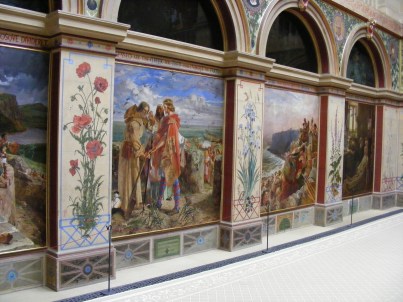 Scotland is apparently bathed in sunshine. Typical, here we have drizzle and falling temperatures. Time for another National Trust property near you visit, this time to Wallington House near the weirdly named Cambo. The house was built for William Blackett in 1688 and then passed into the Trevelyan family, who, as the name suggests, originated in Cornwall. The most notable feature of this house is a central courtyard, which was covered over in the 1850s and decorated with murals depicting the history of Northumberland, for which the artist, William Bell, was paid £100 a panel. We are supposed to spot stuffed squirrels in the various rooms. I clearly need a two year old with me for this. Mind you I was not helped by the sample squirrels being three times the size of the hidden ones. There is a group called Robson’s Choice playing the Northumbrian pipes in the hall. These are very different from Scottish bagpipes and are much more suited to an indoor performance. They are not blown but the air is injected by squeezing bellows strapped to the elbow. My favourite features are once again the kitchen and also a series of photographs of former servants that are on display as part of a ‘Silent Voices’ project.
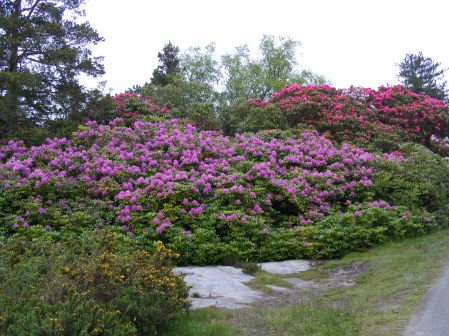 Cragside has plenty of opportunities for outside exploration, with gardens and extensive grounds. Given the temperature, we opt for driving along the six mile estate drive, which commences by driving under an arch through the house. This is obviously the right time for a visit as the rhododendron lined woodland paths are spectacular. It is a shame that we have neither the time, energy, or the warmth, to explore on foot. Home then via a quick shopping stop at Rothbury.
 The main product that was smuggled was tea, which in Nisbet’s time attracted 119% tax. The house includes a hidden chute where large quantities of tea could be stored, a hidey hole under the floorboards, capable of concealing three men and warren like cellars, where our tour began. The top floors were not finished for twenty years, by which time a tenant, John Stewart, was in residence. The house was sold to rival merchant and smuggler, Alexander Robertson, to pay debts and then passed to the Home family. From 1906-1965 the house was run as a guest house by the Dougals. It then did time as a clubhouse for golfers and was finally acquired for restoration by the trust in 1998. In fact very little had been altered by the succession of owners. Pleased with our choice of ‘bonus’ visit, we return to Berwick Seaview site, which is by then living up to its name.
 The weather is much better today. Not as much better as some of the locals, with their bare chests and shorts, are implying; I still have my coat and jumper on. We can at least see the view over the Firth of Forth as the mist has lifted. The castle fire a cannon at 1pm daily, except Sundays, so we shall miss that. St Margaret’s Chapel is the oldest part of the castle. It was built in memory of Margaret, the mother of David I. It is very tiny and although it is still used for weddings, you are limited to 25 guests. After our tour we wait for an excellent presentation by an historical interpreter, representing Sir Thomas Randolph, Earl of Moray who, in 1314, was charged with recapturing the castle from English occupation. It was one of three castles in English hands at the time. Roxborough was re-taken by men disguised as cows. Randolph, whose half uncle was Robert the Bruce, climbed the rock using a secret path revealed to him by the son of a former castle governor and got inside the castle with thirty men, whilst others created a diversion at the gates, so the castle was recaptured from inside. It is great to chat to the interpreter and try his weaponry. The chain mail is seriously heavy and the full face helmet certainly restricts the field of vision. He has a fiendish looking mace, which was designed for use by churchmen who were not allowed to let blood, although bashing people over the head was fine!
 The History Interpreter - Janet Few