Adventures in Stirling

Although access was not without its problems, we are sad to be leaving this site on Kintyre with its lovely sea views, having not had the weather or opportunity to enjoy them. We travel the long way round Kintyre in order to avoid the twenty miles of single track road but it turns out that this might have been the lesser of two evils. Without warning there is a hairpin bend on a very steep uphill stretch. The road is wet, slippery and in need of resurfacing. You remember how no one round here seems to be able to reverse? Well, we are reversing quite nicely, the trouble is we are meant to be going forwards. The car wheels are spinning, the back of the caravan is in a hedge and there are some seriously scary moments before Chris somehow manages to change our angle of approach and get us going in the right direction.

There is some beautiful scenery on this side of Kintyre as we drive alongside Loch Fyne. This only gets better as we travel north of Inveraray through Glen Aray, beside Loch Awe. I had hoped to listen to the last of the Commonwealth Games on the car radio but it seems we are beyond any sort of useful radio coverage. Then eastwards through the northern edge of Loch Lomond and Trossachs National Park to our site near Stirling. We had planned an afternoon visit but it is later than we hoped and we decide to reschedule and relax after getting our supplies. To do this we pass four major supermarkets before reaching the one of our choice and then we discover that fuel was cheaper at one of the others so end up going there too. Our media blackout continues as we are without television coverage for the next three days and internet availability is coming at a price but who needs media? We will cope. Ok, so one of the coping strategies was to pay for 24 hours’ internet access but nobody’s perfect.

We have booked ourselves a place to see a ‘Battle Show’ at the newly opened Bannockburn Battle Experience. This is another attraction that the National Trust for Scotland have clearly invested in heavily. So, as all around us are marking the 100th anniversary since the outbreak of the first world war, we are commemorating 700 years (on 24 June) since Robert the Bruce and the ‘Scottish Patriots’ routed Edward II. It is ironic that we are learning about a fight for Scottish independence in the run up to the referendum over the same issue. It is this area that has provided us with the first evidence of support for the yes campaign. Everyone we have spoken to up until now and the very few posters we have seen, have been in favour of union with England.

We don our 3-d glasses and are in the thick of the fighting. This is a little different from what we are used to in the seventeenth century and spears are not wielded in quite the same way as pikes. Here we have long-bows and cross-bows, the former were banned by Elizabeth I in favour of more modern ‘weapons of fire’; a very short-sighted move as the long bow is infinitely more accurate than the musket. In fourteenth century Scotland the fighting unit is the schiltron, rather than the pike block. After ‘conversing’ with some virtual characters of the time, we are called for our Battle Show. We learn how, despite being outnumbered 2:1, Robert the Bruce, aided by Sir James ‘Black’ Douglas, took advantage of the terrain to defeat the English troops.

122 4 August 2014 Wallace Monument

The Wallace Monument, Stirling

Other visitors have booked to take part in a virtual Battle of Bannockburn war game, re-writing history. We are able to watch this from the viewing gallery. Participants take it in turns to move their allocated units and can attack if they wish. It is interesting that the women, of what ever age, tend to go for strategy and keeping out the way, whilst the men are much keener to engage with the enemy. One of the adult players clearly isn’t aware that this is a family show and each time it is his turn says, ‘attack the b****rs’. History is indeed re-written and the Battle of Stirling golf course (the players seemed to avoid putting their troops near the Bannock Burn) ends with a victory for Edward II.

We stop for a weapon handling session, interested in comparing the swords and helmets that we are used to with those of 400 years earlier. The whole experience is very well done and designed to attract today’s young people but I do have some reservations, as I do during some of our seventeenth century activities. It does seem to be making a game out of warfare and the players revel in ‘killing’ thousands of enemy troops. I just wish at some point someone would explain the horrors of war and that, even though it was 700 years ago, these were real people who suffered and died and it matters.

Next it is a short journey to Stirling Castle, not quite as short as it should have been owing to us paying attention to the sat nav but short none the less. Stirling seems to be a beautiful, serene city, with soft stone buildings, cobbled streets and a commanding position overlooking the River Forth. In the time of Robert the Bruce it was believed that the Forth completely bisected Scotland and that the only land route from lowlands to highlands was across Stirling Bridge, hence its strategic importance. When the English were defeated by Robert the Bruce many Scottish castles were destroyed, so the English could not attempt to regain them and use them as strongholds. This of course meant that the Scots couldn’t use them either, maybe they didn’t think of that.

Today for the first time we are aware of school holiday crowds; the castle is heaving and its car park is full. We are directed down a side street to get out of the way of a bus. It seems it is perfectly possible to park down this side street. Notwithstanding, cars are queuing for what is likely to be a very long time in order to get a space in the car park. Our chosen parking spot has not only saved us queuing but has also saved us £4. I know I have mentioned it before but we really have benefited from the savings that our National Trust membership has gained us and we are grateful for the reciprocal arrangement with National Trust Scotland. We walk up the steep hill to the castle and as we approach I remember that Stirling Castle is managed by Historic Scotland and is not a National Trust property. Instead for this we need our English Heritage card. The good news is that I have remembered to bring it. The bad news is that it is back at the bottom of the hill in the car. A member of our party is dispatched to fetch it.

It is a good job that we didn’t try to squeeze this visit in yesterday afternoon as there is a great deal to see. We start in the Queen Anne Garden then move on to the ‘Access Gallery’ in the vaults. There are plenty of interactive opportunities, although a little less high-tech than Bannockburn. We can play medieval instruments, if we were smaller we could have dressed up and there are various things to touch and press. Stirling has been an important defensive site since the ninth century, if not before. The first evidence of its use as a royal castle is in 1110 under Alexander I. It played a role in William Wallace’s victory over the English at the battle of Stirling Bridge in 1297. Most of what is seen today is a result of James V’s ambitious and status seeking building campaign following his marriage to Mary of Guise in the early sixteenth century. In keeping with European Renaissance style, 250 sculptures were erected outside. These depicted classical figures, alongside James himself, making a statement about his rule. These would almost certainly have been painted although there is now no evidence of this and sadly many are now damaged, not least by acid rain. Local Devon lad General Monck laid siege to Stirling Castle in the English Civil War. The last siege at Stirling took place in 1745 when Charles Stuart, ‘Bonnie Prince Charlie’ failed to take Stirling for the Jacobites.

Costumed characters provide additional information. We learn about the series of tapestries depicting a unicorn hunt and its religious allegory. The castle is also famous for the Stirling Heads, a series of large circular woodcarvings that have now been replicated. Like the sculptures these are a combination of classical images and depictions of members of the Scottish royal family.

The lack of good drying weather this week has meant that we are running short of clothes so, on returning the van, we do a major wash and invest in a tumble dryer. I don’t know what was wrong with the machine but let’s just say it performed one of its two functions very well. Our laundry is superbly tumbled but not at all dry. We hang it out as best we can on our teeny tiny airer and hope that the showers will steer clear.
Islands in the Sun – and rain

We pop in to their site to say goodbye to Martha, Rob and Ed. The latter is looking very cute in his wet suit and I am allowed to accompany him to the site pool. Then it is time to leave. Despite a slight issue when the automatic caravan leg winder only seems to want to lower the legs not raise them, we set off for the Kintyre peninsula. The sat nav tells us is seventy miles to our new site but that seems to involve two ferries so we opt for the land route, which is more than twice as far.

 We cross the Clyde via Erskine Bridge and are in beautiful countryside by the loch in the Loch Lomond and Trossachs National Park. There are many single story, white washed cottages. Then we are travelling alongside Loch Fyne and arrive on Kintyre – as in Mull of, although Mull is one Scottish island we won’t be visiting. Despite having read the Caravan Club’s instructions to ‘only approach the site this way’ several times, my eye has missed out a vital word. This means that I navigate us the wrong way, which involves twenty miles of single track road. Fortunately there are frequent passing places, marked by black and white poles. When Chris finally accomplishes the feat of getting us to the site entrance there are more problems. First we negotiate a long bumpy track to reception, then we take a wrong turning on the site. We find ourselves in a field full of tents on soft ground with no way out expect the way we have come and very little space to turn a car and caravan. Despite some wheel spin Chris accomplishes this and drives our unit between two cars with the proverbial cigarette paper space on either side. All I can say is that it is a good job our wing mirrors were higher than those on the cars. If caravan manoeuvring were a Commonwealth sport Chris would be in with a chance of a gold medal.

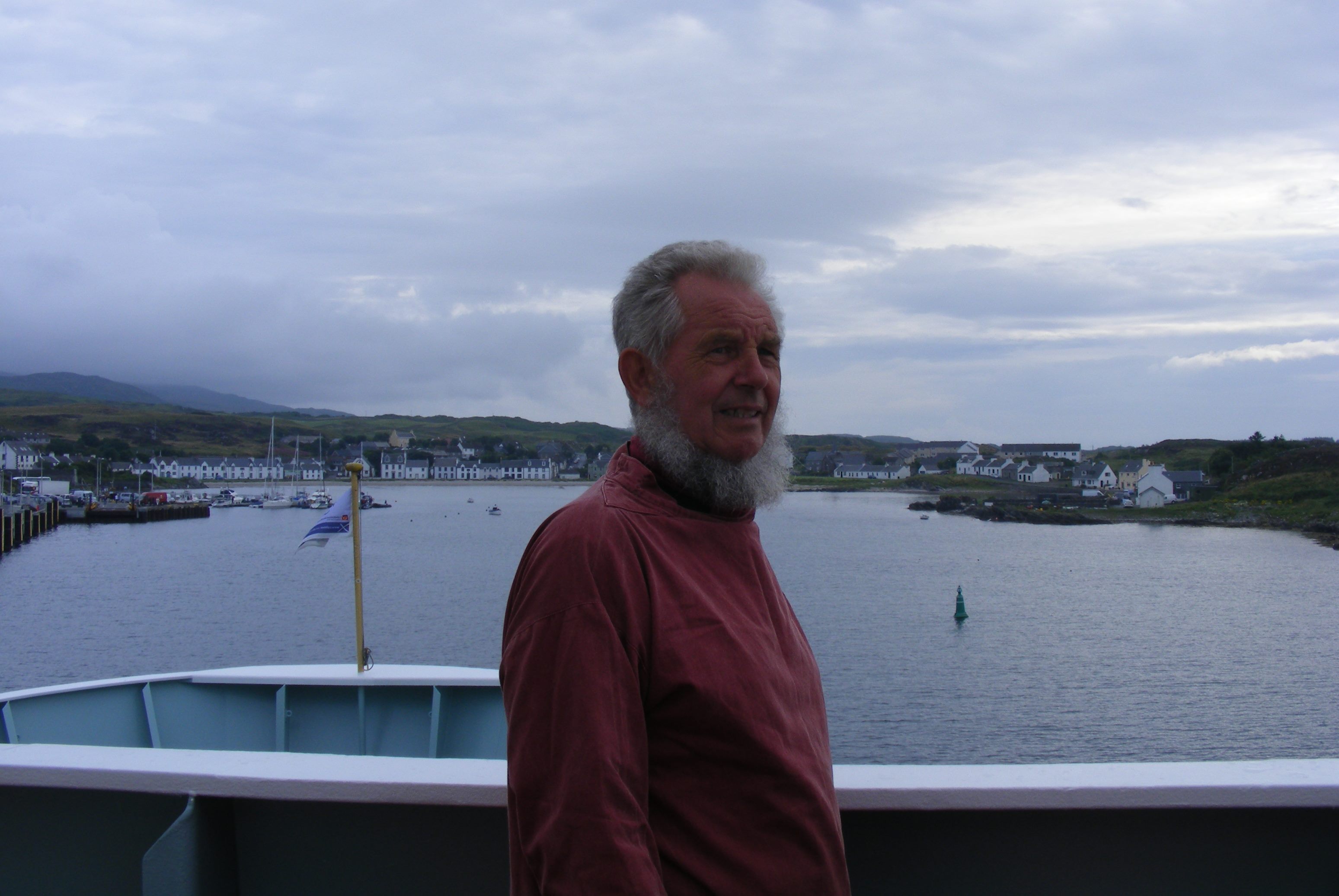
The next day we leave the van at 5.50am, yes 5.50am, to get the ferry from Kennacraig to Islay. It is cloudy but serene across the bay with many baby rabbits. We are trying not to mention our destination as we don’t know how to pronounce it. Is it ‘Iz-lay’ or is the ‘s’ silent (as in ‘island’) making is ‘I-lay’? Turns out it is ‘I-lah’, well, who knew. A shower means that the outside seats on The Hebridean Isles are wet so we sit in the reclining lounge. It is the seats and passengers that recline, rather than the lounge itself you understand. Reclining is all very well but in order to see out of the windows of the reclining lounge you have to adopt a meerkat like pose as the windows are very high. We complete a customer service questionnaire. Actually, I complete two, one each on behalf of my travelling companion and myself (still no reading glasses). Now, what to do for the next two hours and ten minutes of our journey? One of our party is already asleep, so conversation is limited. Mind you after three short nights who can blame him?

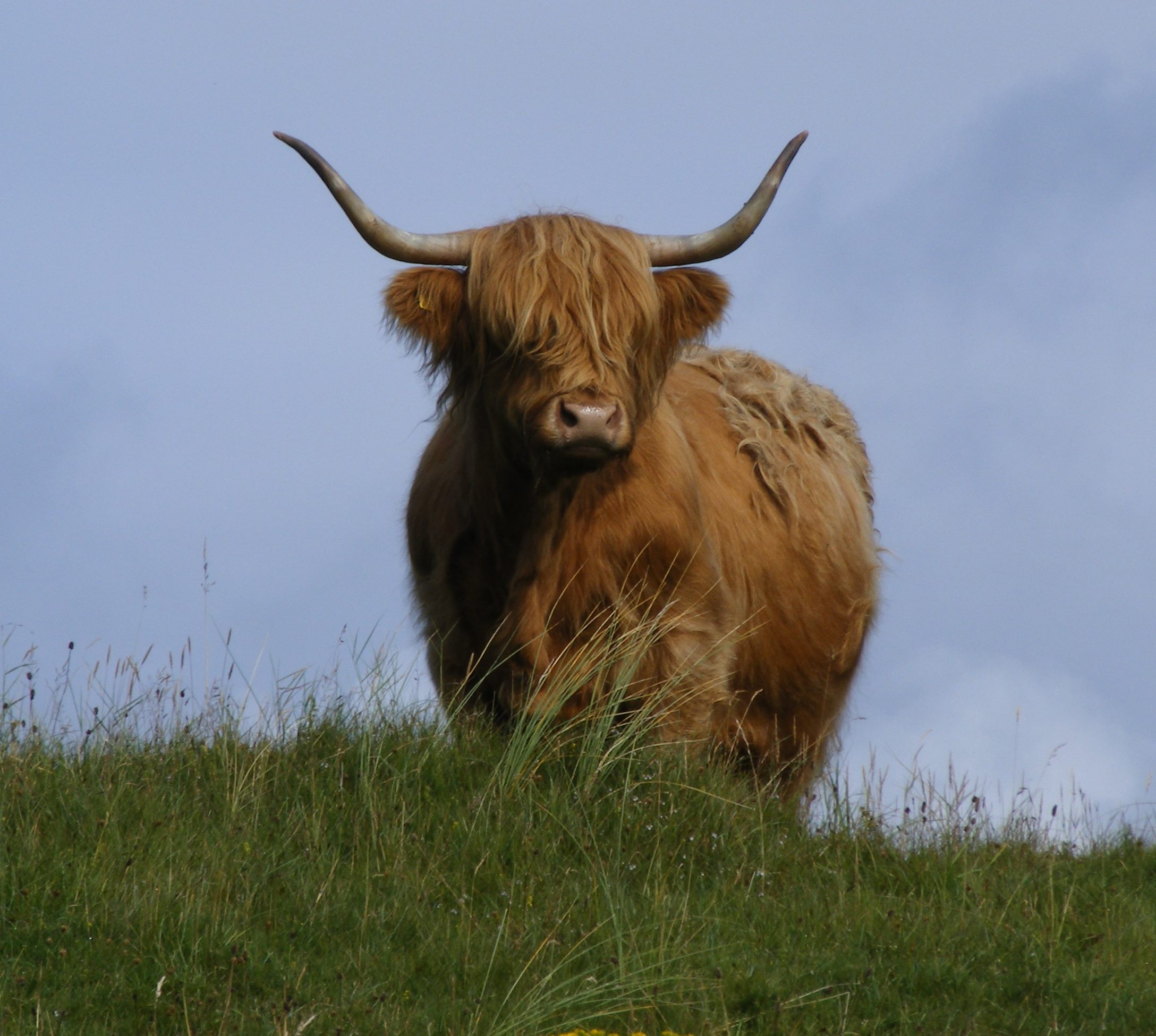
We land at Port Ellen and our pre-ordered hire car is ready and waiting. Then begins a roughly clockwise tour of the island, starting at the Mull of Oa, just as the sun comes out to greet us. We have noticed that cemeteries here seem to be seriously in the middle of nowhere and Islay is no exception. 086 1 August 2014 Chris on way to IslayThere are some impressive highland cattle roaming the beach and I also spot some hooded crows that are new to me. We fail to make the sands sing; that would be because we weren’t quite in the right place. A tractor passes with a huge trailer full of clam shells; the aroma lingers for a long way. We notice evidence of peat cutting and arrive at Bowmore Round Church. It was built in 1767 by Donald Campbell. The idea behind it being round is to prevent the devil hiding in the corners. A coach is disgorging its passengers as we arrive at the Round Church and we seem to have gate-crashed some filming; we suspect it is a new series of An Island Parish. The graveyard has numerous second world war graves to unknown sailors. Incredible scenery is interspersed with unsightly but no doubt necessary, signs of industry. This is of course the land of whisky distilleries and we see several.

094 1 August 2014 Highland Cattle 5At Port Charlotte we stop at the Museum of Islay Life, which has been set up in a disused Free Church. There is an eclectic mix of exhibits and one can imagine their hearts sinking when a well meaning local donates yet another bit of tat that has to be lovingly displayed. There are pictures of a D & N MacKenize bus of the 1930s; this is the firm that we have hired our car from. We chat to the friendly staff member. It seems there are variations on witchcraft prevention in Scotland – red string round the door, rowan trees instead of bays and quartz stones on the gateposts. I ask if there is a toilet. There is a staff one that I can use but health and safety requires the custodian to tell me that this is at my own risk. I fail to see what risks could be attached to this activity but maybe I am not thinking hard enough. In any case I emerge unscathed.

We drive down to the westernmost point of Islay, a fishing village called Porthnahaven; now we are further north than Ireland, next stop to the west is America. We get the very small ferry from Port Askaig to Feolin on Jura. I am already panicking in case there isn’t room for us on the return trip; perhaps we should join the queue now. Jura was granted to the Campbells in the early seventeenth century and the last Campbell left in 1938. A famous resident was George Orwell, who wrote 1984 on Jura; I guess there weren’t many distractions!

Jura appears deserted with no sign of habitation for several miles as we travel north on the only road. There is a complete lack of livestock and no sign of farming activity. Apparently there are cattle and 6000 red deer on Jura but we don’t see a single one. The human population is about 200, virtually all of whom are concentrated in the one settlement of Craighouse. Chris enjoys looking at the boats and we set off back to Feolin in good time for the ferry. Suddenly a warning light appears on the dashboard and the car loses all power, this is seriously worrying, are we going to be stranded on Jura? We have no idea how we are going to resolve this, it seems unlikely that Chris’ AA membership will extend to rescuing us from Jura any time soon. Chris turns the engine off and on again and all seems to be well. Inevitably we arrive in time to be first in the queue for the ferry but this is just as well as one car does get left behind.

Back on Islay, as instructed, we go to fill the car with petrol. We don’t seem to be able to open the petrol cap. The vehicle handbook is in the glove compartment and it seems to explain everything possible that one might need to know. I can use the cigarette lighter and CD player, I know all about the air bag but have no clue how to fill up with petrol. Fortunately the garage owner can cope; brute force is required. The ferry for our return to Kintyre is the Finlaggan. The gangway for passenger access is set at a slope of 1:2. Chris is manfully helping the ferry staff carry a child and bag-laden buggy up the gantry. Once on board we are once again in a media spotlight as photography is taking place, presumably for a new ferry brochure. We offer to move out of the way but are told this isn’t necessary; maybe we will be photo-shopped out. Finally a chance to watch Tom Daly and his new diving partner win silver in the synchronised diving on the ferry TV before returning, shattered, to the van.

A slightly later start today but only slightly, as the Claonig to Lochranza ferry operates on a first come first served basis and we spotted a camper van heading for the queue last night. Presumably they were planning to fly camp (legal in Scotland) to ensure their place on the ferry. Having seen none of Jura’s 6000 deer yesterday we do see two on the way to the ferry. We are second in the queue. Now I can stop worrying about whether or not we will fit on the ferry (surely it has room for two vehicles) I worry instead about whether or not we can pay our fare by credit card. Even with all the ‘emergency change’, of which there is quite a bit, we are £1.10 short. All is well, card payments are accepted and we are headed for Arran. It is raining, that would be raining quite a lot. We have worked out how to cover most of the island’s main roads, which form a figure of ‘eight’, assuming the eight has three circles instead of two. It takes a few goes to work out how to do this with as little repetition as possible (I can name at least two friends who now have paper and pencil out trying it! If that’s you, the cross pieces between the circles are roads from one side to the other and not just cross roads, so you can’t avoid some repetition).

We start off going clockwise from Lochranza and halt at Brodick Castle. This has the advantage of being under cover but the disadvantage of being shut. In the end it turns out not to be shut at all. In common with all those we have encountered so far the staff are really friendly. They explain that they have opened early and will be providing a single guided tour any minute now before shutting for a wedding. Hurrah! The guidedness of the tour is a bonus as normally it is show yourself around and ask questions of the room guides. Arran is of strategic importance as it guards the entrance to the Clyde and Brodick is one of three ancient fortifications on the island, the other two being at Lochranza, which we saw through the rain on our way to Brodick and Kildonan, which we didn’t. Brodick has been used as a defensive site since Viking times. The earliest parts of what now stands are sixteenth century but most is nineteenth century. The Castle was owned by the Dukes of Hamilton, whose main residence was in Hamilton and it was used as a hunting lodge. Cromwell was responsible for the death of the then Duke and Brodick was used as a Parliamentarian garrison before being returned to the family after the Restoration.

The entrance hall contains 87 stags heads. No one could be more opposed to hunting for sport than I but it certainly makes a statement. I score seven out of eight on the ‘what are these unusual historic objects?’ quiz in the kitchen, missing out on the pudding mould. There was a decidedly eerie feeling in the basement and that was before the guide regaled us with tales of bodies in tunnels. We decide it is not the weather for looking at the gardens and paddle back to the car. Some die-hards are still playing golf but we are trying to remain vaguely dry. Walking up tracks from the road to view standing stones are also off the itinerary. We head from east to west across ‘The String’. The roller coaster road and the surface water mean that this is a little like a water ride in a theme park. By this time we are in thick fog and even the most intrepid of cyclists, of which there have been many, usually on the narrowest parts of the road, have given up. Then there was the bus meets car (not ours fortunately, we were behind the bus) incident, when the car driver was another incapable of reversing. The bus driver solved this by making it clear he was in no position to reverse, which he wasn’t but it took some time for progress to be made.105 2 August 2014 Deer near Carradale

After a brief detour to the southernmost point of the island at Kildonan, we headed north again. Whiting Bay seems to be the affluent side of the island, with large houses, probably designed for the golfing set. All this being in the middle of nowhere has meant we are a little low on fuel. We manage, with the help of the sat nav, to find a petrol station at the second attempt – the first was no longer open. This is at a combined petrol station and DIY shop, which makes sense. It was also the local off licence, which was a less likely combination. Although Arran provided our first view of Scottish heather there was no sign of the knitting to which the island has given its name. I don’t know why Scottish cars have reverse gears as no one knows how to use them. We encounter yet another example on a single track road. We are 200 metres from a passing place, the car coming in the other direction is about 5 metres past theirs. Their attempt at reaching the pull in results in their getting stuck in a ditch. The passenger has to get out of the car and push them out. As the rain is still torrential, Chris was a little slower than usual in offering assistance. So slow in fact that they were gone before he had the opportunity of getting wet.

We slightly revise our planned route, miss out Lamlash to Brodick and head west again, this time across ‘The Ross’, a higher road than The String and lined with pine forests, at least that’s the bits we could see through the rain. Deciding to call it a day, we return for a earlier ferry than the one we had intended. On a quick trip to the facilities I get caught in a downpour and find myself in the car in my underwear, having removed soaked clothing, for the second time this holiday. There is some delay with the ferry but eventually we are vanward bound. Considering Arran is sheltered on both sides the crossing is pretty jolly choppy and I am regretting consuming a packet of stale chilli rice crackers that I found lurking in the bottom of my bag. I wonder if I may be going to see them again. Fortunately I do not have to dwell on the logistics of being unwell on a boat when in a state of undress as we reach Claonig without mishap.


5 go wild in Glasgow – well relatively wild

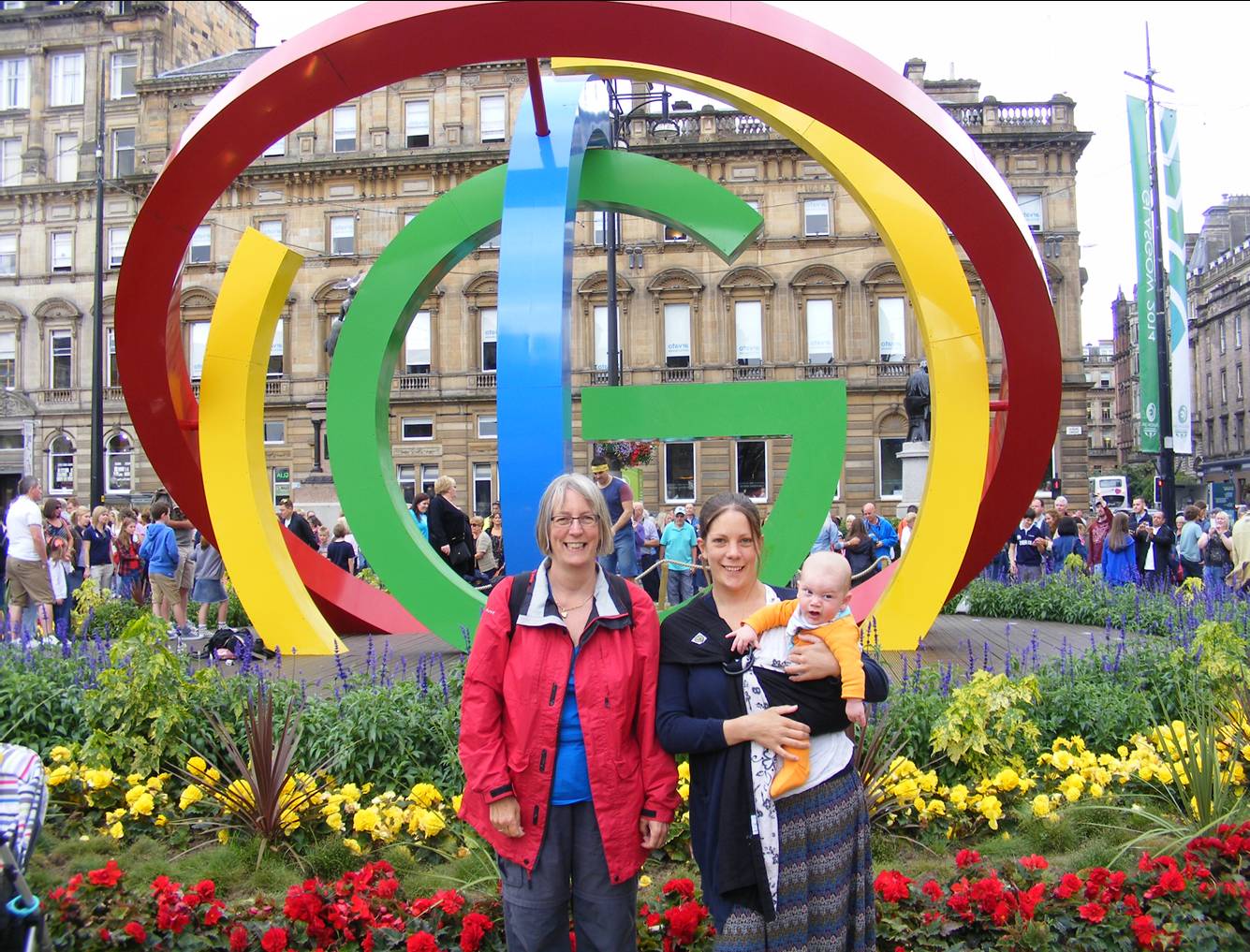
The five of us head for Glasgow on the train from Ayr. Even though I am not in general a fan of cities, Glasgow is looking good. We spend some time on the green but pass up the opportunity of queuing for an hour to have our pictures taken by the Games’ logo. We compromise by queuing not at all and being portrayed by its reverse image. With a bit of judicious photo-shopping I even make it look like we are standing on the right side! Every busker in Scotland is clearly taking the opportunity to benefit from Glasgow’s time in the spotlight. Quality varies; my favourite was the elderly lady in a headscarf with her accordion. We pass various athletes we can’t identify in the streets of Glasgow. Walking through the jewellery quarter our men folk like the look of the £29.50 price tags until they realise it is £2950. There is also a clothes shop with virtually no stock but a window display containing over 1000 old sewing machines. I bet they don’t change their display very often. Unfortunately the reflections from the glass make it difficult to photograph. There are a number of impressive murals on the walls and everyone is very friendly. We follow a ‘Clyde Trail’, seeing how many Games’ mascots we can spot without walking ourselves into the ground, bearing in mind that Martha has Edward to carry.J M & E logo reversed

With Martha and I involved in the planning it is inevitable that those of our party heading for the Games do so in good time. We have decided that a teething Edward probably won’t cope with an evening session so Martha loses out, Chris has passed on participation so Rob and I board a vomit filled train for Mount Florida station and Hampden Park. We are of course far too early and have to wait for security to open but the journey has been hassle free and lacking in delays. I wonder why the huge queues on the other side of the road are not getting on the numerous empty buses that pass but it turns out that they too are waiting for security. The security staff do their best to entertain the queue and we are soon through to the stadium. We have excellent seats with a good view of the decathlon javelin, which is one of the first events. There are plenty of finals on the programme this evening. The women’s triple jump is on the far side of the stadium and England’s Laura Samuels wins silver. The woman’s 10,000 metres ends in a clean sweep for Kenya but is particularly interesting for the three laps in the middle when the field was led by Beth Potter of Scotland.

The semi finals of the men’s 400 metres feature Martin Rooney who is head and shoulders taller than the other competitors. Medal ceremonies come thick and fast and we are destined to hear the Jamaican anthem often enough to know it by heart. The ceremonies for yesterday’s 100 metres finals have been held over to today so more chance for us to practice the Jamaican anthem and we see Adam Gemili awarded his silver medal. Alongside the cool radio controlled vans that retrieve the missiles in throwing events, the synchronised hurdle arranging, involving many of the workforce, appeals. Will Sharman gets the silver medal for England in the 110 metre hurdles. Then there is an inevitable Jamaican one, two, three in the women’s 400 metres.

I am very excited to see that one of the Scottish hammer competitors is Andy Frost, who went to school with Rebecca and who I remember being born when his family lived across the road. Sadly tonight is not his night and he just misses out on a chance for an additional three throws but England get the silver. The final decathlon event, the 1500 metres, is exciting with two English competitors in medal contention. In the end Ashley Bryant improves his standings to come home with the silver and somewhat of a pattern seems to be emerging.

Rob and I have our exit strategy planned like a military operation. We watch the final event from the top of the stadium. It is the women’s 1500 metres and guess what, England get the silver medal, thanks to Laura Weightman. As the athletes cross the line we are gone and by the dint of swift walking, we reach Mount Florida station just as the platform is filled to capacity and a train is drawing in. I cannot see how all these people are going to fit on one train but it turns out that many of them are not heading for Glasgow. We are on the train and there isn’t even anyone standing. Once in Glasgow we make the Ayr train with five minutes to spare so are running an hour and a half earlier than our expected scenario. Chris kindly meets us at the station, just a shame that he is at one entrance and we come out of the other. We are back in our respective vans by midnight, which is probably just as well as Rob is due to be on the 6.50 train in the morning in order to go back to the Games.

The next day, after a morning catching up, I take the train to Glasgow where I meet Martha, Rob and Edward. We call in at the Museum of Modern Art and although Edward likes the mirrors and stained glass, we decide we don’t quite ‘get’ most of the exhibits. Today we time our journey to Hampden Park better and there is no queue for security. There is a debate as to whether my kindle requires scanning but the verdict is that it does not. Quite how I might secrete contraband in a kindle I have no idea.

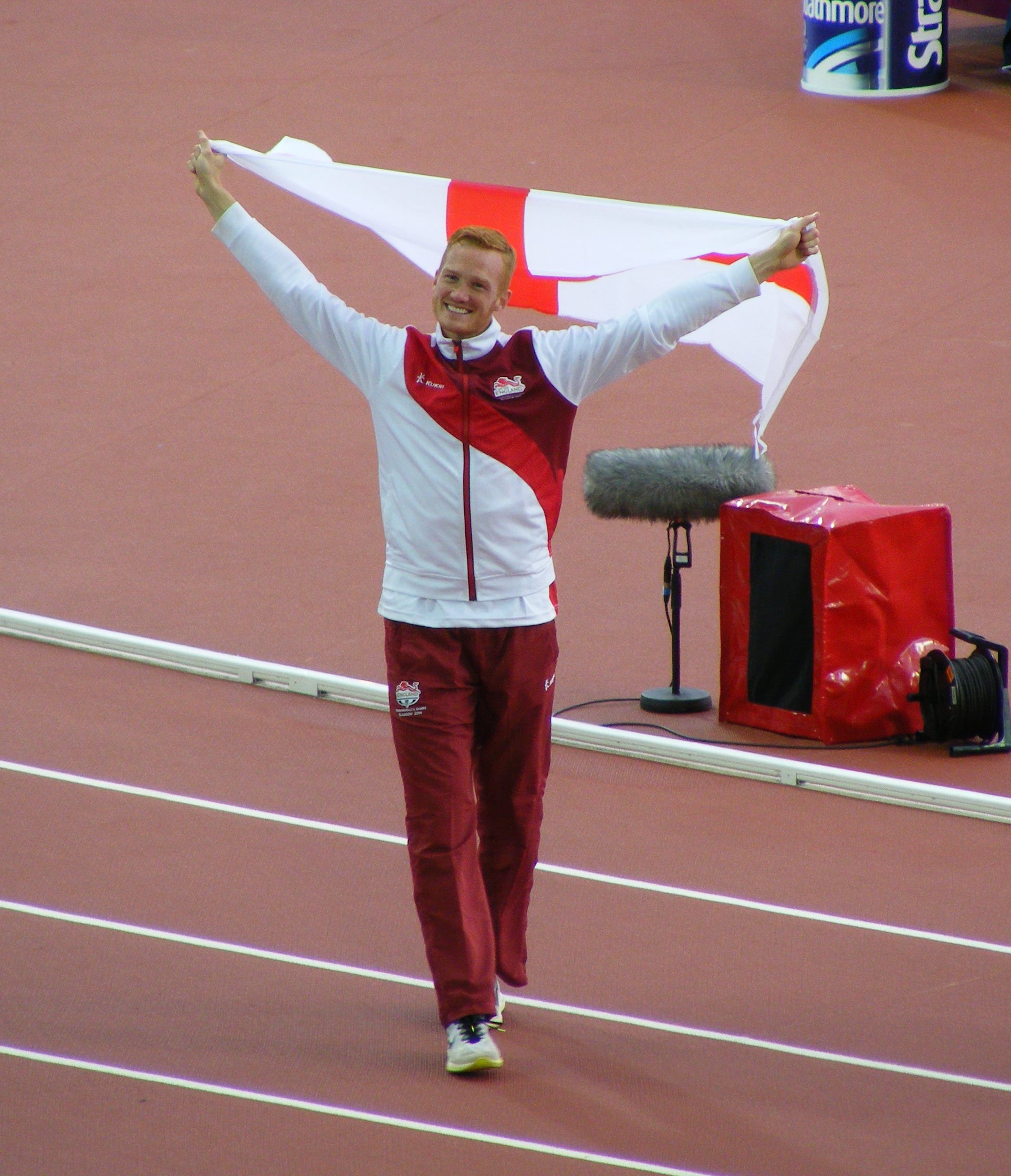
A stereotypical Glasgow mizzle has set in at the start of the evening; particularly trying for those competing in the field events. We are at the other end of the stadium tonight and higher up. This makes it hard for us to see the sixth event of the heptathlon, which is the javelin; two English competitors are in with a chance of a medal. We have a much better view of the men’s high jump final in which England come fourth. There is a stupendous reception for Greg Rutherford as the long jump final gets underway; the weather has improved by this time. Meanwhile the Hampden crowd goes mad for Eilish McColgan, daughter of Liz, who manages a season’s best in the steeplechase, behind a predictable Kenyan one, two, three. We see the medal ceremony for the 1500 metres from last night. Then the final heptathlon event, the 800 metres, where England’s Jessica Taylor hangs on to the bronze medal in a race against the Jamaican athlete.

Valerie Adams begins her defence of the shot put at our end of the stadium. The people sitting in front of us seem to know one of the athletes, clearly this gives them the right to stand up and block our view at random moments. Martin Rooney just misses out on a medal in the men’s 400 metres, which is won by Kirani James in a new games’ record. Meanwhile another games’ record is slaughtered by Australia’s Kim Mickle when she throws the javelin more than three metres further than the previous record. The men’s 800 metre semi-finals feature David Rudisha and England’s Michael Rimmer also scrapes into the final.081 30 July 2014 Rutherford 4

Edward, Earl of Wessex is the token royal in residence and he presents Kirani James with his medal. The Grenadan national anthem is very jolly and makes a change from those of Jamaica and Kenya. Next comes death by women’s 200 metres heats, of which there are eight. The stadium begins haemorrhaging spectators. Not only does this seem rude to the athletes, it is also unfair on all those who applied for tickets and were unsuccessful. We agree to remain for these heats, in which we see all three English competitors safely make the final. We also form part of a dramatically reduced audience who wait to view the three final medal ceremonies, including that of Greg Rutherford. Our theory is that, as people have steadily been leaving the stadium for best part of an hour, they will be on their way making it easier for us to secure transport. This was fine as a theory but sadly they are not quite far enough on their way and we have to queue to be allowed on the railway platform. The station staff are doing their best to keep the passengers in a good mood with ‘Glaswegian waves’ (pretty indistinguishable from the Mexican sort) and singing. We get a seat on the train but are later leaving this time and also just miss our connection at Glasgow, so we arrive in Ayr an hour later than yesterday but it has been worth it to be part of another great sporting occasion.