Making Christmas Cake and more Cs from the history interpreter’s historical advent calendar

Christmas Cake making time, a little later than usual this year. They seemed to turn out well. Then off to source a Christmas tree. The year I don’t have a tree I will have turned up my toes. Not for me the colour coordinated decor though. I have to have the largest tree my cottage will accommodate. Well actually, to be honest, I often opt for one that doesn’t fit in my cottage. Then I have to persuade someone of my acquaintance to wield a saw. I have to say that I am perfectly capable of wielding my own saw but not in zero temperatures. One year I famously took a tree back because it was too small, then there was the year that I took a seven foot tree on a bus crowded with Christmas shoppers – and that was in the days before trees got squished into handy nets. Anyway back to the reason for the large as possible tree. I have a large collection of tree decorations and they all have to be displayed. A large number of these are older than I am (that’s seriously ancient – what it is to be vintage!) and all have family significance; the collection having been added to each year. Some were made by my mother and daughters and all are precious. Last year, as I removed them from the tree, I made a note of any of particular interest so my descendants will know what they are disposing of! I even took the precaution of putting all the really special ones in one box. I haven’t worked out how these will be identified if I drop dead whilst they are on a tree!

Today then, the annual ‘spring’ clean of the living room that occurs pre decorations. This means all the historic brasses have been cleaned. In the days when I was a Tawny Owl, this task was delegated to the hapless Brownies – I am sure it was good for some badge or other. Now I am lacking slave labour I have to do my own. Tomorrow the tree comes in and the pudding gets made (yes late again).

Carols

Carol is a word of Anglo-Norman origin and actually means a circle dance, not necessarily accompanied by singing. Music was viewed as pagan and carols were banned from church services. Traditionally St Francis of Assisi is thought to have added singing to a Christmas service in a cave in Greccio, Umbria in 1223. In Medieval Times, carols or curls, were Christmas songs that were often regional in nature, sung by local groups of waits, sometimes as part of a mystery play. Most of the well known carols date from the C16th. Carols fell out of use in the C17th to be revived in the C19th.

Christmas Carol

The well known story by Charles Dickens was first published in 1843, making Ebenezer Scrooge, Bob Cratchit and the three ghosts famous.

Christingles

Christingle means ‘Christ Light’ and they were originally part of the traditions of the Moravian Church. Each part of the Christingle was given a religious significance and Bishop Johannes de Watteville first used it as a way of explaining the meaning of Christmas in 1747. In 1968, the Christingle Service in the UK became a way of raising money for the Children’s Society

Crackers

Crackers were invented by confectioner Tom Smith in 1847 as a way of marketing his bonbons.
C is for Candy Canes, Cake and a very cold Clovelly – the history intepreter’s historical advent calendar and other things

Yesterday it seemed like a good idea to join the community of Clovelly in their switching on of the Christmas lights celebration. That would be seemed. A lovely occasion but for some reason best known to myself, I failed to don my normal winter wear of a million thermal layers. We also arrived ridiculously early. Surely even I should have worked out that turning on lights and fireworks would require something resembling darkness? Unfortunately not. So I froze. Have already written note to self in next year’s diary along the lines of ‘on no account arrive before 4.30pm’ and ‘thermal socks required’. Clovelley’s cobbles may be iconic but the cold don’t half strike upwards from them! The Lapland holiday is looking increasingly like mid-life crisis madness.

The first half of the Cs for the advent calendar today and cake making for me, later than usual this year. For someone who can’t cook – and I do mean REALLY can’t cook – it is incongruous that I always make cakes and pudding.

Cake

Originally a ‘plum pottage’ was eaten at the end of a period of fasting on Christmas Eve. Spices, fruit and honey were added to make a celebratory dish and to represent the gifts of the wise men. Richer household, with ovens, converted this to a plum cake. Neither contained plums but they did include fruit such as raisins. This was traditionally eaten on Twelfth Night rather than Christmas Day. It didn’t become a Christmas Day cake until Twelfth Night celebrations were banned in 1870.

Candles

The use of candles at Christmas derives from the many light festivals that accompany the winter solstice in different traditions. In Victorian times, candles were placed, rather dangerously, on Christmas trees, before these gave way to electric fairy lights. Martin Luther is credited with being the first to add candles to an indoor tree in the C16th. He was trying to recreate the impression of the stars shining on the outdoor trees.

Candy Canes

It is thought that sweets in the shape of shepherds’ crooks were first made in 1670 at the request of Cologne Cathedral’s choirmaster in order to quieten children during services. Candy canes were white until the beginning of the C20th. According to the National Confectioner’s Association, in 1847, German immigrant August Imgard used the candy cane to decorate a Christmas tree in Wooster, Ohio. Religious symbolism has been attached to the candy cane. The white is said to represent Christ’s purity and red His shed blood. Traditionally, the three red stripes are for the Holy Trinity.

Cards

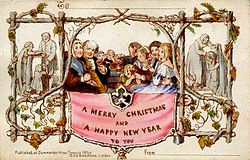
The First Christmas Card

The First Christmas Card

The earliest reference to a Christmas card is thought to be that of  1843 in the diary of Henry Cole, director of V & A Museum. The first commercial design, by John Horsley, was issued in 1846 when 1000 copies were printed.

B is for Bells, Boar’s Head and Boxing Day – the history interpreter’s historical advent calendar

Bells

The association between Christmas and bells, particularly church bells, is a longstanding one. Christian church tradition starts the new day at sunset on Christmas Eve. Services that began after that time would be regarded as the first Christmas Day service and bells would be rung. Some churches ring only the largest bell four times before midnight, followed by all the bells being rung in celebration at midnight.

Boar’s Head

This tradition probably dates from Anglo-Saxon times and is based on Norse sacrifices to the goddess to Freyr, to bless the new year. A boar’s head with an apple in its mouth is the heart of a traditional Medieval banquet. Queen’s College Oxford celebrate the Boar’s Head on the Saturday before Christmas. Apparently a former student escaped from a boar by thrusting a copy of Aristotle down its throat.

Boxing Day

The day to box up excess food to share with the poor. Church alms boxes were often distributed on this day. Modern Christmas ‘boxes’ take the form of money.

A is for Advent – the history interpreter’s historical advent calendar

The first in my alphabetical historical trivia advent calendar. Yes I know there are 24 days and 26 letters of the alphabet. Actually I am in trouble as I have several letters with no entries thus far.

Advent

The modern period of Advent was established by The Council of Tours in 567 as a period of fasting. They also declared the twelve days from Christmas to Epiphany to be a sacred, festive season. Previously there had been a 6 week fast from St. Martin’s day (11th November Martinmas).

Advent Calendar

A Lutheran idea originating in Germany in the early C19th to mark the count down to Christmas. Originally this might have been as simple as drawing a chalk line on the door each day from 1st December. Others hung religious pictures on the wall or lit candles each day, sometimes the 24 candles would be arranged in a frame known as an advent clock. This developed into the modern wreath. The first reference to a (handmade) calendar is in 1851 and printed calendars appeared in the first decade of the C20th.

Advent Wreath

In ancient Rome people used decorative wreaths as a sign of victory. Some believe that this is where the hanging of wreaths on doors came from. The roots of the Advent wreath go back to the pagan practices of the Germanic peoples who, in the dark days of winter, decorated their houses with evergreens and lit candles as symbols of hope of spring to come. These traditions were adopted by the Christian church and the symbolism was transferred to represent Christ the everlasting light. Traditionally, the wreath is made of four candles in a circle of evergreens with a fifth candle in the middle. Three candles are violet and the fourth is rose but four white candles or four violet candles can also be used. Each week in church, the candles are lit, one candle the first week and then another each succeeding week until the Sunday before Christmas. The last candle is the middle candle. The lighting of this candle takes place on Christmas Eve. It represents Jesus Christ being born. The first reference to a public hanging of an Advent wreath is in Hamburg in 1839.