Mistress Agnes turns Witchfinder

Well it is official, I have the plague – or more strictly a throat infection. Whilst some of my acquaintance are enjoying the peace and quiet it has made working impossible, so I am off sick for the first time in thirty years. I am very annoyed to be missing the fun but I have to admit that miming what not to wear in the C17th isn’t awfully effective. I know I should be able to solve this, probably with lemon balm and echinacea but at present I am on proprietary medicines; can one overdose on Strepsils?

I have been putting the finishing touches to my C17th witchcraft talk – due for its premiere next month at the North Devon branch of Devon Family History Society. I am fascinated by this topic. Partly because three of the last (or possibly the last depending on who you believe) witches to be hanged in England came from Bideford, my nearest town. Witch fever also has resonances with modern day bullying culture and mass hysteria. It was very interesting to watch Channel 4’s programme about an American town where a number of teenaged girls have developed Tourette’s like symptoms. Was I alone in screaming (silently due to the lack of voice) ‘erogtism’ at the screen?

As part of the talk I have been looking at Devon witches, not just those from Bideford. I normally begin my C17th talks by encouraging my audience to think of their own C17th ancestors, named or unnamed. Up on the screen go the three couples amongst my own C17th ancestors who I can name. These include Peter and Katherine Elford of Mary Tavy, Devon. When I get to the list of those indicted in Devon for witchcraft in the C17th who do I find but Johanna Elford. Is it, could it be? Peter had a sister called Johanna………..

Other news is that I am now leader of the North Devon Group of Devon Family History Society. This is a great honour and we are working on planning the Summer Conference for next year. Two excellent speakers booked already and a novel theme – under wraps at present. I croaked my way through a discussion on the form that Clovelly Archive Association‘s database might take. This promises to be innovative and exciting with applications for other One Place Studies and Local History Societies. Then it was back to the memorial inscriptions indexing for my own parish and investigating possible chancel liability for the PCC; a bit different this last. Today I work on regaining my voice, wait for a series of bastardy examinations to arrive in the post and some healing herbs work. Never let it be said that my life isn’t varied.

Out of the mouths of babes – healing herbs in the C17th

Today I was schueduled for 3 x 45 minute sessions with 6 and 7 year olds, talking about healing herbs. Not only is this not the best time of year for gathering herbs but it is a bit tricky to make this more than ‘here is a plant’, ‘here is another plant’. So the children have imaginary diseases and I cure them, they grind seeds, they smell herbs and they get green and sticky rubbing soap wort in their hands.

A child comes in from break for the start of the session with her arms held out straight in front of her. ‘Are you drying your hands?’ I ask. Not a random assumption as they’ve all just been asked to go to the toilet on the way in. She looks me up and down scathingly. ‘No’, she says. ‘I am a zombie’. Well, silly me, I clearly should have known.

This age group are great, they are never quite sure if I am really from the seventeenth century or not (I am of course) and we get the occasional Santa Claus moment. The answers to the questions are great too. Me: ‘What do you need to do when you’ve had lots to drink?’ (I am trying to illicit the repsonse ‘wee’ here – nothing goes down so well as wee and poo with year 2). Child: ‘You wash up your cup.’

One child, almost certainly on the autistic spectrum, knows plenty about the uses of herbs, can name most of my examples and is coming up with some really intelligent answers. Bless him though, when I explain the Ladies Mantle (useful for holding wrinkles at bay) and say I’ve been using it for 350 years and it isn’t working yet, he says ernestly ‘yes it is I can see!’ Hurrah – made my day.

Mistress Agnes (almost) makes butter

Twenty six 7-9 year olds in front of us to learn about daily life in the sixteenth and seventeenth centuries. Amongst other things, we dress them up, give them toys to play with and set them to work with my recently acquired hand butter churn. Of course it is the wrong time of year to make butter; the seventeenth century housewife made butter in the spring but we want the children to have an idea just how much hard work this was. As they start their lunch we leave them with the churn to plunge away with in shifts. We do have full cream milk – no hope without but wonder if we should have gone for super extra creamy milk to give them half a chance. The children stalwartly thud up and down with the hand churn for nearly 2 hours. The milk has gone decidedly yellow and there are signs of little solid flecks in it. I wonder if this may consititute slave labour so I take over whilst my colleague puts out the Great Fire of London again. Yes, as I rinse the churn out after the children have left, there is definitely something solid in there. It’s very small but it is there. I am very excited by this. Even after my short stint my arm is aching and I shall probably never play the violin again (not that I could in the first place). This is the way to begin to appreciate the sheer physical effort required for the daily tasks of our ancestors.

Mostly about a Puncture + other historical ramblings

It has been a busy few days since we returned from the frozen north. Inevitably there was the post holiday mound of e.mails and post to wade through. These contained several requests for talks and some Braund one-name study queries. A lovely review of Coffers, Clysters in the latest Cornwall Family History Society Journal too. Then some exciting ideas for the Clovelly Archive database/website and plans for a winter indexing project. Next I spend a day inspiring some lovely people to create their own family’s story in some kind of permanent form. I struggle to do my quota of transcribing of C17th Admiralty documents for the Marine Lives Project. The latest lot are about whaling.

Today, back to the real work in the seventeenth century and we get up at silly o’clock to take the delights of the Civil War to a not very nearby school. Vehicle loaded, three passengers in full C17th rig, a couple of miles up the road and we get a puncture. Simple, some of us at least know how to change a tyre. What we don’t know is where in this fairly new to us car to find the jack. Will we have to empty armour, wooden buckets and clyster syringes out on to the road? It is still dark, raining and we are on a bend approaching the crest of a hill, this could be somewhat of a hazard. It turns out that we don’t have a jack. We contemplate using the C17th head crusher instead (every car should have one). We decide to go for the AA option. Strangely the substitute AA man, when he arrives, blinks not an eye-lid to find our driver dressed in knee high boots and breeches. I do think the high-viz jacket set them off well though. It seems the spare wheel is the wrong sort and it is difficult to tighten the nuts. Not wishing to see our back wheel rolling down a hill, we take advice and return to a garage. Sadly, this means we have to postpone our school booking as we are already nearly two hours late. There’s a bit of an issue while we wonder if we actually have any money on us – will they take groats?


Homeward Bound

The is the coldest day yet and we have to deice the car before our 288 mile drive back down the Great North Road, except in our case it will be the Great South Road. We leave before the site office is open so I am instructed to chalk our now vacant pitch number on a blackboard provided for the purpose. Blackboard fine, chalk the size of a pea, more difficult but I manage, despite the gloves. All the time we have been on this site we have seen and heard large skeins of geese, who apparently live on the nearby former gravel pit. On other sites we have been ‘entertained’ by cockerels and peacocks, here it has been geese. One flies past very low as we leave, as if to say goodbye. We need yet more fuel and decide to leave the main road at Newcastle to try and obtain some at cheaper than services prices. Our map tells us that there is a Morrisons here but the Sat Nav fails to recognise the road so we are guessing. I spot a large M on a road sign, it is yellow and black, Morrisons’  colours and in the same font as Morrisons’ signs so we follow these only to find that it also stands for Metro. Fortunately the Metro is close to Tescos so we are fine. The Angel of the North looms on the horizon, unfortunately we cannot stop on this road so I try taking pictures first through the windscreen and then by letting in a lot of cold air, leaning precariously out the open window and turning round backwards as we speed past.

The Angel of the North

The Sat Nav does have a few funny turns as we take her down roads she thinks are fields. ‘Turning around where possible’ is probably not an option on the A1(M). The caravan limits us to a maximum of sixty mph so it is nearly seven hours before we arrive back at Tewkesbury. The annual mop fair is being held. Sadly this doesn’t seem to pay any lip service to the historic hiring fair that it would once have been. Now it is an excuse for an oversized fun-fair creating a diversion in the town. We do however get to the camp site on time this time. The site has been flooded in our absence so is a little on the spongy side but we settle in for the last night of our holiday. The following morning it is home from Tewkesbury – now for catching up with all the work that hasn’t been done over the last three weeks.

Mistress Agnes takes to the water

Another lovely day after a frosty start; the Northumbrian weather is certainly making up for that we experienced in the Lake District. Last on my list of things to do, is to visit the Farne Islands. We are not sure that trips run this late in the year but we are off to Seahouses to find out. A close sighting of some more deer on the way. We are fortunate, there are several trips to the Farnes today. We choose the 11am sailing on Glad Tidings VI, which allows us to land on one of the thirty islands. The mate on the Glad Tidings VI is a member of Chris’ fan club and he asks if he has seen Chris on television. Chris admits to having been televised; no one asks me about my starring role. I’ve been up the Franz Josef glacier, I know about dressing for weather conditions, so I am suitably attired for a trip on the North Sea, fleecy jumper, fleecy coat, waterproof coat, thermal gloves, woolly hat. I do rather resemble a Michelin person but I am certainly not cold.

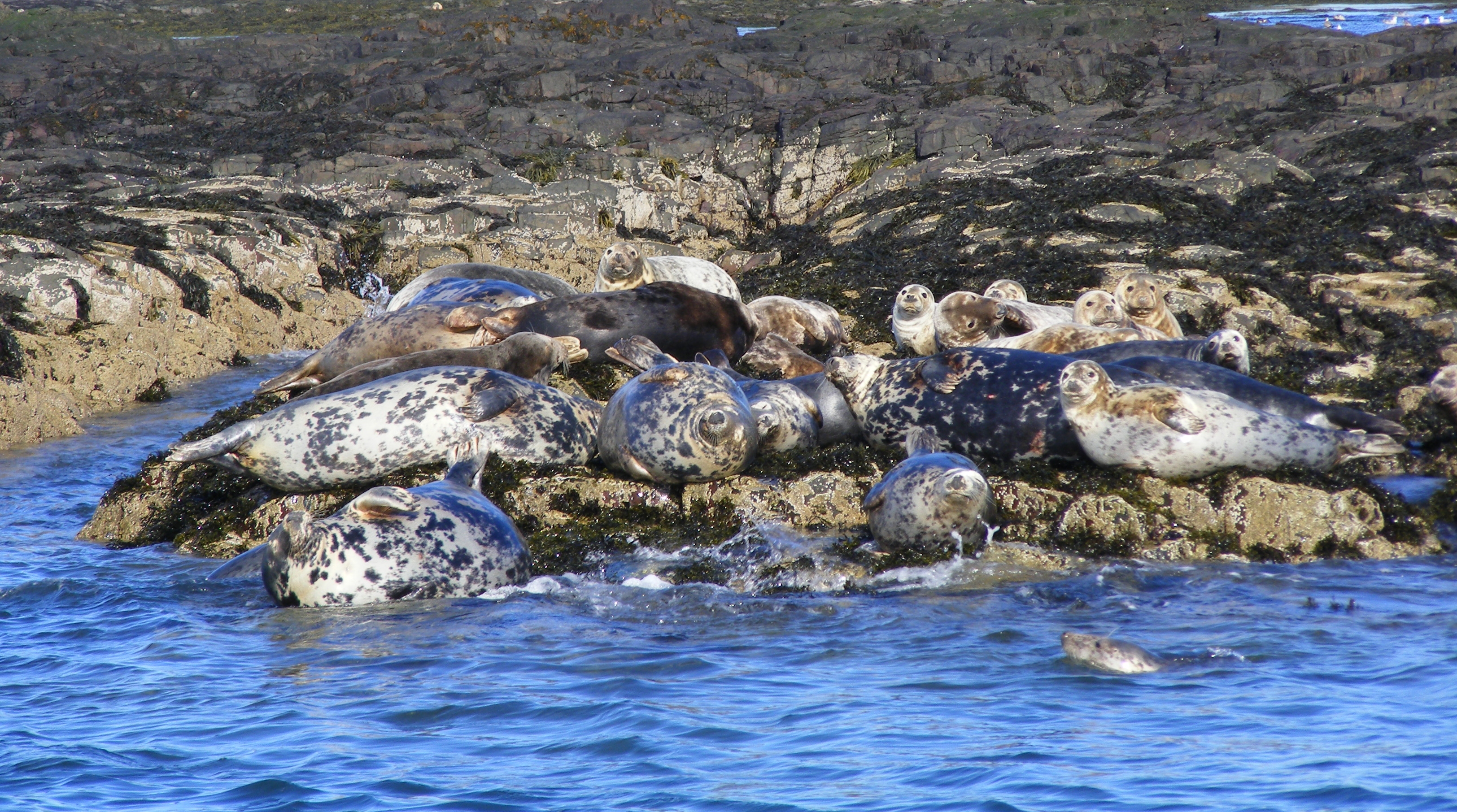
We see a large colony of Atlantic grey seals at very close quarters. During the nesting season there are apparently over a thousand guillemots on four rocky stacks alone. The Farnes are also home to seventy thousand puffins, known locally as Tommy Noddies, sadly they have virtually all left for their winter quarters and we don’t see any. We pass the Longstone Lighthouse, built in 1826 and home of Grace Darling. We also see Harcar Island, which was the scene of her rescue in 1838. She and her father rescued nine crew members of the Forfarshire, although forty three perished.

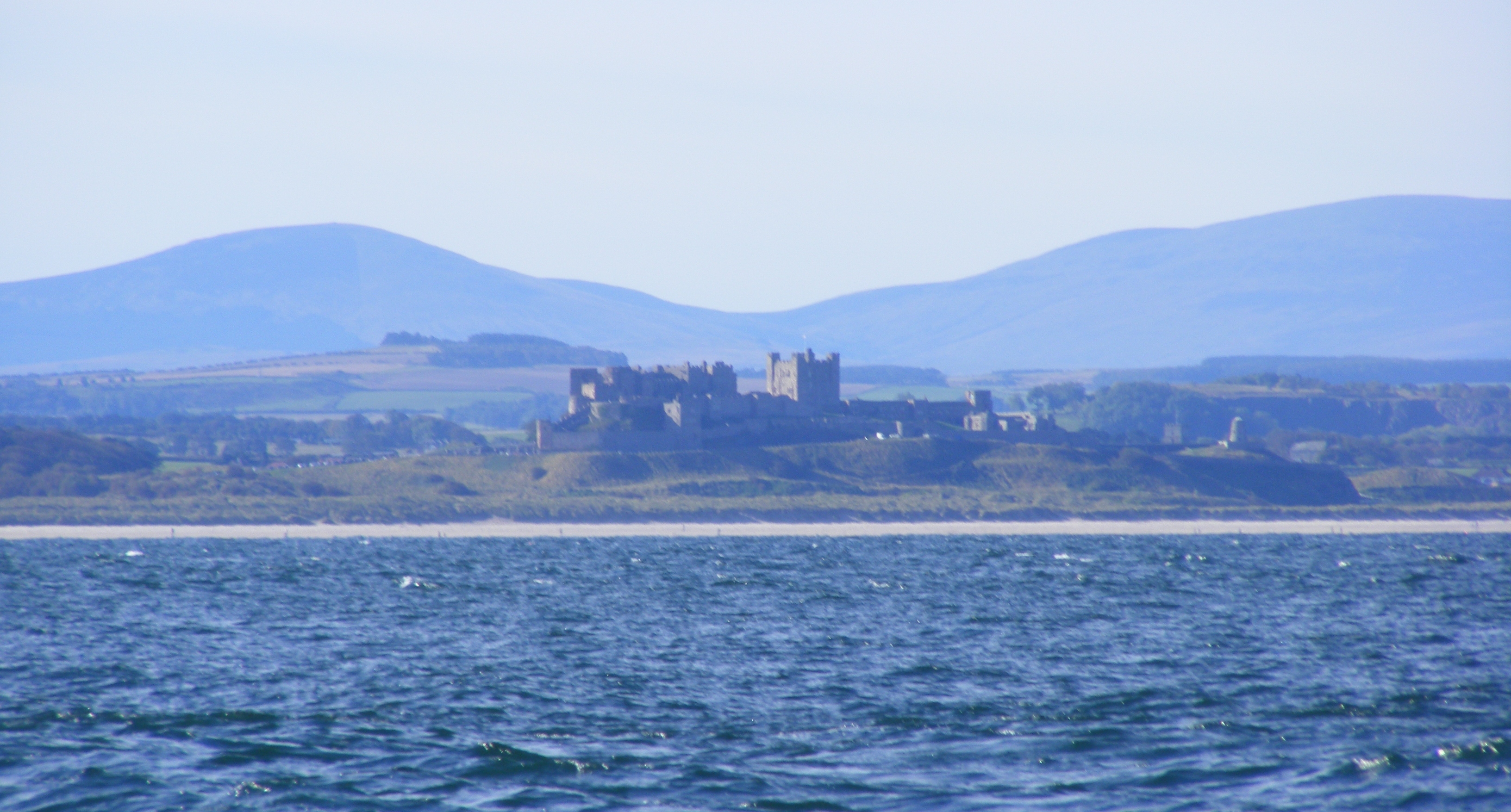
Bamburgh Castle from Farne

We land on Inner Farne and one of the rangers tells us about their work there. They have no mains water and only solar electricity. Until this year there were no flushing toilets either. Mind you there warnings in the toilets, which use sea water, that the cisterns may take fifteen minutes to refill so ‘flushing’ may be a relative term. Let’s hope there isn’t a queue. We see St. Cuthbert’s Chapel with its C17th carving and the C15th pele tower that was erected as a defence against both the French and the Scots. We walk round the island and chat to the rangers. One of their tasks is to weed between the boardwalk panels, which seems to be a painting the Forth road bridge sort of a task. On the way home our skipper suddenly turns round and heads back towards the islands, what is going on? It seems there has been a sighting of a Minke whale. I have already played the how many photos of water where a whale was three seconds earlier can you take? game when in New Zealand but I can’t help but bow to peer pressure and join in.

We go on an affordable diesel hunt on the way home and this takes us back past the mega second hand bookshop. This time we both go in and I do buy a couple of books. It is such a great concept, every town should have one.

How not to use a microfiche reader, plaudits for Northumberland Record Office, Dade Registers and mega scale maps

We wake to a white world as there has been a frost over night but another lovely autumn day. Today we are going to the Northumberland Record Office. Yes it is Sunday but yes we really are going to a Record Office and yes it really is open. The recently created archives complex at Woodhorn is a joy to behold. Situated on an old pit, with some of the workings still on display, it has a museum on site and is next to a Country Park AND is open weekends. Other archives take note, although it was disappointing that more people weren’t taking advantage of this. The Country Park is potentially handy for non-researching travel companions; I though recruit my travel companion to assist. It was one of those days when you try to cram a fortnight’s research into two hours. We don’t do too badly until it comes to trying to use the reader printer, when all common sense seems to desert us and we really can’t seem to get it to produce a decent copy. Encouraged by a fellow researcher who informs us that inadequate copies are not charged for, we try several times with varying success. I end up threading the film in backwards and requiring frequent help from the staff. Felling like both a newbie and a numpty, I give up the plan to obtain copies of all parish register entries for my direct ancestors.

Some strokes of luck though. The baptism entries for siblings of great great grandma Pearson are of the Dade Register format. These are hugely detailed, giving mother’s maiden name, position in the family and the parish of origin of both parents. Next, to ask for the Board of Health maps mentioned in my newly acquired book about Morpeth. These are brilliant and show that 42 Newgate Street today, as photographed on Friday as the abode of Isabella Pearson in 1851, was not number 42 in 1851. Number 42 was then down one of the ‘lanes’ hidden behind the then number 39. Fortunately, on Friday, I did duck up some private alley to see what was there and I think I have captured a picture of Isabella’s home behind the shops without knowing it at the time. Today has not been an overwhelming success as regards getting copies of documents. The member of staff at the desk is unsure if I can photograph the map; they can do it for me at great cost. He agrees to ask the boss when she comes back from lunch. It must have been a good lunch as I have permission! My reaction to the news that I am allowed to photograph a 120″ to the mile (yes that was the scale) map of Morpeth was something akin to an X factor contestant learning that they had been put through to the next round. I am not sure clenching my fist bringing my bent elbow down and hissing ‘YES!’, was wholly appropriate but hey. I do decide not to ask if I can stand on the table to take the photograph, which I have done in another repository; I have probably embarrassed my fellow researcher sufficiently.

We reluctantly leave the archives, stopping for a quick look at the naive art created by miners in the mid 20th. We have a bit of trouble pinpointing a couple of family locations before arriving at the row of cottages inhabited by John Hogg in 1851. I am very pleased to have positively identified an ancestral abode at last. We can’t ignore the Braund research so finish the day at Cramlington, a much larger settlement than we were expecting. Some Braunds who had been mining in Cornwall were drafted in to the Cramlington mines in the 1880s when the Northumbrian miners were on strike. This probably didn’t endear them to their new neighbours. We arrive at the church at an appropriate time, squeezing in our visit between a christening and harvest festival.

Incredible churches and 2000 year old grave stones

It is a glorious autumn day again, we can see for miles and the trees are turning. Off in a south westerly direction today to visit the homes of early generations of the Hogg family. Some of these are not yet confirmed as my ancestors but I thought I’d better get to these places while I have the chance, in anticipation of being able to add them to the tree at a later date. We begin by visiting Chesters Roman Fort, situated on the River Tyne alongside Hadrian’s wall. At last I get my first glimpse of a fragment of the wall itself. The bath house, close to the river is particularly well preserved. There is a museum of various artefacts including Roman gravestones. I should stress that I am not anticipating being able to add any Roman legionaries to the family tree. it seems that these artefacts were collected by a chap who probably dug them up in his garden. I can’t even dig up a Victorian pipe or bottle. There has been a very heavy dew and today I haven’t brought any spare socks so I am destined to spend the day with damp socks drying on the dashboard.

Chollerton church is two miles away from the Roman Fort. This is the place where two generations of potential Hogg ancestors married, perhaps the home of the brides. I wonder if they were aware of the significance, or even the existence, of the Roman remains on their doorstep? Sadly, the church was virtually rebuilt in the C19th so would not be as the Hoggs would have known it. The porch has various fragments built in to it including a carving of some shears. This is described in the guide book as a grave cover and apparently the shears indicate a female grave but I am not convinced of this, surely a shepherd would be more likely? Inside an inverted Roman alter has been converted for use as a font.

After a brief visit to Hallington and Kirkheaton, both essentially a few cottages a farm and not much else, we head to Thockrington. This is truly something else and everyone should come here at some point in their lives. The church is on top of a hill and accessed by a farm track. Apart from a single farm there is nothing in sight but sheep. The 360 degree views are spectacular and we can see for miles in all directions. This just has to be where three generations of my ancestors were baptised and buried. Apart from my potential Hogg ancestors, who have unmarked graves, the graveyard is the last resting place of William Beveridge, father of the NHS. The village of Thockrington disappeared after 1847 when a cholera epidemic, reputedly brought to the village by a returning sailor, wiped out the inhabitants. The ‘road’ and I use the word advisedly, to and from Thockrington is barred by several farm gates, which it is my job to open and close. Working out how to open some of them requires an engineering degree. I am able to sneak in the odd swing on a gate, solely in the interests of keeping out of the mud of course.

The View from Thockington Church

Great Bavington, another middle of nowhere hamlet, is next on the itinerary. This is one of several locations that great great grandfather, John Hogg, listed as his place of birth. Great Bavington contains some fascinating C17th cottages, a well hidden Victorian postbox, which is apparently still emptied and the 3rd oldest Presbyterian Church in the country, dating from 1725. Two more quick stops at ancestral churches and we head home having felt that all this Hogg hunting has certainly taken us to places other tourists do not reach.

Ploughing, pulled down houses, closed churches and a vote for reports to the Board of Health

It is the turn of the Hogg family today so we set off for Morpeth via a couple of very small places. We then drive in to Morpeth which is a very interesting town. Councils in Morpeth and the surrounding areas appear to have acquired a job lot of begonias so the town is looking very attractive. Someone or other’s law states that every house in which my ancestors lived has subsequently been demolished and in this case, are now an old people’s home and Morrison’s car park. We do have some luck with 42 Newgate Street. Chris is inside number 44 asking where number 42 is just as I spot the number on the door of 42; good job I sent him to recee. Many of the shops have old photographs in their window, together with information about previous occupants. Unfortunately most of these do not go back before the C20th.

We call in at Morpeth Tourist Information Centre where they are playing some jolly Northumbrian pipe music. This may not be such a good idea as they sell numerous fragile items and I just hope no one starts dancing some kind of reel. The assistant tells us that they have only just set up again, having evacuated as a precaution during last week’s floods but apart from one closed bridge, there is no obvious evidence of flooding in the town. Many of the old Morpeth streets have alleys or courts hidden behind them and I manage to pick up a book about these that looks very interesting. Apparently the medieval ploughing strips correspond with the later burgage plots and what are now the frontages of the shops in the historic streets. An oxen-pulled plough creates a strip five and a half yards wide and many of the shops are this width. The book also contains several old maps that will be useful. It also has extracts from the Report to the General Board of Health in the mid nineteenth century, when the Hoggs were here. Needless to say they mostly lived in the poorest streets. This is the stuff from which family histories are made.

I have checked carefully and St. Mary’s church, ‘the best C14th church in Northumberland’, is allegedly open today, that would be allegedly. I am already a bit annoyed that they haven’t responded to my enquiry concerning the burial places of my ancestors. Now I am even more annoyed that I can’t get in the church. The churchyard is huge and there doesn’t seem to be any sort of system with, for example, burials from a certain period in one place. I don’t believe that there are any surviving relevant gravestones but had they answered by enquiry I might have been able to find the burial plots of four of my ancestors. I do find the grave of suffragette, Emily Wilding Davison, who threw herself under the king’s horse at the Derby. The railings round  the grave have been decorated with suffragette coloured ribbons.

We return to the van in good time, so I can start writing up all this family history before I forget.

In search of a mill and a trip to Lindisfarne

As we seem to be fitting more in to each day than planned, we decide we can find time to visit the archives at Berwick on Tweed, as advised by our friend from Norham. This has to be today as they only open twice a week. Typically the weather is better today than any we’ve had so far. Although tiny, Berwick archives ranks up there with the best I’ve been to, certainly in terms of the helpfulness of the staff. The tithe schedule suggests Norham mill was not on the site of 95 year old Bill’s house but on the opposite side of Norham’s main street. I can still not be certain if this was the mill associated with Peter Eadington. I manage to find reference to Peter in some manorial records and in the 1798 Land Tax, now available on ancestry. We exhaust the possibilities of the archives in good time and plan to return south down the coast road. We then realise that we have time to visit Holy Island today, instead of leaving it until later in the week.

From Lindisfarne causeway

I was imagining something akin to St. Michael’s Mount but Holy Island is much larger, with dwellings and shops, more like one of the smaller Scilly Isles. We drive across the causeway, park up and walk to the Tudor castle, another link in the chain of border defences. Following the union of the crowns it had less significance. It is sunny at last and I am very taken with the panoramic views and clear skies here in Northumberland, not dissimilar in some ways to Australia. The Castle too is unexpected, much more like a residence, having been converted to a holiday home in 1902 by Edwin Lutyens. The kitchen has a high backed curved settle that takes my fancy. It even incorporates a useful cupboard in the back, originally for hanging bacon. I wonder if anyone will notice if I take it home with me. I haven’t worked out how I would get it through my front door but that’s probably the least of my worries. There is an exhibition of tiny cotton bound figures, clothed in Fimo, by Laura Johnson, scattered throughout the castle’s rooms.

We walk across to look at the walled garden, designed by Gertrude Jekyll, which is about 500m from the castle. This was formerly the vegetable garden for the garrison. Apparently, having a garden a distance away from the house is not unusual in this area. Chris examines the cobles and other boats in the harbour. There are several upturned hulls that have been turned into sheds. The priory is next on the list. Of course Lindisfarne had a very important role to play in the establishment of Christianity in Britain; Aiden arriving from Iona in 635. The present priory was built in the C12th on the spot where St. Cuthbert had been buried before his body was taken with the monks fleeing Viking raids. At the height of the wars with the Scots, the priory was embattled. It fell into ruin about two hundred years ago.